
Rialú Impedance PCB 10 Sraith agus Fíorú TDR
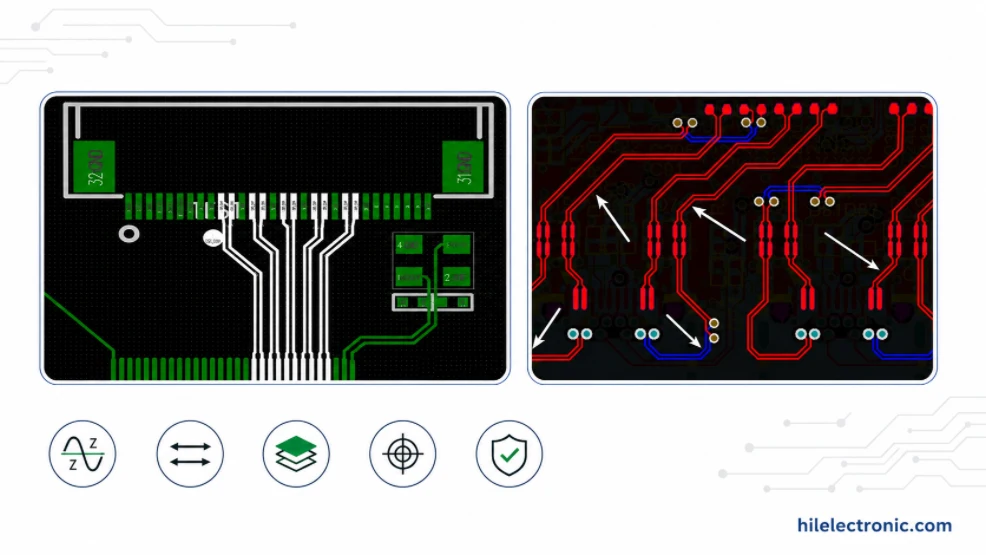
Fíor 1. Cúpón rialaithe impedance PCB 10 ciseal agus fíorú TDR.
Clár na nÁbhar
- Is Sainmhíniú Cruachta agus Próisis é Impedance Rialaithe
- Ionchuir Riachtanacha Sula bhFéadfar Geoiméadracht Rian a Scaoileadh
- Impedans Aonair-Fhoirceanta, Mód Odd agus Difreálach
- Struchtúir Mhicristripe, Stialllíne agus Chomhphlánacha
- Éagsúlacht Déantúsaíochta agus Buiséad Lamháltais Réalaíoch
- Dearadh Cúpóin agus Fíorú TDR
- Conas Impedance a Shonrú ar an Líníocht Déantúsaíochta
- Diagnóis a dhéanamh ar Thoradh Impedance a Chailleann an Sprioc
- Minicíocht, Caillteanas agus Brí Uimhir TDR
- Indéantacht Lamháltais Dhian agus Údarás Ealaíne
- Liosta Seiceála um Scaoileadh Impedance
- Éiginnteacht Tomhais agus Comhghaol Cúpóin go Táirge
Baintear amach impedance rialaithe trí struchtúr líne tarchuir a rialú, ní trí leithead rian caighdeánach a shannadh do phrótacal. Is féidir go mbeadh geoiméadracht an-difriúil ag teastáil don sprioc 50 Ω chéanna ar dhá bhord deich-chiseal toisc go bhfuil tiús tréleictreach, tiús copair, tógáil ábhair, masc sádrála agus copar comharsanachta difriúil. Dá bhrí sin, ba cheart go sonrófaí an sprioc agus an struchtúr tagartha i líníocht táirgthe, agus sainmhíníonn an cruachadh scaoilte agus ríomh an mhonaróra an leithead agus an spásáil deiridh.
Míníonn an treoir seo cad is gá a ríomh, cad a bhaineann le lamháltas monaraíochta i ndáiríre, agus conas ba chóir do chúpón TDR an struchtúr ródaithe a léiriú. Seachnaítear d'aon ghnó rialacha uilíocha “5 míle cothrom le 50 Ω” a fhoilsiú, toisc go n-éiríonn na huimhreacha sin mícheart a luaithe a athraíonn an tógáil.
Is Sainmhíniú Cruachta agus Próisis é Impedance Rialaithe
Socraítear an bac tréith de rian PCB trí dháileadh réimsí leictreacha agus maighnéadacha timpeall an tseoltóra. Is iad na príomhionchuir ná trasghearradh críochnaithe an tseoltóra, an fad go dtí eitleán tagartha amháin nó níos mó, airíonna tréleictreacha, spásáil péirí le haghaidh línte cúpláilte, masc sádrála ar struchtúir dhromchla agus láithreacht copair in aice láimhe. Bíonn tionchar ag garbhacht copair agus caillteanas tréleictreach ar iomadú agus ar fhreagairt tomhaiste, go háirithe de réir mar a mhéadaíonn an ráta imeall.
Ba cheart go bhfreagródh ordú bacainn rialaithe dhá cheist éagsúla. Ar dtús, cén geoiméadracht a bhfuiltear ag súil léi an sprioc a bhaint amach ar an gcruachás roghnaithe? Ar an dara dul síos, conas a fhíorófar an táirgeadh? Pléann ríomh réiteora réimse leis an gcéad cheann; pléann nós imeachta ionadaíoch cúpóin agus TDR leis an dara ceann. Ní chuireann ceachtar acu in ionad insamhalta cainéil nuair a bhíonn caillteanas ionchuir, neamhleanúnachas trí agus nascóirí tábhachtach.
Ní mór an carnán 10 sraithe a reo sula reoitear an geoiméadracht ródaithe. Má athraíonn an monaróir croí, réamhphlandáil, scragall copair nó tiús brúite, ní mór an ríomh impedance a nuashonrú agus ní mór aon athrú saothar ealaíne a eascraíonn as sin a leanúint an próiseas formheasa comhaontaithe.
Ionchuir Riachtanacha Sula bhFéadfar Geoiméadracht Rian a Scaoileadh
| Ionchur | Cén fáth a n-athraíonn sé impedance | Cad ba chóir a thaispeáint sna sonraí a scaoiltear |
|---|---|---|
| Sraith agus eitleán(a) tagartha | Tá geoiméadracht an réimse difriúil i gcás micristialla seachtrach, micristialla leabaithe, stialllíne shiméadrach agus stialllíne neamhshiméadrach. | Ciseal comhartha, ciseal nó ciseal tagartha, agus cibé an bhfuil an copar tagartha leanúnach. |
| Tiús tréleictreach brúite | Tá an-íogaireacht ag baint leis an mbacainníocht don achar idir an rian agus an tagairt. | Ainmniúil agus caoinfhulaingt tar éis lannaithe, ní hamháin tiús catalóige prepreg. |
| Geoiméadracht chopair críochnaithe | Fásann copar seachtrach le linn plátála agus tá an rian eitseáilte traipéisóideach. | Tiús críochnaithe móide toimhdí leithead barr agus bun a úsáideann an réiteoir. |
| Tógáil ábhar | Braitheann Dk éifeachtach ar ábhar roisín, gloine agus modh tástála. | Tógáil chruinn croí/réamh-ullmhaithe nó dearadh monaróra - samhail Dk. |
| Masc solder | Laghdaíonn masc impedance rian dromchla agus is féidir leis difear a dhéanamh do chúpláil difreálach. | Cibé an bhfuil masc i láthair, an tiús leigheasta glactha agus an tsamhail. |
| Spásáil péirí agus copar in aice láimhe | Braitheann impedance difreálach ar chúpláil corrmhód; athraíonn doirteadh talún nó sciatha an réimse freisin. | Spásáil imeall go himill, imréiteach comhphlánach agus aon chopar garda nó tagartha. |
| Sprioc agus caoinfhulaingt | Ní féidir sprioc gan banda glactha a thástáil. | Óim ainmniúla, lamháltas móide/lúide nó íosta/uasta, agus an struchtúr lena mbaineann sé. |
I gcás péirí difreálacha, ba cheart don mhonaróir leithead agus spásáil a fháil mar athróga seachas riail saothar ealaíne dochloíte nuair atá an carnadh fós á chríochnú. Is féidir leis an líníocht a scaoiltear coigeartú rialaithe leithead a údarú laistigh de theorainneacha sonraithe, nó féadfaidh sé ceadú an chustaiméara a éileamh sula n-athraítear an saothar ealaíne.
Impedans Aonair-Fhoirceanta, Mód Odd agus Difreálach
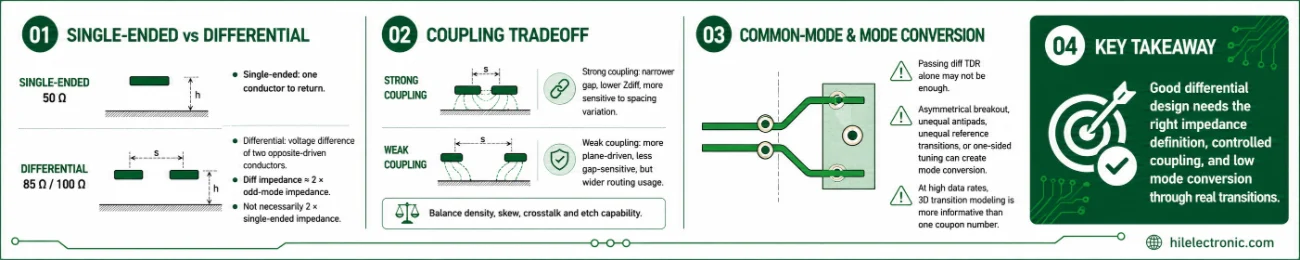
Déanann sprioc aon-chríochnaithe amhail 50 Ω cur síos ar sheoltóir amháin i gcoibhneas lena struchtúr fillte. Déanann sprioc difreálach amhail 85 Ω nó 100 Ω cur síos ar an difríocht voltais idir dhá sheoltóir atá á dtiomáint i dtreonna difriúla. I gcás péire cúpláilte siméadrach, tá an fhriotaíocht difreálach thart ar dhá oiread an fhriotaíocht corrmhód. Ní gá go bhfuil sé dhá oiread an fhriotaíocht aon-chríochnaithe de cheachtar rian nuair nach bhfuil an rian eile ann.
Ligeann cúpláil láidir spásáil níos cúinge idir péirí agus is féidir léi bacainní difreálacha a ísliú, ach déanann sí an toradh níos íogaire freisin maidir le hathrú spásála agus scaradh áitiúil idir péirí. Bíonn tionchar níos mó ag a bplánaí tagartha ar phéirí atá cúpláilte go lag agus níos lú ag an mbearna chruinn, ach féadfaidh siad níos mó leithead ródaithe a ídiú. Braitheann an chothromaíocht cheart ar dhlús ródaithe, claonadh, traschaint le bealaí comharsanacha agus cumas eitseála an mhonaróra.
Is féidir le bacainní mód coiteann agus tiontú mód a bheith tábhachtach fiú nuair a théann an uimhir TDR difreálach tharstu. Is féidir le briseadh amach neamhshiméadrach, frithcheapanna neamhionanna trí, aistrithe tagartha éagsúla agus tiúnáil aontaobhach fuinneamh difreálach a thiontú go mód coiteann. Ag rátaí sonraí arda, tá samhail aistrithe 3D níos faisnéiseach ná uimhir cúpóin aonair.
Struchtúir Mhicristripe, Stialllíne agus Chomhphlánacha
Micreastiall an chiseal sheachtraigh
Is furasta micristrip a thástáil agus a threorú ach síneann a réimsí isteach sa lannán agus san aer nó i masc sádrála araon. Dá bhrí sin, tá an tairiseach tréleictreach éifeachtach níos ísle ná an lannán mórchóir Dk. Is féidir le masc sádrála, bailchríoch dromchla, doirteadh copair áitiúil agus ceapacha comhpháirteanna cur isteach ar an toradh. Athraíonn plátáil an chiseal sheachtraigh tiús an tseoltóra freisin tar éis an scragall bonn a roghnú.
Micreastrip agus stialllíne leabaithe
Tá micristiall leabaithe clúdaithe le tréleictreach ar an dá thaobh ach tá tagairt déanta di go príomha do phlána amháin. Tá an stialllíne suite idir dhá phlána. Tá spásáil tréleictreach chomhionann nó beagnach comhionann ag an stialllíne shiméadrach; tá tagairt níos gaire ceannasach ag an stialllíne neamhshiméadrach ach idirghníomhaíonn sí fós leis an dá phlána. Ba chóir do réiteoir réimse samhaltú a dhéanamh ar an dá theorainn agus ar an suíomh rian iarbhír tar éis lannaithe.
Struchtúir threoracha tonnta comhphlánacha
Is féidir le talamh comhphlánach scaipeadh réimse a rialú agus sciath a sholáthar, ach is gné ríthábhachtach eile í an bhearna go dtí an copar taobh. Ní mór oileáin talún a bheith ceangailte leis an eitleán tagartha le patrún trína cuí nó is féidir leo gníomhú mar sheoltóirí athshondais. Ba cheart struchtúir chomhphlánacha a shamhaltú leis an masc iarbhír agus geoiméadracht talún seachas iad a chur leis mar riail ghinearálta “doirteadh talún”.
| struchtúr | Saintréithe úsáideacha | Rialuithe ar fiú aird a thabhairt orthu |
|---|---|---|
| Micreastiall sheachtrach | Bealaí gearra scoir inrochtana, agus cuardach éasca ar chúpóin. | Copar plátáilte, masc sádrála, bailchríoch, doirteadh áitiúil agus neamhleanúnachas dromchla. |
| Striplíne siméadrach | Réimse dea-theoranta agus timpeallacht tagartha intuartha. | Airde tréleictreach, lárnú rianta, tógáil gloine agus leanúnachas plána araon. |
| stialllíne neamhshiméadrach | Is féidir leithid phraiticiúla a fheistiú laistigh de chruach srianta. | Eitleáin tagartha agus suíomh na sraithe araon; níl chomh hiontaofa céanna garmheastacháin shimplí foirme dúnta. |
| Micreastiall/stialllíne chomhphlánach | Is féidir leis scaipeadh réimse a rialú agus tacú le struchtúir RF. | Caoinfhulaingt bearna taobh, trí nascadh talún, masc agus oscailtí áitiúla. |
Éagsúlacht Déantúsaíochta agus Buiséad Lamháltais Réalaíoch
Bogann impedance táirgeachta toisc go mbogann roinnt toisí le chéile. Athraíonn greanadh leithead an uachtair agus an íochtair. Athraíonn lannú tiús tréleictreach brúite. Bíonn tionchar ag ábhar roisín agus dáileadh gloine ar an Dk éifeachtach. Cuireann plátáil an chiseal sheachtraigh agus masc sádrála níos mó éagsúlachta leis. Úsáideann anailís lamháltais fhreagrach cumas próisis an tsoláthraí don tógáil chruinn seachas glacadh leis gur féidir gach ionchur a choinneáil ag a luach ainmniúil.
Is lamháltas coitianta soláthair é +/-10%, ach ní réamhshocrú uilíoch é a fhorchuirtear le doiciméad IPC. D’fhéadfadh bandaí níos doichte a bheith indéanta ar struchtúir agus méideanna painéil roghnaithe, ach d’fhéadfadh roinnt struchtúr ard-bhacais, an-mhín nó atá plátáilte go trom a bheith níos lú indéanta. Sula sonraítear +/-5% nó níos doichte, deimhnigh an corrlach geoiméadrachta atá ar fáil, an modh cúpóin, sampláil bhaisc agus cibé an dtomhaistear an lamháltas ar an gcúpón nó an ráthaítear é ag gach suíomh ródaithe.
Is féidir le teannú bacainní gan chúis ar leibhéal an chainéil an dramhaíl a mhéadú nó geoiméadracht rian/spáis níos leithne a fhorchur a dhéanann dochar do dhlús an ródaithe. Os a choinne sin, d’fhéadfadh cúpón ainmniúil +/-10% a bheith neamhleor i gcás nach bhfágann neamhleanúnachas nascóirí, pacáiste agus trí-bhealaí corrlach córais beag. Ba cheart an lamháltas a theacht ón mbuiséad leictreach agus ón staidéar ar chumas déantúsaíochta.
Dearadh Cúpóin agus Fíorú TDR
Is treoir dearaidh é IPC-2141 do chiorcaid rialaithe-impedance; ní hé an modh tástála TDR é. Clúdaítear tomhas impedance tréith trí fhrithchaiteachas fearainn ama le Modh 2.5.5.7A IPC-TM-650. Ba chóir d'ordú ceannaigh an modh is infheidhme nó nós imeachta comhaontaithe custaiméara a lua agus ansin na sonraí cúpóin agus glactha nach gcinnfidh an modh ina aonar a shainiú.
Cúpón ionadaíoch
Ba chóir don chúpón an ciseal céanna, an struchtúr tagartha, an próiseáil copair, an tógáil tréleictreach agus an riocht maisc sádrála a úsáid leis an mbealach rialaithe. Ba chóir do chúpóin difreálacha leithead agus spásáil na mbeirteanna a atáirgeadh. Nuair a bhíonn ilstruchtúir ann, ní féidir le rian cúpóin amháin iad uile a léiriú. Tá tábhacht le suíomh an chúpóin ar an bpainéal táirgthe toisc gur féidir le plátáil agus eitseáil a bheith éagsúil ar fud an phainéil.
Fuinneog tomhais agus seoladh
Ní mór an lainseáil, na ceapacha tóireadóireachta agus an neamhleanúnachas tosaigh a dheighilt ón gcuid aonfhoirmeach a úsáidtear le haghaidh léamh an impedance. Ba chóir go mbeadh am ardú an TDR oiriúnach don ghné atá á tomhas; is féidir le himill thar a bheith gasta béim a chur ar neamhleanúnachas beag, agus is féidir le himill mhall iad a mheánú. Is féidir le cailliúint agus scaipeadh rian fána a chruthú, mar sin ba chóir an fhuinneog glactha agus an modh tuairiscithe a chomhaontú.
Sampláil agus taifid
Is roghanna tráchtála agus plean cáilíochta iad “in aghaidh an phainéil,” “in aghaidh an bhaisc” agus “an chéad alt amháin”, ní hiarmhairtí uathoibríocha ar luach lamháltais. Sonraigh líon agus suíomh na gcúpón, stádas millteach nó coinnithe, sainmhíniú an bhaisc, riail aththástála agus cibé an bhfuil plotaí nó torthaí achoimre ag teastáil. I gcás clár ard-iontaofachta, coinnigh inrianaitheacht idir an cúpón, an painéal agus na boird a seoladh.
Fíor 2. Pleanáil rian rialaithe impedance PCB 10 ciseal.
Conas Impedance a Shonrú ar an Líníocht Déantúsaíochta
Ba cheart go mbeadh an tábla impedance sách soiléir le go bhféadfadh foirne innealtóireachta, CAM agus cigireachta é a léirmhíniú ar an mbealach céanna.
| Réimse | Ábhar molta |
|---|---|
| Aitheantóir ranga | Ainm uathúil amhail Z1, Z2 nó DIFF85 seachas ainm prótacail ina aonar. |
| Sprioc | Impedance ainmniúil aon-chríochnaithe nó difreálach in óim. |
| Lamháltas | Céatadán móide/lúide nó íosmhéid agus uasmhéid follasach. |
| Sraith | An ciseal ródaithe iarbhír; ná habair “na ciseal istigh go léir” má tá a dtimpeallachtaí tréleictreacha difriúil. |
| Tagairt | An plána nó na plánaí leanúnacha a úsáidtear sa ríomh. |
| Údarás geoiméadrachta | Luaigh an féidir leis an monaróir an leithead/spásáil a choigeartú agus an bhfuil ceadú an chustaiméara ag teastáil. |
| Coinníoll an masc | Clúdaithe, gan chlúdach, oscailte go roghnach nó measctha. |
| Cúpón/tástáil | Modh tástála infheidhme, comhaireamh/suíomh cúpón, tuairisciú agus diúscairt. |
| Athbhreithniú ábhair/cruachta | Nasc an tábla le hathbhreithniú cruachta scaoilte ionas nach féidir an geoiméadracht a dheighilt ón tógáil. |
Coinnigh rialacha ródaithe prótacail ar an leagan amach nó ar shonraíocht an dearaidh agus coinnigh glacadh le bacainní ar an líníocht monaraíochta. Cuireann an deighilt seo cosc ar sholáthraí “PCIe” a léirmhíniú mar riachtanas leictreach iomlán.
Chun athbhreithniú a dhéanamh ar an saothar ealaíne, bain úsáid as an treoir ródaithe 10 sraithe ; le haghaidh athróga monaraíochta agus doiciméadacht, féach an treoir phróisis monaraíochta.
Diagnóis a dhéanamh ar Thoradh Impedance a Chailleann an Sprioc
Ba cheart go spreagfadh cúpón teipthe imscrúdú struchtúrtha seachas athrú láithreach ar leithead na líne. Deimhnigh go n-oireann an cúpón do struchtúr an bhoird, gur úsáideadh an t-athbhreithniú cruachta ceart, go bhfuil an fhuinneog lainseála agus tomhais TDR bailí, agus nach bhfuil caillteanas iomarcach ná neamhleanúnachas tóireadóir i réim sa toradh tuairiscithe. Ansin déan comparáid idir an trasghearradh rian iarbhír agus an tiús tréleictreach leis an tsamhail réiteora.
Is féidir le bacainn íseal tomhaiste a bheith mar thoradh ar rian níos leithne, tréleictreach níos tanaí, Dk níos éifeachtaí, copar níos tibhe, talamh comhphlánach níos gaire nó masc sádrála breise. Is féidir le bacainn ard a bheith mar thoradh ar na coinníollacha os coinne. Is féidir le torthaí difreálacha athrú mar gheall ar spásáil péirí fiú nuair a bhíonn leithead gach rian ceart. Tá sonraí micrea-alt agus samhail athríofa níos úsáidí ná ionchur amháin a athrú trí bhuille faoi thuairim.
Más córasach an teip, nuashonraigh an tsamhail atá calabraithe de réir próisis agus cúiteamh na saothar ealaíne. Má tá sé suite de réir shuíomh an phainéil, déan imscrúdú ar aonfhoirmeacht an ghreanta, an phlátála nó an lannaithe. Ba cheart go gcuirfí corrlach an chórais san áireamh, ní hamháin an céatadán cúpóin, in aon athoibriú nó diúscairt úsáide mar atá.
Cuir Tábla Cruachta agus Impedance isteach lena Athbhreithniú
Minicíocht, Caillteanas agus Brí Uimhir TDR
Is minic a chuirtear bac tréith i láthair mar uimhir amháin, ach bíonn idirnascadh fíor scaipthe agus caillteanach. Athraíonn airíonna tréleictreacha, garbhacht copair agus éifeacht craicinn de réir minicíochta, mar sin is féidir leis an rian TDR dealraitheach claonadh feadh cúpóin fhada. Féadfaidh léamh difriúil a bheith ar chuid ghearr aonfhoirmeach nuair a thomhaistear í le ráta imeall difriúil nó modh dí-leabaithe. Dá bhrí sin, ba cheart don nós imeachta glactha a shainiú cá háit agus conas a léitear an luach seachas brath ar scáileáin amháin.
Ní chruthaíonn cúpón bacainne pasála caillteanas ionchuir íseal. Is féidir le dhá rian 50 Ω a thomhas araon agus úsáideann ceann amháin copar garbh agus tréleictreach níos airde caillteanais. Os a choinne sin, is féidir le rian caillteanais foirceann i bhfad tonnfhoirm TDR a dhéanamh difriúil fiú nuair a bhíonn a gheoiméadracht fhisiceach aonfhoirmeach. Nuair a bhíonn caillteanas cainéil tábhachtach, bain úsáid as cúpón caillteanais comhartha cuí nó tomhas S-paraiméadar chomh maith le TDR.
Gaistí cúpóin difreálacha
Éilíonn TDR difreálach lainseálacha cothroma agus fad leictreach comhionann leis an rannóg tomhais. Is féidir le neamhshiméadracht an eochaircheap tóireadóir, lucht leanúna míchothrom nó oscailt san eitleán tagartha tiontú mód a chruthú a bhfuil cuma fadhb péire-impedance air. Ba chóir go mbeadh fad aonfhoirmeach leordhóthanach sa chúpón chun an lainseáil a dheighilt ón bhfuinneog meastóireachta agus ba chóir dó an struchtúr masc agus tagartha iarbhír a atáirgeadh. Is féidir le tuairisciú ar iompar difreálach agus, nuair is úsáideach, iompar mód coiteann neamhshiméadracht atá i bhfolach ag meánluach aonair a nochtadh.
Comhghaol táirgeachta
Nuair a thugtar isteach cruachadh nua, déan comhghaolú idir torthaí TDR agus leithead an rian micrea-ghearrtha, tiús copair agus spásáil tréleictreach. Cruthaíonn an comhghaol sin samhail phróisis níos iontaofa do bhaisc níos déanaí. Má athraíonn soláthraí tógáil ábhair, scragall nó timthriall preasa, ba cheart an comhghaol a athbhreithniú seachas glacadh leis go bhfuil an cúiteamh roimhe seo fós i bhfeidhm.
Indéantacht Lamháltais Dhian agus Údarás Ealaíne
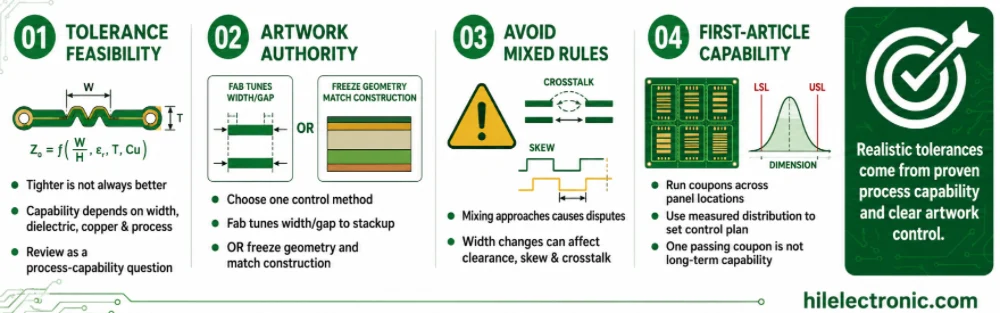
Ní sonraíocht níos fearr i gcónaí uimhir níos doichte. Braitheann an dáileadh is féidir a bhaint amach ar leithead an rian, airde tréleictreach, tiús copair, suíomh an phainéil, an próiseas greanta agus cibé an bhfuil an struchtúr plátáilte ar dhromchla an struchtúir. Is féidir le rianta an-chúng athrú céatadáin mór a thaispeáint ó athrú beag absalóideach ar ghreanadh; d’fhéadfadh go mbeadh leithead nó bearnaí tréleictreacha neamhphraiticiúla ag teastáil ó línte an-ard-impedance. Ba chóir don mhonaróir lamháltas a athbhreithniú mar cheist cumas próisis, ní hamháin glacadh leis mar rogha díolacháin.
Sula scaoilfear an saothar ealaíne, comhaontaigh cé a rialaíonn é. Modh amháin is ea go soláthróidh an custaiméir geoiméadracht ainmniúil agus go n-údaróidh sé don mhonaróir an leithead agus an bhearna péireála a chúiteamh leis an gcruachás scaoilte. Modh eile is ea geoiméadracht a reo agus a cheangal ar an soláthraí an tógáil a mheaitseáil go díreach. Cruthaíonn meascadh an dá chur chuige díospóidí nuair a choigeartaíonn soláthraí leithead na líne ach nuair a ghlacann an tsamhail imréitigh leagan amach, claonta nó traschainte leis an geoiméadracht bhunaidh.
I gcás tógála nua, smaoinigh ar rith cumais den chéad alt le cúpóin trasna suíomhanna painéil ionadaíocha. Bain úsáid as an dáileadh tomhaiste chun plean rialaithe táirgeachta réalaíoch a shocrú. Ní féidir le cúpón amháin a rith cumas fadtéarmach a bhunú, agus d’fhéadfadh próiseas atá údaraithe go staitistiúil tacú le banda níos doichte gan cigireacht iomarcach.
Liosta Seiceála um Scaoileadh Impedance
Ní bhíonn ceanglas impedance críochnaithe ach amháin nuair a bhíonn an sprioc, struchtúr na líne tarchuir, an t-údarás monaraíochta agus an plean fíoraithe sainmhínithe. Fágann líníocht a liostaíonn “difreálach 50 Ω” nó “difreálach 100 Ω” gan ciseal, tagairt, lamháltas agus riocht maisc go bhfuil sé de dhualgas ar an soláthraí toimhdí a dhéanamh.
- Aithin gach rang impedance de réir ciseal comhartha, plána nó plánaí tagartha, sprioc, lamháltas agus cineál struchtúir.
- Cuir geoiméadracht ainmniúil ar fáil mar chuspóir dearaidh agus luaigh an féidir leis an soláthróir an leithead nó an spásáil péirí a choigeartú.
- Tréleictreach brúite samhail, copar traipéisóideach críochnaithe, masc sádrála agus copar in aice láimhe.
- Bain úsáid as sonraí ábhair atá sainiúil don tógáil nó samhail dhearaidh-Dk monaróra doiciméadaithe.
- Dear cúpóin a léiríonn an struchtúr táirgthe iarbhír agus a shainíonn an modh TDR, minicíocht na samplaí agus ábhar na tuarascála.
- Coinnigh fíorú impedance cúpóin ar leithligh ó chaillteanas ionchuir cainéil, comhlíonadh via agus nascóirí.
Ba cheart go mbeadh údar maith le lamháltas daingean trí íogaireacht cainéil agus cumas próisis léirithe. Ní ionadach é do chonair leanúnach fillte, aistriú trí earra nó samhail caillteanais iomláin.
Éiginnteacht Tomhais agus Comhghaol Cúpóin go Táirge
Bíonn tionchar ag an gcúpón, an lainseáil, an daingneán, bandaleithead na hionstraime, cáilíocht an eitleáin tagartha, an calabrú agus an modh a úsáidtear chun an réigiún impedance tuairiscithe a roghnú ar thoradh TDR. Is féidir le dhá shaotharlann an cúpón céanna a thomhas ar bhealaí difriúla mura bhfuil na coinníollacha seo ailínithe. Dá bhrí sin, ba cheart don nós imeachta glactha níos mó ná an sprioc agus an lamháltas a shainiú.
- Aithin an modh tástála nó an nós imeachta an chustaiméara agus ionchais na hionstraime/calabrúcháin.
- Sainmhínigh fad an cúpóin, an cur chuige maidir le baint lainseála nó geataíocht agus an réigiún a úsáidtear don luach tuairiscithe.
- Coinnigh an cúpón ar an tógáil phainéil, an ciseal, an copar agus an córas tagartha céanna leis an struchtúr táirge.
- Taifead an meánluach, airmheán, toradh fuinneoige nó staitistic chomhaontaithe eile atá sa luach tuairiscithe.
- Sainmhínigh conas a láimhseáiltear eisceachtaí, lainseálacha cúpóin damáistithe agus aththástáil.
Tá teorainneacha ag baint le comhghaol cúpóin freisin. Ní chuimsíonn cúpón fada díreach gach ceap, muineál síos, trína, lainseáil nascóra nó oscailt eitleáin ar an táirge. Baineann na neamhleanúnachais sin leis an tsamhail chainéil nó le struchtúr tástála tiomnaithe. Os a choinne sin, má chuirtear gnéithe casta táirge leis an gcúpón impedance, is féidir go mbeadh sé deacair impedance próisis a dheighilt ó neamhleanúnachas d'aon ghnó.
I gcás clár lamháltais dhlúth, ba cheart don chomhghaol sonraí geoiméadracht cúpóin tomhaiste agus micriseacrachta a chur i gcomparáid leis an tsamhail réiteora réimse. Má tá an impedance ard nó íseal, ba cheart don athbhreithniú an tréleictreach brúite, leithead barr/bun an tseoltóra, tiús copair agus tógáil ábhair a mheas sula n-athraítear an saothar ealaíne. Is féidir le leithead an rian a choigeartú gan an chúis fhisiceach a aithint baisc amháin a chur thar bráid agus in-athdhéantacht a lagú agus an t-athdhéanamh a lagú.

Poist is molta
Déantúsaíocht PCB Scagaire TMM4
Tá monarú PCB scagaire TMM4 á rialú ag an...
Déantúsaíocht PCB TMM3 do Mhodúil RF
Is úsáideach an rud is mó a dhéantar le monarú PCB TMM3 nuair a bhíonn an modúl RF...
Déantúsaíocht PCB TMM6
Is é monarú TMM6 an leathanach rialaithe próisis do lár-Dk...

Déantúsaíocht PCB TMM10 le haghaidh Dearthaí RF Dlútha
Clár ÁbhairConas a Laghdaíonn TMM10 Struchtúir RFTMM10 vs...
Conas luachan a fháil le haghaidh PCBanna
Déanaimis anailís DFM/DFA a dhéanamh duit agus rachaimid ar ais chugat le tuarascáil. Is féidir leat do chuid comhad a uaslódáil go slán tríd ár suíomh Gréasáin. Teastaíonn an fhaisnéis seo a leanas uainn chun luachan a thabhairt duit:
-
- Gerber, ODB++, nó .pcb, sonraíocht.
- Liosta BOM má tá cóimeáil uait
- Cé mhéad
- Cas am
I gcás seirbhísí PCBA, cuir do Bhille Ábhar (BOM) agus aon treoracha tionóil sonracha ar fáil. Cuirimid anailís DFM/DFA ar fáil freisin chun do dhearaí a bharrfheabhsú le haghaidh inmhonaraitheachta agus tionóil, rud a chinntíonn próiseas táirgthe réidh.