
Tillverkning och montering av kretskort för spelkontroller för specialanpassade trådbundna, trådlösa och multiingångskontroller
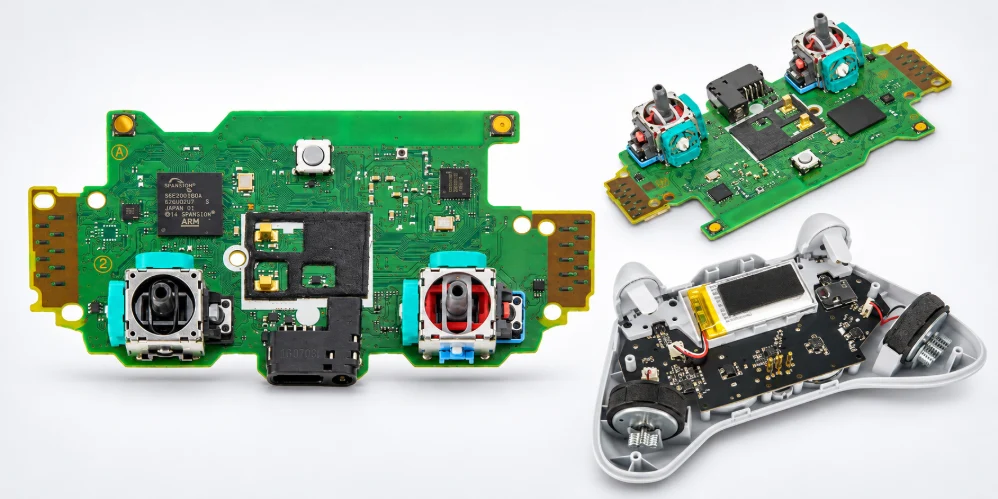

Highleap Electronics manufactures customer-released gaming controller PCB and PCBA designs for wired, wireless and modular control products. The practical manufacturing focus is the relationship between digital inputs, analog sensors, USB or RF communication, haptics, power, firmware and the final enclosure—not generic claims about gaming performance.
Gaming Controller PCB Architecture Starts with the Input and Feedback Map
A gaming controller PCB is not one universal board type. A compact handheld controller may combine digital buttons, analog joysticks, Hall-effect triggers, an IMU, RGB lighting, haptic actuators, USB and wireless communication, while an arcade or simulation controller may move those same functions onto several daughterboards. Highleap Electronics manufactures customer-released controller PCB and PCBA designs, so the production package should define the exact input map, output devices, host interface, firmware and mechanical stack rather than relying on the product name.
Compact handheld controller
Main MCU, dual analog sticks, triggers, buttons, haptics and USB/wireless functions share a constrained enclosure.
Wired USB controller
The RF and battery sections disappear, but USB connector durability, ESD and report mapping become primary production concerns.
Modulär styrenhet
A main logic board connects to button, trigger, lighting or accessory boards through FFC, board-to-board connectors or harnesses.
Specialty accessibility controller
Large or remappable inputs can require unusual connectors, external switches and clear channel identification.
Controller with display or RGB
Lighting and display rails add transient load and firmware/SKU configuration that should be tested with the inputs active.
Custom OEM platform
One base PCB can support multiple faceplates or regional SKUs if population options, firmware and mechanical variants are tightly controlled.
The useful manufacturing question is therefore not whether a board is a “game controller PCB,” but which electrical domains must work together in the finished unit. A design review can combine DFM with enclosure data so joystick height, connector access, keep-outs and test access are reviewed before PCB-montering är släppt.
Digital Buttons and Analog Controls Need Different Production Tests
A digital button usually has a simple electrical state, but analog controls introduce center offset, sensor supply accuracy, ADC reference, usable range and mechanical travel. A board can pass continuity while a joystick sits off-center or a trigger reaches only part of its intended range. Production should therefore separate raw electrical checks from calibrated controller behavior.
| Ingångstyp | Tillverkningsrisk | Useful factory check |
|---|---|---|
| Tactile or membrane button | Open contact, wrong map, switch height, enclosure interference | Verify physical location against the diagnostic or host report. |
| Potentiometer joystick | Center offset, range mismatch, solder or connector issue | Sample center plus several positions and compare with customer limits. |
| Hall-effect joystick/trigger | Sensor orientation, magnet gap, supply or calibration mismatch | Test with the released mechanical magnet/sensor stack, not the bare PCB alone. |
| Roterande kodare | Missed pulses, direction reversal, shaft/mechanical mismatch | Rotate both directions and verify count and direction. |
| IMU or motion input | Part revision, orientation, bus failure, calibration data | Read device identity and run the OEM-provided motion diagnostic. |
Where magnetic inputs are used, the production principles are similar to other Hall-effekt-kretskort applications: sensor orientation and the distance to the moving magnet are functional dimensions. Highleap should reproduce the released stack and calibration procedure rather than invent dead-zone or sensitivity values.
USB, Wireless and Power Domains Should Be Validated Together
A controller that works on a bench supply can fail in the final product when haptics, LEDs or a radio transmit at the same time. The test plan should include realistic combined states: wireless traffic while both motors run, USB reconnect after battery charging, or repeated trigger/joystick activity while LEDs change. This exposes ground, supply and connector faults that single-subsystem testing can miss.
- USB: follow the released differential routing, protection and connector footprint; USB-C-kontakt anchoring matters when the user plugs and unplugs the cable frequently.
- Trådlös: antenna keep-out, matching parts and enclosure clearance should remain fixed under trådlös och RF tillverkningskontroller.
- ESD: user-accessible ports and metal controls should preserve the approved discharge path and ESD-skydd nätverk.
- Effekt: battery or USB power rails should be checked during peak haptic and lighting loads, not only at idle.
- Firmware-identitet: programmed image, option state and controller identity should be tied to the work order.
Highleap Electronics • Kretskortstillverkning och PCBA
Send the released PCB files, BOM, assembly drawings, enclosure data, firmware, input map, test requirements and target quantities for a manufacturing review.
Request a Gaming Controller PCB Quote →Diskutera din PCBA-konstruktion →
✓ DFM- och DFA-granskning ✓ Prototyp för upprepad produktion ✓ PCB-tillverkning och montering
Haptic Motors, LEDs and Other Outputs Can Disturb the Inputs
Haptic actuators are noisy electromechanical loads. Their startup current and switching edges can introduce rail droop or ground disturbance, while an LED animation can change current consumption at the same moment that analog inputs are sampled. The manufacturing test should therefore operate outputs while reading raw joystick and trigger channels. If the readings move only under a specific output state, the investigation belongs in power integrity, grounding, component population or harness routing—not in arbitrary firmware compensation.
For designs with separate output boards, connector pinout and harness length need the same revision control as the main PCBA. Where motors or actuators are substantial, the principles used in motordrivkretskort production can help define current-path inspection, connector checks and functional load testing.
Latency Claims Should Be Tied to a Defined Measurement
Terms such as “instant input” and “zero delay” are not manufacturing specifications. End-to-end game latency depends on input scanning, debounce, MCU firmware, USB or wireless report timing, host drivers, application software and display timing. If latency is important, the OEM should provide a repeatable method and an acceptance limit for the stage of the product Highleap can actually measure. That allows production samples and firmware revisions to be compared without making unsupported system-level claims.
Highleap can reproduce the released hardware, program the approved firmware and execute a customer-defined timing or report test. It should not infer console compatibility, gameplay performance or latency from the PCB category alone.
International OEM Projects Need a Complete, Region-Neutral Manufacturing Package
A US or Canadian gaming accessory company sourcing custom gaming controller PCBA from China usually gains more from one controlled global hardware platform than from country-specific boards. The important handoff is a complete package: controller revision, BOM, enclosure drawing, firmware, programming data, USB or wireless identity rules, and test software. UK, German, French, Dutch, Italian and Spanish engineering teams can use the same approach while keeping regional packaging, labeling and software choices under their own product control.
For European brands, component substitutions should be visible before production because a mechanically compatible joystick, connector or radio module may change calibration, regulatory status or enclosure fit. Inköp av elektroniska komponenter should therefore use approved alternates rather than selecting parts only by package or price.
Gaming Controller NPI and End-of-Line Test
- Incoming configuration: verify PCB revision, BOM option, enclosure variant and programmed firmware.
- Raw input map: exercise every button, joystick, trigger, encoder and sensor channel.
- Analog calibration: run the approved center/range procedure and record failures by channel.
- Gränssnittstest: verify USB enumeration or the defined wireless pairing/communication behavior.
- Combined-load test: operate haptics, LEDs and other outputs while inputs are monitored.
- Mechanical retest: repeat critical controls after the final panel, screws, cable and enclosure are installed.
A production fixture becomes more useful when the PCB exposes rails, reset, programming and raw-input diagnostics using design för testbarhet. Final acceptance can then use customer-defined funktionstestning rather than a generic power-on check.
Controller Families Need a Variant Matrix Before Material Release
A controller family often reuses one PCB across wired, wireless, premium and cost-reduced models. The risk is not the shared board itself; it is allowing the variant to exist only in operator knowledge. A controlled matrix should connect the bare-board revision to populated jumpers, radio option, battery/charging parts, haptic type, LED/display option, firmware image and final enclosure. If a premium controller adds rear paddles or a detachable module, the corresponding connector and diagnostic should be tied to that SKU before kitting.
This matters when European and North American brands release cosmetic variants at the same time. A French or German product team may change the enclosure finish without changing electronics, while a US version may add a different accessory bundle. The manufacturing traveler should distinguish true electrical variants from packaging-only differences so the factory does not create unnecessary PCB revisions or accidentally mix firmware.
RFQ Inputs for Gaming Controller PCB Manufacturing
For quotation, provide Gerber/ODB++, fabrication notes, BOM with approved alternates, centroid, assembly drawings, 3D/enclosure files, all daughterboard and harness drawings, firmware, programming instructions, input/output map, calibration limits, host diagnostic and quantity by SKU. If the product will be delivered as a complete controller, also identify the scope of boxbyggd montering and which final system tests remain the OEM’s responsibility.

Rekommenderade inlägg
Checklista för kvalificering av I-Tera MT40 PCB-leverantör
Highleap Electronics tillverkar kretskort...
PCB-materialdatabas: Laminatkvaliteter och egenskaper
Hur man får en offert för kretskort Låt oss köra DFM/DFA-analys för...
TMM PCB-tillverkning
Innehållsförteckning TMM PCB-tillverkningsområde för RF och...

RT duroid 6002 PCB Citat och Stackup
Den här sidan äger offert- och stackup-definitionsuppgiften...
Hur man får en offert för kretskort
Låt oss köra en DFM/DFA-analys åt dig och återkomma till dig med en rapport. Du kan ladda upp dina filer säkert via vår webbplats. Vi behöver följande information för att kunna ge dig en offert:
-
- Gerber, ODB++ eller .pcb, spec.
- Stycklista om du behöver montering
- Antal
- Vändningstid
För PCBA-tjänster, vänligen ange din BOM (Bill of Materials) och eventuella specifika monteringsanvisningar. Vi erbjuder även DFM/DFA-analys för att optimera dina konstruktioner för tillverkningsbarhet och montering, vilket säkerställer en smidig produktionsprocess.