
Tg170 PCB-fremstilling og -montering til industriel elektronik
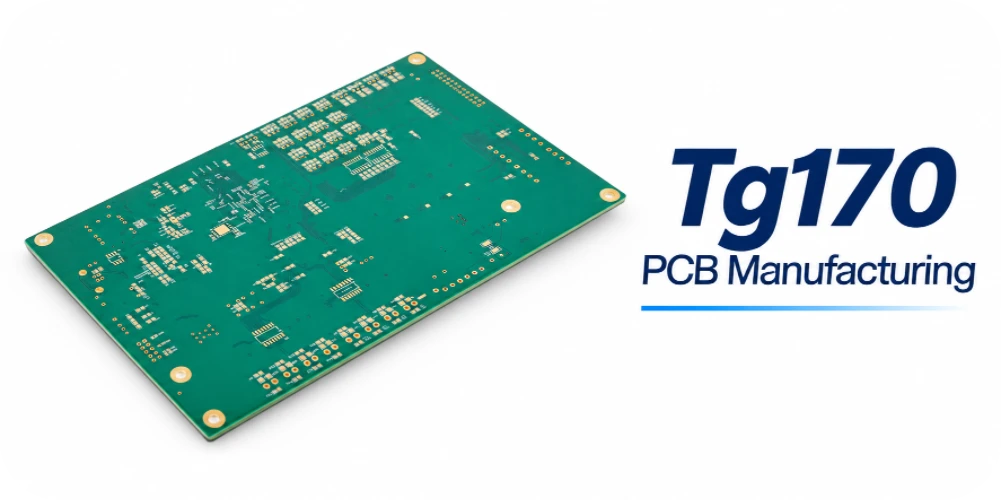
Highleap Electronics provides PCB fabrication and PCB assembly services for projects that require coordinated engineering review, manufacturing planning and production quality control. For Tg170 FR-4 projects, the process starts with reviewing the specified laminate, board construction, order quantity and requested delivery schedule.
For purchasing teams, this review is particularly important when a project involves a large production volume, a specified laminate grade or a fixed product launch date. A manufacturable design also needs a realistic material procurement and production plan.
Indholdsfortegnelse
- Tg170 PCB Manufacturing and Assembly Services
- How to Specify Tg170 FR-4 PCB Materials
- Tg170 PCB Fabrication Requirements and Quality Control
- How to Source a Tg170 PCB Manufacturer for US and European Projects
- 2026 PCB Material Supply and Large-Volume Order Planning
- Tg170 PCB Cost, Lead Time and Quotation Requirements
Tg170 PCB Manufacturing and Assembly Services
Tg170 PCB is a common description for a circuit board manufactured with a laminate whose glass transition temperature is approximately 170°C under a specified test method. In a manufacturing RFQ, however, Tg170 should be treated as a starting requirement rather than a complete material specification.
Different laminate manufacturers may offer materials with similar Tg values but different decomposition temperatures, thermal expansion behavior, dielectric properties and processing requirements. These differences can affect multilayer lamination, plated through-hole reliability, signal integrity and assembly performance.
Depending on the approved design and project scope, PCB manufacturing and assembly coordination may involve the following steps:
- Ingeniørgennemgang: Check Gerber files, drill data, stack-up, board thickness, copper weights and manufacturing constraints.
- Material review: Confirm the specified Tg170 laminate grade, core and prepreg construction, copper foil and material availability.
- PCB-fremstilling: Manufacture the approved board construction according to the required layer count, dimensions, hole structure, surface finish and electrical requirements.
- PCB-samling: Coordinate component sourcing and assembly requirements when the project includes PCBA.
- Inspektion og prøvning: Define inspection and electrical test requirements according to the design and agreed acceptance criteria.
For projects requiring both bare boards and assembled products, coordinating fabrication and assembly can reduce handoff issues between suppliers. Explore Highleap’s PCB-fremstillingstjenester, PCB montage tjenester og nøglefærdig PCB samling for mere information.
How to Specify Tg170 FR-4 PCB Materials
A quotation request that only states “Tg170 FR-4” may leave important engineering and purchasing questions unanswered. Identifying the required material and board construction helps reduce the risk of unapproved substitutions, quotation differences and production delays.
Confirm the Exact Laminate Grade
Specify the laminate manufacturer and grade when the project requires a particular approved material. If equivalent materials are permitted, define the acceptance criteria before quotation. A similar Tg value alone does not establish that two laminate systems are interchangeable.
For eksempel: Isola IS420 is a commercially available laminate system with a published Tg of 170°C. Its published material data applies to that specific product and should not be treated as a universal specification for every Tg170 laminate.
Evaluate the Relevant Material Properties
Glass transition temperature describes a change in the behavior of a resin system. It is not a guaranteed continuous operating temperature for the finished PCB. Actual operating limits depend on the complete laminate system, board construction, component temperatures, thermal cycling and environmental conditions.
| Parameter | Hvorfor det drejer sig om |
|---|---|
| Tg | Glass transition temperature, including the applicable test method. |
| Td | Decomposition temperature, providing additional information about thermal behavior. |
| Z-akse CTE | Through-thickness thermal expansion, particularly relevant to plated-hole reliability. |
| Dk og Df | Dielectric constant and dissipation factor for applications with signal-integrity requirements. |
| Moisture and reliability properties | Performance considerations based on the product’s environment and qualification requirements. |
Define the Complete PCB Construction
Material requirements should be reviewed alongside the board’s physical and electrical specifications. A useful RFQ package normally includes:
- Layer count, finished board thickness and board dimensions.
- Copper weight by layer and the required stack-up.
- Minimum trace width and spacing, hole sizes and via structures.
- Controlled impedance targets and tolerances, where applicable.
- Surface finish, solder mask and other fabrication requirements.
- Special processes such as blind vias, buried vias, microvias or sequential lamination.
For controlled-impedance designs, provide the target impedance, tolerance, relevant signal layers and reference-plane arrangement. The stack-up should be evaluated using the selected material’s properties rather than a generic Tg170 designation.
For manufacturing review, see Highleap’s PCB design for manufacturability review.
Tg170 PCB Fabrication Requirements and Quality Control
Reliable Tg170 PCB manufacturing requires compatibility between the approved laminate, the board construction and the selected fabrication process. The appropriate controls depend on layer count, thickness, hole structure, electrical requirements and intended operating conditions.
Material and Stack-Up Verification
Before production, verify the laminate grade, core thickness, prepreg construction, copper foil and finished board thickness. For multilayer boards, the stack-up must account for dielectric spacing, copper distribution and lamination requirements. Any proposed material change should be evaluated against the approved engineering specification.
Drilling, Plating and Via Reliability
Hole geometry, aspect ratio, copper thickness and via construction influence fabrication requirements. Through-hole and multilayer designs require suitable drilling, desmear and plating controls. For products exposed to demanding thermal cycles, plated through-hole reliability and the laminate’s Z-axis expansion behavior may require particular attention.
HDI designs using laser-drilled microvias, blind or buried vias, via filling and sequential lamination introduce additional process considerations. These features should be identified early so engineering review and quotation reflect the actual construction.
Elektrisk og visuel inspektion
Inspection should follow the PCB specification and agreed acceptance criteria. Depending on the design, the quality plan may include automated optical inspection, electrical continuity and isolation testing, dimensional verification, impedance testing or other specified checks.
For controlled-impedance boards, agree on target values, tolerances and verification methods before manufacturing. Dense multilayer constructions may also require attention to registration, annular rings, hole quality and other design-specific risks.
Where the project specifies an industry standard, identify the applicable revision, product class and acceptance criteria in the RFQ. The standard should be selected according to the end product and its reliability requirements rather than assumed from the Tg value alone.
Consider Assembly Requirements Early
If the Tg170 PCB will be assembled, review the bare-board specification alongside the assembly process. Reflow profiles, component temperature limits, board thickness, warpage requirements, connector interfaces and thermal management can all affect the finished product.
A Tg170 designation alone does not guarantee compatibility with every lead-free assembly profile or operating environment. Qualification should be based on the selected laminate, complete board construction and actual process conditions.
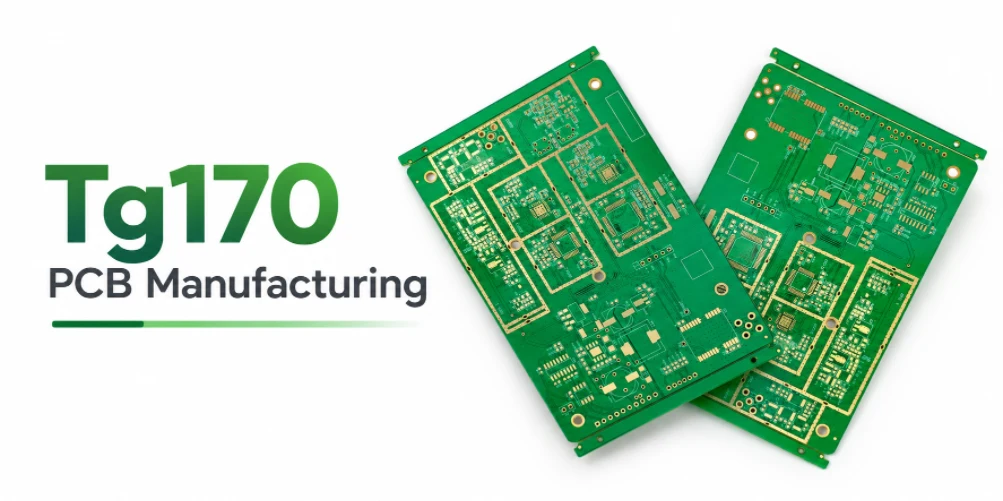
How to Source a Tg170 PCB Manufacturer for US and European Projects
For buyers in the United States and Europe, selecting a Tg170 PCB manufacturer involves more than comparing unit prices. The supplier needs to understand the approved laminate, fabrication requirements, quality documentation, order volume and delivery expectations. A clear RFQ helps engineering and procurement teams compare suppliers on a consistent basis.
Prepare an RFQ That Supports a Meaningful Comparison
Send the same technical package to each shortlisted manufacturer. At a minimum, include fabrication data, drill files, stack-up, finished board thickness, copper weights, surface finish, quantity and requested delivery date. If a specific Tg170 laminate is mandatory, state the manufacturer and exact grade rather than describing the material only by its Tg value.
If the design permits alternative laminates, identify who must approve a substitution and what supporting documentation is required. Ask suppliers to distinguish confirmed material availability from estimated replenishment dates, and to identify any assumptions affecting their quotations.
For projects requiring assembled boards, include the BOM, pick-and-place files, assembly drawings and testing requirements. This allows the supplier to assess the full manufacturing scope instead of quoting bare boards against an incomplete specification.
Evaluate Quality Systems and Product Acceptance Requirements
Quality requirements should be defined before placing the order. Buyers may need to specify the applicable IPC requirements, product class, inspection records, electrical test requirements, traceability expectations and documentation supplied with each shipment. The exact requirements depend on the end product and the purchasing agreement.
Where a project requires UL-related recognition, RoHS or REACH documentation, or other compliance evidence, identify the specific requirement and ask the supplier to provide applicable documentation for the relevant product or material. Do not assume that every PCB material, finished board or supplier automatically meets every regulatory or certification requirement.
A useful supplier review also clarifies how engineering changes, nonconforming boards, material substitutions and approval records will be handled. These details are particularly important for repeat production, where the approved construction must remain consistent across manufacturing lots.
Check Delivery Planning and International Logistics
For cross-border orders, distinguish material procurement time, fabrication time, assembly time where applicable, and shipping time. Confirm whether the quoted lead time begins after file approval, material confirmation, deposit or another agreed milestone.
Buyers should also clarify the delivery term, shipment destination, packaging requirements and responsibility for import clearance or duties. A quoted production lead time does not necessarily include international transit or customs processing.
For repeat orders, ask whether the manufacturer can support a forecast, scheduled releases or phased delivery. The practical solution depends on material availability, production capacity and the customer’s inventory requirements. A staged plan may help manage supply risk, but it should be agreed before the purchase order is released.
Compare Total Project Risk, Not Just Unit Price
A lower quotation may be based on a different laminate grade, different acceptance criteria, an incomplete inspection scope or a delivery assumption that does not match the purchasing schedule. Before comparing prices, confirm that each supplier is quoting the same board construction, quantity, material specification and quality requirements.
For projects with fixed launch dates, material confirmation and delivery planning may be as important as the unit price. Buyers should ask for written clarification of material substitutions, quotation validity, production milestones and any conditions that could affect the committed schedule.
Highleap Electronics supports PCB fabrication and PCB assembly project coordination. Buyers can submit their project specifications for review through the PCB-fremstillingsservice page or contact the team to discuss a specific production requirement.
2026 PCB Material Supply and Large-Volume Order Planning
PCB material procurement in 2026 requires closer attention to pricing, availability and production scheduling. Following multiple rounds of laminate price increases, some suppliers and PCB manufacturers have tightened material allocation or adjusted their order acceptance policies. The impact varies by laminate manufacturer, material grade, thickness, copper construction and the quantity required.
For købere, der søger sourcing Tg170 PCB products, a larger order does not automatically guarantee a lower unit price or faster production. Under normal conditions, higher volumes may reduce setup and processing costs per board. However, when the specified laminate is in limited supply, material availability and allocation can become more important than order quantity alone.
Why Some Factories May Limit Large-Volume PCB Orders
A factory managing constrained laminate availability must balance material allocation across multiple customer projects. A single large order requiring substantial quantities of a specific Tg170 FR-4 grade or another specialty laminate may consume a significant portion of the material available for a particular production period.
Accepting the entire order without sufficient supply could delay other customers’ scheduled projects. To manage this risk, some manufacturers may limit the quantity accepted for one production window, request phased deliveries or require material availability to be confirmed before committing to the full order.
These decisions are not necessarily a reflection of the order’s value or the customer’s importance. They may be part of an effort to balance available materials, production capacity and delivery commitments across multiple customers.
This is relevant for purchasing teams accustomed to the assumption that a larger order will always receive priority or a lower unit price. Volume discounts may still be possible, but they depend on material cost, production efficiency, available capacity and delivery requirements. When supply is constrained, the manufacturer may need to assess whether the full quantity can be supported before offering a firm price and schedule.
Why Early Communication Matters
The issue is not limited to Tg170 FR-4. Projects using other FR-4 grades, high-frequency laminates, high-speed materials or specialty constructions may also require advance procurement planning when availability is restricted. The level of risk depends on the exact material and the supplier’s current stock and replenishment schedule.
For a large-volume Tg170 PCB order, contact the manufacturer before finalizing the purchase order. Share the required material grade, estimated quantity, target delivery dates and whether the project will be released in one batch or across scheduled orders. This allows the manufacturer to evaluate the actual procurement and production requirements.
Large-Volume PCB Order Checklist
- Materiale tilgængelighed: Confirm the laminate manufacturer, grade, thickness and copper-clad construction.
- Quantity acceptance: Ask whether the full volume can be supported in the requested production window or whether phased deliveries are more practical.
- Quotation validity: Confirm how long the price remains valid and whether material price adjustments may apply before procurement or production release.
- Blytid: Clarify material procurement, PCB fabrication, assembly if applicable, and shipment timing separately.
- Alternative materialer: Review possible alternatives with the engineering team if the specified grade is unavailable. Similar Tg values alone do not establish equivalence.
- Demand forecasts: For repeat orders, share an estimated forecast and release schedule where possible to support earlier procurement and capacity planning.
For large-volume projects, early communication helps establish whether the requested material, quantity and delivery plan are feasible. For recurring production, a demand forecast and planned release schedule can also support more effective material procurement discussions. For further background, see Highleap’s guide to PCB material supply constraints.
Tg170 PCB Cost, Lead Time and Quotation Requirements
The cost of a Tg170 PCB depends on more than the laminate’s glass transition temperature. A reliable quotation needs to account for the complete board construction, manufacturing complexity, material availability, order quantity and delivery requirements.
What Affects Tg170 PCB Pricing?
| Omkostningsfaktor | Impact on the Quotation |
|---|---|
| Laminate grade | Material specification, availability and procurement cost can affect both price and lead time. |
| Antal lag og tykkelse | Multilayer construction, core and prepreg requirements, and finished thickness influence material use and processing. |
| Kobbervægt | Heavy copper and layer-specific copper requirements may change process requirements and cost. |
| Design kompleksitet | Fine features, small holes, high aspect ratios, HDI structures, via filling and controlled impedance can add manufacturing complexity. |
| Overfladefinish og testning | Finish selection, electrical testing, impedance verification and special inspection affect the process scope. |
| Mængde og tidsplan | Volume may improve setup efficiency, but material availability and requested delivery dates can limit the benefit. |
| Samlingsomfang | For PCBA, the BOM, component availability, package types, assembly processes and testing requirements affect total project cost. |
Why a Larger Order May Not Always Receive a Lower Price
In a stable supply environment, a larger order can reduce the unit cost of setup and certain production operations. However, the quotation still depends on material purchase cost, panel utilization, manufacturing yield, process requirements and available capacity.
When laminate prices are changing or a specified material is difficult to obtain, a large order may require a substantial upfront material purchase. The factory must assess whether the material can be secured, whether the requested delivery schedule is realistic and how the order fits with existing production commitments. As a result, the usual pricing advantage associated with higher volume may be reduced or may require a different delivery arrangement.
Compare quotations using the same material specification, board construction, quantity, delivery terms and acceptance requirements. A lower unit price may not be the more practical option if the material differs from the approved specification or the delivery schedule is uncertain.
For additional pricing considerations, see PCB manufacturing cost factors in 2026.
Information to Include in a Tg170 PCB RFQ
To support an accurate manufacturing review, provide the following information where available:
- Gerber or other accepted fabrication data and drill files.
- Layer count, finished board dimensions and thickness.
- Required laminate manufacturer and exact material grade, or clearly defined material acceptance criteria.
- Stack-up, copper weight, minimum trace and spacing, and special via requirements.
- Surface finish, solder mask, legend and special fabrication instructions.
- Electrical testing, impedance requirements and acceptance criteria.
- Required quantity, prototype needs, repeat-order forecast and target delivery dates.
- For PCBA, the BOM, pick-and-place data, assembly drawings and required testing information.
Highleap Electronics can review the supplied project information to clarify manufacturing scope and outstanding engineering or purchasing questions. For large-volume orders, the quotation discussion should include material availability and schedule feasibility rather than treating quantity as the only purchasing variable.
HIGHLEAP ELEKTRONIK
Get a Tg170 PCB Manufacturing Quote
Send your PCB files, laminate specification, order quantity and target delivery date. Our team can review the manufacturing requirements and clarify material availability, production scope and scheduling questions for your project.
✓ DFM Support
✓ Prototype to Production
✓ PCB Fabrication and PCBA
A successful Tg170 PCB project requires the right material, a manufacturable board construction and a realistic procurement plan. Confirm the exact laminate grade and current availability before committing to a large order, particularly when the project has a fixed delivery window or requires repeat production. This helps align engineering requirements, purchasing decisions and manufacturing schedules from the beginning.

anbefalet Indlæg
Fremstilling og montering af bærbare temperaturloggere til BLE-sensor-OEM'er
Et bærbart temperaturlogger-printkort er det elektroniske printkort...

Fremstilling og montering af PCB-kort til tilsluttede sikkerhedshjelme til industrielle IoT-OEM'er
Et tilsluttet sikkerhedshjelm-printkort er et industrielt IoT-printkort...
Produktion og montering af printkort til mobile Wi-Fi-routere til 4G/5G hotspot-OEM'er
Et printkort til en mobil Wi-Fi-router er produktionsplatformen...
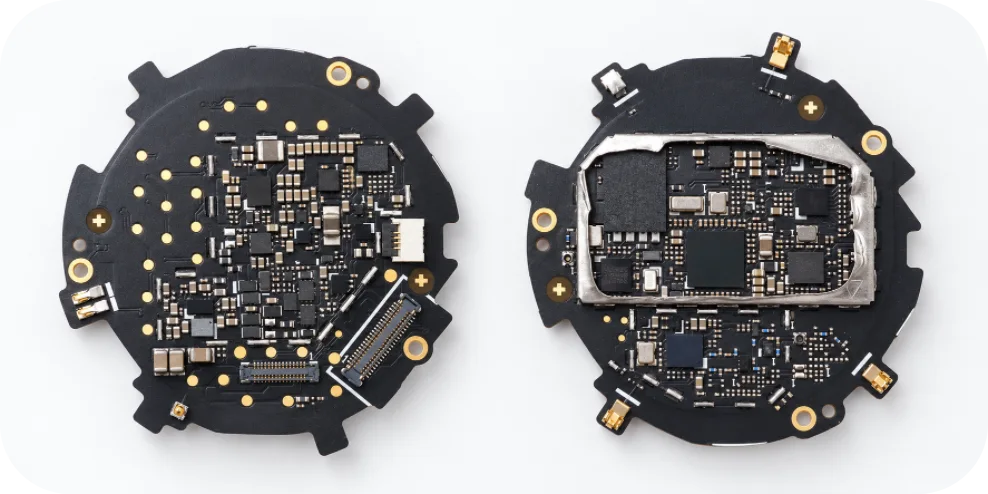
Vejledning til design og fremstilling af PCBA til fitnesstracker
Et fitnesstracker-printkort skal kombinere sensorer, Bluetooth-printkort...
Sådan får du et tilbud på printkort
Lad os køre en DFM/DFA-analyse for dig og vende tilbage til dig med en rapport. Du kan uploade dine filer sikkert via vores hjemmeside. Vi har brug for følgende oplysninger for at kunne give dig et tilbud:
-
- Gerber, ODB++ eller .pcb, spec.
- Stykliste, hvis du ønsker montering
- Antal
- Vendetid
For PCBA-tjenester bedes du fremvise din BOM (Bill of Materials) og eventuelle specifikke monteringsinstruktioner. Vi tilbyder også DFM/DFA-analyse for at optimere dine designs med hensyn til fremstillingsevne og montering, hvilket sikrer en problemfri produktionsproces.