

Microduck Robot: Open-Source Physical AI, Sim-to-Real and PCB Engineering
Microduck: Inside the Tiny Physical-AI Robot and the Electronics Behind It
Pollen Robotics' Microduck combines reinforcement learning, embedded computing, sensing and 15 actuated degrees of freedom in a 25 cm biped robot. The interesting engineering story is not only how it moves, but how simulated intelligence becomes dependable real-world hardware.
Technical claims in this article were checked against Pollen Robotics' official Microduck materials and official GitHub repositories on 30 August 2026.
Why Microduck has become an interesting physical-AI platform
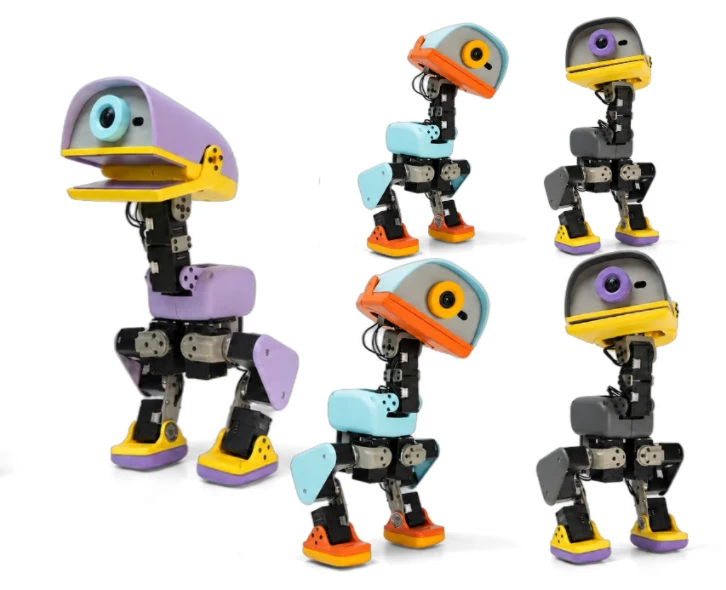
Pollen Robotics announced Microduck on August 27, 2026. At launch, the company described it as a 25 cm biped robot designed to make physical-AI experimentation, movement learning and sim-to-real development more approachable.
The published specification includes a Rockchip RK3566 with AI accelerator, 1 GB RAM, 32 GB storage, a front camera, an 8×8 time-of-flight LiDAR matrix, two IMUs, microphones, a speaker, two NFC antennas, Wi‑Fi, Bluetooth and a removable NP-F550 2600 mAh battery.
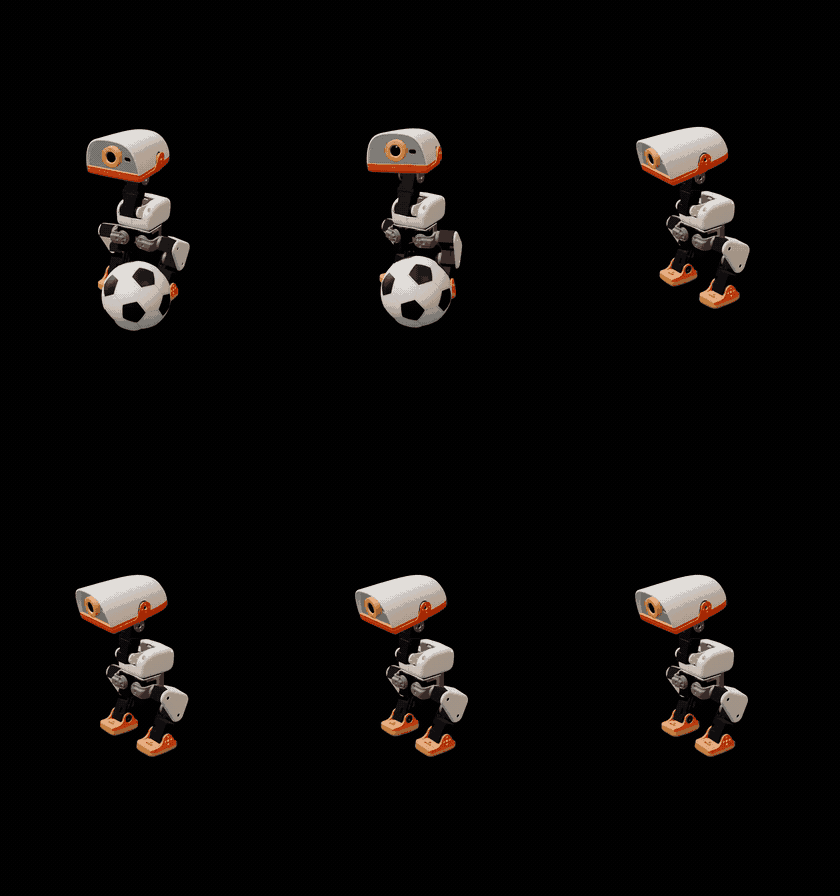
Its articulated beak can grasp objects, and the official materials describe behaviors including walking, sitting, crouching, getting back up from common falls, object pickup, kicking and roller-skating.
Launch details worth quoting accurately
- Pre-orders opened on August 27, 2026.
- The introductory price was announced as US$399 before taxes and shipping.
- First deliveries were targeted before Christmas 2026.
- North America and Europe were the launch markets.
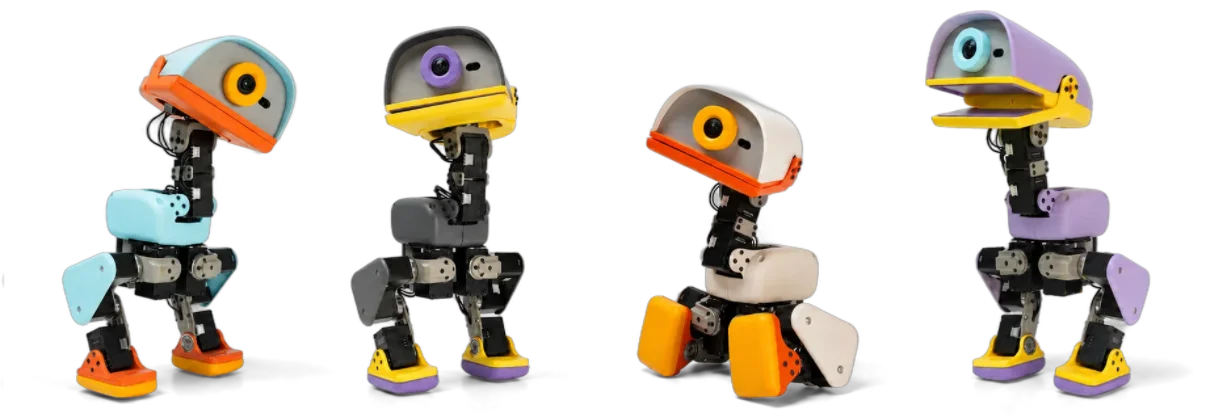
- Four launch colorways: Cream, Graphite, Lavender and Sky.
- Battery runtime was stated as around one hour depending on use.
*The US$399 figure is the introductory launch/pre-order price, not a promise of a permanent retail price.
What is actually open source — and what is not
Microduck is accurately described as having an open-source software stack. Pollen Robotics explicitly states that the open-source claim covers software; the robot's mechanical and electronic design files are not open source. That distinction is important for engineers who may otherwise assume that schematics, PCB layout files or mechanical manufacturing files are publicly available.
Onboard runtime, control services and robot software. Repository license: Apache-2.0. Microduck RL repository github.com/pollen-robotics/microduck_rl
RL environments, sim-to-real tooling, PPO training and ONNX export. Official browser simulator Hugging Face Microduck Sandbox
Run trained Microduck policies in a browser-based simulation.
From simulation to a robot that can kick, walk and recover
The official microduck_rl repository describes reinforcement-learning environments built on mjlab (MuJoCo Warp) with PPO. Policies are trained at 50 Hz, exported to ONNX, and then loaded by the Microduck runtime on the real robot.
The repository also documents a sim-to-real recipe that includes actuator physics, domain randomization and backlash simulation. Those techniques matter because a policy that performs well in an idealized simulator can fail when it meets real motors, mechanical play, sensor noise, friction changes and battery variation.
What Pollen Robotics has publicly specified
The table below stays within the launch specifications that Pollen Robotics has published. It deliberately avoids guessing at unreleased PCB details.
| Area | Published Microduck specification |
|---|---|
| Dimensions | 25 cm tall, 14 cm wide |
| Weight | Under 800 g |
| Actuation | 15 degrees of freedom across articulated legs, head and neck |
| Compute | Rockchip RK3566 with AI accelerator |
| Memory / storage | 1 GB RAM, 32 GB storage |
| Vision | Front camera with a camera-use indicator |
| Range sensing | Compact LiDAR using an 8×8 time-of-flight matrix |
| Motion sensing | Two IMUs, one in the body and one in the head |
| Interaction | Articulated grasping beak; microphones and speaker; two NFC antennas |
| Connectivity | Wi‑Fi and Bluetooth; versions were provisional at launch |
| Battery | Removable NP-F550, 2600 mAh; around one hour depending on use |
| Control / policy | 50 Hz onboard policy loop |
Why physical AI eventually becomes an electronics manufacturing problem
Microduck's PCB schematics and electronic design files have not been released, so it would be incorrect to claim a particular Microduck PCB stack-up, board count, motor-driver topology or layout strategy. What can be discussed confidently is the broader engineering problem shared by compact robots: sensing, compute, connectivity, actuation and power have to operate together inside a small moving system.
Power integrity
Actuator loads can change quickly. Power-domain planning, grounding, decoupling, connector current rating and transient behavior can determine whether sensitive logic remains stable while a robot moves.
Signal integrity and sensor noise
Cameras, IMUs, depth sensors and digital interfaces can be sensitive to return-path problems, interference and supply noise. Stack-up, routing and component placement matter.
Thermal density
Processors, regulators and actuator electronics generate heat in a confined enclosure. Copper distribution, thermal vias and system-level heat paths need to be considered early.
Mechanical reliability
Robots move, vibrate and sometimes fall. PCB mounting, cable strain relief, connector selection, solder-joint quality and assembly inspection can affect field reliability.
A robotics prototype is not yet a repeatable product
Once a robotics team moves beyond experiments, the hardware process has to become repeatable. A practical manufacturing path often progresses from prototype validation to engineering builds, NPI, pilot production and then volume manufacturing.
For a robotics PCB or PCBA project, a complete manufacturing package may include Gerber or ODB++ data, BOM, pick-and-place data, assembly drawings, special process requirements and an agreed test plan.
Developing a robot controller, sensor board or physical-AI device?
Highleap Electronics supports PCB fabrication and PCB assembly for embedded electronics, robotics and other engineering-intensive products. If your design is moving from prototype to a repeatable build, send the manufacturing data for a PCB/PCBA review and quotation.
Microduck questions engineers often ask
Is Microduck fully open-source hardware?
No. Pollen Robotics' press kit explicitly says the open-source statement covers the software stack. Mechanical and electronic design files are not open source.
How big and heavy is Microduck?
The official specification lists Microduck as 25 cm tall, 14 cm wide and under 800 g.
What does Microduck use for reinforcement learning?
The official RL repository describes environments built on mjlab (MuJoCo Warp) with PPO. Policies are trained at 50 Hz, exported to ONNX and deployed by the robot runtime.
Where are the official open-source repositories?
The robot software is available at pollen-robotics/microduck, and the reinforcement-learning environment is at pollen-robotics/microduck_rl.
Are Microduck's PCB design files public?
No. Pollen Robotics specifically states that the electronic design files are not open source. Public discussions of Microduck's exact PCB construction should therefore not be presented as verified unless the company releases additional hardware documentation.
Recommended Posts
High-Speed RFSoC PCB Manufacturing and Assembly: Key Engineering Considerations
How to get a quote for PCBs Let's run DFM/DFA analysis for...

1206 PCB Assembly Services for Prototypes & Production
src="https://hilelectronic.com/wp-content/uploads/2026/08/PC...

Kitted PCBA Services for Customer-Supplied Components
Kitted PCBA is a manufacturing model in which the customer...

Build to Print PCB Assembly Services
src="https://hilelectronic.com/wp-content/uploads/2026/08/PC...
How to get a quote for PCBs
Let’s run DFM/DFA analysis for you and get back to you with a report. You can upload your files securely through our website. We require the following information in order to give you a quote:
-
- Gerber, ODB++, or .pcb, spec.
- BOM list if you require assembly
- Quantity
- Turn time
For PCBA services, please provide your BOM (Bill of Materials) and any specific assembly instructions. We also offer DFM/DFA analysis to optimize your designs for manufacturability and assembly, ensuring a smooth production process.