
Photoresist Explained: Principles, Types, and Role in PCB Fabrication

Using PCB Dry Film Photoresist to PCB
Introduction
Transferring circuit designs onto copper-clad laminates with precision remains one of the fundamental challenges in PCB fabrication. The accuracy of this pattern transfer directly determines trace fidelity, signal integrity, and overall board reliability. Photoresist serves as the enabling material for this critical step, acting as the core medium in photolithography that bridges design intent and physical circuitry.
What Is Photoresist?
Photoresist is a light-sensitive polymeric material used in PCB photolithography to selectively protect or expose copper surfaces during pattern transfer. When subjected to specific wavelengths of light, its chemical structure undergoes transformation, altering its solubility in developer solutions.
Chemical Composition of Photoresist
A typical photoresist formulation consists of three primary components: a polymer resin that forms the structural backbone, a photoactive compound (PAC) that initiates the photochemical reaction, and a solvent system that controls viscosity and coating properties. The interaction between these components determines how the material responds to exposure and development.
How Photoresist Works
During exposure, UV light passes through a photomask carrying the circuit pattern. The illuminated regions of the photoresist undergo photochemical changes that modify their solubility characteristics. Subsequent development then selectively removes either exposed or unexposed areas depending on the photoresist type, leaving behind a precise replica of the intended circuit geometry.

Positive Photoresist and Negative Photoresist
Types of Photoresist in PCB Fabrication
Photoresist materials are classified by two primary criteria: their response mechanism to light exposure and their physical form during application.
Positive Photoresist
Positive photoresist becomes soluble in developer solution after light exposure. The exposed regions are removed during development, leaving the unexposed material to protect underlying copper. This type delivers superior resolution and edge definition, making it the preferred choice for high-density interconnect (HDI) boards and fine-pitch designs where trace widths fall below 75 μm.
Negative Photoresist
Negative photoresist polymerizes and hardens upon exposure, rendering illuminated areas insoluble. The unexposed portions wash away during development. While offering lower resolution than positive variants, negative photoresist provides excellent adhesion and chemical resistance at reduced cost, suitable for standard PCB applications without demanding line/space requirements.
Dry Film Photoresist
Dry film photoresist arrives as a solid sheet laminated between protective carrier films. Application involves thermal lamination onto cleaned copper surfaces under controlled pressure and temperature. This format ensures consistent thickness across the panel, delivers excellent conformity to surface topography, and simplifies handling in production environments—attributes that favor high-volume manufacturing.
Wet Film Photoresist (Liquid Photoresist)
Liquid photoresist is applied through spray coating, curtain coating, or spin coating methods. It offers flexibility in thickness control and lower material costs compared to dry film alternatives. However, achieving uniform coverage demands precise process control, and sensitivity to environmental conditions requires more stringent cleanroom protocols.
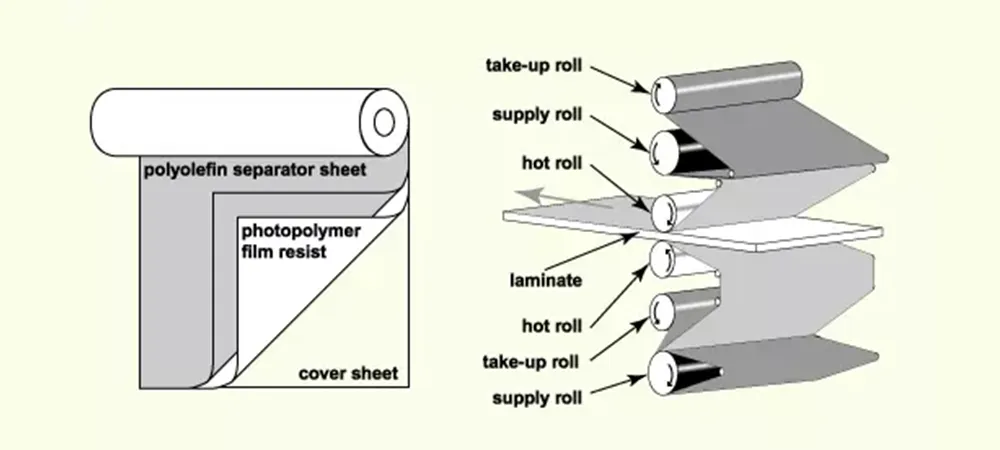
Dry Film Photoresist
Photoresist Selection Considerations
Resolution Requirements
High-density designs with fine lines and tight spacing demand positive photoresist for its superior resolution capability. Standard designs with relaxed geometries can utilize negative photoresist without compromising quality while benefiting from cost advantages.
Process Compatibility
Equipment capabilities influence photoresist selection significantly. Facilities with LDI systems can leverage the full resolution potential of advanced photoresist formulations, while conventional mask aligners may limit achievable feature sizes regardless of photoresist capability.
Thickness and Aspect Ratio
Photoresist thickness must match the intended copper weight and process requirements. Thicker photoresist supports deeper etching or plating but reduces resolution. Applications requiring high aspect ratio features need specialized formulations that maintain sidewall integrity during extended development cycles.
Cost and Throughput
Production economics factor into material selection. Dry film photoresist commands premium pricing but delivers consistent results with minimal process variability. Wet film alternatives reduce material costs but may require additional process controls to maintain equivalent yield performance.
Common Process Issues and Prevention
Exposure-Related Defects
Insufficient exposure energy produces soft, poorly defined patterns that wash away during development. Excessive exposure causes light scattering beneath mask edges, broadening features beyond design intent. Regular exposure calibration and process monitoring prevent these defects.
Adhesion Failures
Poor photoresist adhesion manifests as lifting or undercutting during development and etching. Root causes include inadequate surface preparation, contamination, or improper lamination parameters. Maintaining rigorous cleaning protocols and verifying lamination conditions eliminates most adhesion-related failures.
Conclusion
Photoresist functions as the essential pattern-transfer medium in PCB photolithography, directly governing achievable resolution, process yield, and manufacturing capability. Understanding the distinctions between positive and negative types, dry film and wet film formats, and the critical process parameters throughout the imaging sequence enables informed material selection aligned with specific production requirements. Mastery of photoresist technology remains foundational to advancing PCB fabrication performance.

Recommended Posts
How to Compare 6 Layer PCB Quotes Before Ordering
Comparing 6-layer PCB quotes is not just a matter of...
Quick-Turn 6 Layer PCB Manufacturer in China
Highleap Electronics manufactures six-layer printed...
TG150 PCB Manufacturer for Fabrication and Assembly
Highleap Electronics manufactures TG150 PCB boards to...
TG140 PCB Material Selection and Fabrication
Table of Contents TG140 PCB Materials and Selection...
How to get a quote for PCBs
Let‘s run DFM/DFA analysis for you and get back to you with a report. You can upload your files securely through our website. We require the following information in order to give you a quote:
-
- Gerber, ODB++, or .pcb, spec.
- BOM list if you require assembly
- Quantity
- Turn time
In addition to PCB manufacturing, we offer a comprehensive range of electronic services, including PCB design, PCBA, and turnkey solutions. Whether you need help with prototyping, design verification, component sourcing, or mass production, we provide end-to-end support to ensure your project’s success.
For PCBA services, please provide your BOM (Bill of Materials) and any specific assembly instructions. We also offer DFM/DFA analysis to optimize your designs for manufacturability and assembly, ensuring a smooth production process.