
High-Quality Arlon 33N PCB Manufacturing
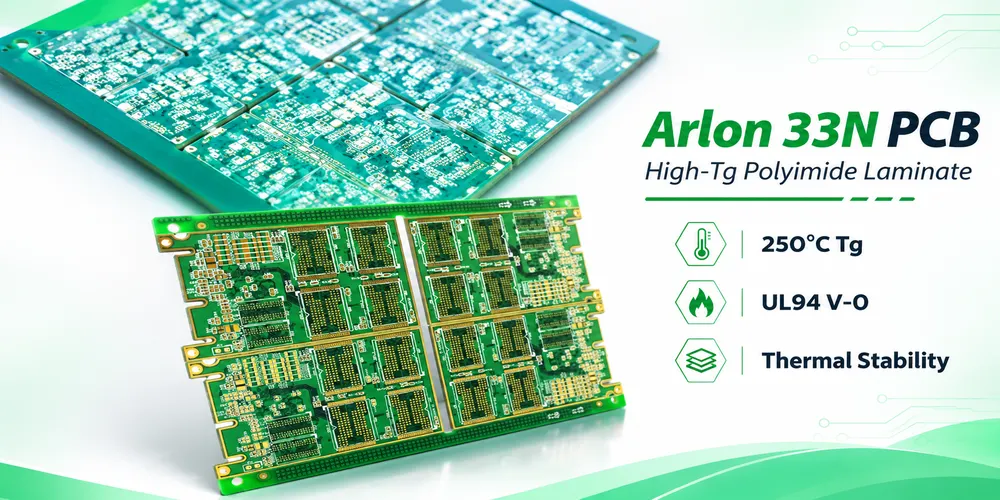
PCB manufacturing illustration. Confirm the specified Arlon material grade through the project documentation and material traceability.
An Arlon 33N PCB is usually specified because a design needs both a polyimide thermal-performance profile and a clearly defined flame-retardance requirement. The difficult part for a PCB manufacturer is not repeating the words ‘UL 94 V-0.’ It is carrying the correct material requirement from the OEM drawing into core/prepreg purchasing, lamination, drilling, plating and final evidence without treating a raw-material classification as automatic certification of the end product.
Highleap Electronics is a PCB fabrication and PCB assembly supplier. A 33N inquiry should therefore be evaluated as a build specification: which sections require the stated resin system, which documentation must accompany it, what construction is technically feasible, and what finished-board or assembled-product tests have actually been requested. An Arlon 33N PCB manufacturing enquiry should separately identify the approved laminate and prepreg, bare-board acceptance criteria and any PCB assembly documentation.
Arlon 33N PCB — At a Glance
Arlon-published material values; UL 94 classification is not an end-product approval. Confirm thickness, material traceability and the applicable documentation before release.
33N Material Identity: Why the Flame Requirement Changes the PCB Specification
Arlon lists 33N as a flame-retardant polyimide laminate and prepreg system with Tg 250°C, 5% weight-loss decomposition temperature 389°C, Z-axis expansion 1.2% from 50–260°C, and UL 94 V-0 in its product-family data. A closely related grade, 35N, is listed as V-1. This difference is not cosmetic: if an approved design explicitly requires V-0 for a nominated material, substituting a V-1 material without formal review changes the basis of the specification.
Table: swipe horizontally on narrow screens to view all columns.
| Topic | 33N published information | Why a PCB buyer should care |
|---|---|---|
| Resin family | Flame-retardant polyimide | Establishes a distinct process and material identity, not generic ‘high Tg’ |
| Tg | 250°C | Relevant to processing and elevated-temperature use; not itself a service-life rating |
| 5% weight-loss Td | 389°C | A lab decomposition measure; not a safe soldering setpoint |
| Z expansion, 50–260°C | 1.2% | One factor in plated-hole thermal loading |
| Flame classification | UL 94 V-0 | Verify the exact material, thickness and documentation relevant to the OEM’s requirement |
| Product specification family | IPC-4101 /40 and /41 | The applicable slash sheet and material callout should be unambiguous on the purchase documents |
Three different requirements that must not be confused
Material flame classification concerns the particular material and test conditions. Fabricated-board workmanship concerns dimensions, copper, plated holes, dielectric integrity and acceptance to the specified IPC requirements. Product safety approval may cover a complete electronic unit with its components, enclosure, spacing and installation conditions. Meeting one does not automatically establish the other two. An OEM that needs a particular end-product listing should identify the relevant safety construction and supporting documentation rather than assuming the laminate’s V-0 result completes the device approval.
This separation protects manufacturing decisions. It prevents a purchasing substitution made on the basis of similar Tg from invalidating a safety-critical material callout, and it avoids asking the PCB fabricator to ‘certify’ a complete product without an agreed qualification scope. At the material-selection stage, resin chemistry and specification class should be considered alongside construction and reliability, not reduced to a headline flame grade.
From the OEM Drawing to a Controlled Laminate and Prepreg Build
A useful RFQ lists 33N at the right level of detail. The manufacturing files should state whether the requirement applies to all dielectric layers or to a specified subassembly, the core and prepreg constructions if already approved, expected copper weights and pressed dielectric targets, any IPC-4101 slash-sheet requirement, and whether substitutions are prohibited or subject to approval.
Trace the material requirement from OEM release to shipment
Specify 33N, affected dielectric layers, slash sheet, V-0 requirement and substitution rules.
Connect core/prepreg identity and press history to the approved board revision.
Retain required material documents and finished-board inspection results.
Material-control points before lay-up
- Core versus prepreg: a laminate sheet and a bonding prepreg perform different functions; a single ‘Arlon 33N PCB’ note is not enough to establish every dielectric thickness in a multilayer stack-up.
- Construction and thickness: specify the dielectric build and finished-board tolerance; etched copper topography changes resin demand and the pressed result.
- Material identity and lot records: agree which supplier and shipment documents are required, especially when the OEM controls permitted materials.
- Inner-layer handling: identify the sequence for copper surface treatment, thermal conditioning and lay-up so that prepared surfaces do not sit indefinitely awaiting the press.
- Deviation approval: a different resin system, prepreg style or thickness is a change to the engineering basis of the board; the OEM must authorize changes affecting the released specification.
A credible fabrication package also maps material choices onto the stack-up, copper layout and drill structures. A six-layer circuit with conventional through-holes and a thick high-layer-count assembly board have different plating, resin and thermal concerns even when both specify 33N. The PCB stack-up becomes the controlled link between the material purchase order and the completed board.
33N Prepreg Conditioning and Lamination Cure Control
Arlon’s published starting guidance for 33N includes inner-layer preparation, pre-lay-up inner-layer baking for 60 minutes at 107–121°C, prepreg vacuum desiccation for 8–12 hours, a 30–45-minute pre-vacuum, controlled heating around 4.5–6.5°C/min in the specified 100–150°C range, and an approximately 213°C cure setting with a 90-minute hold initiated near 210°C product temperature. The supplier also describes an altered first-stage hold for sequential lamination. These are not universal factory settings; the chosen stack-up and qualified press process govern production.
Why the temperature location matters
A press platen reaching its setpoint does not show that the slowest-heating laminate section has met the required cure history. Copper distribution, lay-up thickness and press loading can alter how quickly heat reaches the product. An engineering traveler should identify how the laminate’s thermal history is controlled and how deviations are reviewed. Insufficient cure can undermine resin performance; indiscriminate over-processing can increase dimensional and stress problems. A 33N board should be accepted based on the approved construction and finished evidence, not the assertion that the furnace displayed the correct number.
Drilling, Desmear and Hole Metallization in a 33N PCB
After lamination, drilling exposes both copper and polyimide along the barrel. The supplier’s 33N product guidance gives an illustrative drilling speed of 350 surface feet per minute, with undercut-bit recommendations for small vias, and polyimide-appropriate alkaline-permanganate or plasma desmear. The correct RPM depends on bit diameter, material stack and machine constraints. Using the same numerical RPM for every tool size would not maintain the specified surface speed.
The reason for desmear is not just cleanliness. If resin obscures an inner-layer copper junction, the following metallization may fail to make a sound connection. Conversely, aggressive dielectric attack can create unwanted recession and exposed fiber or weaken the interface. A good PCB drilling and hole-wall preparation plan ties drill geometry, tooling, smear removal, copper deposition and inspection together.
Table: swipe horizontally on narrow screens to view all columns.
| Observable condition | Possible process origin | Appropriate evidence |
|---|---|---|
| Resin over inner-layer copper | Drilling smear or insufficient desmear | Cross-section through representative junction |
| Excessive recession or rough interface | Hole-wall damage or aggressive chemical treatment | Hole-wall cross-section and process review |
| Barrel copper void / thin zone | Metallization access or plating distribution | Copper-thickness and continuity evidence to drawing criteria |
| Interlaminar separation | Bond preparation, resin flow or thermal history | Relevant microsection and agreed thermal testing |
Do not set inspection solely by a generic sample count. The board’s thickest sections, smallest relevant holes, buried interfaces and high-copper locations may be the most informative areas. The actual sampling plan must follow the agreed acceptance standard and product risk.
When a 33N-to-35N Substitution Is a Real Design Change
33N and 35N are both flame-retardant polyimides and both appear in Arlon’s /40-/41 family, but the published flame classifications are not identical. The manufacturer’s current family listing identifies 33N as V-0 and 35N as V-1. It also lists different 5% decomposition values: 389°C for 33N and 407°C for 35N. A higher decomposition value does not erase the flame-class distinction, and neither value automatically determines how the finished electronics unit will behave in a safety test.
More importantly, a replacement can change material availability, specific prepreg construction, processing documents and the evidence required under the OEM’s controlled drawing. A responsible change request should identify the exact proposed material, the requirement it impacts, the revised stack-up or processing assumptions, any necessary tests and the approving design authority. An email asking for ‘equivalent polyimide’ is not sufficient to revise a safety-relevant construction.
For the assembly stage, the board’s material and traceability requirements must remain connected to the hardware revision and any controlled BOM restrictions. PCB assembly can introduce additional thermal exposure and inspection requirements, but none of those operations independently converts a V-1 laminate classification into V-0. The qualification evidence should be preserved across the handoff from fabricated PCB to populated electronic assembly.
Arlon 33N PCB Manufacturing RFQ and Acceptance Plan
The highest-value information to provide is not a long statement that the product is ‘high reliability.’ Send a complete drawing and file package and identify what is non-negotiable. An effective 33N RFQ contains: Gerber or ODB++ data; NC drills; approved layer stack-up; material and IPC slash-sheet callout; copper weight by layer; surface finish; hole sizes and tolerances; applicable IPC acceptance class; required material records; any additional heat, humidity or safety-related testing; quantities; and delivery requirements. Add BOM, placement and test instructions if assembly is requested.
Material-document and acceptance matrix
Use this matrix to make the RFQ auditable rather than turning the manufacturer’s flame classification into a vague completed-board promise.
On smaller screens, swipe the table horizontally to view all columns.
| Control point | What to state or supply | Why it matters |
|---|---|---|
| Material definition | 33N core and prepreg; affected layers; approved construction | Avoids a generic “polyimide PCB” interpretation |
| Flame requirement | Required V-0 material and applicable thickness/record | Preserves the safety-related material callout |
| IPC reference | Specific IPC-4101 slash sheet and applicable board acceptance standard | Separates raw material classification from board workmanship |
| Traceability | Lot/shipper records and certificates specifically required by OEM | Links delivered boards to purchased material |
| Change approval | Who approves resin, prepreg, thickness or flame-class changes | Prevents undocumented 33N-to-35N substitution |
| Finished evidence | Electrical tests, inspection and agreed microsection/coupon tests | Defines acceptance of the fabricated board |
Before accepting the order, the useful manufacturing conversation resolves: Which layer constructions use 33N? What material evidence must be retained? Which hole geometries and dielectric dimensions drive process risk? What checks demonstrate that the finished board—not just the purchased laminate—meets the released drawing? If the board forms part of a regulated assembly, the OEM should identify the relevant safety documentation and approval responsibilities.
Highleap’s role is to evaluate PCB fabrication and optional assembly against the submitted requirements and establish what can be sourced, built, inspected and documented for that job. This positions 33N correctly: a specified PCB construction material whose characteristics influence manufacturing, rather than a raw material Highleap claims to produce.
How to Select an Arlon 33N PCB Fabrication Supplier
The key question for an OEM searching for an Arlon 33N PCB manufacturer is whether the selected supplier can review a V-0 polyimide PCB design against a controlled material and drawing specification. Highleap Electronics provides PCB fabrication and assembly services in China; Arlon, not Highleap, manufactures the 33N laminate. Material supply, an acceptable construction and the exact manufacturing route must be confirmed for the order.
Material identity and traceability matter more than a broad high-Tg claim
An Arlon 33N polyimide PCB fabrication review should match the released stack-up to core and prepreg forms, required dielectric thicknesses and the applicable IPC-4101 callouts. If a safety or materials file names 33N or requires a particular V-0 construction, the supplier should identify any proposed deviations before the order is accepted. Request the agreed material-lot information and compliance documentation; a general statement that a factory uses high-Tg polyimide is not a substitute.
Cross-border documentation for UK and EU OEM projects
For engineering and procurement teams in the United Kingdom, France, the Netherlands or other European markets, the most useful supplier comparison is a document-based one: does the quotation reference the correct drawing revision, inspection class, material restrictions and deliverable records? An Arlon 33N PCB supplier in China should clarify the terms for approved substitutions, any first-article requirements, and what evidence is supplied with the finished boards. Country of manufacture does not replace board-specific qualification.
Send fabrication data, NC drilling information, the controlled layer stack-up, material and flame-classification requirements, copper weights, finished-board acceptance criteria and any traceability needs. For an Arlon 33N PCB assembly enquiry, specify the components, soldering conditions and product-level approvals as separate requirements. The resulting quotation should distinguish confirmed feasibility from open engineering questions.
Arlon 33N PCB — Frequently Asked Questions
Can Arlon 35N replace 33N if the drawing requires V-0?
Not as an automatic material substitution. Arlon lists 33N as V-0 and 35N as V-1 in its product-family data. If a controlled drawing names 33N or requires a particular approved construction, the OEM must evaluate any change, including flame documentation, processing and qualification.
Does a 33N laminate with UL 94 V-0 make the assembled product UL certified?
No. The laminate classification addresses a specific material and test configuration. Fabricated-board acceptance and complete equipment safety approvals have separate scopes, evidence and requirements.
What documentation should accompany a 33N PCB RFQ?
Provide the released stack-up, core/prepreg and applicable IPC-4101 calls, material substitution rules, Gerber/ODB++ or equivalent data, drill maps, copper weights, workmanship criteria and the expected material traceability records.
What should I verify when requesting Arlon 33N PCB manufacturing from a supplier in China?
Request confirmation of the actual 33N core and prepreg supply, applicable V-0 documentation, the approved stack-up, IPC and drawing requirements, plated-hole acceptance, traceability and permitted substitutions. Ask for a design-specific feasibility review; a general polyimide capability statement is not proof that the particular construction is qualified.
Have a PCB design specifying Arlon 33N? Highleap Electronics can evaluate the board files, stack-up, material requirements, manufacturing constraints and, where needed, PCB assembly scope. Include your order quantity and acceptance criteria so the quotation can address the actual construction.
Specification and test boundary: Arlon values above are published material data or illustrative supplier process guidance, not Highleap production results, a guaranteed board build capability, or a product qualification. Confirm the revision, material form, applicable IPC specification, lot availability and acceptance plan for each project.

About the Author
Sabrina
PCB Engineering Specialist at Highleap Electronics
Sabrina has over 18 years of experience in the PCB industry, with a strong background in CAM engineering and PCB file review. She supports PCB projects from prototype to volume production, focusing on manufacturability and process reliability.
Her work helps engineering teams reduce production risk and achieve stable, high-quality PCB manufacturing results.

Recommended Posts
Arlon 85HP PCB Manufacturing Services in China
PCB manufacturing illustration. Confirm the specified...
Arlon 86HP HDI PCB Manufacturing
PCB manufacturing illustration. Confirm the specified...
KB-6169GT High-Tg PCB Fabrication & Assembly
HIGHLEAP ELECTRONICS / KB-6169GT / HIGH-Tg PCB BUILDSHave...
KB-6165F PCB Manufacturing & Assembly in China
HIGHLEAP ELECTRONICS / KB-6165F / PCB FABRICATION &...
How to get a quote for PCBs
Let‘s run DFM/DFA analysis for you and get back to you with a report. You can upload your files securely through our website. We require the following information in order to give you a quote:
-
- Gerber, ODB++, or .pcb, spec.
- BOM list if you require assembly
- Quantity
- Turn time
In addition to PCB manufacturing, we offer a comprehensive range of electronic services, including PCB design, PCBA, and turnkey solutions. Whether you need help with prototyping, design verification, component sourcing, or mass production, we provide end-to-end support to ensure your project’s success.
For PCBA services, please provide your BOM (Bill of Materials) and any specific assembly instructions. We also offer DFM/DFA analysis to optimize your designs for manufacturability and assembly, ensuring a smooth production process.