
Heavy Copper PCB vs. Thick Copper Plating: Understanding the Critical Differences

Introduction
Copper thickness directly determines a PCB’s ability to handle high current loads, dissipate heat effectively, and maintain mechanical integrity under demanding conditions. As power electronics evolve toward higher density and efficiency, the choice of copper configuration becomes increasingly critical.
Two terms frequently appear in high-power PCB specifications: heavy copper PCB and thick copper plating. While both involve increased copper thickness, they represent fundamentally different approaches to circuit board design and manufacturing. Understanding these distinctions enables engineers to select the appropriate solution for specific thermal and electrical requirements without unnecessary cost or complexity.
Heavy Copper PCB and Thick Copper Plating: Definitions and Key Differences
Heavy Copper PCB: Full-Layer Thick Copper Construction
A heavy copper PCB features copper thickness of 3 oz/ft² (approximately 105 µm) or greater across entire circuit layers. This specification applies uniformly to base copper and plated-through holes, creating a continuous thick copper structure throughout the board. The copper weight designation refers to the weight of one square foot of copper foil at a specific thickness, where standard PCBs typically use 1 oz/ft² (35 µm) copper.
Manufacturing heavy copper PCB involves specialized processes to handle the increased copper mass during etching, lamination, and drilling. The result is a board structure capable of carrying significantly higher continuous current while providing enhanced mechanical strength and improved heat spreading across large areas.
Thick Copper Plating: Selective Copper Enhancement
Thick copper plating represents a localized approach where additional copper is electroplated onto specific features such as power traces, thermal vias, or high-current pads. The base PCB may use standard 1-2 oz copper, with selective areas built up through additional plating to achieve 3-5 oz or higher in critical zones.
This technique allows engineers to reinforce power delivery paths and thermal management points without the cost and complexity of full heavy copper PCB construction. The plating thickness can be precisely controlled based on current carrying requirements and thermal dissipation needs in each zone.
Comparative Overview
| Criteria | Heavy Copper PCB | Thick Copper Plating |
|---|---|---|
| Definition | Full-layer thick copper structure across all layers | Selective copper enhancement on specific features |
| Copper Thickness | ≥3 oz/ft² (105 µm) uniformly throughout | Variable thickness applied only where needed |
| Coverage | 100% of circuit layers | Targeted areas (traces, pads, vias) |
| Current Capacity | Consistent high-current handling across entire board | Enhanced capacity in specific power paths |
| Manufacturing | Specialized etching, lamination, and drilling processes | Standard PCB base with additional plating steps |
| Cost Premium | 40-80% above standard PCB | 15-30% above standard PCB |
| Typical Applications | Power converters, inverters, EV systems | Mixed-signal power supplies, RF amplifiers |
| Best For | Distributed high-current circuits (>40-50A) | Localized power paths (<30A) |
Heavy Copper PCB Manufacturing Process
Fabrication Challenges and Solutions
Heavy copper PCB manufacturing begins with thick copper foil laminated to core materials. The etching process requires modified parameters to account for increased copper volume and the characteristic sidewall angle that develops when removing thick copper. Standard etchants remove copper more slowly, and undercutting becomes more pronounced, affecting trace geometry control.
Layer-to-layer registration presents additional challenges in heavy copper PCB production. Thick copper conducts heat more efficiently, creating temperature gradients during lamination that can cause layer misalignment if not properly managed. Prepreg resin flow must be carefully controlled to ensure complete fill around thick copper features without creating voids.
Drilling and Plating Considerations
Drilling through heavy copper PCB demands specialized bits and reduced feed rates to prevent burr formation and maintain hole quality. Plating-through holes requires extended electroplating time to achieve adequate copper thickness on hole walls, ensuring reliable electrical connection between layers in the heavy copper PCB structure.

Heavy Copper PCB Manufacturing Process
Thick Copper Plating Process Characteristics
Selective Plating Methodology
Thick copper plating starts with a standard PCB base fabricated using conventional 1-2 oz copper. After initial circuit patterning, selected areas receive additional electroplating to build up copper thickness. Pattern plating techniques allow precise control over which features receive enhancement.
The electroplating process deposits copper onto exposed areas at controlled rates, typically 20-25 µm per hour. Multiple plating cycles may be required to achieve target thickness. Current distribution must be managed carefully to ensure uniform deposition across all features, particularly in high-aspect-ratio vias or narrow traces.
Surface Topology Considerations
Surface finish follows the selective plating, with the final board exhibiting visible topology where plated regions sit higher than standard copper areas. This height differential requires consideration in component placement and solder paste stencil design to ensure reliable assembly.
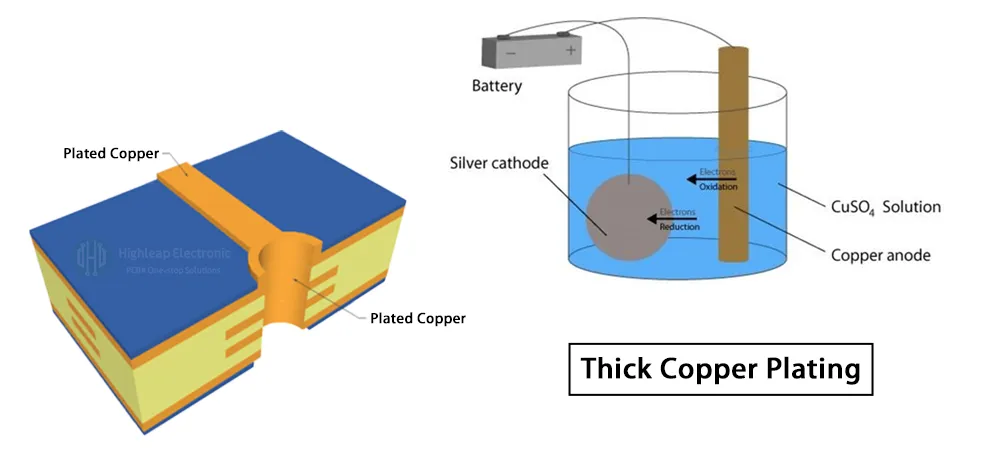
Thick Copper PLating
Heavy Copper PCB Performance and Applications
High-Current Power Systems
Power conversion systems operating above 50A continuous current benefit from heavy copper PCB construction. The uniform thick copper distribution enables efficient current spreading across multiple parallel paths, reducing hotspots and improving overall thermal performance. Industrial inverters, welding equipment power supplies, and traction inverters for electric vehicles commonly specify heavy copper PCB construction.
High-Reliability Applications
The mechanical robustness of heavy copper PCB makes it suitable for high-vibration environments:
- Enhanced barrel strength – Increased copper volume provides better anchor strength for plated-through holes, reducing barrel cracking risk.
- Thermal cycling resistance – Matched thermal expansion characteristics across all layers minimize stress at interconnection points.
- Vibration tolerance – Greater copper mass improves structural integrity under mechanical stress.
Solar inverters and wind turbine converters utilize heavy copper PCB to handle the high continuous currents inherent in renewable energy systems. The enhanced heat spreading capability allows for more compact designs by improving the board’s ability to conduct heat to mounting surfaces or integrated heat sinks.
Thick Copper Plating Use Cases
Mixed-Signal Power Electronics
Switch-mode power supplies benefit from thick copper plating on high-current traces and power device landing pads while maintaining standard copper weight for control circuitry. This selective enhancement optimizes both performance and cost. The technique proves particularly effective for current paths under 30A where full heavy copper PCB construction would be excessive.
RF and High-Frequency Applications
RF power amplifiers and high-frequency switching circuits use thick copper plating to reinforce ground planes and thermal vias without the skin-effect penalties that would come with uniformly thick copper across all layers. The ability to maintain standard copper thickness on signal layers preserves impedance control while enhancing thermal management.
Battery Management Systems
Battery management systems employ thick copper plating on current sensing traces and protection circuit paths. This approach provides the necessary current capacity for safety-critical functions while keeping overall PCB thickness and cost manageable for high-volume consumer electronics applications.

Heavy Copper PCB Fabrication
Selection Guidelines: Heavy Copper PCB vs. Thick Copper Plating
When Heavy Copper PCB Is Required
Heavy copper PCB becomes necessary when continuous current exceeds 40-50A per trace or when multiple high-current circuits populate the same board. The uniform copper distribution prevents current crowding and associated thermal issues that selective plating cannot fully address.
Applications requiring extreme reliability under thermal cycling should specify heavy copper PCB. The matched thermal expansion characteristics across all layers reduce stress at plated-through hole interfaces, a critical factor for systems experiencing wide temperature swings or high cycle counts during their operational life.
When Thick Copper Plating Suffices
Thick copper plating offers an optimal solution when high current paths are confined to specific board regions. Products with mixed analog and digital sections benefit from this approach, as standard copper weight maintains signal integrity on control circuits while plated regions handle power distribution.
Cost-sensitive designs with moderate current requirements, typically 10-30A, achieve necessary performance through thick copper plating without heavy copper PCB premiums. Consumer power supplies, LED drivers, and automotive auxiliary power modules frequently employ this strategy.
Design Decision Framework
Current density analysis should drive the decision between heavy copper PCB and thick copper plating. Calculate the required copper cross-sectional area based on operating current and acceptable temperature rise. If this analysis indicates copper thickness requirements affect more than 40% of the board area, heavy copper PCB likely provides better value despite higher initial cost.
Thermal simulation reveals whether localized copper enhancement adequately manages heat generation. Thick copper plating works well when heat sources are concentrated and thermal vias can efficiently transfer heat to external sinks. Distributed heat generation across large areas favors heavy copper PCB for its superior heat spreading capability.
Conclusion
Heavy copper PCB and thick copper plating serve distinct roles in power electronics design. Heavy copper PCB provides comprehensive high-current capacity and thermal management through uniform thick copper across all layers, suited for demanding power conversion and high-reliability applications. Thick copper plating offers economical selective enhancement of critical current paths on otherwise standard boards, ideal for mixed-signal designs and moderate power applications.
The selection depends on current distribution patterns, thermal requirements, reliability targets, and cost constraints. Engineers should analyze these factors during the schematic design phase to specify the appropriate copper configuration.
At Highleap Electronics, we deliver comprehensive solutions for high-power PCB applications:
- Heavy copper PCB fabrication – Full-layer copper thickness from 3 oz to 20 oz with precise etching control and thermal management.
- Selective thick copper plating – Targeted copper enhancement on critical power paths and thermal zones for cost-effective performance.
- Engineering support – Copper thickness specification assistance and thermal analysis to optimize your design for performance and manufacturability.
Contact our engineering team to discuss your next power electronics project and determine the optimal copper configuration for your application requirements.

Recommended Posts
How to Select Tg180 PCB Materials for Custom Boards
Choosing a Tg180 PCB involves more than selecting a...
Tg170 PCB Manufacturing and Assembly for Industrial Electronics
A Tg170 PCB may be specified for industrial electronics,...
Racing Wheel Controller PCB Manufacturing & Assembly for Force-Feedback and Direct-Drive Gaming Systems
Highleap Electronics provides PCB fabrication and PCBA for...
FR4 Dielectric Constant Calculator and PCB Design Guide
How to get a quote for PCBs Let's run DFM/DFA analysis for...
How to get a quote for PCBs
Let‘s run DFM/DFA analysis for you and get back to you with a report. You can upload your files securely through our website. We require the following information in order to give you a quote:
-
- Gerber, ODB++, or .pcb, spec.
- BOM list if you require assembly
- Quantity
- Turn time
In addition to PCB manufacturing, we offer a comprehensive range of electronic services, including PCB design, PCBA, and turnkey solutions. Whether you need help with prototyping, design verification, component sourcing, or mass production, we provide end-to-end support to ensure your project’s success.
For PCBA services, please provide your BOM (Bill of Materials) and any specific assembly instructions. We also offer DFM/DFA analysis to optimize your designs for manufacturability and assembly, ensuring a smooth production process.