
Back to blog
The Evolution and Impact of UCAVs in Modern Warfare

Unmanned Combat Aerial Vehicles (UCAVs), often referred to as combat drones, have revolutionized modern warfare. These unmanned aircraft, armed with precision-guided munitions, air-to-air missiles, and other weapons, are deployed for intelligence gathering, surveillance, reconnaissance, and targeted strikes. UCAVs offer several advantages over manned aircraft, including the ability to undertake dangerous missions without risking human lives, superior maneuverability, and extended endurance capabilities, allowing for prolonged surveillance and precise strikes.
Advantages of UCAVs
One of the primary advantages of UCAVs is their ability to operate in hostile environments without endangering pilots, making them ideal for missions in dangerous territories. Additionally, UCAVs can maneuver with greater agility and flexibility than manned aircraft, as they are not limited by the physical constraints of accommodating human pilots. This enables them to execute complex maneuvers and operate in areas where manned aircraft would be at a disadvantage.
Another significant advantage of UCAVs is their long endurance capabilities, allowing them to remain airborne for extended periods. This capability is crucial for providing persistent surveillance and the ability to strike quickly and decisively when necessary. Moreover, UCAVs can be equipped with specialized payloads tailored for specific missions, enhancing their effectiveness in intelligence gathering, surveillance, and targeted strikes.
Key UCAV Systems
Several key UCAV systems have been developed by various countries, each offering unique capabilities and features:
-
MQ-1 Predator: Developed by General Atomics, the MQ-1 Predator was one of the first UCAVs to be equipped with precision-guided munitions. It has been in service since 1995 and has been used extensively in conflicts around the world.
-
MQ-9 Reaper: Also developed by General Atomics, the MQ-9 Reaper is a larger and more capable version of the MQ-1 Predator. It is capable of carrying a larger payload of weapons and has a longer endurance, making it well-suited for long-range strike missions.
-
RQ-1 Predator: The RQ-1 Predator is an unarmed surveillance-only variant of the MQ-1 Predator. It was used primarily for reconnaissance missions and has since been retired from service.
-
X-45A: Developed by Boeing, the X-45A was a technology demonstrator for UCAV capabilities. It was designed to test autonomous flight and strike capabilities and has since been retired.
-
X-47A Pegasus: Developed by Northrop Grumman, the X-47A Pegasus was another technology demonstrator for UCAV capabilities. It was designed to test carrier-based operations and autonomous flight capabilities and has since been retired.
-
nEUROn: Developed by a multinational consortium of European countries, the nEUROn is a UCAV technology demonstrator aimed at developing advanced UCAV capabilities for European militaries.
-
Taranis: Developed by BAE Systems, Taranis is a British UCAV technology demonstrator designed to test advanced UCAV capabilities, including stealth and autonomous flight.
-
Avenger: Developed by General Atomics, the Avenger is a jet-powered UCAV designed for aircraft carrier launch and low observable capabilities. It is currently in development.
-
Skat: Developed by Russia, Skat is a UCAV prototype designed for high maneuverability and tactical strike missions. It is currently in development.
UCAVs in Modern Warfare
Unmanned Combat Aerial Vehicles (UCAVs) have emerged as pivotal assets in modern warfare, revolutionizing military strategies with their advanced capabilities. These aircraft, controlled remotely by operators on the ground, have been extensively utilized in various conflict zones, including Iraq, Afghanistan, Pakistan, Yemen, and Somalia, showcasing their effectiveness in combat operations.
One of the key roles of UCAVs is reconnaissance, where they provide real-time intelligence, surveillance, and reconnaissance (ISR) capabilities. Equipped with high-resolution cameras, sensors, and other reconnaissance equipment, UCAVs can gather crucial information about enemy positions, movements, and activities without risking the lives of human pilots.
Moreover, UCAVs are highly valued for their precision strike capabilities. Armed with precision-guided munitions, such as missiles and bombs, these aircraft can conduct targeted strikes against enemy targets with exceptional accuracy. This precision not only minimizes collateral damage but also allows military forces to eliminate high-value targets with minimal risk.
Design Considerations for UCAVs
The design of UCAVs incorporates several critical factors to ensure their performance and survivability in combat environments:
-
Airframe: UCAV airframes are designed for efficient cruise flight to achieve long loiter times. They must also be structurally strong to handle maneuvering stresses and payload weights over the full mission duration. Additionally, UCAVs may incorporate low observability features, such as radar-evading stealth shapes and non-metallic materials, to reduce their radar signature.
-
Propulsion: UCAVs are typically powered by turbofan or turboprop engines for fuel efficiency and long endurance. These engines must be reliable and capable of operating over long distances and inhospitable terrain. Additionally, UCAVs may incorporate features to reduce their infrared (IR) signature and engine noise to avoid detection.
-
Payload: UCAVs are equipped with a variety of weapons and sensors, including missiles, bombs, electro-optical sensors, infrared sensors, and synthetic aperture radar. These payloads are tailored to the mission requirements and provide UCAVs with the capability to perform a wide range of missions, including reconnaissance, surveillance, and precision strike.
-
Control Systems: UCAVs are equipped with sophisticated control systems, including autopilots, navigation systems, collision avoidance systems, target recognition systems, and health monitoring systems. These systems allow UCAVs to operate autonomously or semi-autonomously, depending on the mission requirements.
History of UCAV Development
The history of UCAVs can be traced back to the development of early target drones and remotely operated vehicles used for training and weapons testing purposes. These early experiments, which began as early as the 1930s, aimed to validate the concept of unmanned remote-controlled flight.
One of the earliest examples of a target drone was developed by the UK in 1935. These early target drones were primarily used for training purposes, allowing anti-aircraft gunners to practice their aim.
In the years following World War II, the development of target drones continued to advance. In 1946, the US Navy developed the TDN-1 assault drone, which was capable of carrying 2,000 lbs of explosives and was used for testing new anti-ship missile systems.
Ryan Firebee, a jet-powered target drone, was introduced in 1964 and entered wide use. These early target drones laid the groundwork for the development of more sophisticated unmanned aerial vehicles (UAVs) and UCAVs in the years to come.
Early UAV Experiments
In the 1960s and 1970s, several countries began experimenting with unmanned aerial vehicles for reconnaissance and surveillance purposes. The US Navy, for example, developed the QH-50C helicopter UAV, which was jet-powered and capable of carrying out a variety of missions.
Israel also pioneered the use of small UAVs for real-time surveillance after the Yom Kippur War in 1973. They were used successfully for reconnaissance and electronic warfare during the Lebanon War in 1982. These early efforts demonstrated the viability of unmanned vehicles for battlefield support roles.
Emergence of Operational UCAVs
The 1990s marked the emergence of operational UCAVs with the development of the armed Predator UAV by General Atomics. Initially designed for reconnaissance, the Predator was equipped with Hellfire missiles in 2001 for strikes in Afghanistan, marking a significant milestone in UCAV development.
Since then, various UCAV designs have emerged, alongside steadily improving technology demonstrations. These include platforms such as the MQ-9 Reaper, the X-45A and X-47A technology demonstrators, and the nEUROn and Taranis European UCAV technology demonstrators.
In recent years, major militaries have committed to UCAV acquisition and development, highlighting the growing importance of unmanned systems in modern warfare. The continuous evolution of UCAVs is driven by military interests in exploiting unmanned technologies for a wide range of missions, including intelligence, surveillance, reconnaissance, and precision strike.
For production planning, it also helps to compare this topic with RF and microwave PCB and RF PCB fabrication before finalizing the fabrication or assembly package.
UCAVs in Modern Warfare
UCAVs have proven highly effective in operational environments where adversaries have limited technological capabilities. Their ability to operate in permissive environments and conduct precision strikes with minimal risk to human pilots has made them valuable assets in modern warfare. However, UCAVs face challenges that must be addressed to enhance their effectiveness and reliability. One key challenge is their restricted situational awareness compared to manned aircraft. While equipped with advanced sensors and communication systems, UCAVs often rely on pre-programmed flight paths and human operator instructions, which can make them vulnerable to unexpected threats and limit their adaptability to changing battlefield conditions.
Another significant challenge for UCAVs is their vulnerability to signal jamming. UCAVs rely on communication links to receive instructions and transmit sensor data, but these links can be disrupted or jammed by adversaries, compromising their operational capabilities. To overcome these challenges, there is a growing trend towards increasing the autonomy of UCAVs. Advances in artificial intelligence and machine learning enable UCAVs to make more autonomous decisions, such as autonomous takeoff and landing, executing search patterns, and avoiding obstacles in flight.
Additionally, ongoing research and development efforts are focused on improving UCAV airframe designs to enhance their payloads, range, and stealth capabilities. Advances in materials science and aerodynamics are enabling the development of UCAVs with greater endurance and survivability, making them more effective in a wide range of operational scenarios. Despite these challenges, the future outlook for UCAVs is promising, with ongoing advancements in technology and operational concepts. Addressing the challenges and limitations facing UCAVs will be critical to ensuring their continued success on the battlefield.
The Role of PCBs and PCBAs in UCAV Systems
PCBs and PCBAs are integral components of UCAV systems, playing a crucial role in their functionality and reliability. These electronic circuits are used in various subsystems of UCAVs, including avionics, communication systems, control systems, and sensor arrays. The advanced electronics required for real-time data processing, communication, and control in UCAVs depend heavily on the quality and design of PCBs. High-density interconnect (HDI) PCBs, for instance, are often used to accommodate the complex circuitry in a compact space, enhancing the overall performance of the UAV. Additionally, the reliability and durability of PCBAs are vital for the harsh operational environments UCAVs encounter, ensuring sustained functionality during long missions and in extreme conditions. As the development of UCAVs continues to advance, the demand for high-quality PCBs and PCBAs tailored to specific aerospace requirements is expected to grow, highlighting the critical intersection of electronics manufacturing and aerospace innovation.

Related Articles
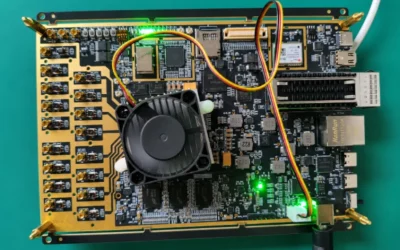
RFSoC Board PCB Manufacturing and Assembly One-Stop Service
Highleap Electronics is a PCB fabrication and PCBA factory for customer-designed RFSOC board projects with high-speed materials, 100G optical interfaces, NVMe 4.0, dense BGA routing, and RF channels.

Robot PCB Thermal Management for Motors, Power Rails and Compute
Robot PCB thermal management for heavy copper, thermal vias, heatsinks, airflow, component derating, and production reliability.
Robot PCB EMI/EMC Design for Reliable Robotics
Robot PCB EMI and EMC design for filtering, shielding, grounding, cable interfaces, layout control, and manufacturing test review.