
What is Stretchable PCB? Technology, Applications, and Implementation

Introduction: Understanding Stretchable PCB Technology
Stretchable printed circuit boards mark a major leap in electronic design, surpassing the limits of rigid and flexible PCBs. Unlike flexible boards that only bend, stretchable PCBs can expand and contract in multiple directions while maintaining electrical performance.
This property enables new applications in wearable electronics, medical devices, and automotive systems that require conformity to complex 3D surfaces. Whereas traditional PCBs crack under tension and flexible ones resist stretching, stretchable PCBs can endure elongations of 20–100% without failure—unlocking new possibilities for next-generation electronic designs.
Stretchable PCB Architecture: Core Technology Components
Material Systems for Stretchable PCB Design
Stretchable PCB performance depends on the interaction between elastic substrates and conductive materials. Elastomeric substrates such as PDMS, TPU, and silicone rubber provide flexibility with elastic moduli of 0.1–10 MPa.
Conductive pathways use materials that maintain electrical stability under strain. Liquid metal alloys like eutectic gallium–indium offer excellent stretchability and stable resistance. Conductive polymer composites with silver nanoparticles or carbon nanotubes present alternative options depending on required conductivity, stretch range, and environmental resistance.
Fabrication Methods for Stretchable PCB Manufacturing
Screen printing is the most common method for producing stretchable PCBs, balancing cost and scalability with line widths of 100–500 µm. Inkjet printing achieves finer features below 50 µm and supports rapid prototyping with minimal material waste.
For high-precision or multilayer designs, photolithography and laser ablation deliver superior accuracy but at higher cost and lower throughput.
Design Principles for Stretchable PCB Circuits
Reliable stretchable PCB design relies on managing stress during deformation. Serpentine or wavy traces distribute strain evenly and improve durability through repeated stretching.
Active components are typically mounted on low-strain “islands,” connected by stretchable interconnects designed to absorb mechanical movement. Trace geometry—including width, spacing, and curvature—must be optimized to match the intended stretch direction and magnitude.
Stretchable PCB Applications Across Industries
Wearable Technology Integration
Stretchable PCBs play a key role in next-generation wearables that require close skin contact and mechanical flexibility. Smart textiles with embedded biometric sensors use stretchable circuits that move naturally with fabric deformation, improving comfort and data accuracy.
Fitness trackers and electronic skin patches benefit from consistent sensor contact during motion, enabling continuous, multi-day health monitoring without sacrificing comfort or reliability.
Medical Device Innovation
In healthcare, stretchable PCBs must meet high standards for biocompatibility, sterilization, and long-term stability. They enhance wearable cardiac monitors by maintaining stable electrode contact, improving signal quality over rigid systems.
Applications such as smart wound dressings and implantable medical devices use stretchable circuits to match the movement of biological tissues, reducing inflammation and enhancing durability in neural or cardiac monitoring systems.
Automotive and Industrial Applications
In automotive systems, stretchable PCBs enable sensor integration into curved or soft surfaces such as steering wheels, seats, and panels—maintaining reliability under vibration, temperature shifts, and long operating lifetimes.
In industrial automation, stretchable electronics support tactile sensing and soft robotics where compliant materials are essential for safe human interaction. These circuits provide reliable electrical connectivity without restricting mechanical flexibility.
Technical Specifications of Stretchable PCB Performance
Key Performance Metrics
Stretchable PCBs typically support 20–100% elongation, with advanced materials achieving even higher strain limits. Well-designed circuits maintain less than 20% resistance variation at maximum stretch and can withstand over 10,000 stretch–release cycles.
Operating temperatures depend on substrate choice, generally ranging from –40°C to +85°C. These parameters must align with the specific mechanical and environmental demands of each application.
Reliability and Testing Considerations
Stretchable PCB reliability testing focuses on mechanical endurance and environmental resilience. Cyclic stretching tests evaluate durability under repeated deformation, while combined thermal–mechanical stress tests simulate real-world conditions.
Common failure modes involve gradual resistance increases rather than open circuits. Proper encapsulation enhances moisture and temperature resistance without reducing flexibility. Because of their unique mechanics, stretchable PCBs require specialized testing beyond conventional IPC standards.
Implementation Challenges in Stretchable PCB Development
Design Complexity Management
Stretchable PCB design demands expertise beyond conventional PCB engineering. Finite element analysis (FEA) tools are essential for predicting stress distribution and optimizing trace geometry before fabrication, minimizing costly prototyping cycles.
While some CAD platforms now support stretchable electronics, design expertise remains specialized. Component integration poses additional challenges since standard SMD parts lack flexibility. Using flexible packaging or mounting components on rigid “islands” offers practical solutions. Early collaboration with suppliers is critical due to limited component availability for stretchable applications.
Manufacturing Scalability
Scaling from prototypes to mass production requires precise process control. Screen printing remains the most scalable manufacturing method, though achieving uniform print quality across large substrates demands tight parameter management.
Automated optical inspection adapted for flexible materials ensures consistency. Yield optimization often depends on simplifying circuit layouts to accommodate manufacturing tolerances—an approach that balances cost, performance, and time-to-market efficiency.
Cost and Economic Considerations
Stretchable PCBs generally cost more than rigid boards due to specialized materials and processes. Elastomeric substrates and conductive inks can be three to ten times more expensive than standard materials, with higher processing costs in low-volume production.
However, system-level savings—such as reduced connectors, lighter assemblies, and novel form factors—can offset the premium. The value proposition is strongest when stretchable PCBs enable functions unattainable with rigid or flexible boards rather than serving as direct replacements.
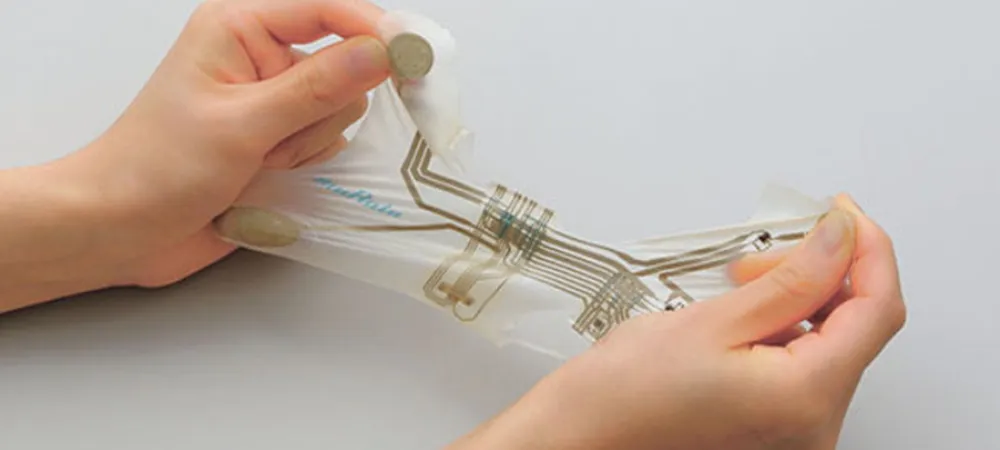
Stretchable PCBs
Stretchable PCB Compared to Alternative Technologies
Comparative Analysis
Determining when stretchable PCBs provide real advantages requires comparing them with conventional options. Rigid PCBs offer excellent electrical performance and low cost but cannot tolerate deformation. Flexible PCBs allow bending around fixed radii but resist in-plane stretching, limiting their use in fully conformable designs.
Stretchable PCBs trade some electrical performance and cost efficiency for multi-directional flexibility, making them ideal for applications demanding complex surface adaptation. The optimal choice depends on mechanical needs, electrical specifications, production scale, and cost targets. For simpler single-axis bending, flexible PCBs often remain the more practical solution.
Selection Guidelines
When deformation occurs along predictable directions, flexible PCBs generally deliver higher reliability at lower cost. Stretchable PCBs become essential for products requiring free-form flexibility or unpredictable motion.
The decision point lies in balancing mechanical performance with cost tolerance. Early prototyping and mechanical testing are critical to confirm feasibility and prevent redesigns. Comparing prototypes made from both technologies under realistic conditions provides valuable data for selecting the most effective solution.
Industry Trends in Stretchable PCB Development
Market Evolution and Technology Maturation
The stretchable electronics market is rapidly expanding as applications mature and manufacturing becomes more scalable. Healthcare and wearable devices currently lead adoption, while automotive integration is emerging as a key growth area.
Analysts project annual growth rates exceeding 20% through 2030, driven by continuous advances in materials and processing. Next-generation conductive polymers now deliver higher conductivity and stability, while liquid metal composites provide greater stretchability with lower resistance—broadening the design possibilities for stretchable PCB systems.
Emerging Capabilities and Research Directions
Self-healing materials are a promising frontier for stretchable electronics. Substrates with dynamic chemical bonds can repair mechanical damage autonomously, extending device lifetime and reliability. Although still in early research, these materials may reach commercial applications within the next five years.
Sustainability is also shaping future development. Biodegradable substrates and water-based conductive inks reduce environmental impact and align with global green manufacturing initiatives. Such innovations not only support eco-friendly production but may also lower material costs through bio-derived alternatives.
Practical Resources for Stretchable PCB Implementation
Vendor Selection and Manufacturing Partnerships
Successful stretchable PCB development depends on collaboration with experienced manufacturers. Vendor evaluation should consider material expertise, process capabilities, quality systems, and relevant project experience.
Requesting material characterization data and process capability reports provides objective benchmarks for comparison. Engaging in prototype runs before full-scale production helps validate designs and uncover manufacturing challenges early. While prototype lead times can extend several weeks, early supplier involvement ensures smoother transition to volume production.
Design Support and Engineering Resources
Modern design software increasingly supports stretchable circuit development, with some platforms offering integrated mechanical simulation to model stress and strain behavior.
Engineers can also leverage resources from industry organizations and academic research groups specializing in flexible and stretchable electronics. Technical conferences and journals provide updates on materials, fabrication methods, and design practices—helping teams accelerate adoption and reduce the learning curve in stretchable PCB design.
Conclusion: Strategic Implementation of Stretchable PCB Technology
Stretchable PCB technology has evolved from experimental research to a practical solution for electronics that must conform to complex, dynamic surfaces. It enables innovations unattainable with rigid or flexible boards alone.
Successful adoption depends on accurate mechanical evaluation, proper material selection, optimized design for manufacturability, and collaboration with experienced manufacturing partners. While costs are higher than traditional PCBs, the value lies in enabling new functionalities and next-generation product designs.
At Highleap Electronics, we provide advanced PCB manufacturing and assembly services, supporting innovative projects that demand flexibility, reliability, and precision. Our engineering team can assist in evaluating feasibility, prototyping, and optimizing stretchable PCB designs for production. Contact Highleap Electronics to explore how stretchable PCB technology can bring your next-generation product concepts to life.

Recommended Posts
Hard Gold Finger PCB Manufacturing: Plating and Beveling
Hard gold finger PCB manufacturing is used when a circuit...
Small PCB Panelization: Array Design and Depaneling
Imagine a 26 × 18 mm circuit that must pass through...
PCB Panelization for Volume Production: Cost and Yield
A fabrication panel that holds more boards is not...
PCB SET Delivery and Panelization: Quantities and Acceptance
A purchase order for “500 SET” looks straightforward until...
How to get a quote for PCBs
Let‘s run DFM/DFA analysis for you and get back to you with a report. You can upload your files securely through our website. We require the following information in order to give you a quote:
-
- Gerber, ODB++, or .pcb, spec.
- BOM list if you require assembly
- Quantity
- Turn time
In addition to PCB manufacturing, we offer a comprehensive range of electronic services, including PCB design, PCBA, and turnkey solutions. Whether you need help with prototyping, design verification, component sourcing, or mass production, we provide end-to-end support to ensure your project’s success.
For PCBA services, please provide your BOM (Bill of Materials) and any specific assembly instructions. We also offer DFM/DFA analysis to optimize your designs for manufacturability and assembly, ensuring a smooth production process.