
5G HDI PCB Design and Material Guide | Highleap Electronics

Introduction
The deployment of fifth-generation wireless networks has fundamentally transformed printed circuit board design requirements. As 5G systems operate across increasingly complex frequency spectra from sub-6GHz to millimeter-wave bands, the demand for advanced interconnect solutions has intensified. 5G HDI PCB technology addresses these challenges through high-density integration, precise impedance control, and optimized signal routing architectures that conventional multilayer boards cannot achieve.
High-density interconnect printed circuit boards enable the miniaturization and performance enhancement essential for modern RF modules. Through microvias, fine-pitch traces, and sophisticated layer stackups, 5G HDI PCB designs support the stringent electrical characteristics required for gigabit-speed data transmission while maintaining signal integrity across multiple frequency domains.
Why 5G RF Modules Require HDI PCB Technology
Frequency Spectrum Challenges
Fifth-generation wireless systems operate across diverse frequency bands spanning from sub-6GHz to millimeter-wave ranges at 28GHz and 39GHz. Each frequency band presents distinct electrical requirements that directly impact PCB design parameters. High-frequency signals demonstrate extreme sensitivity to trace geometry, dielectric properties, and interconnect structures, making conventional PCB technology inadequate for advanced RF applications.
Traditional PCB Limitations
Standard multilayer boards encounter significant performance barriers in high-frequency environments. Through-hole vias introduce parasitic inductance and capacitance that distort signal waveforms and generate impedance discontinuities. Limited routing density restricts component placement options, forcing longer signal paths that increase insertion loss and electromagnetic interference.
HDI Technology Advantages
High-density interconnect architecture overcomes these limitations through laser-drilled microvias that minimize parasitic effects while enabling shorter signal paths. RF HDI design incorporates advanced structures that achieve routing densities impossible with mechanical drilling:
- Via-in-pad placement – Eliminates stub resonances and enables direct component mounting over interconnects.
- Fine-line capability – Trace widths down to 50-75 microns support precise impedance control with reduced crosstalk.
- Sequential lamination – Enables any-layer connections while maintaining signal integrity across the entire frequency spectrum.
Material Selection for 5G HDI PCB Performance
Dielectric Performance Requirements
Material selection directly determines signal quality in high-frequency applications. Low dielectric constant (Dk) and low dissipation factor (Df) characteristics minimize signal attenuation and phase distortion across RF frequency bands. Stable electrical properties across temperature variations ensure consistent performance in demanding operational environments where 5G HDI PCB assemblies must maintain precise specifications.
High-Frequency Laminate Options
Advanced RF applications demand specialized substrate materials beyond standard FR-4. a specialty low-loss laminate and a specialty low-loss laminate laminates provide Dk values between 3.38 and 3.48 with exceptionally low loss tangent characteristics suitable for microwave frequencies. Panasonic Megtron 6 offers an effective balance between performance and manufacturability for sub-6GHz applications, while PTFE-based materials like Taconic RF-35 deliver superior electrical performance at millimeter-wave frequencies.
Material Performance Trade-offs
Standard FR-4 substrates prove cost-effective but exhibit significant dielectric losses above 2GHz, making them unsuitable for demanding 5G applications. High-frequency laminates substantially improve electrical performance while introducing manufacturing considerations including higher material costs and specialized processing requirements. Coefficient of thermal expansion matching between different material layers becomes critical in maintaining reliability across temperature cycling, particularly in multi-material HDI PCB constructions.

5G HDI PCB Stackup Design for Signal Integrity
Core Stackup Architectures
Effective stackup implementations for 5G HDI PCB typically follow 1+n+1 or 2+n+2 configurations, where high-density interconnect layers on outer surfaces connect to conventional core structures. Any-layer HDI designs enable direct connections between non-adjacent layers, reducing via counts and minimizing signal path lengths. This approach proves particularly valuable in complex RF modules where multiple impedance-controlled signal layers must coexist with power distribution networks.
Reference Plane Configuration
Solid reference planes positioned adjacent to signal layers provide controlled impedance environments and minimize electromagnetic interference. Symmetrical power and ground layer placement creates balanced stackups that reduce warpage during thermal processing. Strategic via placement connects reference planes at regular intervals, maintaining low-inductance return paths critical for high-frequency signal integrity.
Microvia Implementation Strategy
Via-in-pad technology eliminates stub lengths that cause signal reflections, particularly important above 10GHz where quarter-wavelength stubs create resonances. Buried and blind microvias enable dense component placement while preserving routing channels for controlled impedance traces. These structures require filled and planarized vias to ensure reliable component attachment, delivering essential performance benefits for millimeter-wave designs.
Dielectric Thickness Control
Layer-to-layer spacing directly determines characteristic impedance for microstrip and stripline geometries. Tolerance control becomes increasingly critical at higher frequencies where small dimensional variations significantly impact electrical performance. Precise control of core and prepreg thicknesses ensures HDI PCB for 5G designs meet target impedance specifications across the entire board area.
RF HDI PCB Layout Design Considerations
High-Frequency Transmission Lines
Microstrip and stripline routing configurations form the foundation of RF HDI design for controlled impedance signal paths. Microstrip traces on outer layers provide easy access for tuning and measurement but exhibit greater electromagnetic radiation. Stripline routing between reference planes offers superior isolation and reduced emissions, essential for sensitive RF circuits requiring precise impedance matching.
Signal Isolation Techniques
Via fencing creates electromagnetic barriers that prevent coupling between sensitive RF circuits and digital logic sections. Ground via arrays surrounding high-frequency traces confine electromagnetic fields and reduce crosstalk between parallel signal paths. Strategic component placement separates high-power transmit sections from sensitive receiver circuitry, minimizing interference through proper signal isolation implementation.
Simulation-Driven Verification
Electromagnetic field solvers enable pre-layout verification of impedance profiles, S-parameters, and coupling mechanisms in complex routing configurations. Power integrity analysis identifies resonances and insufficient decoupling before prototype fabrication. Time-domain reflectometry simulation reveals impedance discontinuities at via transitions, component pads, and connector interfaces, proving essential for first-pass success in millimeter-wave 5G HDI PCB designs.
Thermal and EMI Management
High-power RF amplifiers generate substantial heat requiring thermal vias connecting to internal ground planes or dedicated heat-spreading layers. Shield compartments or conductive gaskets contain electromagnetic emissions from transmitter sections while preventing external interference from disrupting receiver sensitivity. Proper grounding strategies and shield effectiveness directly impact system-level EMI compliance and operational performance.

Manufacturing Challenges in 5G HDI PCB Production
Microvia Reliability
Laser drilling technology creates small-diameter holes essential for high-density interconnect structures, typically ranging from 75 to 150 microns. Copper plating uniformity within these microvias directly affects electrical conductivity and mechanical reliability:
- Plasma desmear treatment – Removes resin smear and activates hole walls for reliable copper adhesion.
- Electroless copper seed – Provides uniform conductive layer prior to panel plating operations.
- Aspect ratio control – Sequential build-up enables reliable plating in high aspect ratio structures.
High-Frequency Material Processing
PTFE-based laminates present unique manufacturing challenges compared to traditional epoxy-glass substrates. Lower glass transition temperatures restrict processing temperature windows during lamination cycles. Material surface preparation requires specialized treatments to achieve adequate copper adhesion, while layer registration accuracy becomes more demanding with mixed dielectric stackups combining FR-4 cores with high-frequency surface layers.
Surface Treatment Selection
Surface finish selection must balance electrical performance requirements against assembly process compatibility. Electroless nickel immersion gold (ENIG) provides reliable solderable surfaces but introduces small losses in high-frequency applications. Electroless nickel electroless palladium immersion gold (ENEPIG) offers improved wire bonding characteristics essential for RF module assembly, while immersion silver delivers excellent electrical properties with minimal signal degradation for 5G HDI PCB applications.
Typical Applications of 5G HDI PCB Technology
Base Station Infrastructure
Massive MIMO base stations incorporate arrays of transmit and receive chains, each requiring precise phase relationships maintained through controlled impedance routing. Power amplifier modules demand designs capable of handling high current levels while dissipating substantial thermal loads. Baseband processing boards integrate high-speed digital interfaces with RF front-end circuitry, necessitating careful partitioning within unified 5G HDI PCB stackups.
Antenna Integration Modules
Antenna-in-Package (AiP) architectures achieve extreme miniaturization by integrating radiating elements directly with RF transceiver die on advanced substrate technologies. Smart antenna arrays for beamforming applications require tight mechanical tolerances to maintain element spacing accuracy across millimeter-wave frequency bands. These mmWave PCB designs involve complex feed networks with precisely controlled phase velocities and minimal amplitude imbalance.
Automotive and IoT Applications
Automotive radar systems operating at 77-81GHz demand similar high-frequency design approaches as 5G infrastructure within more stringent automotive qualification requirements. Vehicle-to-everything communication modules integrate multiple wireless protocols on compact form factors where HDI technology enables the required routing density. Industrial IoT gateways consolidate cellular, WiFi, and proprietary wireless interfaces, benefiting from 5G RF module PCB capabilities.

Future Trends in 5G HDI PCB Development
Advanced Interconnect Evolution
Any-layer HDI constructions enable direct connections between arbitrary layer pairs, eliminating the layer-to-layer stepping limitations of conventional sequential build-up processes. Substrate-like PCB technology reduces feature sizes below 25-micron line widths, approaching semiconductor redistribution layer capabilities. These architectures support increasingly complex RF front-end integration as channel counts multiply in advanced 5G systems.
Hybrid Material Integration
Mixed dielectric constructions combine high-frequency laminates in RF sections with cost-effective FR-4 materials in digital processing areas. Heterogeneous integration approaches embed active die directly into PCB substrates, minimizing interconnect parasitics for critical RF functions. Advanced lamination techniques enable reliable bonding between dissimilar materials while maintaining registration accuracy essential for 5G HDI PCB performance specifications.
Next-Generation Requirements
The evolution toward 5G-Advanced and preliminary 6G research targets frequencies extending beyond 100GHz, demanding even tighter loss budgets and smaller feature sizes. Ultra-low-loss materials with dissipation factors below 0.001 become necessary as signal bandwidths expand and channel counts increase. Higher layer counts with 20-plus layers incorporating multiple HDI regions will support the integration density required for next-generation wireless infrastructure.
Conclusion
High-density interconnect technology provides the essential foundation for 5G and RF module performance through specialized material selection, optimized stackup architectures, and precision manufacturing processes. The progression from conventional multilayer boards to advanced 5G HDI PCB constructions addresses fundamental challenges in high-frequency signal propagation, enabling the miniaturization and integration density demanded by modern wireless systems operating from sub-6GHz through millimeter-wave frequency ranges.
Highleap Electronics delivers comprehensive HDI PCB solutions specifically engineered for 5G and RF applications:
- Advanced material procurement – specialty low-loss laminate, Megtron, and PTFE laminates with verified dielectric properties for high-frequency performance.
- Precision manufacturing capabilities – Laser-drilled microvias from 75 microns, fine-line routing to 50 microns, and controlled impedance tolerance within ±5%.
- Design for manufacturability support – Stackup optimization, signal integrity consultation, and pre-production DFM review to ensure first-pass success.
- Full turnkey assembly services – Component sourcing, SMT placement, RF testing, and functional validation for complete module production.

Recommended Posts
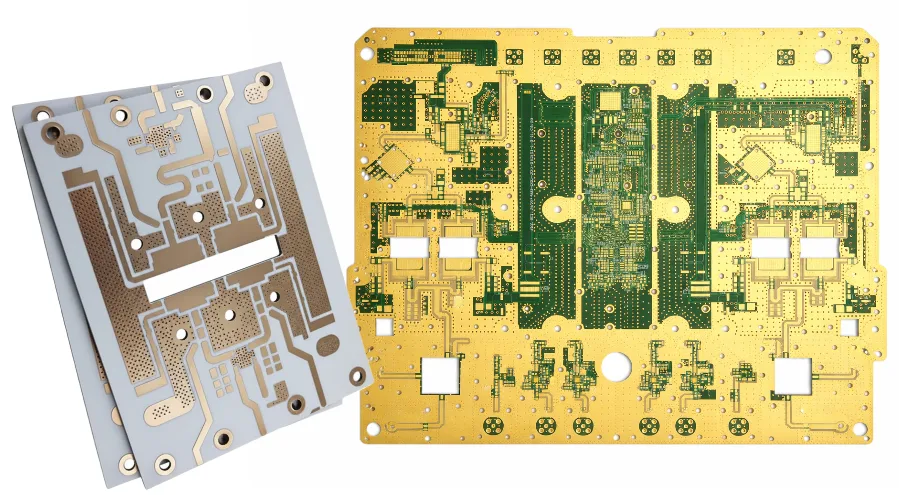
PCB Materials Database: Laminate Grades & Properties
How to get a quote for PCBs Let‘s run DFM/DFA analysis for...
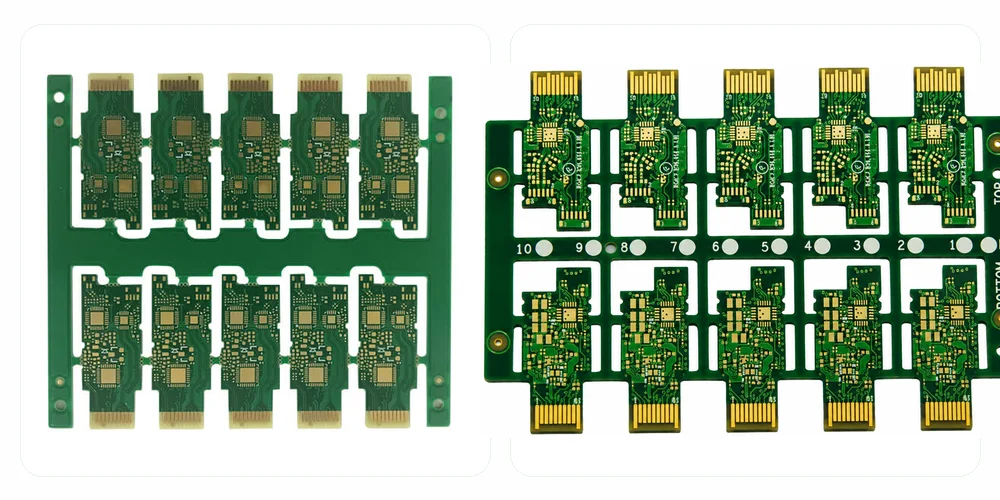
Optical Transceiver PCB Manufacturer for Custom Pluggable Modules
Highleap Electronics manufactures and assembles custom...
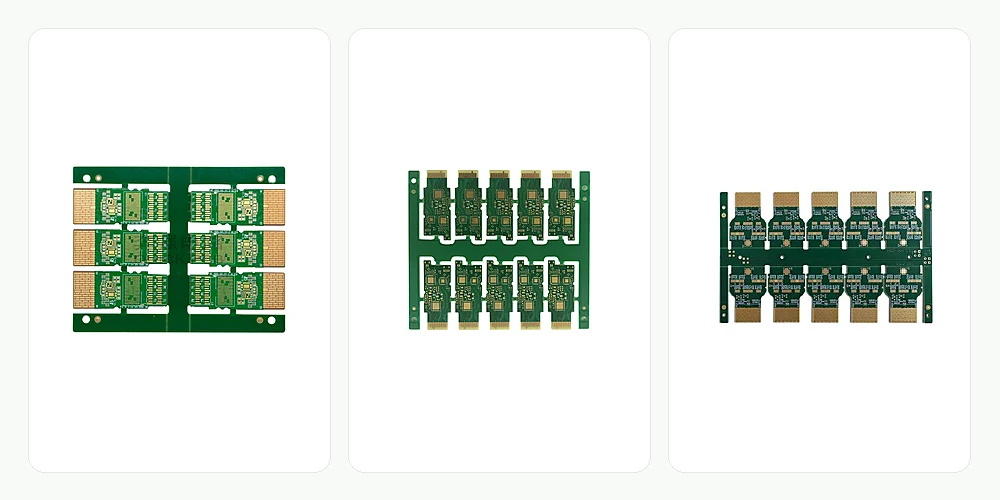
Optical Module PCB Manufacturer for 400G, 800G and 1.6T Programs
Highleap Electronics provides optical module PCB...
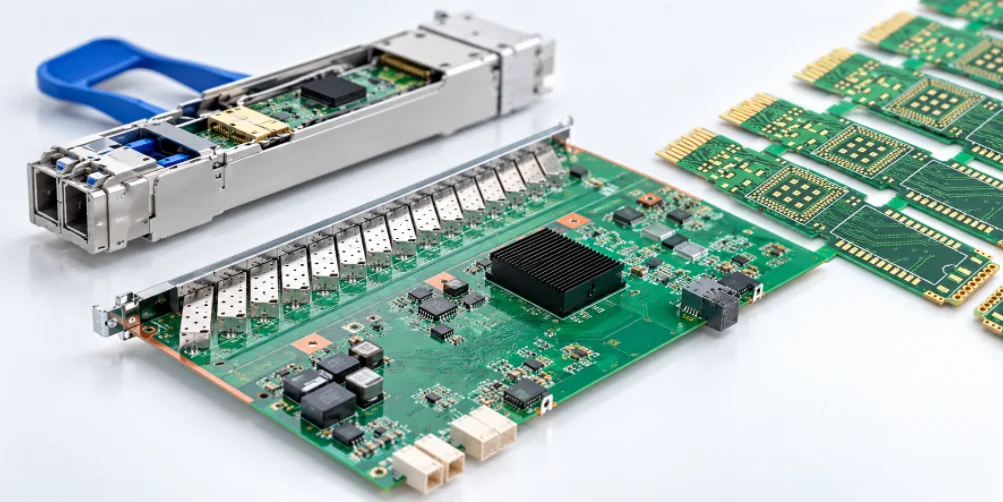
Optical Communication PCB Manufacturer for Fiber Network Equipment
Highleap Electronics manufactures and assembles optical...
How to get a quote for PCBs
Let‘s run DFM/DFA analysis for you and get back to you with a report. You can upload your files securely through our website. We require the following information in order to give you a quote:
-
- Gerber, ODB++, or .pcb, spec.
- BOM list if you require assembly
- Quantity
- Turn time
In addition to PCB manufacturing, we offer a comprehensive range of electronic services, including PCB design, PCBA, and turnkey solutions. Whether you need help with prototyping, design verification, component sourcing, or mass production, we provide end-to-end support to ensure your project’s success.
For PCBA services, please provide your BOM (Bill of Materials) and any specific assembly instructions. We also offer DFM/DFA analysis to optimize your designs for manufacturability and assembly, ensuring a smooth production process.