
Card Printer PCB Manufacturing for Direct-to-Card, Retransfer and Encoding Systems
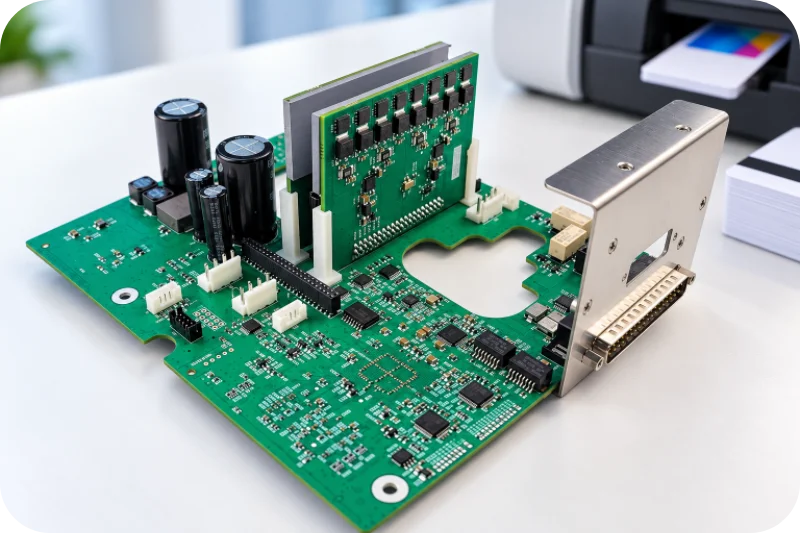

Highleap Electronics manufactures customer-designed card printer controller PCBs and PCBAs through its electronic manufacturing services, including component sourcing, mixed SMT/through-hole assembly, inspection, programming and customer-defined functional testing. Secure credential data, color management, encoding keys and final issuance policy should remain under the OEM or system integrator’s controlled workflow unless a separate secure manufacturing process is defined.
Decide Direct-to-Card Versus Retransfer Before Freezing the Electronics
A card printer PCB can support very different print engines. Direct-to-card systems place dye or resin from a ribbon directly onto the card surface, while retransfer systems first print to an intermediate film and then transfer the image to the card. The second architecture adds film transport, more heating/mechanical stages and a different sensor/thermal load.
| Architecture | Controller implication | Typical product reason |
|---|---|---|
| Direct-to-card | Ribbon control, card transport, head/platen pressure, optional flipper | Compact and fast credential printing |
| Retransfer | Ribbon + transfer film + heated transfer process + more sensors | Edge-to-edge quality and broader card-surface tolerance |
| Dual-sided | Card flipper/turn path | More motion states and jam recovery |
| Lamination | Heater/laminate motion and interlocks | Durability/security overlay |
| Encoding options | Magstripe/contact/contactless/UHF modules | Credential personalization beyond printed image |
Treat the Card Transport Path as a Positioning System, Not a Paper Feed
CR80 cards are rigid and must arrive at printing, flipping, encoding and output stations at repeatable positions. Roller diameter, motor microstepping, card thickness and sensor latency affect image registration and encoder alignment. The PCB therefore needs reliable motor-driver circuitry, card-present sensing and deterministic recovery when a card stalls between stations.
- Map every card sensor to a physical station and document the expected state sequence.
- Set current limits for pickup, transport and flipper motors based on the released mechanics.
- Define jam recovery so a card is not unexpectedly printed or encoded twice.
- Support reject-bin logic if failed personalization should be physically separated.
- Retain serial/job data needed to reconcile a rejected credential with the host system.
Drive Dye-Sublimation and Resin Panels with Controlled Thermal Energy
Color card printers often process a ribbon as a sequence of panels such as Y, M, C, K and overlay. The controller must synchronize ribbon-panel detection, card position and printhead heating. A wrong panel offset is not a cosmetic nuisance—it can make a credential unusable. The head-driver stage shares power and temperature-control requirements with thermal printer PCB assemblies, while ribbon-panel timing and card positioning follow the specific card-printing mechanism.
| Control point | Failure if unstable | PCB/firmware consideration |
|---|---|---|
| Ribbon panel detection | Wrong color/overlay alignment | Optical sensor threshold and calibration |
| Head energy | Color density or resin adhesion changes | Supply stability, thermistor and pulse table |
| Card velocity | Color planes misregister | Motor current and timing |
| Head lift/pressure state | Smearing or mechanical damage | Actuator/sensor interlock |
Integrate Magnetic Stripe, Contact and Contactless Encoding as Credential Subsystems
Card printers can personalize magnetic stripes, ISO 7816 contact chips and 13.56 MHz contactless credentials. These functions should be designed as independent stations with clear electrical and software boundaries. Commercial printers may also support secure-access modules or UHF RFID in specialized configurations.
- Magstripe: control head interface, card speed and track orientation for the released mechanical station.
- Contact smart card: sequence card position, contact landing and reader power so the chip is not damaged.
- Contactless: preserve antenna tuning and metal clearances; keep noisy motor/head switching from degrading RF performance.
- Use host-to-printer job state so print and encode results stay associated with the same physical card.
- Treat encoding keys and security policy as separate from ordinary PCBA programming.
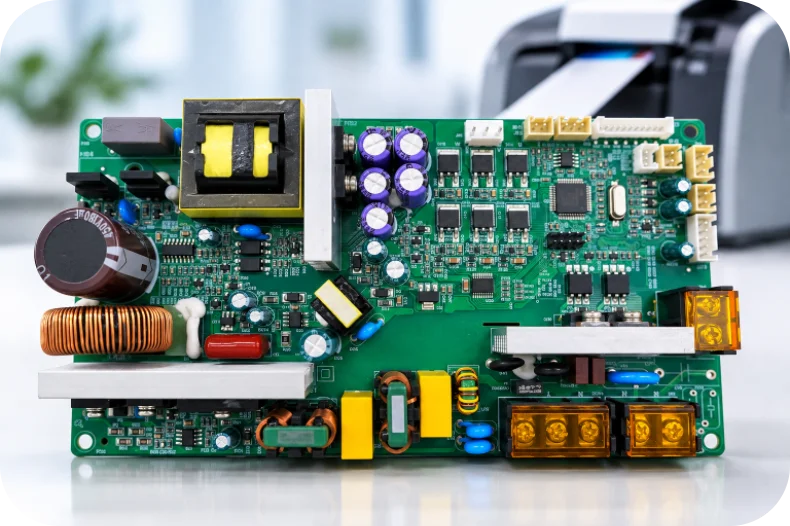
Security Architecture Changes the Manufacturing Process
Credential printers can handle names, photos, account identifiers and access-control data. Modern commercial platforms may use printer-host authentication and encrypted data transport. Even if the OEM software implements the policy, the manufacturing flow may still need secure boot configuration, unique device identity or protected key injection.
| Production asset | Manufacturing question | Control |
|---|---|---|
| Device serial/MAC | Is identity globally unique? | Serialized programming record |
| Secure boot/key material | Who owns and injects it? | Restricted station and audit trail |
| Firmware image | Which SKU/options does it enable? | Hash/version control |
| Encoder security module | Is personalization allowed at factory? | Explicit custody and authorization process |
Highleap Electronics • PCB Manufacturing & PCBA
Manufacturing Review for Card Printer Controller PCB
Send the print-engine architecture, card path, ribbon/film/head data, motor and sensor map, encoder options, security-provisioning boundary, PCB files and test-card flow. Highleap can review option and production risks before NPI.
Use Variant Control for Flippers, Laminators and Encoder Options
Card-printer families often share a core controller while adding dual-sided printing, laminators, larger hoppers or credential encoders. That creates a high risk of “electrically similar but functionally wrong” assemblies. The released BOM, firmware and final label should be tied together.
- Assign an option code that is readable by both production and service tools.
- Use connector keying and mechanical presence detection where practical.
- Keep spare/unpopulated interfaces electrically safe when an option is absent.
- Run at least a presence/communication check for every populated encoder module.
- Avoid field-installing high-power options unless the original board and supply were qualified for them.
Pilot Production Should Prove Job Integrity from Blank Card to Finished Credential
A card printer is a personalization machine, so NPI should validate the whole job sequence. A good DVT/PVT test uses known cards and test data, then verifies print, flip, encode and reject behavior under controlled conditions. Earlier PCBA functional testing can screen motor drivers, card sensors and specified I/O before the full printing sequence is evaluated.
| Pilot sequence | What to verify | Evidence |
|---|---|---|
| Single-sided color | Ribbon panel sync and image registration | Reference card and print log |
| Dual-sided | Flipper positioning and second-side registration | Front/back alignment sample |
| Encode + print | Correct physical card receives correct test credential | Job/serial record |
| Forced encode failure | Reject path and host status | Error/reject trace |
| Long batch | Motor/driver/head thermal stability | Temperature/current/yield log |
PCBA Inspection and FCT Should Separate Electronics Quality from Card-Personalization Quality
Highleap can manufacture the customer-designed electronics with controlled sourcing, PCB assembly, AOI/X-ray where appropriate, programming and functional fixtures. PCBA FCT should prove motors, sensors, head interface and option-module communication. The OEM’s final card-color calibration, credential keys and application workflow can then remain in a controlled system-level process.
- Run motor/sensor station checks before consuming real ribbon and cards where possible.
- Use test cards/ribbons for print-path validation without exposing production credential data.
- Verify Ethernet/USB/Wi-Fi option identity and device serial programming.
- Record fitted encoder and laminator option codes in the manufacturing log.
Design Power and Thermal Margin for Retransfer and Lamination Options Separately
Retransfer and lamination can add heat sources and motor loads that do not exist in a basic direct-to-card model. A shared controller family should not assume that the power supply, connectors and thermal design qualified for the base printer automatically cover a laminator or transfer heater. Option current and heat should be modeled as separate states.
- Measure simultaneous print, transport and heater loads under the highest-throughput approved job.
- Check connector and harness temperature where optional modules draw power through the main controller.
- Use interlocks so a heater cannot energize without the expected film/card state.
- Define overtemperature and sensor-fault behavior for each heated station.
- Qualify airflow/fan behavior if the enclosure thermal design changes between printer variants.
For modular products, it can be safer to give the laminator or transfer section its own controlled power/logic interface rather than extending a base board with undocumented spare outputs.
Make Rework and Failure Analysis Compatible with Secure Credential Products
Card-printer boards may be returned from systems that handle sensitive credentials. Production and repair flows should distinguish ordinary electronics from security assets. A board that is electrically repairable may still require secure erasure or controlled replacement if it contains device keys or audit data.
| Returned asset | Question before rework | Possible control |
|---|---|---|
| Main controller | Does flash contain protected identity/keys? | Secure erase or restricted repair |
| Encoder module | Contains SAM or credential material? | Customer-controlled custody |
| Network module | Unique certificate/identity? | Preserve/reissue through approved process |
| Failed card/job logs | Any real cardholder data? | Data-minimizing diagnostics |
These controls are not required for every printer, but they should be decided explicitly for secure credential products rather than discovered after field returns begin.
Qualify Card and Ribbon Variability Without Hiding Electronics Margin
Card printers interact with consumables that have real electrical and mechanical consequences. Card thickness, flatness and surface finish affect transport and head pressure; ribbon lot and panel sensing affect registration; retransfer film and laminate change tension and heat transfer. A controller that works only with one hand-selected consumable lot has insufficient margin for production.
- Run transport and registration across the approved card-thickness range.
- Use at least low/high friction or warp examples when the product specification allows them.
- Check ribbon-panel sensor margin across approved ribbon lots and near end-of-roll conditions.
- For retransfer/lamination, validate heater control with the thinnest/thickest approved film stack.
- Record which consumable SKU was used for DVT/PVT so later print-quality changes can be traced.
The OEM owns consumable qualification, but the PCB/PCBA manufacturing test should not mask weak electronics by using unusually easy cards or ribbons. A released golden consumable set should represent normal production material and be periodically checked against field-approved supplies.
RFQ Data for Card Printer PCB and PCBA Production
Because this category includes both simple direct-to-card models and complex secure credential systems, the RFQ should identify architecture and options explicitly.
| RFQ input | Information to provide | Production impact |
|---|---|---|
| Print engine | Direct-to-card/retransfer, head, ribbon/film system | Defines thermal/motion electronics |
| Card path | Hoppers, flipper, reject path, card thickness range | Defines sensors and motor test |
| Encoding | Magstripe/contact/contactless/UHF/SAM options | Defines RF/security/SKU control |
| Security | Secure boot, identity, key ownership, programming limits | Defines controlled provisioning |
| Acceptance | Test-card sequence, registration, option/FCT checks | Defines pilot and production test |

Recommended Posts
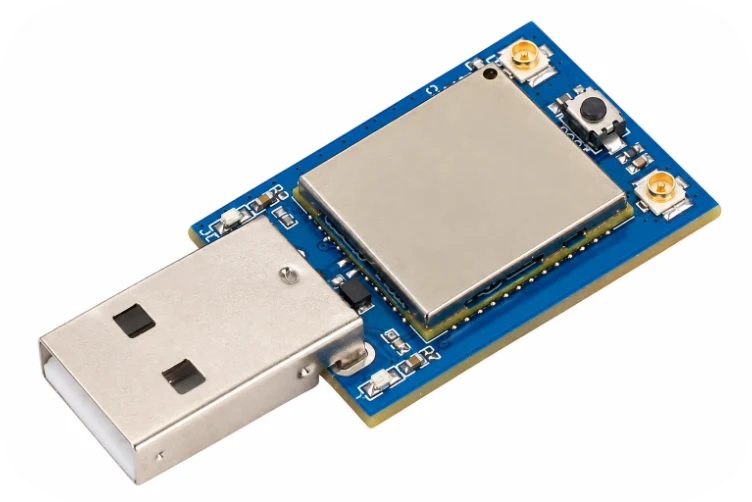
USB Modem PCB Manufacturing & PCBA for LTE/5G Dongles and Data Adapters
USB Modem PCB fabrication and assembly involves a compact...
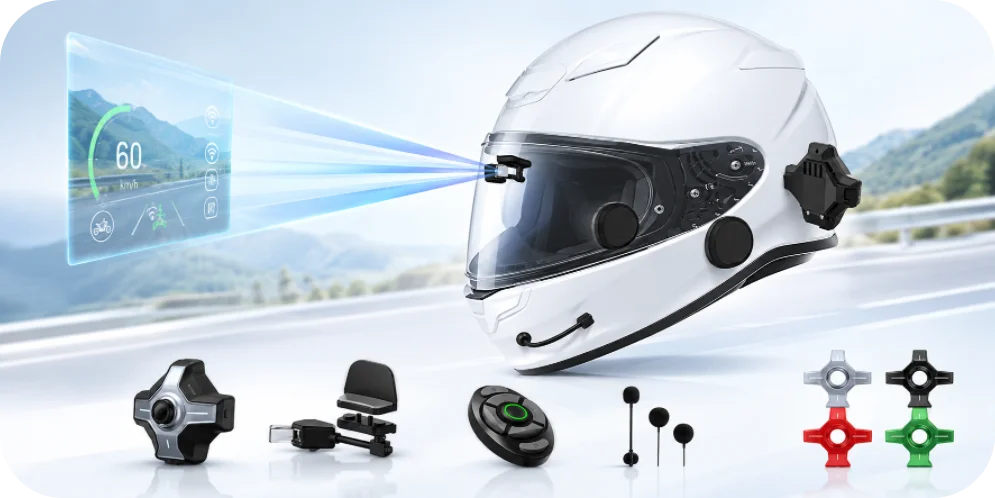
Custom Smart Motorcycle Helmet PCB for Connected Riding
A smart motorcycle helmet may combine an intercom,...
Wearable Haptic Vest PCB Manufacturing & Assembly for Multi-Zone Haptic OEMs
In a wearable haptic vest, the wearer notices the...
Wearable Temperature Logger PCB Manufacturing & Assembly for BLE Sensor OEMs
A wearable temperature logger PCB is the electronic board...
How to get a quote for PCBs
Let’s run DFM/DFA analysis for you and get back to you with a report. You can upload your files securely through our website. We require the following information in order to give you a quote:
-
- Gerber, ODB++, or .pcb, spec.
- BOM list if you require assembly
- Quantity
- Turn time
For PCBA services, please provide your BOM (Bill of Materials) and any specific assembly instructions. We also offer DFM/DFA analysis to optimize your designs for manufacturability and assembly, ensuring a smooth production process.