
How to Choose Between Different Actuator Types

Figure 1. Actuator Types
Actuators are the muscle of every machine — they convert energy into controlled motion. But every actuator type imposes different electrical demands on the circuit that drives it. This guide covers all major actuator types from first principles, their selection logic, and the PCB design requirements each one creates.
Table of Contents
- How Actuators Are Classified: Motion Type and Energy Source
- Electric Actuator Types: Brushed DC, BLDC, Stepper, Servo, Linear and Piezoelectric
- Hydraulic and Pneumatic Actuators: Force, Speed and Control
- Specialty Actuators: Solenoid, SMA, Thermal and Soft
- Actuator Types in Robotics: Industrial Arms, Cobots, Legged Robots and Humanoids
- How Actuator Type Drives PCB Design: Power, Thermal and Protection
- Actuator Selection Framework and Quick-Reference Guide
Highleap Electronics manufactures and assembles the PCBs that control actuators across industrial automation, robotics, medical devices, and aerospace. This guide is written from that vantage point: not just what each actuator type is, but what it demands from its driver electronics — and why those demands shape every layer count, trace width, and protection circuit decision we make.
1. How Actuators Are Classified: Motion Type and Energy Source
An actuator is any device that converts an input energy into controlled mechanical motion. Classification runs along two independent axes that must both be specified to define an actuator precisely.
Motion type describes the geometric output: linear actuators produce straight-line displacement (push/pull/lift); rotary actuators produce angular rotation (torque around an axis); and multi-axis or combined actuators — such as voice coil actuators and Stewart platform stages — produce motion in more than one geometric dimension simultaneously.
Energy source determines power density, controllability, infrastructure requirements, and the nature of the electronic interface.
| Energy Source | Power Density | Precision | Infrastructure Needed | Typical Force Range |
|---|---|---|---|---|
| Electric | Medium | Excellent | Power supply + driver PCB | mN – tens of kN |
| Hydraulic | Very high | Good (with servo valve) | Pump, reservoir, seals, valves | kN – MN |
| Pneumatic | Medium-high | Moderate | Compressor, distribution, valves | N – tens of kN |
| Piezoelectric | Very high (short stroke) | Nanometre-level | High-voltage amplifier PCB | N – kN |
| Thermal / SMA | Low | Limited | Heater or current driver | µN – N |
The intersection of motion type and energy source defines the actuator. A hydraulic rotary actuator and an electric linear actuator are fundamentally different devices requiring different control electronics, different failure-mode analysis, and different PCB architecture — yet both fall under the single label of “actuator.” The sections below unpack each category technically.
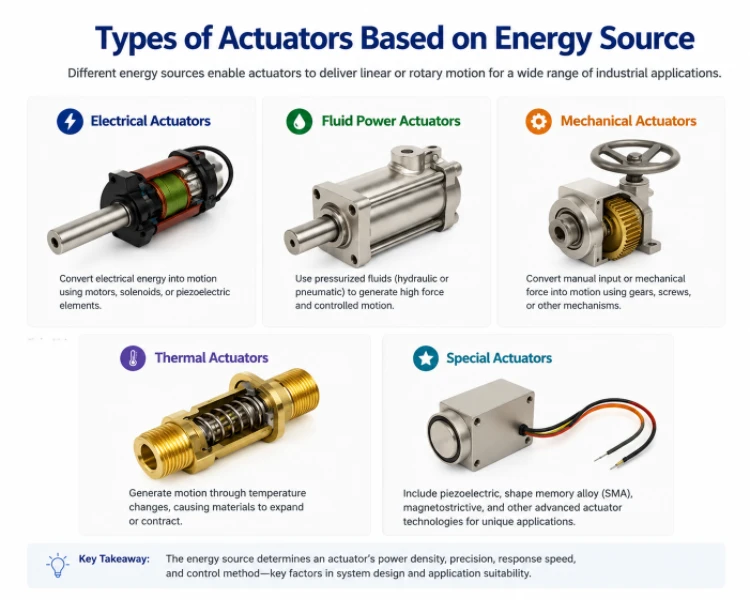
Figure 2. Actuators categorized by energy source including electrical, fluid, mechanical, thermal, and special actuators
2. Electric Actuator Types: Brushed DC, BLDC, Stepper, Servo, Linear and Piezoelectric
Electric actuators dominate modern automation and robotics because they require no fluid infrastructure and interface directly with digital control systems. The subcategories differ sharply in control architecture, feedback requirements, and what they demand from the driver PCB.
Brushed DC Motors
Brushed DC motors convert electrical energy to rotation through carbon brushes contacting a segmented commutator ring, which switches current direction in the rotor windings to maintain unidirectional torque. Torque is proportional to armature current (T = Kt × Ia); speed is governed by armature voltage minus back-EMF. The linear speed-torque relationship makes PWM duty cycle a direct speed command — mechanically simple and electronically straightforward. Efficiency runs 70–85%; brush wear sets the service life ceiling, typically 500–2,000 hours in continuous operation.
Driver PCB requirements: H-bridge topology (L298N, DRV8833, or discrete MOSFET H-bridge for currents above 5 A), PWM from a microcontroller, current sensing via shunt resistor. Commutation sparking generates broadband EMI — a 100 nF ceramic capacitor at each motor terminal plus a common-mode choke on motor leads is the minimum mitigation. Applications: power windows, power tools, conveyor drives, consumer appliances, low-cost industrial automation.
Brushless DC (BLDC) Motors
BLDC motors replace mechanical commutation with electronic switching — the rotor carries permanent magnets; three stator phases are energised in sequence by the driver PCB based on rotor position from Hall sensors or sensorless back-EMF detection. Field-oriented control (FOC) decomposes stator current into torque-producing (Iq) and flux-producing (Id) components, enabling smooth low-speed operation and maximum efficiency (85–95%). BLDC motors offer higher power density, longer service life, and lower acoustic noise than their brushed equivalents.
Driver PCB requirements: Three-phase inverter (six MOSFETs or IGBTs), gate drivers with bootstrap circuits (e.g. TI DRV835x, Infineon 6EDL), current sense amplifiers on each phase, FOC algorithm running on a DSP or microcontroller with dedicated PWM hardware. PCB layout must minimise the switching current loop — short gate traces, bootstrap capacitor placed within 5 mm of the gate driver, phase current shunts in the low-side path. Applications: EV motors, drones, HVAC compressors, industrial servo drives, robotic joints, medical pumps.
Our PCB manufacturing capabilities support the dense multilayer layouts and tight impedance control that BLDC servo drives require.
Stepper Motors
Stepper motors divide a full rotation into discrete steps — 200 steps/revolution (1.8°/step) is standard for hybrid steppers. Each step is commanded by energising a specific stator phase combination; the rotor aligns with the resulting magnetic field and holds there. No position encoder is needed for open-loop control, which is what makes steppers cost-effective in 3D printers, CNC machines, and laboratory automation. Microstepping (½, ¼, 1/16, 1/32 step) provides smoother motion by proportioning current between two phases simultaneously, at the cost of some holding torque.
The critical limitation is resonance: at certain step frequencies, energy input synchronises with mechanical resonance, causing lost steps and unpredictable behaviour. Anti-resonance DSP in Trinamic TMC-series drivers compensates in firmware. Torque also drops sharply above the corner frequency, so stepper systems are limited to moderate speeds (typically below 1,000 rpm for meaningful torque).
Driver PCB requirements: Chopper constant-current control (A4988, DRV8825, TMC2209), direction and step pulse from microcontroller, coil current sense resistors. Stepper driver ICs dissipate significant heat even at standstill — a copper pour under the thermal pad and thermal vias to inner planes is not optional. Applications: 3D printers, CNC routers, pick-and-place machines, camera pan/tilt systems, textile machinery.
Servo Motors
A servo is not a motor type but a control architecture — a closed-loop position control system pairing any motor (brushed DC, BLDC, or AC synchronous) with a position encoder and a feedback controller. What defines the servo is the loop: encoder output compared to position command, error drives a PID or cascade controller, which outputs a current command to the power stage. Industrial servo systems achieve bandwidth of 100–1,000 Hz and positioning accuracy of ±0.01 mm or better with 24-bit absolute encoders (Hiperface, EnDat, BiSS-C protocols).
Driver PCB requirements: Same BLDC three-phase inverter as above, plus encoder interface (quadrature decoder or SPI/BiSS for absolute), current-sense ADCs, and DSP/FPGA implementing the control algorithm. Industrial servo drives add EtherCAT or PROFINET interface, Safe Torque Off (STO) function per IEC 61508 SIL 2, and extensive fault monitoring. Hobby servos use a simpler interface: 50 Hz PWM, 1–2 ms pulse width sets position. Applications: industrial robot joints, CNC axes, semiconductor wafer handling, flight control surfaces, injection moulding machines.
For servo drive PCBs requiring controlled differential pair routing and EMI-hardened mixed-signal layout, see our high-frequency PCB design and fabrication capabilities.
Linear Electric Actuators
Linear electric actuators translate rotary motor motion to linear displacement through a leadscrew, ballscrew, rack-and-pinion, or belt transmission — or use a linear motor directly. Leadscrews (acme thread) are self-locking and cost-effective; ballscrews add recirculating ball bearings for lower friction, higher efficiency, and lower backlash. Linear motors eliminate the mechanical transmission entirely, achieving the highest acceleration and zero backlash at the cost of requiring position encoding along the full stroke and higher power electronics demands.
Critical design parameters: stroke, peak and continuous force, speed, duty cycle, backdrivability (essential for safety in human-collaborative applications), IP rating, and communication protocol (RS-485, CANbus, EtherCAT for industrial units). Limit switches — normally closed on the PCB input for fail-safe behaviour — define mechanical travel boundaries. Current monitoring enables both overload protection and force control in closed-loop applications. Applications: height-adjustable workstations, hospital beds, solar trackers, industrial presses, valve actuators, aircraft secondary flight controls.
Piezoelectric Actuators
Piezoelectric actuators exploit the inverse piezoelectric effect in PZT (lead zirconate titanate) ceramics: an applied electric field causes the crystal lattice to expand or contract. A stack of thin PZT discs in alternating polarity amplifies the strain cumulatively — a 40 mm stack driven to 150 V produces approximately 60 µm of displacement with blocking forces of several kilonewtons. Response time is in the microsecond range; resolution is theoretically unlimited (sub-nanometre with charge-mode driving). The two key limitations are small stroke without mechanical amplification and hysteresis (displacement lags voltage history by 10–15%), which requires compensation in precision applications.
Driver PCB requirements: High-voltage amplifier (0–150 V or ±200 V), high output current to charge the capacitive load (100 nF to 100 µF). OPA454, OPA541, or dedicated piezo driver chips. Charge-mode rather than voltage-mode driving minimises hysteresis in the most demanding applications. PCB galvanic isolation between the HV amplifier stage and the logic/communication circuitry is mandatory for both safety and noise immunity. Applications: semiconductor lithography stages, AFM scanners, fuel injectors, ultrasonic transducers, vibration isolation systems, precision valve control.
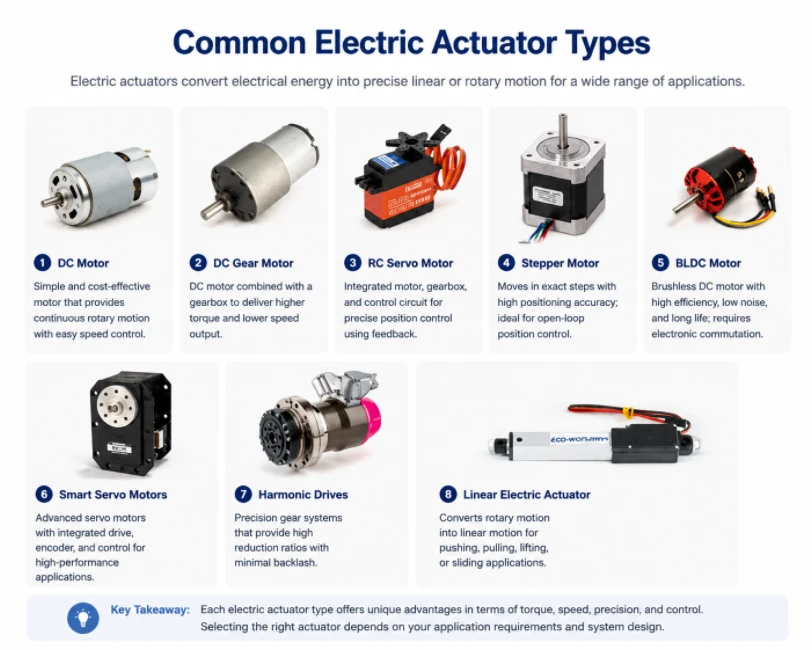
Figure 3. Various electric actuator types including DC, DC Gear, Stepper, Servo, BLDC, Smart Servo, Harmonic, and Linear actuators
3. Hydraulic and Pneumatic Actuators: Force, Speed and Control
Fluid power actuators — hydraulic and pneumatic — generate force through pressurised fluid acting on a piston or vane. They operate on the same fundamental principle (pressure × area = force) but differ dramatically in pressure range, compressibility, and application.
Hydraulic Actuators
Hydraulic systems operate at 100–700 bar (1,450–10,000 psi), producing forces that no electric actuator of comparable size approaches. A 100 mm bore cylinder at 350 bar develops approximately 274 kN — over 27 tonnes. This force density makes hydraulics the only rational choice for construction equipment, forge presses, ship rudders, and aircraft primary flight controls.
Linear hydraulic cylinders (single-acting or double-acting) and rotary hydraulic motors are the two fundamental forms. Precise position control requires electrohydraulic servo valves (EHSVs) or proportional directional control valves, which translate a ±10 V or 4–20 mA command from the control PCB into proportional spool displacement and therefore proportional flow to the cylinder. Servo valve bandwidths reach 50–200 Hz, making closed-loop hydraulic position control viable in flight simulators, active vehicle suspensions, and industrial presses.
PCB role in hydraulic systems: The driver PCB does not power the actuator — it commands the valve. Outputs: 4–20 mA current loop or ±10 V differential to servo valves; PWM to solenoid proportional valves with current sense feedback. Position feedback from LVDT sensors requires precision differential amplification and low-pass filtering on the PCB. Solenoid valve drivers use half-bridge circuits with chopper current control — the freewheeling diode must be rated for the coil’s inductive kick voltage, which can reach 5–10× supply voltage at switch-off without a clamp.
Pneumatic Actuators
Pneumatic actuators use compressed air at 4–10 bar. Lower pressure than hydraulics means less force per unit area — but air is clean, compressible (which gives inherent compliance), and safe in food and pharmaceutical environments where hydraulic oil contamination is unacceptable. Pneumatic systems are fast in on/off operation (valve response in milliseconds) and mechanically simple.
Standard types include single-acting cylinders (spring return), double-acting cylinders (air on both sides), rodless cylinders (carriage on the cylinder body for long-stroke low-buckling applications), and rack-and-pinion rotary actuators for quarter-turn valve operation. Proportional pneumatic control — achieving positions other than fully open or fully closed — requires electropneumatic proportional valves and position feedback, but air compressibility makes precise positioning inherently harder than electric or hydraulic servo control.
PCB role in pneumatic systems: Solenoid valve driver (24 VDC coil, MOSFET output, freewheeling diode essential). For proportional valves: 4–20 mA or 0–10 V command output. For closed-loop electropneumatic positioners: microcontroller PID loop with I/P converter output and potentiometer or LVDT position feedback.
Hydraulic vs. Pneumatic vs. Electric: The Decision Matrix
| Criterion | Electric | Pneumatic | Hydraulic |
|---|---|---|---|
| Maximum force (comparable size) | Low – Medium | Medium | Very high |
| Positioning precision | Excellent | Moderate | Good (servo valve) |
| Speed of response | Good – Excellent | Very fast (on/off) | Fast (servo valve) |
| Energy efficiency | 80–95% | ~10% (compression losses) | ~60–75% |
| Installation complexity | Low | Medium | High |
| PCB driver complexity | High | Low | Medium |
For new installations below 20 kN where infrastructure does not yet exist, total installed cost almost always favours electric. Hydraulic remains the rational choice above that threshold in heavy industry — the infrastructure is the cost, not the actuator itself.
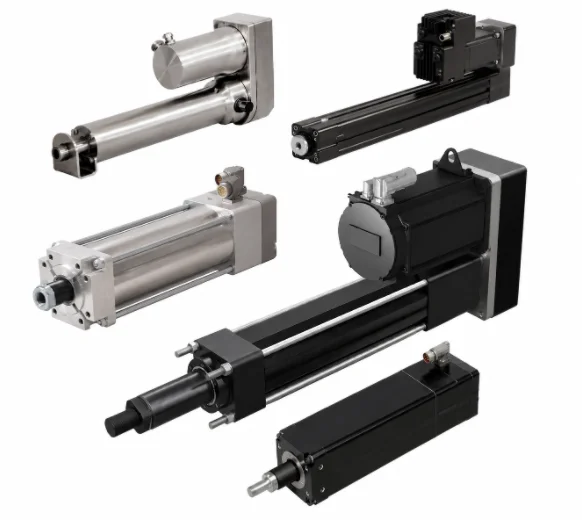
Figure 4. Hydraulic and Pneumatic Actuators
4. Specialty Actuators: Solenoid, SMA, Thermal and Soft
Several actuator types occupy specific niches where mainstream electric, hydraulic, or pneumatic solutions are impractical due to size, weight, biocompatibility, or operating environment constraints.
Solenoid Actuators
A solenoid generates linear force by pulling a ferromagnetic plunger into a coil when current flows. Force is approximately proportional to the square of current and inversely proportional to the square of the air gap — generating high force at short stroke but dropping sharply as the gap increases. Typical stroke: 1–25 mm. Bistable solenoids use a permanent magnet to hold one of two stable positions without continuous power; only a current pulse is needed to switch states, making them ideal for battery-powered or low-duty-cycle applications.
PCB driver note: The solenoid coil stores energy as an inductor. When the switch opens, this energy must go somewhere — without a freewheeling diode or TVS clamp, the voltage spike will destroy the switching transistor within the first few cycles. For proportional solenoids (hydraulic proportional valves), PWM at 100–1,000 Hz with closed-loop current control achieves intermediate force positions. Applications: door locks, fuel injectors, relay coil drivers, pneumatic valve pilots, electromagnetic brakes.
Shape-Memory Alloy (SMA) Actuators
Nitinol (nickel-titanium) SMA wire contracts by 4–8% of its length when heated above its austenite transition temperature (typically 40–90°C depending on composition). Resistive heating with a controlled current is the standard actuation method. Stress generated during the phase transition reaches 200 MPa — far exceeding biological muscle (~0.3 MPa) — in a wire with no moving parts, no magnets, and no electromagnetic interference. The limitation is cycle rate: cooling is the slow step, typically 0.1–2 Hz in free air, improving significantly with forced convection or thermoelectric cooling.
The PCB provides a constant-current driver with resistance monitoring for closed-loop control (Nitinol resistance changes by 15–25% through the phase transition and can therefore serve as a position proxy). Applications: minimally invasive surgical tools, active endoscope tips, vascular stents, satellite deployment latches, haptic feedback devices, robotic grippers in MRI environments.
Thermal Actuators
Bimetallic thermal actuators exploit differential thermal expansion between two bonded metals to produce bending motion on heating. Wax motor actuators use volumetric expansion of a phase-change wax to push a piston — generating substantial force (tens to hundreds of newtons) with no electrical power required in purely passive versions. The simplicity and reliability of wax motors make them the standard for automotive engine cooling thermostats and underfloor heating manifolds. Electrically heated versions add a resistance heater coil for active control; the driver PCB provides only regulated current to the heater and temperature feedback from a thermistor or thermocouple.
Electroactive Polymer (EAP) and Soft Actuators
Dielectric elastomer actuators (DEAs) sandwich a compliant elastomeric film between two flexible electrode layers. Applying 1–5 kV attracts the electrodes together, compressing the elastomer laterally — producing strains up to 380%, far beyond any rigid actuator material. Ionic polymer-metal composite (IPMC) actuators bend under 1–5 V as hydrated ions migrate under the electric field, creating differential swelling. Both types are soft, silent, lightweight, and biocompatible — the right choice for wearable haptics, soft robotic grippers, prosthetic hands, and underwater robots where rigid actuators cannot conform to irregular surfaces.
DEA driver PCBs require high-voltage generation (boost converter plus voltage multiplier) with precise regulation. IPMC drivers need only low-voltage current control but must accommodate the ionomer’s unusual impedance characteristic. Both impose specialist PCB design challenges. For complex multilayer boards serving these applications, our turnkey PCB assembly service handles component sourcing, SMT placement, and functional validation in a single workflow.
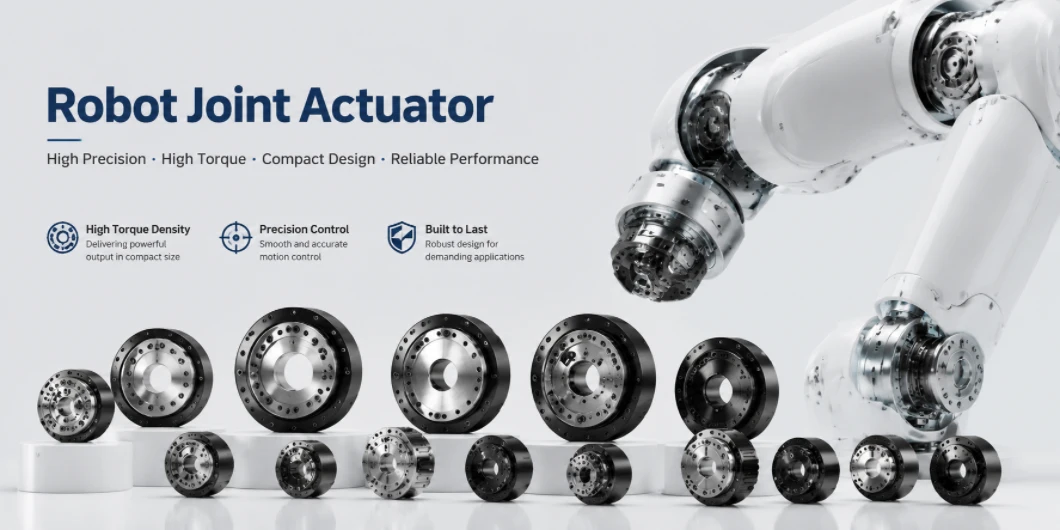
Figure 5. Robot joint actuators for industrial, collaborative, legged, and humanoid robots, showing various sizes and torque ranges
5. Actuator Types in Robotics: Industrial Arms, Cobots, Legged Robots and Humanoids
Robotics is the application domain that simultaneously demands the most from every actuator property: high torque-to-weight ratio, high bandwidth, positioning accuracy, backdrivability for safe human interaction, long duty-cycle service life, and tight integration with electronics — all in a package that must carry its own power and compute. No single actuator type satisfies all of these simultaneously. This is why different robot categories have converged on different actuator architectures, and why the robotics industry has driven more actuator innovation in the past decade than any other field.
Industrial Robot Arms: Precision and Repeatability
Six-axis articulated arms (FANUC, KUKA, ABB, Yaskawa) prioritise repeatability above all else — ±0.02 mm at the tool centre point is a typical specification. Each joint uses a BLDC servo motor coupled to a harmonic drive (strain wave gear) reducer at ratios of 80:1–160:1. Harmonic drives achieve zero backlash in a compact package — essential for repeatability. Absolute multi-turn encoders (24–28 bit resolution, EnDat or BiSS-C protocol) close the position loop. The servo drive PCB for each axis implements current control at 4–32 kHz, velocity control at 1–4 kHz, and position control at 250 Hz–2 kHz. EtherCAT or PROFINET fieldbus connects the drive PCBs to the robot controller, requiring specific PHY/MAC silicon and careful EMC design to prevent switching noise from corrupting fieldbus communication.
Collaborative Robots (Cobots): Force Awareness and Safe Contact
Cobots (Universal Robots UR series, FANUC CRX, ABB GoFa) add joint torque sensing to the servo motor + harmonic drive configuration. A strain-gauge torque transducer on the joint output flange, or motor-current-based torque estimation, detects unexpected contact within one control cycle — stopping motion before the force applied to a human exceeds 80 N (ISO/TS 15066 power-and-force limiting limit). Some designs use series elastic actuators (SEAs), where a calibrated spring between gearbox output and robot link converts deflection (measured by encoder) to force — inherently compliant without a separate sensor.
The joint PCB for a cobot must implement Wheatstone bridge excitation, differential signal conditioning with SNR above 80 dB, ADC sampling at 1–10 kHz for torque feedback, and dual-channel safety monitoring per ISO 13849 PLd or PLe — the safety-critical torque monitoring path must be physically independent from the primary motion control path.
Legged Robots: Quasi-Direct Drive Changes the Game
Quadrupeds (Boston Dynamics Spot, MIT Cheetah, ANYmal) and bipedal running robots have made quasi-direct drive (QDD) the defining actuator innovation of the past decade. QDD actuators use very low gear ratios (1:1–9:1) with high-torque-density BLDC motors wound specifically for this purpose. The result is a highly backdrivable joint — ground impact forces pass through the joint without destroying it, and the leg can absorb and return energy like a spring. Traditional high-ratio harmonic drives cannot do this: the gear is self-locking, so all impact energy must be absorbed by rigid structure.
The trade-off: QDD joints cannot hold position against gravity without continuous motor current, and require larger phase currents (and therefore larger power electronics) than equivalent high-ratio drives. The driver PCB must support peak currents of 30–100 A at 24–48 V in a compact, thermally efficient package integrated directly into the robot joint housing. Our heavy copper PCB manufacturing (up to 10 oz copper) directly addresses this requirement.
| Robot Category | Primary Actuator Type | Gear Ratio | Key Requirement | Example Platform |
|---|---|---|---|---|
| Industrial arm (6-axis) | BLDC servo + harmonic drive | 80:1 – 160:1 | Zero backlash, ±0.02 mm repeatability | FANUC M-20, KUKA KR10 |
| Collaborative robot | BLDC servo + torque sensor / SEA | 100:1 – 200:1 | Contact force sensing, ISO 13849 PLd | UR10e, ABB GoFa |
| Legged / quadruped | QDD BLDC (low ratio) | 1:1 – 9:1 | Backdrivability, impact absorption | Spot, ANYmal, Cheetah |
| Humanoid robot | QDD + SEA + linear (mixed) | Mixed by joint | Dexterity, compliance, energy efficiency | Tesla Optimus, Figure 02, Atlas |
| Surgical robot | Cable-driven + piezoelectric | N/A | Precision, MRI-safe, force feedback | da Vinci, Stryker Mako |
| Soft robotic gripper | Pneumatic (soft) / SMA / EAP | N/A | Compliance, gentle grasping | Soft Robotics mGrip |
Humanoid Robots: The Hardest Actuator Problem
Humanoids (Tesla Optimus, Figure 02, Agility Digit, Boston Dynamics Atlas) require 20–40 actuated degrees of freedom in a body that carries its own power, compute, and sensing. No single actuator type satisfies all joint requirements. Current humanoid architectures mix: QDD BLDC actuators at the hips, knees, and ankles for locomotion; smaller harmonic drive servo actuators at the shoulder and elbow for manipulation; cable-driven or miniature servo actuators in the fingers for dexterity; and linear electric actuators at the spine and torso for trunk mobility.
The driver PCBs inside a humanoid joint represent some of the most demanding electronics in production today: high current density (30–100 A peak) in minimal volume, multi-channel current sensing at microsecond resolution, real-time EtherCAT or CAN FD communication, thermal management in a sealed housing at 85°C ambient, and functional safety certification per IEC 62061. Magnetic absolute encoders (AS5047, MA702) have replaced optical encoders in most humanoid joints — smaller, lower power, more vibration-resistant, and now available at sub-$1 cost in volume.
The broader robotics hardware revolution since 2020 has been enabled primarily by three PCB-level advances: wide-bandgap GaN and SiC power semiconductors enabling higher switching frequencies with lower losses in smaller packages; high-resolution low-power magnetic encoders at mass-market prices; and advanced thermal interface materials and copper-filled thermal via arrays allowing more power in smaller driver PCB footprints. For robotics companies developing these systems, our PCB prototyping service supports rapid iteration from design to tested hardware. Dense BGA escape routing for robot joint ASICs is covered by our BGA PCB assembly capability.
6. How Actuator Type Drives PCB Design: Power, Thermal and Protection
The actuator type is the primary constraint on its driver PCB. This is not a preference — it is a physical relationship. The table below summarises the architectural implications by actuator type. Every item in it has a direct consequence for layer count, copper weight, component selection, and protection circuit topology.
| Actuator Type | Driver Topology | Critical PCB Design Requirements | Protection Circuits |
|---|---|---|---|
| Brushed DC motor | H-bridge + PWM | High-current traces, motor EMI decoupling at terminals | Freewheeling diodes, overcurrent, reverse polarity |
| BLDC motor | 3-phase inverter + FOC | Minimal switching loop area, bootstrap capacitor placement, differential current sense | UV lockout, shoot-through prevention, thermal shutdown |
| Stepper motor | Chopper constant-current | Thermal copper pour under driver IC, current-set resistor accuracy | Overcurrent, thermal, VM under/over-voltage lockout |
| Servo (industrial) | BLDC + encoder interface + DSP | Differential encoder routing, ADC layout, isolated fieldbus PHY | STO function (IEC 61508 SIL 2), encoder fault detection |
| Piezoelectric | HV amplifier (0–150 V / ±200 V) | HV isolation from logic, amplifier compensation for capacitive load | HV output clamp, short-circuit protection, thermal |
| Solenoid / proportional valve | MOSFET half-bridge | Freewheeling diode rated for inductive kick, PWM current filter | TVS or Zener clamp on inductive kick, overcurrent |
| SMA / thermal | Constant-current linear or switching | Resistance monitoring for phase-state feedback, heatsink integration | Overcurrent (wire failure is rapid), over-temperature |
Power Architecture
Actuator driver PCBs almost always require multiple isolated voltage domains: high-voltage motor rail (12–48 V for DC actuators; up to 700 V DC bus for industrial servo drives), logic supply (3.3 V or 5 V), precision analog reference (for ADCs and sensor conditioning), and gate drive supply (12–15 V, bootstrap or isolated). Galvanic isolation between the motor-side and the logic/communication side — via isolated DC-DC converters or isolated gate drivers — is mandatory in industrial designs for both safety and noise immunity (IEC 62061, ISO 13849). Our 4-layer PCB fabrication provides the dedicated power and ground plane pairing that multi-rail actuator PCBs require.
Thermal Management
A BLDC drive at 48 V / 10 A with 95% efficiency dissipates approximately 25 W in the power stage — from three sources: conduction losses (I²R in MOSFETs), switching losses (proportional to fsw × VDS × ID), and gate drive losses. Handling this requires 2–3 oz copper on power layers, thermal via arrays (0.3–0.5 mm diameter, 1–1.5 mm pitch) connecting MOSFET drain pads to inner copper planes, and sometimes external aluminium heat sinks mounted to the PCB. GaN MOSFETs switch at 200–500 kHz versus 20–50 kHz for silicon — higher frequency shrinks passives but demands tighter PCB layout to keep switching loop inductance below 5 nH. For boards requiring 2 oz copper and above on inner layers, our multilayer PCB fabrication service covers these high-copper requirements.
The PCB is not downstream of the actuator decision — it is part of the actuator system. Thermal, electrical, and mechanical constraints flow from the actuator type into every board-level design choice. For the specific constraints of actuator PCB design and DFM review, our engineering team evaluates layout against current, thermal, and signal integrity requirements before fabrication.
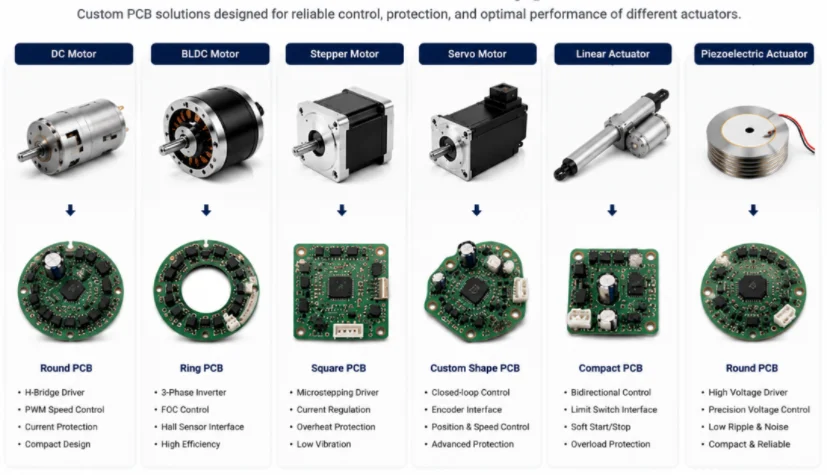
Figure 6. Actuator types and corresponding PCB modules, including DC, BLDC, Stepper, Servo, Linear, and Piezoelectric actuators with PCB layouts
7. Actuator Selection Framework and Quick-Reference Guide
Actuator selection is an engineering process, not a lookup table. The following four-step framework structures the decision and surfaces the critical trade-offs before any component is specified.
Step 1 — Define motion requirements: Specify motion type (linear/rotary), stroke or angular range, peak and continuous force or torque, maximum speed, required positioning accuracy (on/off, multi-point, continuous, nanometre), and duty cycle. These parameters alone eliminate most actuator families immediately.
Step 2 — Evaluate the operating environment: IP rating, temperature range, chemical exposure (cleanroom, food-safe, washdown), vibration and shock, explosive atmosphere classification (ATEX, NEC), and available infrastructure (is compressed air or hydraulic power already present?). A pharmaceutical cleanroom application immediately excludes hydraulic oil. A mining excavator immediately excludes battery-powered electric actuators for the main arm.
Step 3 — Assess control and integration requirements: On/off versus proportional control, open-loop versus closed-loop, position versus force control, communication protocol (analog, PWM, RS-485, CANbus, EtherCAT), functional safety level required (PLc/PLd/SIL 2), and integration with existing PLC or robot controller. These requirements determine the driver PCB complexity and certification cost — often a larger factor than the actuator hardware cost itself.
Step 4 — Calculate total cost of ownership: Compressed air costs approximately 5–8 times more per unit of useful mechanical energy than direct electric actuation. Hydraulic systems require periodic fluid and seal replacement and carry oil contamination liability. Electric systems have higher initial cost but lower operating cost, no consumables, and predictable maintenance schedules. For new installations below 20 kN, total installed cost almost always favours electric — the compressed air infrastructure cost alone typically exceeds the electric actuator and driver PCB combined.
Application Quick-Reference
| Application | Actuator Type | Key Reason |
|---|---|---|
| Robot arm joint (5–200 Nm) | BLDC servo + harmonic drive | Zero backlash, high repeatability, programmable |
| Cobot joint | BLDC servo + torque sensor / SEA | Force awareness, ISO 13849 PLd compliance |
| Legged robot joint | QDD BLDC (low gear ratio) | Backdrivability, impact absorption, dynamic motion |
| CNC / 3D printer axis | Stepper (budget) / servo (performance) | Stepper: open-loop, cost-effective; servo: speed and accuracy |
| Industrial valve (DN50–300) | Electric quarter-turn or pneumatic rack-pinion | Depends on torque and existing infrastructure |
| Fuel injector | Piezoelectric or solenoid | Piezo: 3× faster opening; solenoid: lower cost |
| Semiconductor lithography stage | Piezoelectric (short-stroke) + linear servo (long-stroke) | Sub-nanometre resolution + multi-mm travel combined |
| Surgical tool (minimally invasive) | SMA or cable-driven servo | MRI-safe, compact, biocompatible |
| Excavator arm | Hydraulic double-acting cylinder | Only viable option at this force and stroke |
| Assembly line gripper | Pneumatic cylinder | Speed, simplicity, existing compressed air |
Selecting the right actuator type is the first decision. Building the electronics to drive it correctly is the second — and the one where most failures occur. An undersized H-bridge destroys itself on the first stall. A servo drive with poor encoder routing produces position jitter no filter can remove. A piezoelectric driver without proper isolation fails EMC. At Highleap Electronics, we manufacture and assemble the full range of actuator control PCBs — from industrial-grade motor drive PCBs to compact joint-integrated servo drives for robotics. Our turnkey PCB assembly handles sourcing, SMT assembly, and functional testing — reducing your time from design to validated hardware. Request a quote for your actuator control PCB and tell us the actuator type, power level, and environment — we will take it from there.

Recommended Posts
How to Compare 6 Layer PCB Quotes Before Ordering
Comparing 6-layer PCB quotes is not just a matter of...
Quick-Turn 6 Layer PCB Manufacturer in China
Highleap Electronics manufactures six-layer printed...
TG150 PCB Manufacturer for Fabrication and Assembly
Highleap Electronics manufactures TG150 PCB boards to...
TG140 PCB Material Selection and Fabrication
Table of Contents TG140 PCB Materials and Selection...
How to get a quote for PCBs
Let‘s run DFM/DFA analysis for you and get back to you with a report. You can upload your files securely through our website. We require the following information in order to give you a quote:
-
- Gerber, ODB++, or .pcb, spec.
- BOM list if you require assembly
- Quantity
- Turn time
In addition to PCB manufacturing, we offer a comprehensive range of electronic services, including PCB design, PCBA, and turnkey solutions. Whether you need help with prototyping, design verification, component sourcing, or mass production, we provide end-to-end support to ensure your project’s success.
For PCBA services, please provide your BOM (Bill of Materials) and any specific assembly instructions. We also offer DFM/DFA analysis to optimize your designs for manufacturability and assembly, ensuring a smooth production process.