
How Dielectric Constant & Loss Tangent Affect High Frequency PCB Performance

Introduction
The performance of high frequency PCB designs depends fundamentally on substrate material properties rather than circuit topology alone. As operating frequencies advance beyond 1 GHz, the electromagnetic behavior of dielectric materials becomes the primary factor determining whether signals maintain their integrity from transmitter to receiver. Two material characteristics govern this behavior: dielectric constant and loss tangent.
Dielectric constant controls the speed at which electromagnetic waves propagate through the substrate, directly affecting signal timing and transmission line impedance. Loss tangent quantifies how much signal energy dissipates as heat rather than reaching its destination. Understanding how these parameters interact enables engineers to predict signal attenuation, control impedance precisely, and select materials that meet specific frequency requirements while balancing cost and manufacturability constraints.
Understanding Dielectric Constant (Dk) and Its Role
What Dielectric Constant Means for Signal Propagation
Dielectric constant measures a material’s capacity to store electrical energy when subjected to an electric field, expressed relative to vacuum. This fundamental property determines signal propagation velocity according to the relationship v = c / √Dk, where lower dielectric constant values permit faster signal travel. The practical significance becomes apparent in timing-critical high frequency PCB applications where nanosecond-level precision matters.
Typical Dk Values Across Materials
Common substrate materials span a dielectric constant range that significantly impacts design choices:
- Standard FR4 – Dk values between 4.2 and 4.8 at 1 GHz, suitable for general-purpose applications.
- specialty low-loss laminate a specialty low-loss laminate – Controlled Dk around 3.48, providing tighter tolerance for RF circuits.
- PTFE-based substrates – Dk as low as 2.2, enabling highest propagation speeds for microwave applications.
Dk Uniformity and Impedance Control
Consistency in dielectric constant across the substrate thickness and planar dimensions directly determines impedance control accuracy in high frequency PCB designs. Manufacturing variations of merely 0.1 in Dk translate to several ohms of impedance shift in 50-ohm transmission lines, potentially causing reflections that degrade signal quality. Material anisotropy, where Dk differs between planar and vertical orientations, adds complexity that demands compensation in stackup planning.
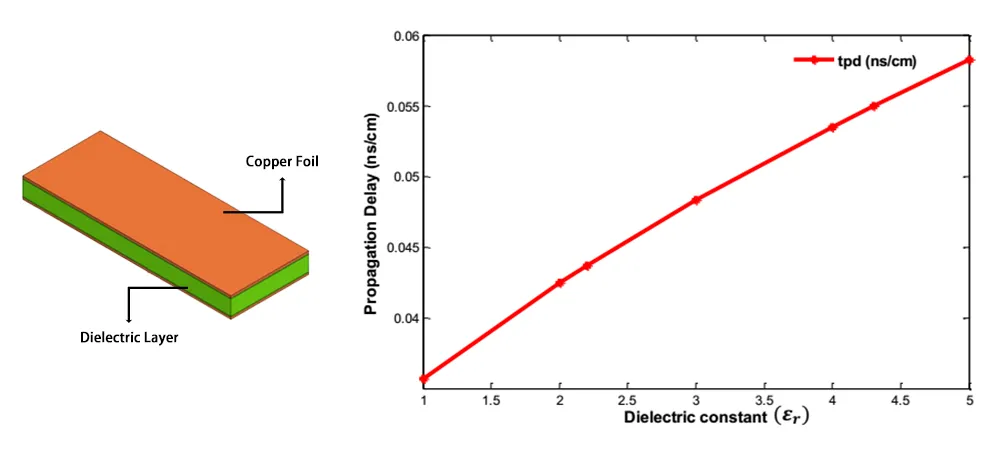
Dielectric Constant vs Propagation Delay
Understanding Loss Tangent (Df or Tan δ)
Defining Dielectric Loss
Loss tangent represents the ratio of energy dissipated as heat to energy stored in the dielectric during each electromagnetic cycle. Mathematically expressed as the tangent of the loss angle, this parameter indicates what fraction of signal power converts to thermal energy rather than propagating along the intended path. Lower loss tangent values correspond directly to reduced signal attenuation and superior high frequency PCB performance.
Material Loss Tangent Comparison
Material loss tangent spans a wide range across available substrate options:
- FR4 – Df between 0.020 and 0.025, limiting practical use to frequencies below 3 GHz.
- specialty low-loss laminate a specialty low-loss laminate – Df approximately 0.0037, extending viable operation to 10 GHz and beyond.
- PTFE-based laminates – Df from 0.001 to 0.002, supporting applications reaching 40 GHz with minimal attenuation.
Frequency-Dependent Loss Effects
The impact of loss tangent intensifies as frequency increases because dielectric loss scales proportionally with operating frequency. At 10 GHz, a material with Df of 0.020 introduces approximately 1-2 dB additional insertion loss per inch compared to materials with Df of 0.004. Environmental factors also influence loss tangent stability, with FR4 substrates experiencing Df increases of 20-30% under high humidity exposure while hydrophobic materials like PTFE maintain consistent performance.

Loss Tangent vs Insertion Loss
How Dk and Df Together Influence High Frequency PCB Performance
Signal Integrity
Higher dielectric constant values increase capacitive coupling between adjacent traces, elevating crosstalk susceptibility in densely routed high frequency PCB layouts. The reduced propagation velocity associated with elevated Dk creates timing skew when signals traverse regions with differing effective dielectric constants. Loss tangent directly governs signal amplitude preservation, with elevated Df values causing progressive attenuation that reduces voltage swing and narrows eye diagram openings.
Impedance Control and Design Tolerance
Manufacturing variations in dielectric constant translate directly into impedance tolerance ranges. A typical ±0.1 Dk variation in standard FR4 produces approximately ±2 to 3 ohms of impedance deviation for 50-ohm microstrip lines. Electromagnetic simulation tools such as Polar SI9000 and Ansys HFSS incorporate both dielectric constant and loss tangent to predict transmission line behavior accurately, revealing how Dk tolerances impact impedance stability while Df determines insertion loss slope with frequency.
Power Loss and Heat Dissipation
Dielectric losses convert RF power into thermal energy within the substrate, raising junction temperatures in active components. A high frequency PCB operating at 5 GHz with Df of 0.020 may dissipate several watts per square inch in densely routed areas, compared to less than one watt for materials with Df below 0.005. RF power amplifiers and transmitter stages derive particular benefit from low loss tangent materials because dielectric heating occurs precisely where thermal management proves most difficult.
Material Selection and Manufacturability
Balancing electrical performance requirements against economic constraints requires matching material capabilities to actual frequency specifications. FR4 serves adequately for applications below 3 GHz, mid-tier materials like specialty low-loss laminate a specialty low-loss laminate provide effective compromises for 5-10 GHz designs, while PTFE-based substrates become necessary when frequencies exceed 20 GHz. Moisture absorption affects both dielectric constant and loss tangent stability, with FR4 absorbing up to 0.15% moisture by weight versus less than 0.02% for PTFE-based laminates.
Material Comparison for High Frequency Applications
| Material | Dk | Df | Frequency (GHz) | Typical Use |
|---|---|---|---|---|
| FR4 | 4.4 | 0.020 | <3 | General digital PCB |
| specialty low-loss laminate a specialty low-loss laminate | 3.48 | 0.0037 | <10 | RF modules |
| specialty low-loss laminate a specialty low-loss laminate (PTFE) | 2.20 | 0.0009 | <40 | Microwave / radar |
| Taconic RF-35 | 3.50 | 0.0018 | <10 | Antennas / 5G |
| Megtron 6 | 3.3 | 0.002 | <15 | High-speed server boards |
This comparison demonstrates the performance spectrum available for high frequency PCB applications across different operating frequency ranges. Material selection should target the minimum performance level satisfying application requirements while ensuring adequate electrical margins for signal integrity and impedance control.
Practical Tips for PCB Designers
Use Actual Material Parameters
Designers should extract actual dielectric constant and loss tangent values from material datasheets at specific frequency and temperature conditions relevant to their application rather than relying on typical values. Many datasheets provide frequency-dependent curves showing parameter variation across the operating spectrum, which substantially improves electromagnetic simulation accuracy for broadband high frequency PCB designs spanning multiple frequency decades.
Consider Frequency Dependence
Both dielectric constant and loss tangent vary with frequency. Dielectric constant typically decreases slightly with increasing frequency while loss tangent may increase. Designers working with ultra-wideband applications or harmonic-rich signals must account for these frequency-dependent effects to maintain performance across the entire spectrum.
Avoid Mixed Dielectric Stackups
Avoiding mixed dielectric stackups wherever practical reduces impedance discontinuities at layer transitions that generate reflections. When different materials prove necessary, such as combining low-loss RF layers with cost-effective digital layers, careful transition design and via stub management minimize discontinuity effects in high frequency PCB applications.
Optimize Copper and Prepreg Selection
Specifying low-loss prepreg materials and low-profile copper foils further reduces total insertion loss:
- Low-loss prepreg – Reduces dielectric loss in multilayer stackups where prepreg comprises substantial substrate volume.
- Smooth copper surfaces – Minimizes conductor losses from skin effect roughness above 10 GHz.
- Collaboration with manufacturers – Ensures achievable impedance tolerances and realistic Dk control limits.
By carefully balancing copper roughness and prepreg dielectric properties, designers can achieve stable impedance and minimize signal degradation across wide frequency ranges. Such material optimization is essential for ensuring consistent high-frequency PCB performance in demanding RF and high-speed digital applications.
Conclusion
Dielectric constant fundamentally controls signal propagation velocity and characteristic impedance throughout high frequency PCB designs, while loss tangent determines energy dissipation and signal attenuation during transmission. These two material properties work synergistically to define achievable performance for RF circuits, microwave systems, and high-speed digital interfaces operating at multi-gigahertz frequencies.
Highleap Electronics High Frequency PCB Capabilities
At Highleap Electronics, we deliver precision high frequency PCB fabrication with comprehensive material expertise:
- Advanced materials – specialty low-loss laminate, Taconic, and Megtron series laminates with controlled Dk and low Df specifications.
- Controlled impedance – Tight tolerance impedance control with verification through TDR and VNA testing.
- Engineering support – Material selection guidance, stackup optimization, and design validation for signal integrity.
- Process excellence – Rigorous manufacturing controls ensuring stable electrical performance across production volumes.

Recommended Posts
Portable Thermal Camera PCB Design and PCBA Manufacturing Guide
The thermal imaging module is often the part of a handheld...
USB Modem PCB Manufacturing & PCBA for LTE/5G Dongles and Data Adapters
USB Modem PCB fabrication and assembly involves a compact...

Custom Smart Motorcycle Helmet PCB for Connected Riding
A smart motorcycle helmet may combine an intercom,...
Wearable Haptic Vest PCB Manufacturing & Assembly for Multi-Zone Haptic OEMs
In a wearable haptic vest, the wearer notices the...
How to get a quote for PCBs
Let‘s run DFM/DFA analysis for you and get back to you with a report. You can upload your files securely through our website. We require the following information in order to give you a quote:
-
- Gerber, ODB++, or .pcb, spec.
- BOM list if you require assembly
- Quantity
- Turn time
In addition to PCB manufacturing, we offer a comprehensive range of electronic services, including PCB design, PCBA, and turnkey solutions. Whether you need help with prototyping, design verification, component sourcing, or mass production, we provide end-to-end support to ensure your project’s success.
For PCBA services, please provide your BOM (Bill of Materials) and any specific assembly instructions. We also offer DFM/DFA analysis to optimize your designs for manufacturability and assembly, ensuring a smooth production process.