
Heavy Copper PCB Technology: Emerging Trends and Manufacturing Innovations

Introduction
As power electronics continue to demand higher current capacity and thermal endurance, heavy copper PCB technology is evolving rapidly. Traditional boards with copper weights exceeding 3 oz/ft² are no longer just about thickness—they now integrate advanced design strategies, intelligent manufacturing processes, and sustainable produ1ction methods. Emerging trends such as precision copper stacking, hybrid substrate integration, and automated inspection systems are reshaping how these boards are designed and manufactured for next-generation applications.
This evolution addresses the growing requirements of renewable energy systems, electric vehicle powertrains, and industrial power conversion equipment where reliability and thermal performance are non-negotiable.
High-Density Multi-Layer Stack-up in Heavy Copper PCB Technology
Advanced Layer Configuration Strategies
Modern heavy copper PCB technology incorporates copper layers ranging from 4 oz to 20 oz within multi-layer structures that were previously considered impractical. This approach enables designers to route high-current traces on specific layers while maintaining signal integrity on others, creating hybrid boards that serve both power and control functions simultaneously.
Thermal Stress Management Through FEA Simulation
The primary challenge in thick copper stack-ups involves managing differential thermal expansion between copper layers and dielectric materials. Heavy copper PCB manufacturers employ finite element analysis to predict stress points during thermal cycling, allowing preemptive design adjustments that prevent delamination and via failure under operating conditions.
Automated Registration Systems
Achieving precise layer-to-layer alignment with thick copper requires advanced registration systems that compensate for material expansion during lamination. Automated optical alignment combined with pressure and temperature profiling ensures inner layer connections maintain designed positions even as copper thickness increases beyond conventional limits.

Heavy Copper PCB
Hybrid Base Materials for Heavy Copper PCB Applications
Integrated Material Systems
The trend toward hybrid substrates combines standard FR-4 with metal-core materials such as aluminum or copper bases, creating structures that optimize both electrical performance and heat dissipation. High-Tg epoxy resins paired with ceramic-filled compounds provide enhanced dimensional stability under thermal stress while maintaining manufacturing compatibility with heavy copper PCB technology.
Thermal Architecture Design
Metal-backed laminate structures place thick copper circuitry on thermally conductive substrates, creating direct heat paths from components to external heatsinks. This configuration proves particularly effective in power supply designs where component temperatures must remain within strict operating windows despite continuous high-current operation.
Strategic Material Selection
Material choices for heavy copper PCB designs involve sophisticated trade-off analysis between thermal conductivity, mechanical strength, and production costs. Key considerations include:
- Thermal performance – Metal-core bases provide thermal conductivity ranging from 1.0 to 4.0 W/mK compared to standard FR-4 at 0.3 W/mK
- Mechanical stability – High-Tg materials (Tg >170°C) prevent board warpage during reflow and operating conditions
- Cost optimization – Selective use of advanced materials in critical sections while employing standard substrates elsewhere
Advanced Electroplating Techniques for Heavy Copper PCB Manufacturing
Pulse Plating for Uniform Distribution
Pulse electroplating techniques have emerged as the preferred method for achieving uniform copper thickness across large panel areas and within high-aspect-ratio vias. By alternating current pulses with rest periods, this process produces denser, more uniform copper deposits compared to direct current plating, reducing thickness variation from panel center to edges.
Precision Etching Control
Etching thick copper traces in heavy copper PCB technology requires carefully controlled chemistry and exposure times to maintain dimensional accuracy. Modern spray etching systems with real-time conductivity monitoring and temperature control ensure consistent undercut profiles even when removing substantial copper mass, preserving trace width tolerances critical for current-carrying capacity calculations.
Closed-Loop Process Integration
Real-time monitoring systems link plating bath analysis, current density measurements, and post-process inspection data into feedback loops that automatically adjust process parameters. This integration significantly reduces batch-to-batch variation and enables consistent production of heavy copper boards with minimal manual intervention.

Thick Copper Circuit Board
Automation and AI-Driven Inspection in Heavy Copper PCB Quality Control
Intelligent Defect Detection Systems
Artificial intelligence algorithms trained on extensive board image datasets now detect defects in heavy copper PCB manufacturing that traditional automated optical inspection might miss. These systems identify subtle copper thickness variations, incomplete via fills, and micro-cracks that could lead to field failures.
Multi-Modal Inspection Integration
Combining automated optical inspection with X-ray fluorescence analysis and cross-sectional imaging provides comprehensive thickness verification without destructive testing. Key capabilities include:
- AOI systems – Surface feature detection at 10-micron resolution
- X-ray inspection – Internal structure verification and void detection in buried vias
- Data correlation – Automated linking of surface defects to internal structural anomalies
Thickness Mapping and Traceability
Advanced measurement systems generate complete thickness maps across entire panels, documenting actual copper weight at thousands of points. This data supports statistical process control initiatives and provides traceability documentation required for aerospace and medical device applications where heavy copper PCB technology ensures mission-critical reliability.
Power Module Integration with Heavy Copper PCB Thermal Management
Direct Thermal Path Architecture
Modern power module designs increasingly use heavy copper PCBs as structural thermal management components rather than simply mounting substrates. By eliminating thermal interface materials between semiconductor devices and the board, these designs reduce thermal resistance and improve power density capabilities in compact enclosures.
Advanced Thermal Via Structures
Via-in-pad configurations combined with copper coin technology create vertical thermal highways through board thickness, conducting heat from component junction to heatsink interface with minimal lateral spreading. Design benefits include:
- Shortest thermal path – Direct heat flow from components to metal base minimizes junction temperatures
- Reduced thermal resistance – Filled thermal vias achieve 0.5-2°C/W compared to 5-10°C/W for standard vias
- Improved reliability – Lower operating temperatures extend semiconductor lifespan by 50-200%
Co-Simulation Design Methodology
Thermal and electrical simulations now run concurrently during design phases for heavy copper PCB applications, ensuring current distribution remains uniform while heat dissipation meets requirements. This approach prevents situations where electrical design creates thermal hotspots or thermal solutions compromise current-carrying capacity.
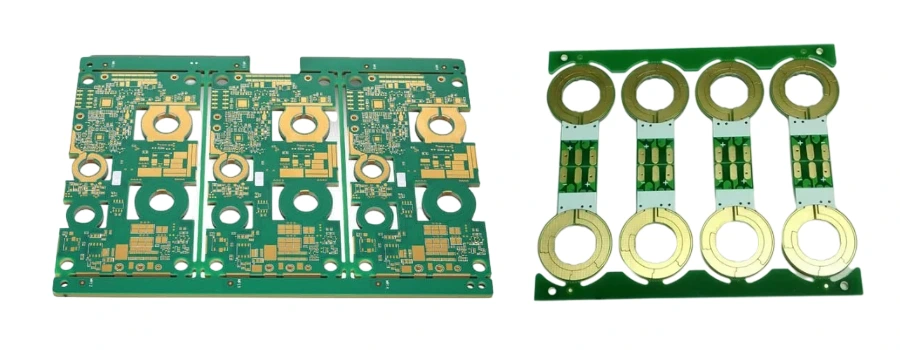
Heavy Copper PCB Manufacturing
Sustainable Manufacturing Practices in Heavy Copper PCB Production
Chemical Process Optimization
Manufacturers are adopting advanced etching chemistries that require lower reagent volumes and produce less hazardous waste. Closed-loop etchant regeneration systems recover copper from spent solutions, converting waste streams into recyclable raw materials while reducing environmental impact and disposal costs associated with heavy copper PCB manufacturing.
Material Efficiency Through Automation
Automated systems that optimize panel utilization and reduce setup waste contribute significantly to sustainable production. Real-time yield monitoring identifies process deviations early, preventing entire batches from becoming scrap due to single-parameter excursions.
Environmental Management Alignment
Leading manufacturers have aligned heavy copper PCB production processes with ISO 14001 environmental management requirements, implementing continuous improvement programs that systematically reduce energy consumption, water usage, and waste generation while maintaining quality standards required for demanding applications.
Conclusion
Heavy Copper PCB technology is transitioning from pure thickness-focused designs toward sophisticated systems that integrate density, intelligence, and sustainability. The convergence of advanced materials, precision manufacturing, and smart inspection systems enables boards that meet increasingly stringent requirements for power handling, thermal management, and reliability.
Highleap Electronics continues to advance heavy copper PCB manufacturing capabilities through:
- Advanced stack-up engineering – Multi-layer designs supporting 4 oz to 20 oz copper weights with precise layer registration
- Hybrid material integration – Metal-core and high-Tg substrate options for optimized thermal performance
- Automated quality systems – AI-driven inspection and real-time process control ensuring consistent production quality
- Sustainable practices – ISO 14001-certified processes with closed-loop material recovery systems

Recommended Posts
PCB Panelization for Volume Production: Cost and Yield
A fabrication panel that holds more boards is not...
PCB SET Delivery and Panelization: Quantities and Acceptance
A purchase order for “500 SET” looks straightforward until...
Optical Transceiver PCB Cost: Compare Equivalent Quotes
Two suppliers may quote a nominally identical six-layer...
PCB Materials Database: Laminate Grades & Properties
How to get a quote for PCBs Let‘s run DFM/DFA analysis for...
How to get a quote for PCBs
Let‘s run DFM/DFA analysis for you and get back to you with a report. You can upload your files securely through our website. We require the following information in order to give you a quote:
-
- Gerber, ODB++, or .pcb, spec.
- BOM list if you require assembly
- Quantity
- Turn time
In addition to PCB manufacturing, we offer a comprehensive range of electronic services, including PCB design, PCBA, and turnkey solutions. Whether you need help with prototyping, design verification, component sourcing, or mass production, we provide end-to-end support to ensure your project’s success.
For PCBA services, please provide your BOM (Bill of Materials) and any specific assembly instructions. We also offer DFM/DFA analysis to optimize your designs for manufacturability and assembly, ensuring a smooth production process.