
Industrial Communication Gateway PCB for Robots

Modern industrial robots rarely operate as isolated machines. They must exchange data with PLCs, HMIs, safety controllers, legacy fieldbus equipment, and increasingly with higher-level IT or MES systems. The challenge is that factory environments still contain multiple generations of incompatible communication protocols — EtherCAT, PROFINET, Modbus, CANopen, RS-485, and others — each with different timing models, voltage domains, and reliability expectations.
An industrial communication gateway PCB bridges these protocol boundaries. It translates data between deterministic fieldbus networks and Ethernet-based systems while preserving real-time behavior, electrical isolation, and long-term reliability under harsh industrial conditions. This makes gateway PCBs fundamentally different from consumer or IT networking hardware.
This article explains how industrial communication gateway PCBs are designed specifically for robotic systems — focusing on protocol requirements, real-time constraints, isolation architecture, physical layer implementation, processing choices, and environmental reliability.
Table of Contents
What an Industrial Communication Gateway PCB Is — and Why Robots Depend on It
In robotic and automation systems, an industrial communication gateway PCB is not simply a protocol converter. It acts as a real-time communication backbone that connects motion controllers, sensors, safety systems, PLCs, and supervisory networks that operate under fundamentally different timing and electrical assumptions.
Unlike general networking equipment, robotic systems require deterministic communication. Motion commands, feedback signals, and safety messages must arrive within defined time windows and with tightly controlled jitter. A delayed or inconsistent packet is not a minor inconvenience — it can directly result in unstable motion, unexpected stops, or safety faults.
From a PCB design perspective, this places industrial communication gateways in a distinct category:
- They must bridge real-time fieldbus networks and non-real-time Ethernet or IP-based systems without allowing timing uncertainty to propagate.
- They must maintain galvanic isolation between multiple ports to protect equipment and prevent ground loops in electrically noisy environments.
- They must operate continuously under vibration, temperature variation, and EMI typical of robotic production lines.
- They must be designed for manufacturing consistency, because small variations in layout, assembly, or isolation spacing can directly affect communication stability.
The sections below explain how these requirements translate into concrete PCB-level design decisions for production-ready robotic communication gateways.
Industrial Protocol Requirements
Gateway PCB architecture is driven first by the communication protocols it must support. Industrial protocols differ significantly in timing behavior, error handling, and physical layer specifications, and these differences directly influence interface circuitry and processing requirements.
- Real-Time Industrial Ethernet: Protocols such as EtherCAT, PROFINET IRT, and EtherNet/IP are designed for deterministic motion control. Achieving their specified cycle times and jitter limits typically requires hardware support rather than software-only stacks.
- Legacy Fieldbus Networks: PROFIBUS DP, DeviceNet, and CANopen remain widely deployed. Gateway support enables continued use of existing equipment while integrating modern robotic systems.
- Serial and Simple Protocols: Modbus RTU over RS-485 and similar protocols are tolerant of simple hardware but require careful timeout handling and buffering when bridged to faster networks.
- Protocol Coexistence: A single gateway often supports multiple protocol families simultaneously, requiring parallel data paths that do not interfere with real-time traffic.
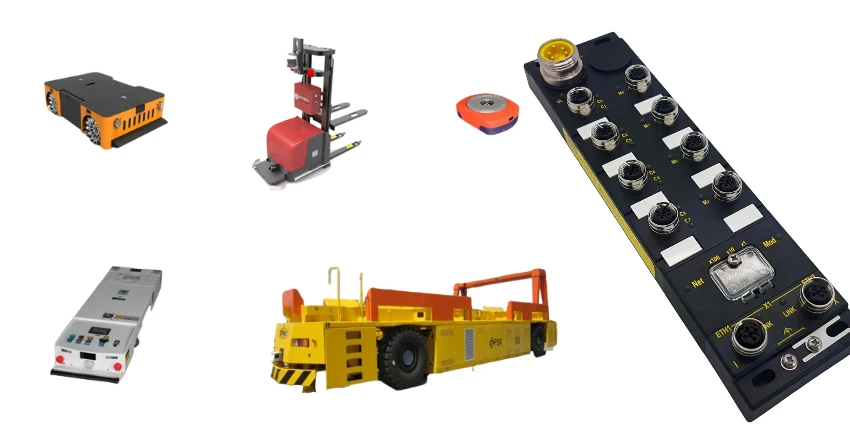
In practice, communication gateways are part of a broader robot electronics ecosystem that includes motion control, power electronics, sensing, and safety subsystems. An overview of how these complex robot PCBs are fabricated and assembled — including multilayer stackups and mixed-signal constraints — is outlined in our robot PCB manufacturing and assembly services reference.
Real-Time Communication Fundamentals
Industrial communication is defined by determinism rather than raw throughput. Robots depend on predictable timing to maintain stable motion and coordinated behavior.
- Cycle Time Budgets: Motion control networks often operate at 1–4 ms cycle times or faster. Each processing stage inside the gateway consumes part of this budget.
- Jitter Control: Consistent latency is often more important than minimal latency. Random timing variation can destabilize control loops even if average latency is low.
- Clock Synchronization: Distributed systems rely on synchronized clocks. IEEE 1588 PTP requires hardware timestamping in Ethernet PHYs and careful clock routing on the PCB.
Multi-Port Isolation Architecture
Communication gateways connect networks operating at different voltages and ground references. Proper isolation protects equipment, ensures operator safety, and prevents communication errors caused by ground loops.
- Port-to-Port Isolation: Each interface may require galvanic isolation from others. Isolation ratings must account for fault conditions and transient overvoltage.
- Isolation Technologies: Digital isolators support high-speed links, transformers provide inherent Ethernet isolation, and optocouplers suit lower-speed interfaces.
- Creepage and Clearance: PCB layout must meet industrial spacing requirements under pollution degree 2 conditions, often requiring slots or extended surface paths.
- Isolated Power Domains: Each isolated interface typically requires its own isolated power supply, adding complexity to power distribution and layout.
Physical Layer Implementation
Reliable communication depends on correct physical layer implementation, particularly in factory environments with long cables and high electrical noise.
- Industrial Ethernet: Controlled-impedance routing, appropriate magnetics, and PHYs that support real-time features are essential for stable operation.
- RS-485 Interfaces: Proper termination, biasing, and transient protection ensure signal integrity and survivability.
- CAN and CAN FD: Transceiver selection must match bit rates and cable lengths, with CAN FD requiring faster devices and tighter layout control.
- Connector Selection: Industrial connectors must withstand vibration, contamination, and repeated mating without degrading signal quality.

Protocol Processing and Translation
Protocol translation requires processing resources matched to data rates, complexity, and timing constraints.
- Microcontroller-Based Designs: Suitable for moderate complexity, but require careful worst-case execution analysis.
- FPGA-Based Solutions: Provide deterministic timing for demanding real-time protocols at the cost of higher development complexity.
- Dedicated Protocol Controllers: ASIC-based controllers optimize performance for specific protocols and simplify timing guarantees.
- Memory and Buffering: Adequate buffering decouples protocol timing differences while maintaining determinism.
When selecting manufacturing partners for complex gateway boards, criteria such as isolation control, mixed-signal assembly, and validation under load are critical. Many of these considerations overlap with those used to evaluate suppliers for other robotic control electronics, as outlined in this robot joint driver PCBA supplier evaluation checklist.
Industrial Environment Reliability
Industrial communication gateways operate in environments that exceed the limits of consumer electronics.
- Extended Temperature Operation: Designs typically target −40 °C to +85 °C with appropriate derating.
- EMI Immunity: Motors, drives, and welding equipment generate significant interference that PCB layout and filtering must withstand.
- Long Service Life: Robots are expected to operate for many years, making component lifecycle planning essential.
- Production Consistency: Communication stability depends on consistent fabrication and assembly across production volume.
In summary, an industrial communication gateway PCB for robotic systems is a real-time, safety-relevant component rather than a generic networking board. Addressing protocol diversity, timing determinism, isolation integrity, and environmental robustness at the PCB level is essential for stable robot network integration and long-term field reliability.

Recommended Posts
TG150 PCB Manufacturer for Fabrication and Assembly
Highleap Electronics manufactures TG150 PCB boards to...
TG140 PCB Material Selection and Fabrication
Table of Contents TG140 PCB Materials and Selection...
How to Select Tg180 PCB Materials for Custom Boards
Choosing a Tg180 PCB involves more than selecting a...
Tg170 PCB Manufacturing and Assembly for Industrial Electronics
A Tg170 PCB may be specified for industrial electronics,...
How to get a quote for PCBs
Let us run DFM/DFA analysis for you and get back to you with a report.
You can upload your files securely through our website.
We require the following information in order to give you a quote:
-
- Gerber, ODB++, or .pcb, spec.
- BOM list if you require assembly
- Quantity
- Turn time
In addition to PCB manufacturing, we offer a comprehensive range of electronic services, including PCB design, PCBA (Printed Circuit Board Assembly), and turnkey solutions. Whether you need help with prototyping, design verification, component sourcing, or mass production, we provide end-to-end support to ensure your project’s success. For PCBA services, please provide your BOM (Bill of Materials) and any specific assembly instructions. We also offer DFM/DFA analysis to optimize your designs for manufacturability and assembly, ensuring a smooth production process.