
High Performance Computing PCB Manufacturing Solutions

In today’s technology-driven world, High-Performance Computing (HPC) is central to innovations across various scientific, engineering, and business applications. Whether for digital currency mining, graphics processing, server platforms, or high-efficiency power systems, HPC PCBs are vital for ensuring the smooth operation of these devices. Highleap Electronics provides advanced GPU PCB manufacturing solutions that cater to these demanding applications, focusing on optimized thermal management, signal integrity, and system reliability. Our HPC PCB manufacturing offers precision engineering to meet the demands of complex computing systems, including AI accelerators, servers, and supercomputers.
Key Requirements for High-Performance Computing PCBs
HPC systems are not just basic circuit boards; they must meet the strict requirements of complex computational tasks. The needs vary depending on the application—mining, graphics cards, and data centers all have distinct PCB requirements. Below are the key technical requirements for HPC PCBs:
1. Efficient Thermal Management
In HPC systems, particularly in mining equipment, graphics cards, and data center servers, power consumption is often extreme, resulting in significant heat generation. If not properly managed, excessive heat can lead to system failures or reduced performance. Therefore, thermal management solutions are integrated into the PCB design:
- Thermal Interface Materials (TIMs): Ensuring efficient heat transfer between PCB surfaces and heat sinks.
- Embedded Cooling Channels: Microfluidic channels integrated into PCB layers for direct liquid cooling.
- Copper Layer Distribution: Strategic placement of copper to dissipate heat effectively across the PCB.
These cooling solutions ensure the system runs reliably under maximum load, maintaining junction temperature within specifications.
2. Signal Integrity
In high-frequency and high-speed data processing, any signal degradation or noise interference can lead to system errors or performance degradation. To maintain efficient data transmission, signal integrity is crucial in HPC PCBs. The design must support:
- Precision Impedance Control: Ensuring stable impedance throughout the frequency range, minimizing signal loss.
- Multi-Layer PCB Design: Optimizing power and ground plane layouts to reduce noise interference and ensure signal quality.
- High-Frequency Signal Handling: Supporting frequencies up to 100 GHz for mining rigs, graphics cards, and other high-frequency applications.
Maintaining signal integrity ensures that data is transferred without errors, which is vital for real-time simulations, data processing, and calculations.
3. High Bandwidth and Low Latency
As HPC applications require higher memory bandwidth and processing capabilities, PCBs must support extreme bandwidth and low-latency communication. Through high-speed interconnects and custom accelerators (such as GPUs, FPGAs, ASICs), HPC PCBs deliver the necessary processing power for parallel computing tasks.
Key Components of a Server Motherboard for High-Performance Computing Systems
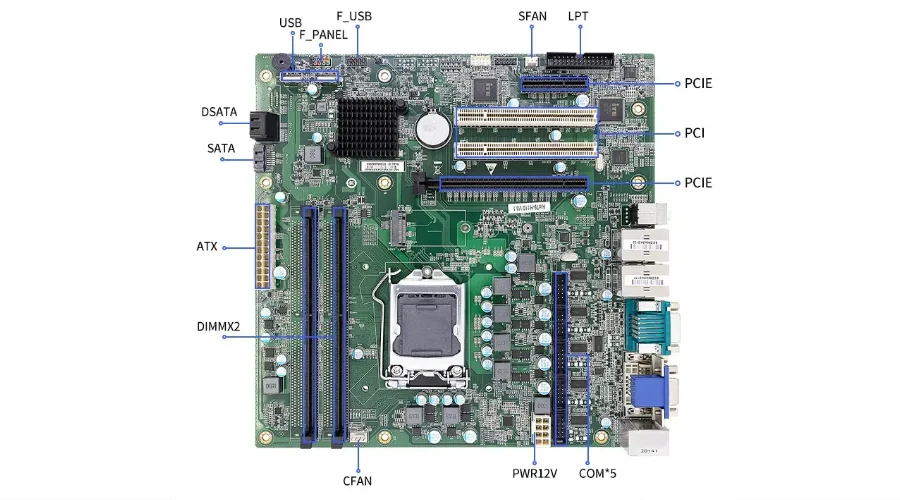
The motherboard is the backbone of any high-performance computing (HPC) system, connecting all critical components to ensure efficient operation. The image above highlights the essential features of a server motherboard, showcasing key areas that are crucial for performance in demanding applications such as data centers, supercomputing, and AI platforms. Understanding these components is vital to optimizing your system for maximum efficiency and reliability.
Key Components and Their Functions
- PCIe Slots (PCIE):The motherboard has several PCIe slots, used to connect expansion cards like GPUs, NICs, and storage controllers. In HPC systems, these are essential for adding high-performance components that handle intensive tasks like data processing and real-time computations.
- DIMM Memory Slots (DIMMX2):DIMM slots are where memory modules are installed. For HPC systems, high-speed RAM is critical to support heavy computational workloads. A larger memory capacity allows the system to process more data simultaneously, making the motherboard’s DIMM slots a key feature for performance.
- SATA and DSATA Ports (SATA, DSATA):The SATA ports are used to connect storage devices such as SSDs and hard drives. In HPC systems, fast storage is crucial for quick data retrieval and efficient processing. DSATA ports are typically used for specialized storage connections to handle larger datasets.
- USB Ports (USB, F_USB):These ports allow for the connection of peripheral devices like keyboards, mice, and USB drives. While they don’t directly affect the computational power of the system, they play an essential role in system management and user interaction.
- Power Supply Connector (PWR12V):The 12V power connector ensures that all components on the motherboard receive stable power. Power regulation is essential for HPC systems, as they require significant energy to run demanding tasks continuously.
- Cooling Fan Connectors (CFAN, SFAN):CFAN and SFAN connectors are used for connecting cooling fans. Effective cooling is essential for maintaining optimal operating temperatures in high-performance environments. Components like the CPU and GPUs generate significant heat, so the proper airflow ensures stable system performance.
- COM Port (COM5):The COM port is used for serial communication and is typically used for legacy devices or system management. While it’s less common in modern setups, it can still be relevant in certain HPC environments for specific control functions.
- ATX Power Connector (ATX):The ATX power connector is the primary connection between the motherboard and the power supply unit (PSU). A reliable power source is crucial for ensuring stable performance in HPC systems, especially those running resource-intensive tasks.
- System Panel and Additional Connectors (F_PANEL, SFAN, LPT):These connectors are used for system management functions like power buttons, LED indicators, and legacy ports like LPT (parallel ports). These components are important for controlling and monitoring the system in high-performance environments.
Tailored Solutions for Specific HPC Applications
1. Mining PCB Solutions
Cryptocurrency mining requires high-performance PCBs where power distribution and thermal management are critical. To support high-performance ASICs or multiple GPUs, mining PCBs must integrate:
- Power-efficient designs to manage high electrical consumption.
- Effective cooling systems to ensure stable, continuous operation.
- High-reliability components to withstand long hours of continuous mining.
For a more detailed exploration of how these designs are achieved, refer to our Computing PCB Layout solutions.
2. Graphics Cards and GPU Accelerator PCBs
Graphics cards play a vital role in fields like gaming, AI training, and high-performance computing. The PCB in a graphics card must support:
- High memory bandwidth (e.g., HBM, GDDR6) for rendering and processing large datasets.
- Signal integrity to maintain high-speed communication between GPU cores, memory, and external interfaces.
- Advanced heat dissipation techniques to prevent overheating during intensive rendering or AI workloads.
3. Data Center and Server PCBs
Data centers are crucial for modern computing infrastructure, supporting cloud computing, storage, and large-scale computations. PCBs in these systems must support:
- High-density interconnects for multi-processor architectures.
- Scalability and redundancy in power and data transmission to ensure uptime.
- Thermal stability to ensure system reliability under constant heavy workloads.

Advanced Manufacturing Techniques for HPC PCBs
In high-performance computing (HPC), the PCB is a critical component supporting supercomputing, data centers, cryptocurrency mining, AI systems, and graphics cards. At Highleap Electronics, we use advanced manufacturing techniques to deliver highly reliable, high-performance solutions. Our custom PCBs excel in signal integrity, thermal management, and power distribution, ensuring efficient and reliable system performance.
1. Laser Drilling and Precision Routing: Achieving Ultra-Fine Traces and Vias
In high-speed computing systems, achieving high-density interconnections with precision is essential. Standard PCB techniques often can’t meet the strict requirements for high-frequency signals and high-bandwidth data. We use laser drilling and precision routing to create ultra-fine traces and vias, ensuring:
- Micron-level precision: Laser drilling creates features with incredible accuracy, necessary for applications like cryptocurrency mining or GPU computation.
- High-density designs: Precision routing enables compact, intricate layouts for AI accelerators and server-grade GPUs.
2. Sequential Build-Up (SBU): Multi-Layer PCBs for Complex Systems
As HPC applications require more processing power, multi-layer PCBs are essential. The Sequential Build-Up (SBU) process produces high-density interconnect (HDI) PCBs, optimizing performance for:
- High-speed data transfer: Multi-layer designs minimize signal interference, optimizing data flow.
- Scalability: SBU allows us to design custom multi-layer PCBs for complex routing and integration, ideal for data center servers or AI supercomputers, as seen in server PCB manufacturing.
3. Embedded Component Integration: Space-Saving and Performance-Boosting Design
Space is critical in HPC systems. Embedded component integration places active and passive components within the PCB layers, reducing space while boosting performance:
- Compact design: Embedding components like resistors and ICs creates more compact systems, ideal for GPU cards, AI accelerators, or high-density servers, such as those used in AI computing hardware PCB manufacturing.
- Reduced signal loss: Shortened electrical paths improve signal integrity and reduce latency, crucial for real-time processing in mining applications.
- Efficient thermal management: Embedded components improve heat distribution, making the system more efficient.
4. Advanced Thermal Management: Keeping Your HPC Systems Cool
Effective thermal management is essential for HPC system longevity and performance. High-power components like CPUs, GPUs, and ASICs generate significant heat, which can lead to throttling or failure if not managed properly. At Highleap Electronics, we integrate advanced thermal management solutions directly into the PCB design:
- Embedded cooling channels: Microfluidic cooling systems provide direct liquid cooling to high-power components.
- Thermal vias and heat sinks: Optimized thermal via designs ensure efficient heat transfer, preventing overheating.
- High-conductivity materials: We use copper and metal-core substrates to transfer heat away from heat-sensitive components, in line with our HDI PCB guidelines for server motherboards.
5. Comprehensive Quality Control: Ensuring Reliability and Performance
At Highleap Electronics, we prioritize quality throughout the manufacturing process:
- Signal integrity testing: We ensure high-speed signals are transmitted with minimal degradation, essential for AI computations and real-time data processing.
- Thermal testing: Thermal simulations ensure your HPC PCB handles intense computational tasks without compromising safety.
- Dimensional accuracy checks: We ensure micron-level precision in component placement, guaranteeing system stability and reliability throughout its lifecycle. Our server motherboard PCB assembly services are a great example of this.
Each HPC PCB we produce undergoes rigorous inspections to meet the highest performance standards, ensuring reliability for mission-critical applications.
Why Choose Highleap Electronics for Your High-Performance Computing (HPC) PCB Manufacturing Needs?
Choosing Highleap Electronics for your HPC PCB manufacturing needs means partnering with a company that specializes in creating custom PCBs designed specifically for high-performance computing applications. Our advanced manufacturing technologies, including laser drilling, sequential build-up, embedded component integration, and advanced thermal management, ensure your systems are built for maximum performance, reliability, and efficiency. We also offer complete PCB fabrication and PCB assembly services to fully support your product development cycle.
- Customized solutions: We tailor every PCB to meet the exact requirements of your HPC system, whether it’s for data centers, AI platforms, graphics cards, or mining rigs. Our comprehensive electronic manufacturing services can help you build and scale your product efficiently.
- Advanced manufacturing: Our state-of-the-art manufacturing processes ensure that each PCB is built to handle the most demanding workloads with precision and consistency.
- Rigorous testing: From signal integrity to thermal performance, we guarantee that every PCB is thoroughly tested to meet the highest standards of quality.

Related Articles
TMM4 Filter PCB Manufacturing
TMM4 filter PCB manufacturing is controlled by the...
TMM3 PCB Manufacturing for RF Modules
TMM3 PCB manufacturing is most useful where the RF module...
TMM6 PCB Fabrication
TMM6 fabrication is the process-control page for a mid-Dk...
TMM13i PCB Manufacturing
TMM13i PCB manufacturing is aimed at ultra-compact RF...
How to get a quote for PCBs
Let us run DFM/DFA analysis for you and get back to you with a report.
You can upload your files securely through our website.
We require the following information in order to give you a quote:
-
- Gerber, ODB++, or .pcb, spec.
- BOM list if you require assembly
- Quantity
- Turn time
In addition to PCB manufacturing, we offer a comprehensive range of electronic services, including PCB design, PCBA (Printed Circuit Board Assembly), and turnkey solutions. Whether you need help with prototyping, design verification, component sourcing, or mass production, we provide end-to-end support to ensure your project’s success. For PCBA services, please provide your BOM (Bill of Materials) and any specific assembly instructions. We also offer DFM/DFA analysis to optimize your designs for manufacturability and assembly, ensuring a smooth production process.