
I-Tera MT40 PCB Supplier Qualification Checklist
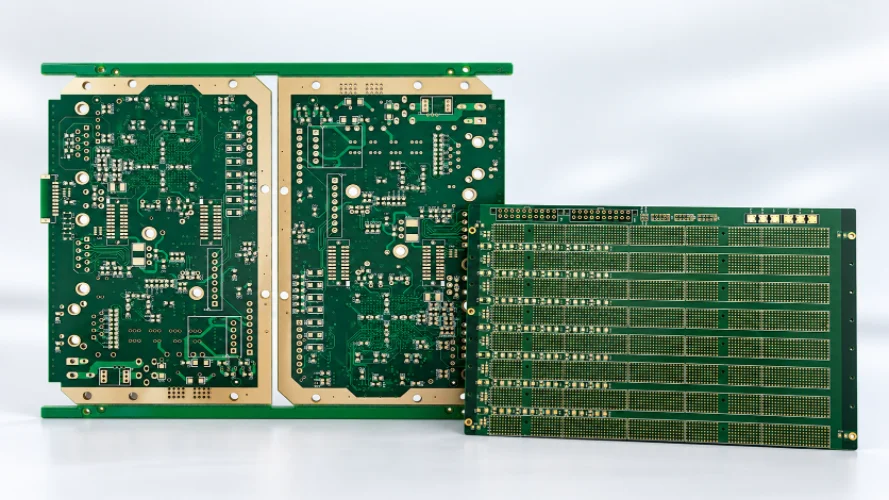
Highleap Electronics manufactures printed circuit boards using Isola I-Tera® MT40 laminate and prepreg for high-speed digital and RF applications. If you are qualifying an Isola I-Tera MT40 PCB manufacturer, the objective is to confirm not only that the specified material can be sourced but also that the PCB fabricator can build the released stack-up, meet impedance requirements, control lamination and document the agreed acceptance criteria.
Isola makes the laminate and prepreg; Highleap fabricates PCBs from customer-approved materials. This distinction matters when searching for an “I-Tera MT40 prepreg manufacturer”: an OEM normally needs a qualified PCB fabrication partner, not a company claiming to manufacture Isola’s proprietary prepreg. A material certificate demonstrates material identity; final trace geometry, dielectric thickness, via quality and measured electrical performance are fabrication responsibilities.
What Qualifies an Isola I-Tera MT40 PCB Manufacturer?
A qualified I-Tera MT40 PCB manufacturer should be able to connect material identity, stack-up engineering, production controls and inspection evidence to the exact PCB revision being purchased. Highleap’s I-Tera MT40 PCB manufacturing service is aimed at the board fabrication and assembly needs of OEMs, while the underlying dielectric system is supplied by Isola.
According to the Isola I-Tera MT40 product data, typical headline properties are Dk 3.45, Df 0.0031, Tg 215°C by DSC and Td 360°C. These are material reference values, not automatic guarantees for every completed trace. The construction-level Dk/Df table, resin content, cured bondline thickness, copper treatment and measurement frequency must inform the actual design model. Isola also describes this material as FR-4 process compatible, lead-free assembly compatible and suitable for multiple lamination and reflow cycles. The process still has to be controlled for the chosen structure.
For a 10-layer high-speed backplane or RF module, manufacturing qualification therefore covers more than a generic statement that the factory “works with Isola.” Request a proposed stack-up with exact core and prepreg constructions, the intended copper foil type, controlled-impedance targets, mechanical requirements and evidence from comparable builds where available.
Six Technical Audit Criteria for I-Tera MT40 PCB Fabrication
The following six checks convert a general capability statement into questions that a purchasing or signal-integrity engineer can verify during supplier qualification.
| Audit criterion | Evidence worth requesting | Warning sign |
|---|---|---|
| 1. Material identity | Isola grade, core construction, prepreg style/resin content, approved sourcing route and traceability arrangement | “I-Tera or equivalent” without an approved alternate list |
| 2. Stack-up control | Nominal and tolerance-based dielectric thicknesses, actual copper weights and impedance targets | Generic layer count and total thickness without dielectric construction |
| 3. Lamination | Process qualification approach and relevant microsection or thermal evidence for the stack-up | An unreviewed press recipe treated as valid for every material and hybrid structure |
| 4. Foil selection | Specified RTF/HVLP or other foil construction and customer approval of the option | Unspecified surface treatment where insertion loss is critical |
| 5. Electrical verification | TDR coupon plan and pass/fail tolerances; RF loss testing when the design requires it | TDR data presented as direct proof of insertion-loss performance |
| 6. Change/lot control | First-article approval, traceable build revision, documented substitution and reporting requirements | Prepreg or copper treatment changed between lots without ECO approval |
Highleap’s advanced PCB fabrication scope covers multilayer and high-frequency boards, but project-specific reports such as material lot certificates, cross-sections and measured TDR data should be agreed in the purchase specification. A supplier qualification should ask what will be delivered for this job, not assume every optional laboratory result is standard.
Prepreg, Lamination and Hybrid Stack-Up Engineering
Prepreg style and cured dielectric geometry must be treated as controlled design inputs. Glass style labels such as 1080, 2116 or 7628 do not uniquely specify finished thickness or effective Dk without the material manufacturer’s available construction and resin-content data. The same glass family can have multiple resin variants. Isola’s official construction tables should be used for the exact material release, followed by confirmation of the fabricator’s achievable build thickness.
At laminate selection and stack-up review, the useful engineering conversation starts with signal layer placement, reference planes, target impedance and board thickness. The fabrication stack-up must reconcile dielectric thickness after pressing, copper distribution, finished plating, solder mask effects where relevant and fabrication tolerance. For closely spaced differential lanes, fiber-weave and skew considerations also deserve review.
For hybrid I-Tera/FR-4 builds, examine the entire lamination architecture—not only material Tg. Resin compatibility, expansion behavior, bonding layers, drill and desmear sequences, surface preparation and repeated thermal exposure can influence manufacturability. Isola’s FR-4 process compatibility reduces certain processing barriers; it does not eliminate the need to qualify the selected hybrid combination.
When blind or buried vias and sequential lamination are involved, integrate HDI interconnect design requirements into the DFM discussion. Via reliability, layer registration, finished dielectric thickness and the sequence of fabrication steps must be considered together.
Copper Foil, Impedance and High-Frequency Verification
Low-loss PCB performance depends on the dielectric and the conductive path. Isola lists RTF and HVLP foil options for I-Tera MT40. A choice between foil grades should be driven by the loss budget, available construction and manufacturability—not a blanket rule that one foil is mandatory above a specific GHz threshold. Conductor loss changes with roughness, trace geometry, copper thickness and frequency, and should be evaluated using the product’s own channel or RF model.
Controlled impedance should begin with a documented design target and tolerance. In controlled-impedance PCB production, TDR measurements on representative coupons can verify impedance at an agreed fabrication stage. TDR verifies impedance response; it does not directly measure dielectric Dk, Df or insertion loss in the operating channel. For insertion-loss acceptance, define appropriate S-parameter measurement structures, frequencies, de-embedding and loss limits if the project needs them.
A cross-section can independently support plated-hole quality, copper thickness and dielectric geometry verification. Those measurements address build quality but cannot replace an RF channel test. For high-frequency RF PCB designs, make explicit which characteristics are design simulations, which are factory-process measurements and which are final acceptance requirements.
First-Article Approval and Repeat-Order Qualification
A first-article review should freeze the construction the OEM actually approved. Before volume release, reconcile the final production stack-up with the simulation, the fabricated coupon design and any test-fixture assumptions. If the first lot shows unexpected impedance or excess insertion loss, look at trace width, copper roughness, etched profile, dielectric thickness and via transitions—not only the Isola material’s nominal Dk.
- Approve the material stack-up: exact grade, construction, glass/resin designation, foil, thickness tolerances and no-substitution notes.
- Define the inspection plan: applicable IPC fabrication class, netlist electrical test, microsection sampling, impedance coupon method and any RF loss measurements.
- Record the first-article result: actual stack-up, measured quantities and documented deviations approved by the OEM.
- Control repeat production: material/foil substitutions, stack-up changes, plating or etch changes affecting controlled features, and production-lot documentation.
For low-loss high-frequency fabrication projects, this process is most valuable when the same board will be reordered over multiple product releases. A stable approved construction helps procurement avoid qualification rework when a nominally equivalent laminate is proposed.
Qualify Highleap Electronics for Your I-Tera MT40 Build
Highleap offers an OEM a combined route from I-Tera MT40 PCB fabrication to optional assembly. Our turnkey PCB assembly capability and SMT electronics assembly support can be considered if the finished hardware includes purchased components, SMT, inspection or product-defined test. This is a factory manufacturing offer—not a claim that Highleap manufactures Isola laminate or automatically provides every optional qualification report.
For a useful manufacturer qualification or RFQ, send Gerber/ODB++ data, a fabrication drawing, proposed stack-up, impedance table, copper foil requirements, minimum trace/space, via structure, IPC class, quantities, target schedule and required inspection deliverables. If you are comparing alternative materials or a hybrid stack-up, attach the allowable engineering-change boundaries.
Manufacturer qualification FAQs
Does Isola manufacture the finished PCB? Isola manufactures the I-Tera MT40 laminate and prepreg. PCB fabricators such as Highleap convert the approved material into finished boards.
Is a material certificate enough to approve a low-loss PCB? No. It identifies the source material but does not verify fabricated impedance, via quality, insertion loss or customer-specific acceptance criteria.
Is RTF copper required for every I-Tera MT40 design? No. Copper selection should follow the specified construction and channel loss budget. RTF and HVLP are Isola-listed options; the approved foil must be reflected in the fabrication package.
Get an I-Tera MT40 PCB Manufacturer Review
Send Highleap your stack-up and production files. Specify any required material traceability, controlled-impedance reports, cross-sections or RF testing so the quotation covers the evidence you actually need.
Material values above are typical Isola reference data; confirm construction-specific data and revisions for your design. Factory stock, equipment methods, reports, certification scope, availability and lead time are subject to project confirmation.

Recommended Posts
Industrial Electronics PCB Assembly
Industrial electronics PCB assembly covers the...
Consumer Electronics PCB Assembly
Highleap Electronics provides consumer electronics PCB...
PCB Assembly with Firmware Programming
Highleap Electronics provides PCB assembly with firmware...
24 Layer PCB Manufacturer in China
How to get a quote for PCBs Let‘s run DFM/DFA analysis for...
How to get a quote for PCBs
Let‘s run DFM/DFA analysis for you and get back to you with a report. You can upload your files securely through our website. We require the following information in order to give you a quote:
-
- Gerber, ODB++, or .pcb, spec.
- BOM list if you require assembly
- Quantity
- Turn time
In addition to PCB manufacturing, we offer a comprehensive range of electronic services, including PCB design, PCBA, and turnkey solutions. Whether you need help with prototyping, design verification, component sourcing, or mass production, we provide end-to-end support to ensure your project’s success.
For PCBA services, please provide your BOM (Bill of Materials) and any specific assembly instructions. We also offer DFM/DFA analysis to optimize your designs for manufacturability and assembly, ensuring a smooth production process.