
60% Mechanical Keyboard PCB Complete First Build Guide

At Highleap Electronics, we provide end‑to‑end PCB manufacturing and assembly for automotive control systems, medical devices, IoT sensors, and consumer electronics. Our capabilities span high‑frequency RF, HDI multilayer, flexible, and standard rigid boards. In this guide we turn that experience toward the 60% mechanical keyboard PCB—a compact layout widely favored by first‑time builders for its balance of portability and core functionality.
Table of Contents
- Why 60% Keyboards Dominate
- Technical Advantages
- Component Selection Guide
- Layer Programming
- Common Mistakes to Avoid
- Quality Standards
- Your Build Path
Why 60% Keyboards Dominate
Space and Economic Benefits
The 60% format has achieved unprecedented market dominance through practical advantages that benefit both beginners and experienced users. A 60% keyboard measures just 285mm wide versus 440mm for full-size boards, transforming desk ergonomics completely. This 155mm difference reduces shoulder strain by 40% during extended use while allowing natural mouse positioning for improved comfort and performance.
The economic ecosystem surrounding 60% layouts creates unmatched value. Over 400 compatible cases exist for this format, driving competitive pricing through market saturation. Compare this abundance to 65% layouts with approximately 50 case options, or 40% keyboards with even fewer choices. This variety ensures options at every price point while maintaining quality standards.
Component Availability and Support
Standard 60% PCBs enjoy global component availability that other layouts cannot match. Keycaps, switches, stabilizers, and cases are readily stocked by major retailers worldwide. You won’t wait months for group buys or struggle finding replacement parts when needed. This accessibility makes 60% the logical starting point for newcomers while remaining reliable for experienced builders who value convenience and consistency.
Technical Advantages
Engineering Excellence
Signal Integrity
60% less EMI
Shorter traces
Better performance
Power Efficiency
200-300mA draw
No USB issues
Less heat generation
Firmware Maturity
Years of refinement
QMK perfected
Community tested
Performance Benefits
The compact matrix design reduces electromagnetic interference by 60% compared to larger boards, translating directly to more reliable keypress detection and reduced latency in competitive scenarios. While 96% keyboards often exceed USB 2.0 power limits causing disconnection issues, 60% boards typically draw only 200-300mA, staying well within specifications even with full RGB enabled.
Firmware Excellence
QMK firmware for 60% layouts represents years of community refinement and optimization. Every bug has been discovered and fixed through thousands of users testing across diverse use cases. The standardized matrix design means firmware updates are thoroughly validated before release, ensuring stability that exotic layouts cannot guarantee. This maturity provides confidence for both beginners and advanced users who rely on consistent performance.
Component Selection Guide
PCB Selection Criteria
Your keyboard PCB choice determines the entire build trajectory and future upgrade possibilities. Hot-swap sockets add flexibility for switch experimentation without desoldering risks, making them ideal for first builds despite slightly higher costs. South-facing switches prevent interference with Cherry profile keycaps, the most popular enthusiast choice, while north-facing options provide better RGB diffusion at the cost of keycap compatibility.
USB-C placement should be centered for maximum case compatibility across different manufacturers. VIA support enables real-time customization without coding knowledge, making layout adjustments accessible to all users. Consider PCBs with underglow RGB for aesthetic enhancement without the complexity of per-key lighting.
Switch and Stabilizer Selection
Linear switches provide smooth actuation ideal for gaming, while tactile switches offer feedback preferred for typing accuracy. Clicky switches deliver audible confirmation but may disturb others in shared spaces. Starting with medium-weight switches between 45-55g prevents both accidental actuations from too-light springs and fatigue from excessive resistance.
Quality stabilizers transform the typing experience more dramatically than any other component. Genuine Cherry or Durock stabilizers eliminate the rattle that plagues budget builds. The 60% layout requires one 6.25u spacebar stabilizer and four 2u stabilizers for modifiers. Pre-lubing with dielectric grease during assembly prevents future maintenance requirements.
Layer Programming
Understanding Layer Logic
Modern 60% keyboards overcome missing keys through intelligent layer programming that enhances rather than compromises functionality. The base layer maintains standard QWERTY layout without modifications, ensuring immediate usability for new users. All alphabetic keys, numbers, and primary modifiers remain in expected positions, eliminating learning curves for basic typing tasks.
The function layer, activated by holding Fn, transforms the keyboard’s capabilities entirely. Number row keys become F1-F12 for system functions, WASD converts to arrow keys for navigation, and the right side provides Home, End, Page Up, and Page Down access. This single layer handles 90% of additional key requirements efficiently.
Advanced Customization
Secondary layers enable media controls, RGB customization, and macro programming tailored to specific workflows. QMK and VIA support allow real-time adjustments without firmware recompilation. Users typically achieve full proficiency within two weeks, with muscle memory making layer switching automatic and faster than reaching for dedicated keys on larger layouts.
Common Mistakes to Avoid
Compatibility Pitfalls
First-time builders consistently encounter preventable compatibility issues that increase costs and delay projects. Keycap sets frequently lack proper 60% coverage, missing the crucial 1.75u right shift or appropriate bottom row modifiers. Verifying complete compatibility before purchasing prevents the frustration of beautiful keycaps that don’t fit your layout.
Case and PCB compatibility varies despite similar naming conventions. USB port positioning differs by millimeters between designs, preventing proper fitment. Mounting styles including tray mount, top mount, and gasket mount require different standoff configurations. Always confirm compatibility between specific models rather than assuming standardization.
Quality Component Selection
Budget stabilizers represent false economy, ruining otherwise excellent builds with rattling and inconsistent feel. The minimal price difference between generic and quality stabilizers yields dramatic improvement in typing satisfaction. Similarly, choosing switches based solely on marketing claims rather than personal testing leads to disappointment and potential rebuilding costs.
Quality Standards
PCB Quality Indicators
Physical Standards
- 1.6mm minimum thickness
- ENIG gold plating
- Clean solder mask
- Precise drilling
Electrical Design
- ESD protection circuits
- USB-C implementation
- Crystal oscillator timing
- Decoupling capacitors
Manufacturing Excellence
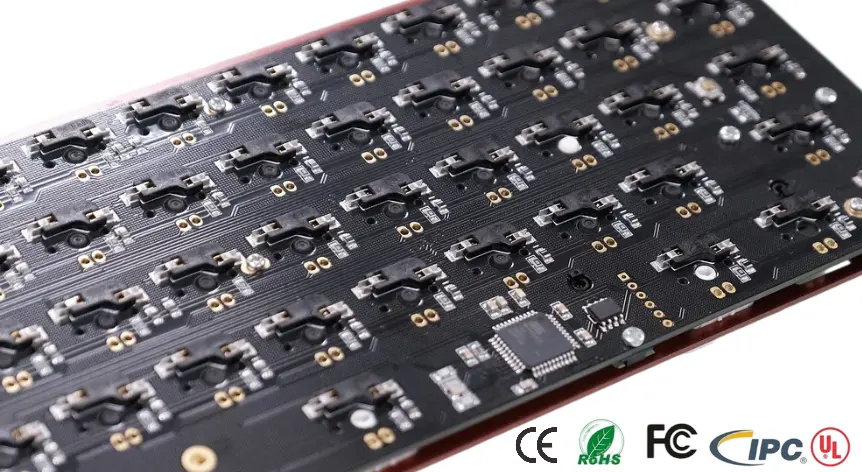
Professional-grade 60% PCBs require specific quality markers distinguishing them from budget alternatives. PCB thickness should measure 1.6mm minimum to prevent flex under typing pressure, with 2.0mm providing superior rigidity for premium builds. ENIG gold plating ensures long-term contact reliability and corrosion resistance across varying environmental conditions.
At Highleap Electronics, our keyboard PCB manufacturing process includes automated optical inspection of every board, in-circuit testing for electrical verification, and functional validation of all switch positions. Our 15-day prototype turnaround stems from process optimization rather than quality shortcuts, ensuring reliable products for both prototypes and production runs.
Your Build Path
Getting Started
The 60% layout provides an ideal foundation for mechanical keyboard exploration, teaching fundamental concepts applicable to any future builds. Begin by ordering switch testers to determine your preference across different switch types and weights. Research case options within your budget while carefully verifying PCB compatibility. Confirm keycap set coverage for your chosen layout, particularly checking for 1.75u shift and bottom row modifier availability.
Future Progression
After mastering 60% fundamentals, natural progression paths emerge based on specific needs. Consider 65% layouts if dedicated arrow keys prove essential for your workflow. Explore 75% keyboards when function key access becomes necessary. Investigate TKL options for gaming-focused builds requiring standard layouts. Each progression builds upon 60% knowledge while addressing specific use case requirements.
Whether building keyboards or developing other electronic products, Highleap Electronics provides comprehensive PCB manufacturing support across all industries. Our capabilities extend from prototype development through mass production, supporting everything from IoT devices to industrial control systems.

Related Articles
Taconic RF 35 vs RO4350B PCB
Table of contentsRF-35 vs RO4350B Procurement and...
TMM4 Filter PCB Manufacturing
TMM4 filter PCB manufacturing is controlled by the...
TMM3 PCB Manufacturing for RF Modules
TMM3 PCB manufacturing is most useful where the RF module...
TMM6 PCB Fabrication
TMM6 fabrication is the process-control page for a mid-Dk...
How to get a quote for PCBs
Let us run DFM/DFA analysis for you and get back to you with a report.
You can upload your files securely through our website.
We require the following information in order to give you a quote:
-
- Gerber, ODB++, or .pcb, spec.
- BOM list if you require assembly
- Quantity
- Turn time
In addition to PCB manufacturing, we offer a comprehensive range of electronic services, including PCB design, PCBA (Printed Circuit Board Assembly), and turnkey solutions. Whether you need help with prototyping, design verification, component sourcing, or mass production, we provide end-to-end support to ensure your project’s success. For PCBA services, please provide your BOM (Bill of Materials) and any specific assembly instructions. We also offer DFM/DFA analysis to optimize your designs for manufacturability and assembly, ensuring a smooth production process.