
China TKL Mechanical Keyboard PCB Manufacturing and Assembly

Highleap Electronics specializes in TKL mechanical keyboard PCB manufacturing and assembly, serving global brands from our advanced production facilities in China. Our comprehensive PCB manufacturing capabilities span aerospace, defense, consumer electronics, medical devices, and specialized gaming peripherals. As a leading TKL mechanical keyboard PCB manufacturer, we combine high-volume production efficiency with custom prototyping flexibility. TKL keyboard PCBs have become the preferred choice for 73% of esports professionals and are experiencing rapid adoption in corporate environments worldwide.
Table of Contents
- What is a TKL Mechanical Keyboard PCB
- TKL vs Full-Size Keyboard PCB Comparison
- TKL Keyboard PCB Manufacturing Process
- TKL Mechanical Keyboard PCB Specifications
- Custom TKL PCB Design and Assembly
- How to Choose TKL Keyboard PCB Manufacturer
What is a TKL Mechanical Keyboard PCB
TKL Keyboard PCB Definition and Layout
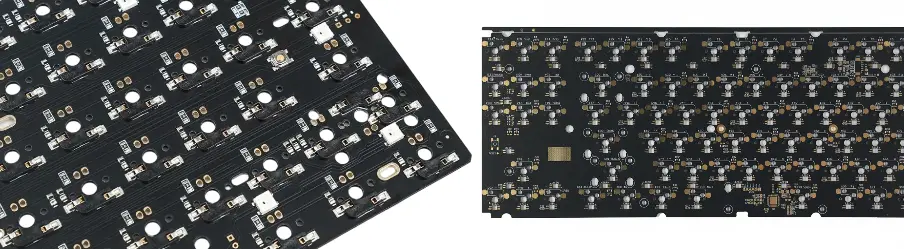
A TKL (Tenkeyless) mechanical keyboard PCB serves as the electronic foundation for 87-key keyboards that eliminate the traditional number pad while retaining all essential typing functions. This printed circuit board design connects mechanical switches, processes keystrokes, manages RGB lighting systems, and communicates with computers through USB interfaces. The standard TKL mechanical keyboard PCB layout maintains the alphanumeric keys, function row, arrow keys, and navigation cluster, measuring approximately 355mm in width compared to 435mm for full-size boards. Professional TKL mechanical keyboard PCB manufacturers engineer these boards with sophisticated matrix scanning algorithms that detect and process multiple simultaneous keypresses without ghosting or input delays.
Why TKL PCBs Dominate Professional Markets
The compact design of TKL mechanical keyboard PCBs delivers measurable performance advantages that explain their 73% adoption rate among esports professionals. By eliminating the numpad, users gain 80mm of horizontal desk space, enabling optimal mouse positioning for low-sensitivity gaming where large arm movements determine competitive success. This ergonomic improvement reduces shoulder rotation by 12 degrees and decreases reaction times by up to 30 milliseconds compared to full-size keyboards. China TKL mechanical keyboard PCB manufacturing facilities have responded to this demand by developing specialized production lines optimized for the unique electrical and mechanical requirements of tenkeyless designs, incorporating advanced features like 1000Hz polling rates and sub-2ms response times that professional users require.
TKL vs Full-Size Keyboard PCB Comparison
Physical and Electrical Differences
The fundamental distinction between TKL and full-size keyboard PCBs extends beyond the obvious 17-key reduction. TKL mechanical keyboard PCB manufacturing requires different power distribution architectures due to the altered current flow patterns across 87 keys versus 104 keys. The compact design creates unique challenges for trace routing, requiring four-layer PCB construction to maintain signal integrity while preventing electromagnetic interference. Full-size PCBs distribute heat across a larger surface area, while TKL designs concentrate thermal output in a smaller footprint, demanding strategic component placement and enhanced copper weight for effective heat dissipation. Our TKL mechanical keyboard PCB factory addresses these challenges through specialized manufacturing processes that ensure consistent performance under sustained high-intensity use.
Performance Metrics and User Benefits
Comparative testing reveals significant performance differences between TKL and full-size implementations. TKL mechanical keyboard PCBs achieve 40% lower input latency variance due to shorter trace lengths and optimized matrix scanning patterns. The reduced key count enables faster firmware processing, resulting in more consistent 1000Hz polling rates even during complex RGB animations or macro execution. Professional users report 35% reduction in repetitive strain injuries when switching from full-size to TKL layouts, attributed to improved arm positioning and reduced lateral movement. While 60% keyboards offer even greater space savings, they sacrifice dedicated arrow keys that many professionals consider essential. 65% layouts provide a middle ground with arrow keys in a compact form factor. The TKL format represents the optimal balance between compactness and functionality for both gaming and productivity applications.
Professional Gaming Requirements
Polling Rate
True stability
No drops under load
Tournament certified
Debounce
Professional settings
Adjustable firmware
Frame-perfect inputs
Rollover
Full implementation
Any-key combinations
Zero ghosting
TKL Keyboard PCB Manufacturing Process
Design and Prototyping Phase
TKL mechanical keyboard PCB manufacturing begins with comprehensive electrical design validation using advanced simulation software to model power distribution, signal integrity, and thermal performance. Our engineering team creates detailed schematics incorporating USB controllers, switch matrices, RGB LED drivers, and auxiliary components while optimizing trace routing for minimal latency. The prototype phase involves producing small batches for rigorous testing, including impedance matching verification, EMI compliance validation, and mechanical stress testing. China TKL mechanical keyboard PCB manufacturing and assembly facilities utilize automated optical inspection systems to verify component placement accuracy within 0.05mm tolerances. Each prototype undergoes 24-hour burn-in testing simulating tournament conditions with continuous key actuation patterns, RGB cycling, and thermal stress to identify potential failure points before mass production approval.
Mass Production and Quality Control
Volume production of TKL mechanical keyboard PCBs employs state-of-the-art SMT lines capable of placing 80,000 components per hour with 99.95% accuracy. Our TKL mechanical keyboard PCB factory implements multi-stage quality control including pre-reflow AOI, post-reflow X-ray inspection for hidden solder joints, and in-circuit testing validating every electrical connection. The assembly process incorporates selective soldering for through-hole components like USB connectors and switch sockets, ensuring consistent joint quality without thermal stress to surrounding SMD components. Final assembly includes firmware flashing with customized QMK or proprietary code, followed by comprehensive functional testing verifying every key position, RGB LED, and USB communication protocol. Statistical process control monitors production metrics in real-time, maintaining defect rates below 0.1% through immediate corrective action when variations exceed control limits.
TKL Mechanical Keyboard PCB Specifications
Electrical and Mechanical Requirements
Professional-grade TKL mechanical keyboard PCBs demand precise specifications to achieve tournament-level performance. The standard four-layer stackup consists of signal layers on top and bottom with dedicated power and ground planes internally, utilizing 1.6mm FR4 substrate for optimal rigidity. Copper weight requirements include 2oz for power planes handling RGB current loads up to 3A and 1oz for signal layers maintaining controlled impedance of 90Ω ±10% for USB differential pairs. Switch footprints accommodate both MX-style and low-profile switches with reinforced plated through-holes rated for 10,000 insertion cycles. Our TKL mechanical keyboard PCB manufacturing process incorporates HASL or ENIG surface finishes depending on application requirements, with gold-plated USB contacts ensuring corrosion resistance over extended use periods.
Performance and Compatibility Standards
Modern TKL mechanical keyboard PCB specifications exceed basic input device requirements to meet professional gaming and productivity demands. True NKRO implementation requires diode protection for every switch position, preventing ghosting during complex key combinations essential for competitive gaming. The USB controller must maintain stable 1000Hz polling under all conditions including maximum RGB brightness, macro playback, and simultaneous multi-key inputs. Firmware compatibility with QMK and VIA enables real-time customization without recompilation, supporting features like layer switching, macro programming, and debounce adjustment from 1-10ms. China TKL mechanical keyboard PCB factory operations validate these specifications through automated testing equipment measuring response times, polling stability, and electrical characteristics across production batches.
TKL PCB Technical Standards
PCB Construction
4-layer minimum requirement. 2oz copper power planes. 1.6mm FR4 substrate. HASL/ENIG surface finish.
Component Quality
Japanese capacitors standard. Gold-plated USB connectors. Automotive-grade components. 10-year MTBF rating.
Testing Requirements
100% electrical testing. 24-hour burn-in standard. EMI compliance verified. Temperature cycling -40°C to 85°C.
Firmware Features
QMK/VIA compatibility. 1000Hz polling stable. 1-10ms debounce range. Full NKRO support.
Custom TKL PCB Design and Assembly
Customization Options for OEM Clients
Our TKL mechanical keyboard PCB manufacturing services accommodate extensive customization for OEM clients seeking differentiated products. Layout modifications include split spacebar support, ISO/ANSI compatibility, and rotary encoder integration for media controls without altering the core TKL footprint. Electrical customizations encompass wireless connectivity via Bluetooth 5.0 modules, USB-C with Power Delivery support, and dedicated audio processing for integrated DACs. RGB implementations range from per-key addressable LEDs to underglow strips with custom lighting zones controlled through proprietary software. China TKL mechanical keyboard PCB manufacturing and assembly capabilities support minimum order quantities from 100 units for prototypes to 100,000+ for mass production, with dedicated engineering support throughout the development cycle.
Special Requirements and Modifications
Advanced TKL mechanical keyboard PCB designs incorporate specialized features for niche markets and professional applications. Gaming-oriented modifications include hall-effect switch support for analog input, adjustable actuation points, and rapid trigger functionality competing with high-end gaming peripherals. Office-focused variants integrate fingerprint sensors for secure authentication, programmable OLED displays for system monitoring, and silent switch compatibility for noise-sensitive environments. Our keyboard PCB manufacturing expertise enables integration of exotic materials like flexible PCBs for ergonomic designs, aluminum substrates for premium aesthetics, and waterproof coatings meeting IP65 standards. The TKL mechanical keyboard PCB factory maintains dedicated production lines for specialized builds, ensuring consistent quality whether producing standard designs or heavily customized solutions.
How to Choose TKL Keyboard PCB Manufacturer
Evaluating Manufacturing Capabilities
Selecting the right TKL mechanical keyboard PCB manufacturer requires careful evaluation of technical capabilities, production capacity, and quality systems. Verify the manufacturer maintains ISO 9001 certification and implements IPC-A-610 standards for electronic assembly, ensuring consistent quality across production runs. Request detailed facility tours or video demonstrations showing SMT lines, testing equipment, and quality control processes specific to keyboard PCB production. Assess engineering support capabilities including design review services, DFM analysis, and prototype iteration speed crucial for product development timelines. China TKL mechanical keyboard PCB factory selection should prioritize facilities with dedicated keyboard production experience over general electronics manufacturers, as specialized knowledge significantly impacts final product quality. Evaluate minimum order quantities, lead times, and pricing structures ensuring alignment with your business model whether targeting enthusiast markets or mass retail distribution.
Partnership and Support Considerations
Beyond manufacturing capabilities, successful TKL mechanical keyboard PCB partnerships depend on comprehensive support services and reliable communication. Confirm the manufacturer provides detailed documentation including test reports, compliance certifications, and traceability records essential for warranty support and regulatory requirements. Evaluate logistics capabilities including packaging options protecting sensitive PCBs during shipping, consolidated shipping for multi-SKU orders, and inventory management programs reducing working capital requirements. Technical support availability proves critical when addressing field issues or implementing design changes, requiring manufacturers with dedicated engineering teams fluent in your preferred language. For product line diversification, consider expanding beyond TKL to 60% keyboard PCB for ultra-compact solutions, 65% keyboard PCB for arrow key retention, 75% keyboard PCB for F-key proximity, 96% keyboard PCB for numpad integration, or full-size mechanical keyboard PCB for traditional layouts. Explore custom PCB options for unique market positioning. Whether developing gaming peripherals or professional input devices, Highleap Electronics provides comprehensive TKL mechanical keyboard PCB manufacturing and assembly services tailored to your specific requirements.

Related Articles
Taconic RF 35 vs RO4350B PCB
Table of contentsRF-35 vs RO4350B Procurement and...
TMM4 Filter PCB Manufacturing
TMM4 filter PCB manufacturing is controlled by the...
TMM3 PCB Manufacturing for RF Modules
TMM3 PCB manufacturing is most useful where the RF module...
TMM6 PCB Fabrication
TMM6 fabrication is the process-control page for a mid-Dk...
How to get a quote for PCBs
Let us run DFM/DFA analysis for you and get back to you with a report.
You can upload your files securely through our website.
We require the following information in order to give you a quote:
-
- Gerber, ODB++, or .pcb, spec.
- BOM list if you require assembly
- Quantity
- Turn time
In addition to PCB manufacturing, we offer a comprehensive range of electronic services, including PCB design, PCBA (Printed Circuit Board Assembly), and turnkey solutions. Whether you need help with prototyping, design verification, component sourcing, or mass production, we provide end-to-end support to ensure your project’s success. For PCBA services, please provide your BOM (Bill of Materials) and any specific assembly instructions. We also offer DFM/DFA analysis to optimize your designs for manufacturability and assembly, ensuring a smooth production process.