
High-Speed PCB Stackup | Manufacturing Challenges and Design Solutions

High-speed PCB stackup has become a cornerstone of modern electronics, where data transmission at multi-gigabit speeds leaves no room for error. From 5G infrastructure to AI computing and autonomous vehicles, these systems demand PCB architectures that balance signal integrity, impedance control, power delivery, and manufacturability.
Stackup design is no longer just a layout decision—it is a manufacturing challenge that directly determines performance, reliability, and cost efficiency. This article explores the key challenges of high-speed PCB stackup manufacturing and provides practical design strategies to achieve consistent, reliable results.
Why High-Speed PCB Stackup Matters in PCB Manufacturing
The fundamental challenge in high-speed PCB stackup manufacturing lies in maintaining consistent electrical characteristics across all signal paths while managing the complex interdependencies between layer arrangement, material properties, and production processes.
Signal Integrity and Impedance Control
Precise impedance matching becomes critical when signal rise times drop below 1 nanosecond, as found in DDR4/DDR5 memory interfaces and high-speed serial protocols. Manufacturing tolerances of ±5% impedance control require careful coordination between trace geometry, dielectric thickness, and copper weight specifications.
Power Distribution Network Design
Effective power plane arrangement in high-speed stackups must provide low impedance power delivery while maintaining adequate plane capacitance. Target impedance levels typically range from 0.5Ω to 2Ω across the frequency spectrum, requiring strategic placement of decoupling capacitance and optimized via distributions.
EMI Mitigation Through Layer Arrangement
Proper stackup design significantly reduces electromagnetic emissions by providing continuous reference planes and minimizing loop areas. Well-designed layer arrangements can reduce EMI by 15-20 dB compared to poorly optimized stackups, often eliminating the need for additional shielding solutions.
Thermal Management Integration
High-speed designs generate substantial heat due to increased power densities and faster switching frequencies. Strategic copper distribution and thermal via placement within the stackup help dissipate heat while maintaining electrical performance requirements.
Manufacturing Challenges in High-Speed PCB Stackup Implementation
The transition from design intent to manufactured reality in high-speed PCB stackup presents numerous technical challenges that require specialized manufacturing capabilities and strict process control measures.
Material Availability and Performance Variations
High-speed PCB materials such as a specialty low-loss laminate series, Isola I-Speed, and Panasonic Megtron 6 offer superior electrical properties but present manufacturing challenges. Different material lots can exhibit dielectric constant variations of ±0.05, directly impacting impedance calculations and requiring continuous process adjustments.
Layer Thickness and Tolerance Control
Achieving target impedance values requires precise control of dielectric thickness, typically within ±10% of nominal values. Prepreg flow during lamination can cause thickness variations of 15-25%, necessitating press-out thickness modeling based on copper density and resin content calculations.
HDI Technology Integration
High-Density Interconnect features introduce additional complexity to stackup design, with blind and buried vias requiring aspect ratio control of 0.75:1 for reliable plating. Via stub optimization and back-drilling processes become essential for maintaining signal integrity in multilayer constructions.
Warpage and Dimensional Stability
Complex stackups with mixed materials and asymmetric copper distributions can experience warpage exceeding 0.75mm on large panels. Advanced press cycles and post-cure stress relief techniques help maintain dimensional stability while preserving electrical characteristics.
Advanced Manufacturing Solutions for High-Speed PCB Stackup
Modern PCB manufacturers employ sophisticated process control and quality assurance measures to deliver consistent high-speed pcb stackup performance across production volumes.
Materials Engineering and Qualification
Successful high-speed PCB manufacturing requires extensive material characterization including dielectric constant mapping, loss tangent verification, and thermal coefficient analysis. Material qualification processes ensure lot-to-lot consistency and enable predictive modeling for impedance control.
Process Control and Monitoring
Real-time monitoring of press temperature, pressure, and vacuum levels ensures consistent dielectric thickness formation. Statistical process control tracks critical parameters with Cpk values exceeding 1.33 for impedance-critical layers.
Advanced Measurement and Verification
Time Domain Reflectometry testing validates impedance control in high-speed PCBs with measurement accuracy of ±1Ω. Automated test coupons provide statistical validation across production panels, ensuring consistent performance delivery.
Collaborative Design Optimization
Early engagement between design teams and manufacturing engineers enables stackup optimization for both electrical performance and manufacturing yield. Design for Manufacturing principles reduce production complexity while maintaining signal integrity requirements.
Practical Guidelines for High-Speed Stackup Design
Effective collaboration between designers and manufacturers requires clear specification of requirements and understanding of manufacturing constraints that impact high-speed PCB stackup feasibility.
Material Selection Strategy
Confirm material availability and lead times early in the design phase, as specialty high-speed materials may require extended procurement cycles. Standard materials like FR-4 can achieve adequate performance for applications below 5 GHz with proper high-speed PCB design techniques.
Impedance Specification and Validation
Clearly specify target impedance values with appropriate tolerances, typically ±10% for standard applications and ±5% for critical high-speed interfaces. Provide reference designators for critical nets requiring impedance control and specify test coupon requirements for production validation.
Stackup Documentation and Approval
Request detailed stackup documentation including material specifications, layer thicknesses, and copper weights before finalizing the design. Manufacturing variations may require trace width adjustments to meet impedance targets, necessitating design approval cycles.
Design Rule Verification
Establish minimum trace widths and spacing requirements based on manufacturing capabilities, typically 3-4 mils for standard processes and 2-3 mils for advanced HDI fabrication. Via design rules must consider aspect ratios and drilling capabilities for reliable production.
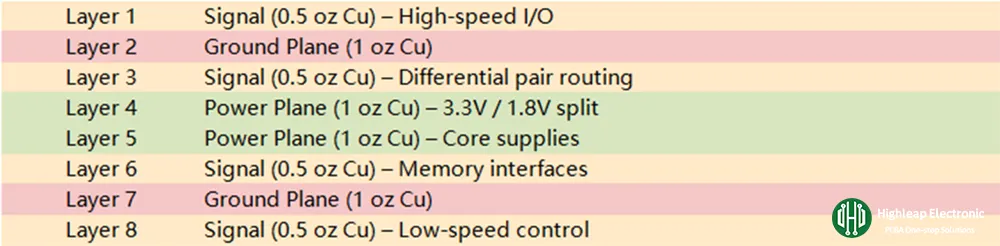
Example: Optimized 8-Layer High-Speed Stackup Architecture
A comprehensive examination of practical high-speed PCB stackup implementation demonstrates the integration of electrical requirements with manufacturing constraints in modern high-speed applications.
Layer Configuration for 10 Gbps Applications
This 8-layer stackup supports high-speed digital interfaces requiring both 50Ω single-ended and 100Ω differential signaling. The configuration provides excellent signal integrity while maintaining manufacturing feasibility.
Material Selection Rationale
The stackup utilizes Isola I-Speed material for layers requiring controlled impedance, providing a dielectric constant of 3.45 and low loss tangent of 0.0031 at 10 GHz. Standard FR-4 prepreg serves non-critical layers, optimizing cost while maintaining performance.
Impedance Control Implementation
Target impedances achieve 50Ω ±5% for single-ended traces and 100Ω ±5% for differential pairs. Manufacturing verification through TDR testing ensures consistent electrical performance across production volumes.
Why Partner with Highleap for High-Speed PCB Manufacturing
Highleap Electronics combines extensive experience in advanced PCB fabrication with specialized capabilities for high-speed electronic applications. Our comprehensive manufacturing approach addresses the complex challenges of modern stackup implementation while delivering cost-effective solutions for demanding applications.
Advanced Manufacturing Capabilities
Our state-of-the-art facility supports HDI fabrication with laser drilling capabilities down to 2-mil via sizes and aspect ratios optimized for high-speed performance. Impedance control systems maintain ±5% tolerance through real-time monitoring and statistical process control.
Material Expertise and Supply Chain Management
We maintain strategic partnerships with leading material suppliers including specialty low-loss laminate, Isola, and Panasonic, ensuring consistent availability of high-performance laminates and prepregs. Our material qualification processes guarantee lot-to-lot consistency and electrical performance validation.
Quality Assurance and Testing
Comprehensive testing protocols include impedance verification, microsection analysis, and environmental stress screening. Our quality management systems comply with ISO9001, ISO13485, IATF16949, and ISO14001 standards, providing confidence for critical applications.
Industry Application Experience
Our manufacturing expertise spans medical devices, automotive electronics, AI computing platforms, and telecommunications infrastructure. This diverse experience enables optimized solutions for specific application requirements and performance targets.
Delivering Reliable High-Speed PCB Solutions
Highleap Electronics provides comprehensive PCB manufacturing and assembly services, enabling single-source responsibility for complex high-speed electronic systems. Our integrated approach combines advanced fabrication capabilities with component sourcing and assembly services.
Accelerated Development Cycles
Our rapid prototyping capabilities support 3-5 day turnaround for high-speed PCB samples, enabling fast design iterations and accelerated time-to-market. Production scalability ensures smooth transition from prototype to volume manufacturing.
Technical Support and Collaboration
Our engineering team provides Design for Manufacturing support, stackup optimization guidance, and manufacturing feasibility analysis. Early collaboration ensures optimal balance between electrical performance, manufacturing yield, and cost targets.

Recommended Posts
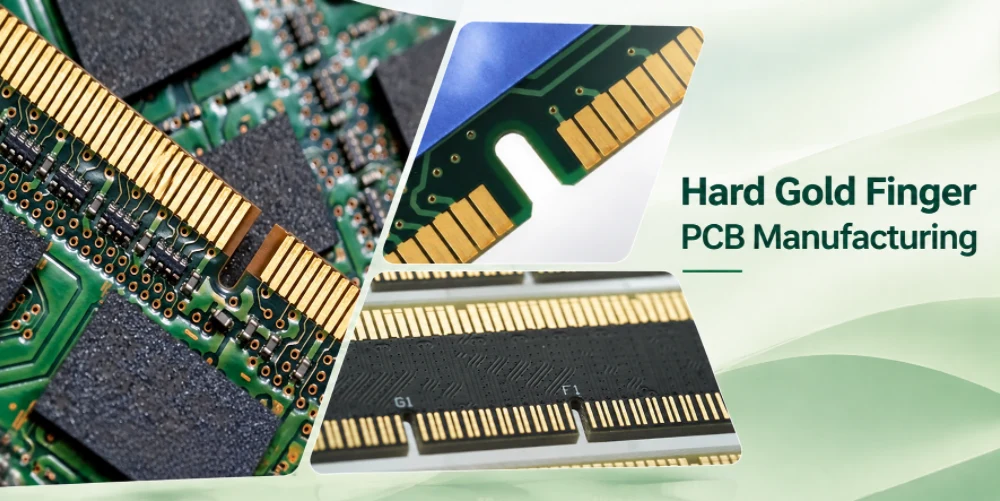
Hard Gold Finger PCB Manufacturing: Plating and Beveling
Hard gold finger PCB manufacturing is used when a circuit...
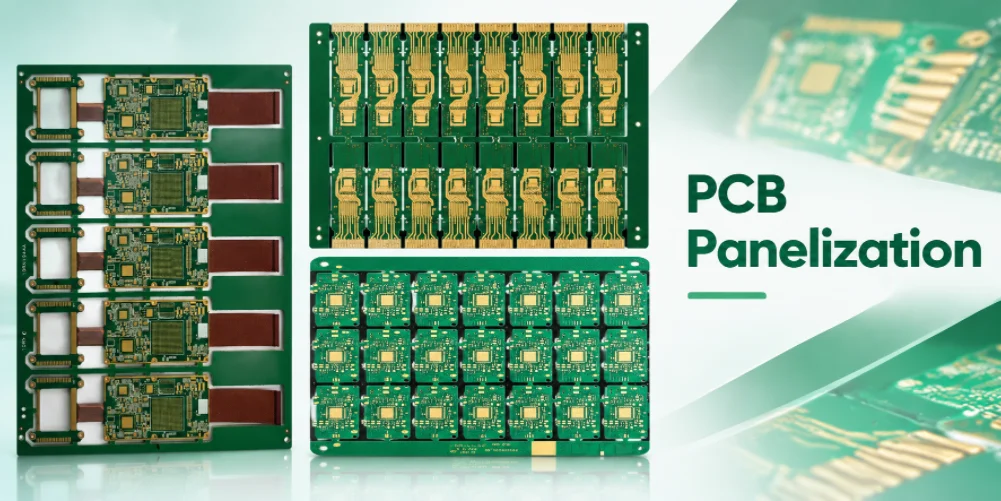
Small PCB Panelization: Array Design and Depaneling
Imagine a 26 × 18 mm circuit that must pass through...
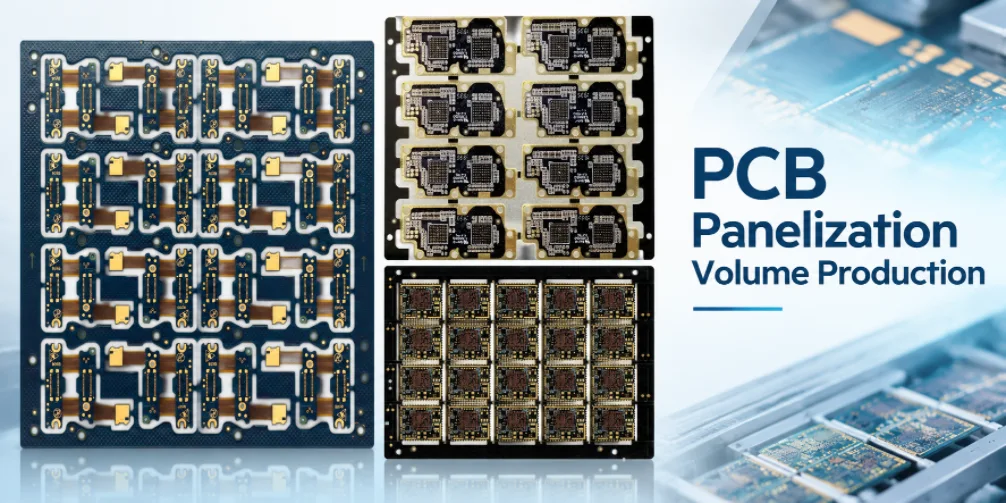
PCB Panelization for Volume Production: Cost and Yield
A fabrication panel that holds more boards is not...
PCB SET Delivery and Panelization: Quantities and Acceptance
A purchase order for “500 SET” looks straightforward until...
How to get a quote for PCBs
Let‘s run DFM/DFA analysis for you and get back to you with a report. You can upload your files securely through our website. We require the following information in order to give you a quote:
-
- Gerber, ODB++, or .pcb, spec.
- BOM list if you require assembly
- Quantity
- Turn time
In addition to PCB manufacturing, we offer a comprehensive range of electronic services, including PCB design, PCBA, and turnkey solutions. Whether you need help with prototyping, design verification, component sourcing, or mass production, we provide end-to-end support to ensure your project’s success.
For PCBA services, please provide your BOM (Bill of Materials) and any specific assembly instructions. We also offer DFM/DFA analysis to optimize your designs for manufacturability and assembly, ensuring a smooth production process.