
FCT Test: Functional Circuit Testing for PCBA

Figure 1. FCT test for PCBA
Last updated: May 2026 · A production-test guide for hardware engineers, test developers, and sourcing teams
An FCT test — Functional Circuit Test, often just called functional test — powers up a fully assembled board and exercises it the way the finished product will, then checks that its real outputs match expected behavior. Where in-circuit test (ICT) asks “is every component correct and connected?”, FCT asks the more important question: “does this board actually do its job?” It is normally the last electrical gate before shipment, and it only works well if test access, stimulus points, and clear pass/fail limits are designed into the board from the start.
What Is an FCT Test (Functional Circuit Test)?
Functional test treats the board as a working unit rather than a collection of parts. A typical FCT applies the inputs the product will see — supply voltage, clock, control signals, sensor stimuli, communication packets — and then measures the responses against a specification: output voltages and currents, timing, frequency, communication replies, display or LED states, relay actuation, RF power, and so on. The result is a simple verdict — pass or fail — backed by recorded measurements.
Because it runs on a powered, assembled board, FCT confirms not just that the right components are present, but that they work together correctly: the firmware boots, the regulator holds its setpoint under load, the radio links, the ADC reads in range, the calibration is valid. That is the evidence most customers actually care about before a unit ships.
FCT vs ICT vs AOI vs X-Ray vs Flying Probe
FCT is one stage in a layered test strategy. Each method answers a different question, and they are complementary rather than interchangeable.
| Test | Question it answers | Powered? | Best at |
|---|---|---|---|
| FCT (functional) | Does the board perform its function? | Yes | System behavior, firmware, calibration, comms |
| ICT (in-circuit) | Is each component correct & connected? | Partly | Component values, opens, shorts, polarity |
| AOI | Does it look correctly built? | No | Solder defects, missing/misaligned parts |
| X-ray | Are hidden joints good? | No | BGA/QFN joints, voids, internal shorts |
| Flying probe | Electrical check without a fixture? | Partly | Low/mid-volume electrical test, no bed-of-nails cost |
A common production combination is AOI and/or X-ray for build quality, ICT or flying probe for electrical coverage, and FCT as the final functional sign-off. Small or fast-turn projects sometimes skip ICT and rely on AOI plus FCT.
How Does a Functional Test (FCT) Station Work?
A functional test station has three core parts working together:
- A test fixture. The board drops into a custom fixture — often spring-loaded “pogo” pins contacting test pads, plus mating connectors — that delivers power and signals and reads outputs. The fixture emulates the board’s real operating interface.
- Instrumentation and I/O. Programmable power supplies, electronic loads, a DMM/DAQ, signal sources, communication interfaces (UART, SPI, I²C, USB, CAN, Ethernet), and sometimes RF instruments apply stimuli and capture measurements.
- A test program. Software sequences the test: power up, load firmware if needed, run each functional check in order, compare every measurement to its limit, log the data, and declare pass or fail. It also drives any programming or calibration steps performed at test.
In practice the operator places the board, the fixture closes, the program runs a sequence of steps in seconds to a couple of minutes, and a pass/fail result plus a test record is produced for that serial number.
Where FCT Fits in the PCB Production Test Flow
FCT is normally the end-of-line electrical test — the last check that the board works before it is packed or built into a higher assembly. A representative flow looks like this:
- SMT / through-hole assembly
- AOI (and X-ray for BGA/hidden joints)
- ICT or flying-probe test (component-level electrical coverage)
- In-circuit programming / calibration (if required)
- FCT — functional verification against spec
- Final inspection, serialization, packing
Because FCT comes late, it is also where the cost of an undetected earlier defect is highest — which is another reason build-quality tests upstream and a well-designed functional test downstream pay off together.
What an FCT Test Catches That Other Tests Miss
- Firmware and software faults — wrong image, failed boot, bad configuration, missing calibration data.
- Parametric failures — a regulator that is in tolerance at no load but droops under real load; an oscillator slightly off frequency; an analog channel reading out of range.
- Communication and interface faults — a bus that enumerates but does not pass data correctly, a connector with intermittent contact.
- Interaction faults — components individually correct (so ICT passes) yet failing together under real operating conditions.
- Calibration and trimming — FCT often performs and verifies calibration so each unit meets spec.
This is the gap that pure visual, X-ray, or component tests leave open: a board can be built perfectly and still not function as a product. FCT is the stage that closes it.
How to Design a Board for Functional Test (DFT)
Functional test that is added after layout is frozen is expensive and fragile, because the board may lack probe access, programming hooks, or measurable limits. Design for test means planning the following before you release files:
- Test points on the nets the test must reach — power rails, key signals, ground references — sized and spaced for pogo pins, on one side where possible.
- Programming/debug access — a header or pads for ISP/JTAG/SWD so firmware can be loaded and the device can be verified at test.
- Boundary scan (JTAG) where dense BGAs limit physical probing, to test interconnects without nails on every net.
- Defined pass/fail limits — every functional check needs a numeric limit (voltage, current, timing, frequency, comms response), not a vague “works/doesn’t.”
- Fixture-friendly mechanics — tooling holes, keep-outs around tall parts, an accessible edge connector, and clear board orientation.
- Stimulus and observability — a way to inject inputs (e.g., a self-test mode, a test connector) and to read outputs without disassembling the product.
| DFT element | Why it matters for FCT |
|---|---|
| Accessible test pads | Stable, repeatable contact for stimulus and measurement |
| Programming header / pads | Load firmware and run calibration at the test station |
| Self-test / test mode in firmware | Lets the board report internal status quickly |
| Documented pass/fail limits | Removes ambiguity between buyer and factory |
| Tooling holes & keep-outs | Reliable fixture alignment and contact force |
Building and Validating the FCT Test Program
A functional test is only as trustworthy as its program and limits. Good practice is to develop the test sequence alongside the first prototypes, then validate it on a first-article batch before production. Validation checks two failure modes that matter: false fails (good boards rejected, which destroys yield and trust) and escapes (bad boards passed, the more dangerous case). Limits are tuned with margin around real measured distributions, and the fixture’s own repeatability is verified so the test measures the board, not the fixture.
For traceability, each unit’s serial number, firmware version, and measured results are logged. That record supports field failure analysis, repeat orders, and audits — and it is exactly the kind of data overseas customers should ask for when sourcing from a contract manufacturer.
FCT Test Limitations and How to Combine Tests
- Diagnosis can be coarse. FCT tells you a board failed a function; it does not always pinpoint the faulty component. Pairing it with ICT/flying probe and AOI narrows root cause faster.
- Fixture and program cost. Custom fixtures and test software take time and money to build, so very low volumes sometimes rely on simpler bring-up plus AOI/X-ray.
- Coverage equals what you wrote. A functional test only checks what the program exercises; gaps in the test plan are gaps in coverage. Define the target defect list deliberately.
- It is not a reliability test. FCT confirms a board works now; burn-in, thermal cycling, or HALT are separate steps for life and stress.
The strongest strategy layers methods to match the product’s risk and volume: build-quality inspection up front, electrical coverage in the middle, and functional sign-off at the end.
FCT Testing Services at Highleap Electronics
Highleap Electronics is a China-based PCB and PCBA manufacturer that builds functional testing into turnkey assembly for customers in the United States, Europe, and Asia-Pacific. Rather than treating test as a checkbox, the useful work happens before the build — agreeing what the functional test must prove and confirming the board can support it.
- Functional testing with custom fixtures and test programs developed to your pass/fail specification.
- Design for Test (DFT) review of test points, programming access, and limits before files are frozen.
- In-circuit programming and calibration performed at the test station where required.
- Complementary AOI, X-ray, ICT, and e-test for layered coverage, with per-unit test records for traceability.
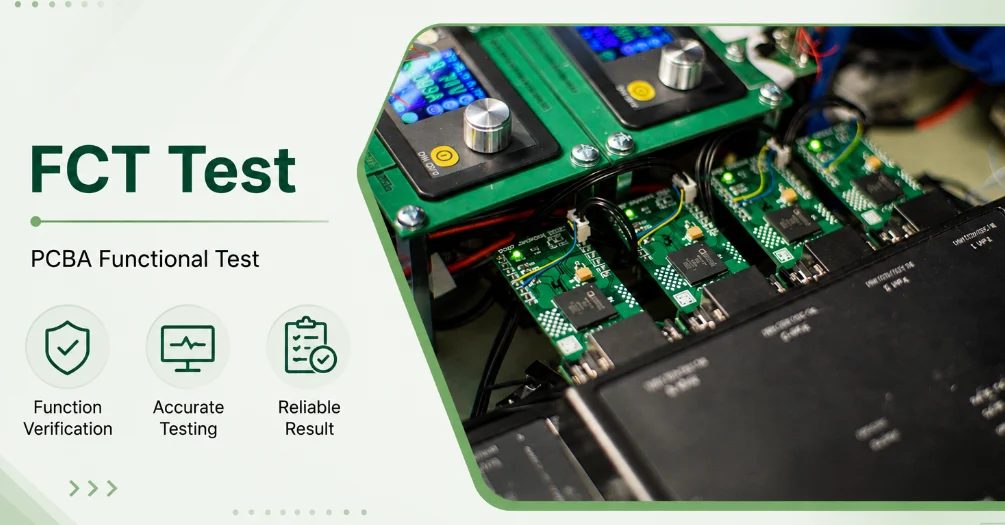
Figure 2. FCT test for PCBA details
FCT Test FAQ
What does FCT stand for?
FCT stands for Functional Circuit Test (commonly shortened to functional test). It verifies that a fully assembled, powered board performs its intended function against defined pass/fail criteria.
What is the difference between FCT and ICT?
ICT (in-circuit test) checks individual components and connections — values, opens, shorts, polarity — usually with a bed-of-nails. FCT checks whether the assembled board actually works as a system, including firmware, calibration, and communication. They are complementary: ICT finds component faults, FCT confirms function.
Is FCT always required?
Not always, but it is strongly recommended for any board that must demonstrably work before shipment. Very simple or very low-volume boards sometimes rely on AOI plus a bring-up check, while products with firmware, calibration, or critical function almost always include FCT.
What do I need to provide to set up a functional test?
A test specification with pass/fail limits, the firmware and programming method, a description of inputs/outputs and the operating conditions, connector and test-point locations, and the target throughput. With that, a fixture and test program can be designed and validated on a first-article batch.
Can FCT replace ICT and AOI?
No. FCT confirms function but may not localize which component failed, and it does not inspect solder quality the way AOI and X-ray do. The most reliable strategy layers them: inspection for build quality, ICT/flying probe for electrical coverage, and FCT for functional sign-off.
How long does a functional test take per board?
Typically from a few seconds to a couple of minutes, depending on how many functions are exercised and whether programming or calibration runs at the same station. The test program is tuned to balance coverage against cycle time.
Can a China-based manufacturer run functional test for overseas products?
Yes, provided the manufacturer can develop and validate the fixture and test program, communicate clearly in English about the specification, control firmware revisions, and deliver per-unit test records. Treating the supplier as a test partner early — sharing limits and self-test hooks — produces the best results.

Recommended Posts
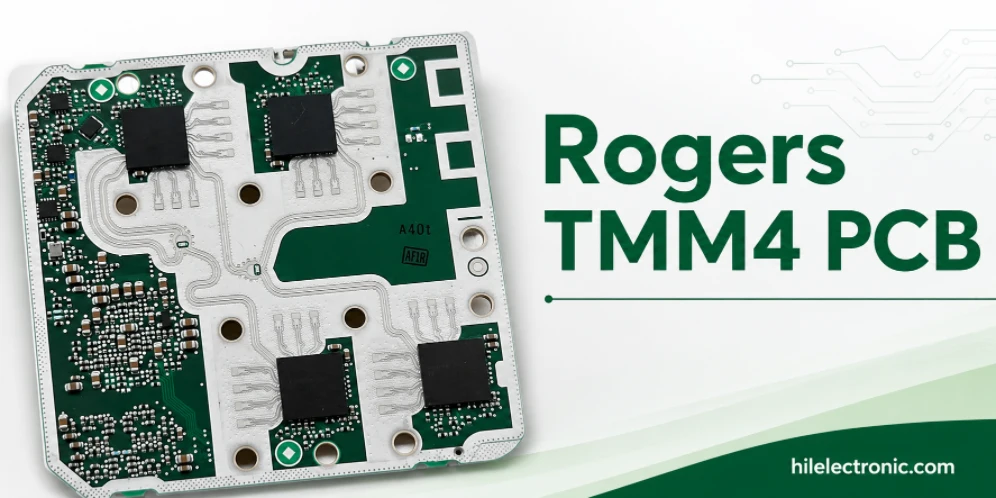
TMM4 Filter PCB Manufacturing
TMM4 filter PCB manufacturing is controlled by the...
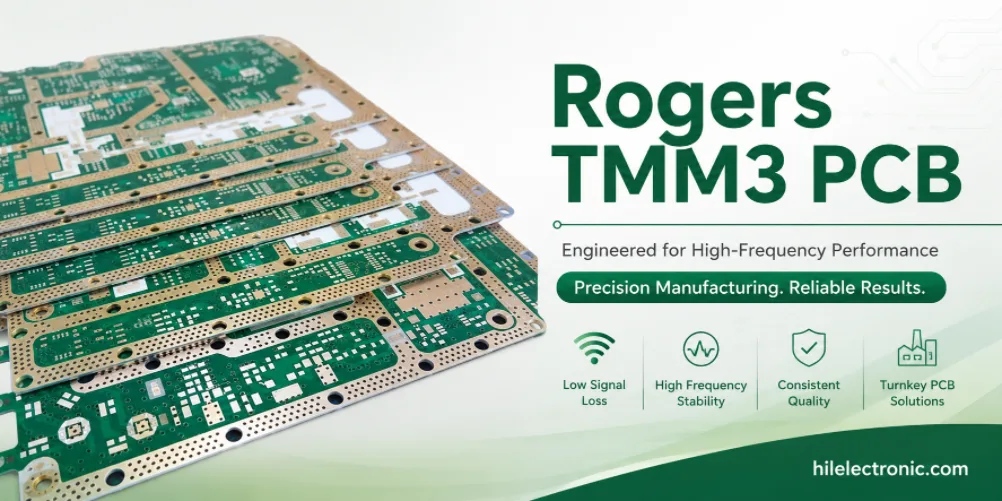
TMM3 PCB Manufacturing for RF Modules
TMM3 PCB manufacturing is most useful where the RF module...
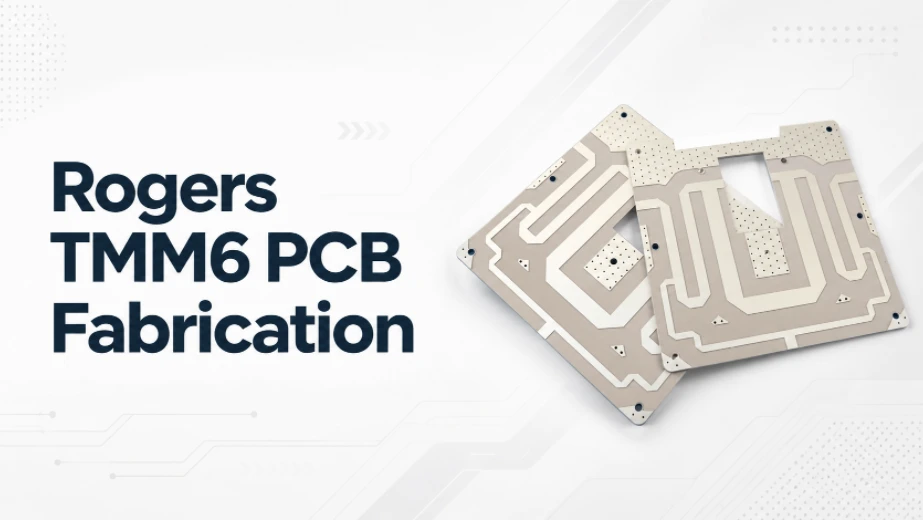
TMM6 PCB Fabrication
TMM6 fabrication is the process-control page for a mid-Dk...
TMM10 PCB Manufacturing for Compact RF Designs
Table of contentsHow TMM10 Shrinks RF StructuresTMM10 vs...
How to get a quote for PCBs
Let‘s run DFM/DFA analysis for you and get back to you with a report. You can upload your files securely through our website. We require the following information in order to give you a quote:
-
- Gerber, ODB++, or .pcb, spec.
- BOM list if you require assembly
- Quantity
- Turn time
For PCBA services, please provide your BOM (Bill of Materials) and any specific assembly instructions. We also offer DFM/DFA analysis to optimize your designs for manufacturability and assembly, ensuring a smooth production process.