
Melting Point of Solder: Alloy Temperature Guide
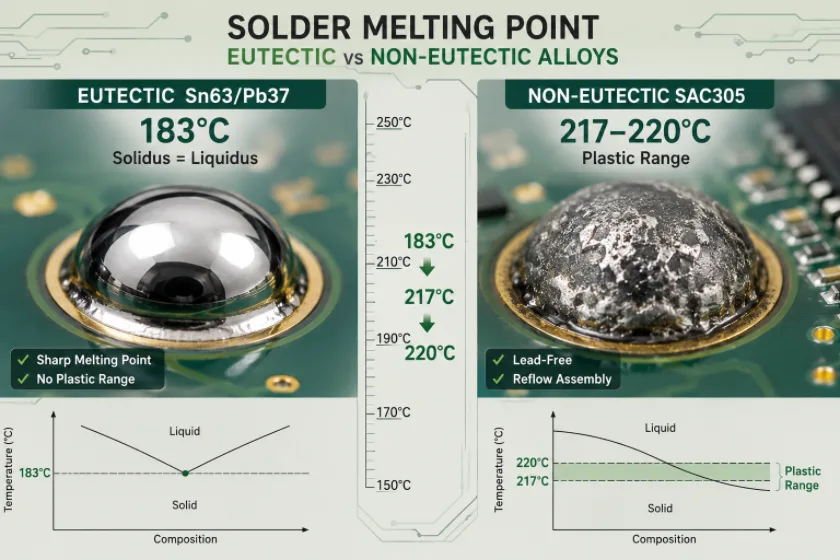
Figure 1. melting point of solder
The melting point of solder depends entirely on its alloy. Eutectic tin-lead solder (Sn63/Pb37) melts at a single, sharp 183 °C (361 °F), while the most common lead-free alloy, SAC305, melts over a range of about 217–220 °C (423–428 °F). Across the full family of soldering alloys the numbers run from roughly 138 °C for low-temperature tin-bismuth up to 300 °C and beyond for high-lead solders. This guide gives the exact figures for each alloy, explains the difference between a melting point and a melting range, and shows why those few degrees decide whether a PCB joint is sound or defective.
What is the melting point of solder?
The melting point is the temperature at which a solder alloy turns from solid to liquid so it can wet metal surfaces and form a joint. The complication is that only eutectic alloys have a true single melting point. A eutectic mixture — Sn63/Pb37 is the classic example — melts and freezes at one exact temperature with no in-between mushy state. That sharp transition is why eutectic solder produces clean joints and is forgiving to work with.
Most non-eutectic alloys instead melt across a range bounded by two temperatures:
- Solidus — the temperature at which the alloy begins to melt. Below this it is fully solid.
- Liquidus — the temperature at which the alloy is fully liquid. Above this it flows freely.
Between solidus and liquidus the solder is partly solid and partly liquid — a slushy “pasty” or “plastic” range. Joints disturbed while in that range tend to come out grainy and weak (a classic cause of a disturbed or cold joint), which is one reason eutectic alloys with no plastic range are preferred for hand soldering.
Melting point of leaded (tin-lead) solder
Tin-lead (SnPb) solder dominated electronics for decades and is still used in aerospace, defense, and medical work where its reliability and the absence of tin whiskers matter. Its melting behavior depends on the tin-to-lead ratio, and all SnPb alloys share the same 183 °C solidus (the eutectic temperature):
| Tin-lead alloy | Melting point / range | Notes |
|---|---|---|
| Sn63/Pb37 (eutectic) | 183 °C (361 °F) — single point | The benchmark electronics solder; no plastic range |
| Sn60/Pb40 | 183–190 °C (361–374 °F) | Very common; small plastic range |
| Sn50/Pb50 | 183–216 °C (361–421 °F) | Wider plastic range; general purpose |
| Sn40/Pb60 | 183–238 °C (361–460 °F) | Higher lead content; plumbing/industrial |
The practical takeaway is that Sn63/Pb37 is the alloy to choose when you want the cleanest possible joints, because it skips the pasty range that the other ratios pass through.
Melting point of lead-free solder
RoHS and similar regulations pushed most commercial electronics to lead-free solder, which is built mainly on tin with additions of silver, copper, and sometimes bismuth or nickel. Lead-free alloys melt 30–45 °C hotter than tin-lead, which is the single biggest practical consequence of the switch — it raises reflow peak temperatures and the thermal stress on boards and components.
| Lead-free alloy | Melting point / range | Notes |
|---|---|---|
| SAC305 (Sn96.5/Ag3.0/Cu0.5) | 217–220 °C (423–428 °F) | The default lead-free alloy for SMT |
| SAC387 (Sn95.5/Ag3.8/Cu0.7) | ~217–218 °C (423–424 °F) | Near-eutectic SAC variant |
| Sn96.5/Ag3.5 (Sn-Ag) | 221 °C (430 °F) | Eutectic tin-silver, no copper |
| Sn99.3/Cu0.7 (Sn-Cu) | 227 °C (441 °F) | Low-cost, common in wave soldering |
SAC305 is the alloy most lead-free PCB assembly is built around. Lower-silver and doped variants exist to cut cost or improve drop-shock and thermal-cycling performance, but their melting points stay close to the 217 °C SAC neighborhood.
Low-temperature and high-temperature solders
Beyond the mainstream alloys, two specialty groups sit at the extremes of the temperature scale.
Low-temperature solders
Tin-bismuth (Sn42/Bi58) melts at just 138 °C (281 °F), and indium-tin (In52/Sn48) at about 118 °C (244 °F). These are used when components or substrates can’t tolerate normal reflow heat — heat-sensitive LEDs, certain sensors, flexible substrates, and step-soldering where a second joint must be made without remelting the first. The trade-off is that bismuth alloys tend to be more brittle.
High-temperature solders
High-lead alloys such as Sn10/Pb88/Ag2 (around 268–290 °C) and Sn5/Pb95 (about 308–312 °C) stay solid at temperatures that would melt ordinary solder. They are used inside power semiconductor die attach, in down-hole oil-and-gas electronics, and in other hot environments. For reference, pure tin melts at 232 °C and pure lead at 327 °C.
Solder melting point comparison chart
This consolidated chart puts the common alloys side by side, from the lowest melting point to the highest.
| Alloy | Composition | Melting (°C) | Melting (°F) | Type / use |
|---|---|---|---|---|
| In52/Sn48 | 52% In, 48% Sn | 118 | 244 | Low-temp, sensitive parts |
| Sn42/Bi58 | 42% Sn, 58% Bi | 138 | 281 | Low-temp lead-free |
| Sn63/Pb37 | 63% Sn, 37% Pb | 183 | 361 | Leaded eutectic (benchmark) |
| Sn60/Pb40 | 60% Sn, 40% Pb | 183–190 | 361–374 | Leaded, general |
| SAC305 | 96.5% Sn, 3% Ag, 0.5% Cu | 217–220 | 423–428 | Lead-free SMT (default) |
| Sn96.5/Ag3.5 | 96.5% Sn, 3.5% Ag | 221 | 430 | Lead-free tin-silver |
| Sn99.3/Cu0.7 | 99.3% Sn, 0.7% Cu | 227 | 441 | Lead-free wave soldering |
| Pure tin (Sn) | 100% Sn | 232 | 450 | Reference metal |
| Sn10/Pb88/Ag2 | 10% Sn, 88% Pb, 2% Ag | 268–290 | 514–554 | High-temp (die attach) |
| Pure lead (Pb) | 100% Pb | 327 | 621 | Reference metal |
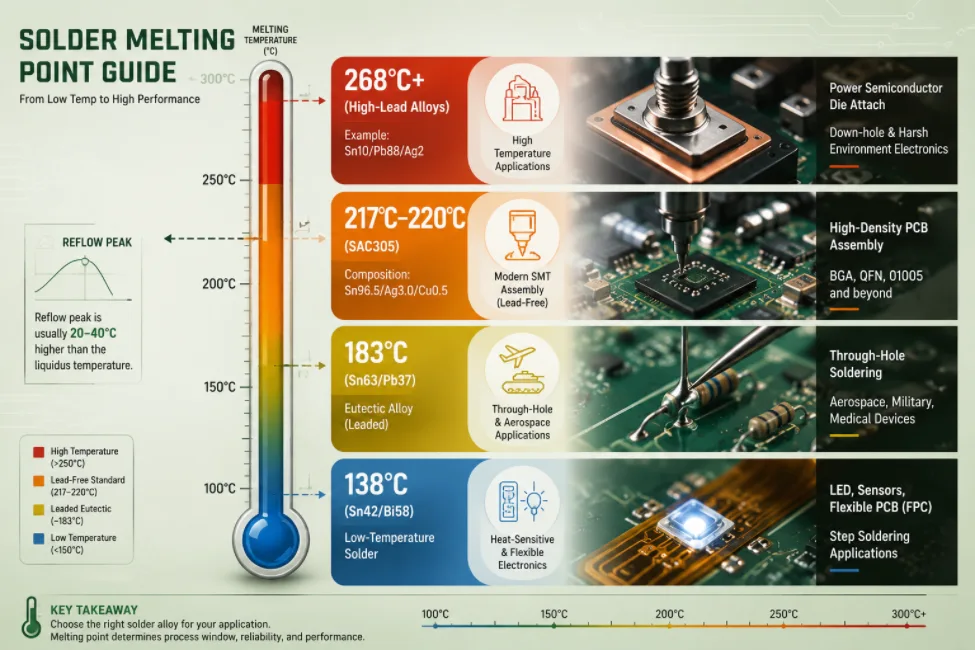
Figure 2. melting point of solder details
Melting point vs soldering and reflow temperature
A common source of confusion is treating the melting point as the temperature you set on your iron or oven. It isn’t. The melting point tells you when the solder becomes liquid; to actually wet pads and flow properly, you work some way above the liquidus.
- Soldering-iron tip temperature is set well above the melting point to push heat into the joint quickly before the tip cools. Typical settings are roughly 315–370 °C (600–700 °F) for leaded solder and 350–400 °C (660–750 °F) for lead-free, adjusted for tip size and joint mass.
- Reflow peak temperature is set about 20–40 °C above the alloy’s liquidus. For SAC305 (liquidus ~220 °C) a typical peak is 235–250 °C; for leaded Sn63/Pb37 a peak around 210–225 °C is normal.
The gap between melting point and working temperature is deliberate: too little margin and the solder barely flows (cold joints, poor wetting); too much and you risk lifting pads, damaging heat-sensitive parts, or exceeding a board’s glass-transition temperature.
Why solder melting point matters in PCB assembly
In production, the melting point is the number every thermal process is built around. Get it wrong and yield suffers. The places it matters most:
- Reflow profiling. The four-zone reflow profile (preheat, soak, reflow, cool) is set from the paste alloy’s solidus and liquidus. The peak must clear the liquidus by a safe margin without cooking the parts — which is why a profile tuned for SAC305 differs from one for a leaded process.
- Board material (Tg). Lead-free’s higher temperatures push closer to a laminate’s glass-transition temperature, so high-Tg FR-4 is often specified for lead-free builds to avoid delamination and warping.
- Mixed alloys. Putting leaded balls through a lead-free profile (or vice-versa) creates unreliable joints. Alloy compatibility has to be controlled across the BOM, especially with BGAs.
- Solder paste and stencils. Paste is matched to the alloy, and the right deposit volume from a laser-cut stencil ensures the joint has enough metal once the flux burns off.
- Low-temp options. When a board carries parts that can’t survive a 245 °C peak, a low-temperature alloy or a selective process is chosen instead.
Highleap Electronics, a China-based PCB and PCBA manufacturer, runs both leaded and lead-free processes with reflow profiles matched to the paste alloy and the board’s thermal mass, verified by AOI and X-ray on area-array parts. If you’re unsure which alloy or finish suits your design, a DFM review covers solder alloy, surface finish, and thermal considerations before the board is built — part of standard turnkey PCB assembly and SMT work.
Melting point of solder FAQ
What is the melting point of solder in Celsius and Fahrenheit?
It depends on the alloy. The most common leaded solder, Sn63/Pb37, melts at 183 °C (361 °F). The most common lead-free solder, SAC305, melts at about 217–220 °C (423–428 °F).
What is the melting point of lead-free solder?
Most lead-free electronics solder melts between about 217 °C and 227 °C. SAC305 is 217–220 °C, eutectic tin-silver is 221 °C, and tin-copper (Sn99.3/Cu0.7) is 227 °C — roughly 30–45 °C hotter than tin-lead solder.
Why does eutectic solder have a single melting point?
A eutectic alloy like Sn63/Pb37 is the specific composition that melts and solidifies at one exact temperature with no in-between pasty range. That sharp transition gives clean joints and makes it forgiving for hand soldering.
What temperature should I set my soldering iron?
Above the solder’s melting point so heat transfers quickly: roughly 315–370 °C (600–700 °F) for leaded solder and 350–400 °C (660–750 °F) for lead-free, adjusted for tip size and joint mass. The exact figure is a working temperature, not the melting point itself.
Is the soldering temperature the same as the melting point?
No. The melting point is when the solder becomes liquid; the soldering or reflow temperature is set above it. Reflow peaks are typically 20–40 °C above the alloy’s liquidus so the solder wets properly.
Can I mix leaded and lead-free solder?
It’s best avoided. Mixing alloys — for example running lead-free BGA balls through a leaded profile — creates intermetallic and melting-point mismatches that cause unreliable joints. In production, alloy compatibility is controlled across the whole assembly.
What is the lowest-melting-point solder?
Among common alloys, indium-tin (In52/Sn48) melts at about 118 °C and tin-bismuth (Sn42/Bi58) at 138 °C. These low-temperature solders are used for heat-sensitive components and step-soldering, though bismuth alloys are more brittle.

Recommended Posts
TMM4 Filter PCB Manufacturing
TMM4 filter PCB manufacturing is controlled by the...
TMM3 PCB Manufacturing for RF Modules
TMM3 PCB manufacturing is most useful where the RF module...
TMM6 PCB Fabrication
TMM6 fabrication is the process-control page for a mid-Dk...

TMM10i PCB Fabrication and DFM
TMM10i PCB fabrication has a stronger DFM emphasis because...
How to get a quote for PCBs
Let‘s run DFM/DFA analysis for you and get back to you with a report. You can upload your files securely through our website. We require the following information in order to give you a quote:
-
- Gerber, ODB++, or .pcb, spec.
- BOM list if you require assembly
- Quantity
- Turn time
For PCBA services, please provide your BOM (Bill of Materials) and any specific assembly instructions. We also offer DFM/DFA analysis to optimize your designs for manufacturability and assembly, ensuring a smooth production process.