
Key Advantages of Taconic RF-35 for High-Speed and High-Frequency PCBs

In the ever-evolving landscape of electronics manufacturing, achieving optimal signal integrity and reliability is paramount. For engineers and designers seeking top-tier materials for high-frequency PCB applications, Taconic RF-35 emerges as a standout solution. At Highleap Electronic, we specialize in leveraging Taconic RF-35 to deliver exceptional PCB manufacturing and assembly services tailored to your specific needs. This comprehensive guide delves into everything you need to know about Taconic RF-35, ensuring you make informed decisions that enhance your product’s performance and reliability.
Why Choose Taconic RF-35 for Your PCB Needs?
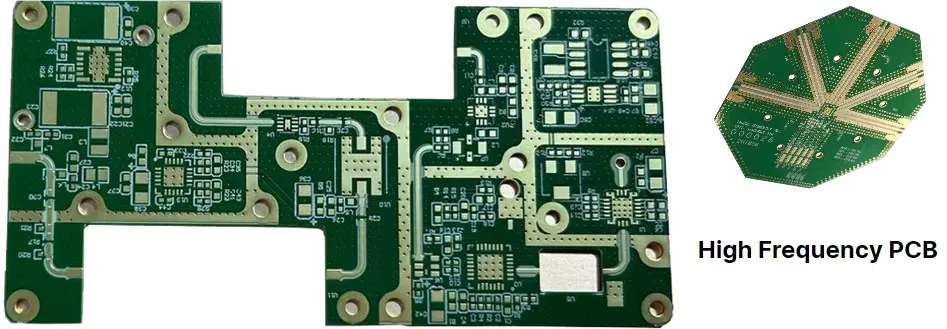
Taconic RF-35 is renowned for its exceptional properties that cater to high-speed digital and analog circuits. With a dielectric constant of 3.5, low loss, and tight material uniformity, RF-35 ensures superior signal integrity, making it the preferred choice for demanding RF, microwave, and multi-gigabit digital applications.
Key Benefits of Taconic RF-35:
-
- Superior Signal Integrity: The precise dielectric constant of 3.5 ± 0.05 ensures consistent impedance control, minimizing signal loss and distortion.
- Low Loss Tangent: With a loss tangent of just 0.0019, RF-35 minimizes energy loss, enhancing the performance of resonant circuits and transmission lines.
- Excellent Thermal Stability: High thermal conductivity (0.71 W/mK) and a Z-axis CTE of 82 ppm/C ensure reliable performance under temperature fluctuations.
- Moisture Resistance: Extremely low moisture absorption (0.02%) enhances long-term reliability, especially in humid environments.
- Cost-Effective: Balancing performance and cost, RF-35 offers an economical solution without compromising on quality.
- Environmental Compliance: RF-35 is lead-free, RoHS compliant, and ITAR free, aligning with modern environmental and regulatory standards.
Understanding Taconic RF-35 Material Properties
Taconic RF-35 is a high-performance PTFE composite laminate that combines woven fiberglass and ceramic filler particles, providing an optimal balance of electrical, thermal, and mechanical properties. This unique composition allows RF-35 to excel in high-frequency applications, offering several advantages:
- Dielectric Constant (Er):
Taconic RF-35 has a precise dielectric constant of 3.5 ± 0.05. This tight tolerance enables superior impedance control, which is critical in high-frequency and high-speed designs. The dielectric constant directly affects signal propagation, ensuring minimal signal distortion and excellent signal integrity across a wide range of frequencies. RF-35’s stable dielectric properties also make it ideal for maintaining phase consistency in RF and microwave applications. - Loss Tangent:
RF-35 boasts a low loss tangent of 0.0019, which is essential for reducing signal loss in high-frequency circuits. This low loss ensures minimal energy dissipation, maintaining signal clarity and improving performance in sensitive applications such as RF communication, radar, and high-speed digital circuits. The low loss tangent is especially beneficial for maintaining high Q-factors in resonant circuits and minimizing insertion loss in transmission lines, ensuring superior performance in applications that require high signal fidelity. - Thermal Performance:
One of the standout features of Taconic RF-35 is its excellent thermal stability. The material has a high glass transition temperature (Tg) of >280°C, which makes it compatible with lead-free soldering profiles that are commonly used in modern electronics manufacturing. In addition, RF-35’s low moisture absorption (0.02%) enhances its reliability in various environmental conditions, especially in applications exposed to humidity or moisture. Furthermore, RF-35 exhibits low thermal expansion, with a Z-axis CTE of 82 ppm/°C, which ensures that the material expands and contracts uniformly with temperature changes, reducing stress during thermal cycling. - Mechanical Stability:
RF-35’s mechanical stability is reinforced by the use of woven glass fiber, which provides dimensional stability and reduces stress during the manufacturing process. This unique fiberglass reinforcement helps mitigate deformation and potential defects caused by thermal or mechanical stress. The result is a more reliable and durable PCB that can maintain tight tolerances over time, even in demanding applications. The glass fiber also contributes to the overall strength and rigidity of the material, ensuring that RF-35 can withstand mechanical stresses during handling, assembly, and operation.
Additional Key Features:
- Moisture Resistance: RF-35’s extremely low moisture absorption (0.02%) makes it highly resistant to the adverse effects of humidity, a common problem in many PCB materials. This property significantly improves the long-term reliability of the PCBs in high-humidity environments, which is particularly critical for military, aerospace, and automotive applications where durability is paramount.
- Thermal Management: The low CTE and excellent thermal conductivity (0.71 W/mK) of RF-35 ensure efficient heat dissipation, preventing the accumulation of heat in critical areas of the PCB. This is especially important for high-power applications where managing heat is crucial to maintaining system performance and longevity.
- Electrical Stability Across Frequency Range: RF-35 maintains its electrical performance from DC up to Ku-band frequencies (18 GHz), ensuring consistent signal integrity and low loss across a wide frequency range. This makes it highly suitable for demanding RF and microwave applications, such as satellite communications, radar systems, and 5G infrastructure.
Taconic RF-35 offers superior performance in high-frequency and high-speed digital applications, thanks to its low loss, stable dielectric constant, high thermal stability, and excellent mechanical properties. Whether you are working on satellite communications, 5G networks, or advanced radar systems, RF-35 provides the reliability and performance required for cutting-edge designs. By utilizing RF-35, engineers can achieve optimal signal integrity, minimal loss, and superior durability in their PCB designs.

Design Considerations for Optimal RF-35 Performance
To maximize the benefits of Taconic RF-35, it’s essential to adhere to best design practices:
- Stackup Planning: Utilize multiple thin cores instead of a single thick core to enhance flexibility and reduce stress.
- Impedance Control: Leverage the precise dielectric constant to maintain target impedance, critical for high-frequency signal integrity.
- Skin Effect Management: At frequencies above 8 GHz, consider surface treatments like micro-etching to mitigate skin effect losses.
- Thermal Management: Ensure adequate thermal spreading and component layout to prevent hotspots and ensure consistent performance.
- Signal Coupling: Implement careful spacing and grounding techniques to minimize interference and maintain signal clarity.
Applications Where Taconic RF-35 Shines
Taconic RF-35 is versatile and finds applications across various high-frequency and high-speed domains:
-
- Satellite Communications: Ensures reliable signal transmission and reception in space applications.
- Radar Systems: Enhances the performance of radar and remote sensing equipment with minimal signal loss.
- 5G Telecom Infrastructure: Supports the high data rates and low latency requirements of next-generation wireless networks.
- Automotive Radar: Provides robust performance in automotive safety and navigation systems.
- Wireless Networking: Facilitates high-speed data transfer in wireless communication devices.
- Defense Electronics: Meets stringent requirements for military-grade electronics with high reliability.
- Aerospace and Avionics: Ensures performance and durability in demanding aerospace environments.
Taconic RF-35 vs. Traditional FR-4: A Comparative Advantage
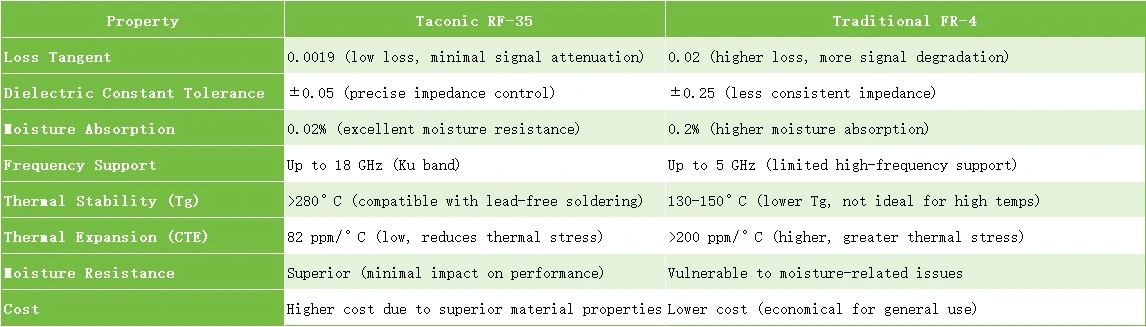
When compared to traditional FR-4 laminates, Taconic RF-35 offers a number of critical advantages, particularly for high-frequency and high-performance applications. Below, we’ll highlight the key differences between the two materials to help you understand why RF-35 is often the better choice for applications that require superior signal integrity, thermal performance, and long-term reliability.
- Lower Loss Tangent:
- RF-35: With a loss tangent of 0.0019, RF-35 provides significantly lower signal attenuation at high frequencies. This ensures minimal signal loss, making it ideal for RF, microwave, and high-speed digital circuits where maintaining signal integrity is critical.
- FR-4: Traditional FR-4 has a loss tangent of 0.02, which is much higher and causes greater signal loss, especially at frequencies above 1 GHz. This is a major drawback when designing for high-frequency or high-performance applications.
- Tighter Dielectric Tolerance:
- RF-35: RF-35 has an exceptional dielectric constant tolerance of ±0.05, which provides more precise impedance control and better consistency in high-frequency circuits. This precision is crucial for RF, microwave, and high-speed digital designs where small variations in impedance can lead to signal reflections and performance degradation.
- FR-4: In contrast, FR-4 has a much wider tolerance of ±0.25, leading to more significant impedance variations, especially at higher frequencies. This can result in inconsistent performance and signal integrity issues.
- Enhanced Moisture Resistance:
- RF-35: One of RF-35’s standout features is its extremely low moisture absorption rate of 0.02%, which makes it highly resistant to the effects of humidity. This is particularly important for applications in environments with high moisture, such as outdoor communications, automotive, and aerospace systems.
- FR-4: FR-4 absorbs up to 0.2% moisture, which can lead to performance issues over time, including swelling, signal degradation, and reliability concerns, especially in humid or wet conditions.
- Higher Frequency Support:
- RF-35: RF-35 is designed to handle frequencies up to the Ku band (18 GHz) and beyond, making it an ideal choice for high-frequency RF and microwave applications. Its stable electrical properties at these frequencies ensure optimal performance in telecommunications, satellite communications, and 5G systems.
- FR-4: Traditional FR-4 begins to lose performance around 5 GHz, making it unsuitable for applications that require operation in the microwave or millimeter-wave frequency range.
- Improved Thermal Stability:
- RF-35: RF-35 has a high glass transition temperature (Tg) of >280°C, which makes it suitable for modern lead-free soldering processes and ensures it can withstand thermal stress without compromising performance. The low CTE (Coefficient of Thermal Expansion) of RF-35 also minimizes thermal stress during temperature cycles, reducing the risk of board warping or cracking.
- FR-4: FR-4 typically has a lower Tg (~130-150°C), which makes it less suitable for high-temperature environments or lead-free soldering processes. It also has a higher CTE, which can result in thermal expansion mismatches and board defects over time.
Comparison Table: Taconic RF-35 vs. Traditional FR-4
Partner with Highleap Electronic for Premium RF-35 PCB Manufacturing
At Highleap Electronic, we understand the critical role that high-quality materials play in the success of your electronic products. Our expertise in Taconic RF-35 PCB manufacturing and assembly ensures that your designs achieve the highest levels of performance and reliability. Whether you’re developing cutting-edge telecommunications equipment, advanced radar systems, or high-speed digital circuits, our team is equipped to deliver precise and dependable PCBs tailored to your specifications.
Why Choose Highleap Electronic?
-
- Expertise in High-Frequency PCBs: Specialized knowledge in RF-35 material properties and applications.
- Advanced Manufacturing Capabilities: State-of-the-art equipment and processes to ensure top-quality PCB production.
- Customer-Centric Approach: Dedicated to understanding and meeting your unique requirements.
- Quick Turnaround Times: Efficient processes to meet your project deadlines without compromising quality.
- Competitive Pricing: Cost-effective solutions without sacrificing performance or reliability.
Request Your Taconic RF-35 PCB Manufacturing Quote Today
Elevate your electronic designs with the unparalleled performance of Taconic RF-35. Partner with Highleap Electronic to ensure your high-frequency PCB applications achieve optimal signal integrity, reliability, and efficiency. Contact us today to request a personalized quote and discover how our expertise can drive your project’s success.
Frequently Asked Questions
Q1: What makes Taconic RF-35 superior to FR-4 for high-frequency applications?
A: RF-35 offers a lower loss tangent, tighter dielectric tolerance, higher moisture resistance, and supports higher frequencies, making it ideal for high-frequency and high-speed applications where FR-4 falls short.
Q2: Can Taconic RF-35 be used for lead-free PCB assembly?
A: Yes, RF-35 is compatible with lead-free solder profiles, offering high glass transition temperatures that accommodate modern assembly processes.
Q3: What are the typical applications for Taconic RF-35?
A: RF-35 is widely used in satellite communications, radar systems, 5G infrastructure, automotive radar, wireless networking, defense electronics, and aerospace applications, among others.
Q4: Does RF-35 require specialized PCB fabrication processes?
A: While RF-35 can be integrated into standard PCB manufacturing workflows, it benefits from advanced PTFE processing techniques for optimal performance, particularly in high-frequency applications.
Q5: How does Taconic RF-35 handle thermal management?
A: RF-35’s excellent thermal conductivity and low CTE in the Z-axis ensure efficient heat dissipation and dimensional stability, enhancing overall PCB reliability under thermal stress.
Get a Free PCB & PCBA Quote

Recommended Posts

Custom Smart Motorcycle Helmet PCB for Connected Riding
A smart motorcycle helmet may combine an intercom,...
Wearable Haptic Vest PCB Manufacturing & Assembly for Multi-Zone Haptic OEMs
In a wearable haptic vest, the wearer notices the...
Wearable Temperature Logger PCB Manufacturing & Assembly for BLE Sensor OEMs
A wearable temperature logger PCB is the electronic board...
Connected Safety Helmet PCB Manufacturing & Assembly for Industrial IoT OEMs
A Connected Safety Helmet PCB is an industrial IoT...
How to get a quote for PCBs
Let us run DFM/DFA analysis for you and get back to you with a report.
You can upload your files securely through our website.
We require the following information in order to give you a quote:
-
- Gerber, ODB++, or .pcb, spec.
- BOM list if you require assembly
- Quantity
- Turn time
In addition to PCB manufacturing, we offer a comprehensive range of electronic services, including PCB design, PCBA (Printed Circuit Board Assembly), and turnkey solutions. Whether you need help with prototyping, design verification, component sourcing, or mass production, we provide end-to-end support to ensure your project’s success. For PCBA services, please provide your BOM (Bill of Materials) and any specific assembly instructions. We also offer DFM/DFA analysis to optimize your designs for manufacturability and assembly, ensuring a smooth production process.