
BMS PCB Design Considerations for Assembly and Manufacturing
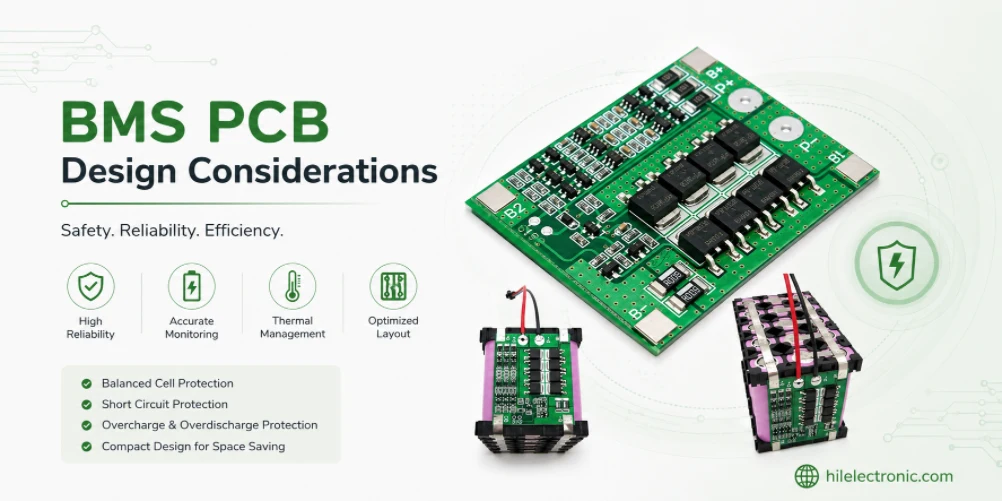
Table of Contents
- BMS PCB Design Goals for Reliable Assembly
- Current Path, Sense Line and Grounding Layout
- Creepage, Clearance and Isolation Planning
- Thermal Design Around Power Components
- Connector, Harness and Mechanical Interface Design
- DFM and DFA Checks for BMS Boards
- Test Point and Programming Interface Planning
BMS PCB design considerations for assembly and manufacturing focus on turning a battery management schematic into a board that can be fabricated, assembled, inspected and transferred to production. Highleap Electronics is a PCB manufacturing and PCB assembly company. We manufacture and assemble boards from customer-approved files; we do not own the complete battery system design, firmware, safety strategy or product certification.
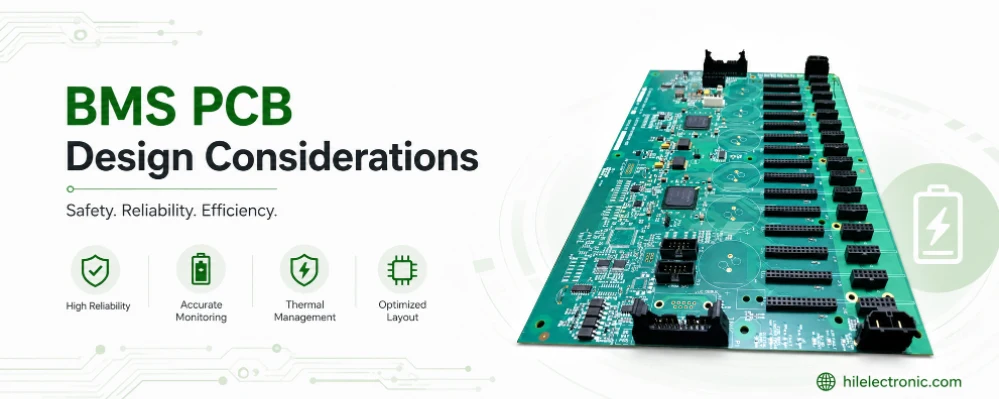
A BMS board often combines low-level sensing, high-voltage separation, protection circuits, communication, thermal monitoring, connectors and sometimes high-current paths. Design choices made before fabrication can strongly affect assembly yield, test access, long-term repeatability and production cost. This page gives manufacturing-focused guidance for engineers preparing BMS PCB and PCBA files for quotation and production.
For assembly service, see BMS PCB assembly services. For high-current copper and thermal builds, see heavy copper PCB assembly.
BMS PCB Design Goals for Reliable Assembly
Manufacturable layout from the first revision
A BMS PCB should be designed so that fabrication, assembly, inspection and test access are practical. This means clear component spacing, stable connector orientation, controlled copper distribution, defined test points, visible polarity markings and realistic soldering access. Early DFM review can prevent problems such as inaccessible pads, unclear pin 1 markings, impossible coating keepouts or connector placement that conflicts with the enclosure.
Design ownership and manufacturing support
The product owner defines battery system behavior, safety thresholds, firmware, functional requirements and compliance strategy. Highleap supports fabrication and assembly review from the manufacturing side. The most productive workflow is to provide Highleap with design files, stackup, BOM, assembly drawing and known risk areas before the first build. This allows manufacturability issues to be identified before material is ordered.
Design release principle: Do not release a BMS PCB to production with unresolved assumptions about spacing, connector pinout, current path, coating, firmware access or test method. These items should be visible in the drawing package.
Current Path, Sense Line and Grounding Layout
Current path clarity
High-current paths should be easy to identify in the PCB files and fabrication notes. Copper width, copper weight, via arrays, terminals, shunts and heat-spreading areas should match the intended current and temperature rise. Current capacity depends on more than trace width; copper thickness, layer position, copper planes, airflow, board material and environment also matter. The customer should validate current and thermal performance at the product level.
Sense line protection
Voltage sense lines and current measurement paths should avoid unnecessary noise coupling, poor connector definition and unclear grounding. From a manufacturing perspective, the BOM should clearly identify precision components and do-not-substitute parts. Test pads should be placed where inspection and debugging can be performed without damaging the assembly. If Kelvin sensing is used, the layout should preserve the intended measurement connection.
Grounding and return path discipline
BMS boards may include analog ground, power ground, communication ground and chassis or shield references. These are design decisions, but the manufacturing files should make ground-related features visible. Mounting pads, plated holes, shield contact areas and chassis connection points should be defined. If a screw hole is intended as a functional ground, the finish, clearance, washer area and assembly requirement should be specified.
Creepage, Clearance and Isolation Planning
Spacing rules based on product requirements
BMS boards used in higher-voltage battery systems require defined creepage and clearance. The required values depend on voltage, environment, pollution degree, material group, coating, standard requirements and product architecture. Highleap can manufacture slots, keepouts and copper clearances according to the drawing, but the values must be defined by the customer or design authority.
| Design item | Manufacturing note | File requirement |
|---|---|---|
| Copper clearance | Needs clear spacing dimensions and layer-by-layer review. | Drawing note and design rule output. |
| Creepage slot | Slot width, length, tolerance and plating status matter. | Rout layer, slot file and fabrication drawing. |
| Coating boundary | Coating affects inspection, rework and keepout planning. | Assembly drawing and coating mask notes. |
Isolation components and package selection
Optocouplers, digital isolators, isolated DC-DC modules and isolation amplifiers must match the required insulation performance and package spacing. Package changes can affect creepage and footprint. Approved alternates should be controlled carefully. A substitute part with similar electrical function but different package geometry may not be acceptable for the final product.
Slots and keepouts for assembly access
Slots and keepouts should be compatible with assembly and inspection. Avoid placing small parts too close to routed slots where edge quality or solder mask definition may become difficult. Keep test points and programming pads outside coating or isolation keepout zones when they must remain accessible after assembly.
Thermal Design Around Power Components
Heat sources on BMS boards
Balancing resistors, MOSFETs, regulators, shunts, pre-charge circuits, relays and connectors can produce heat. The layout should provide enough copper area, via structure and spacing for the intended operating condition. Components should not be crowded into areas where soldering, inspection or heat spreading becomes unreliable. Thermal simulation or product-level testing may be needed for high-power designs.
Assembly impact on thermal performance
Solder paste coverage, voiding, component seating and reflow profile can affect the heat path. Exposed thermal pads need stencil design and via strategy that avoid excessive voiding or solder wicking. If a component connects to a heat sink or metal plate, the mechanical interface should be defined in the assembly drawing.
High-current copper planning
If the BMS board carries substantial current, heavy copper or wide copper regions may be required. Heavy copper increases manufacturing complexity and can affect fine-pitch assembly nearby. Designers should avoid mixing very heavy copper features and delicate analog circuitry without reviewing soldering and spacing effects. For high-current build options, see heavy copper PCB assembly.
Connector, Harness and Mechanical Interface Design
Connector orientation and serviceability
Battery management boards often depend on connectors for cell taps, communication, temperature sensors, power, programming and diagnostics. The design should show connector orientation, latch direction, pin 1, keying and mating harness details. If the board will be installed into an enclosure or battery module, connector placement should allow access without bending the harness or stressing the solder joints.
Harness pinout consistency
The PCB connector pinout and harness drawing must match. Pinout mismatches can be expensive because the PCB and harness may both pass their own inspection but fail during system integration. Use clear labels, connector references and revision control for both the PCB drawing and harness drawing.
Mechanical mounting and grounding features
Mounting holes, plated holes, grounding pads, metal spacers and chassis contacts should be defined in the mechanical drawing. If a mounting hole is not plated, that should be clear. If it is used for grounding, the copper land, finish, washer area and torque or hardware requirement should be specified. Mechanical stress should not be transferred into fragile solder joints or fine traces.
DFM and DFA Checks for BMS Boards
Fabrication DFM points
- Stackup, copper weight, board thickness and surface finish match the drawing.
- High-voltage spacing, slots and keepouts are defined with measurable dimensions.
- Heavy copper, via arrays and thermal pads are manufacturable.
- Test points, programming pads and connector pads are not blocked by coating notes.
- Board outline and mounting holes match enclosure requirements.
Assembly DFA points
- Polarity markings are clear for diodes, ICs, capacitors, optocouplers and connectors.
- Large components have enough spacing and soldering access.
- Fine-pitch parts are not too close to tall connectors or mechanical edges.
- Coating keepouts, labels and inspection areas are visible in the drawing.
- Consigned critical parts are labeled and packaged for production use.
Common release issues
Issues that often delay BMS builds:
- BOM MPN does not match footprint.
- Connector orientation is not shown in the assembly drawing.
- High-voltage keepout is written as a note but not drawn.
- Coating requirement is added after assembly quote approval.
- Programming procedure is missing.
Test Point and Programming Interface Planning
Accessible test points
Test points should be placed where probes can access them after assembly. Avoid placing critical test pads under connectors, under tall components, inside coating zones or too close to board edges. Test points should be labeled consistently and tied to the customer test procedure. If automated testing is planned, pad size, spacing and fixture access should be reviewed early.
Programming interface design
Programming pads or connectors should be accessible and protected from accidental shorting. The design should define programming voltage, interface type, orientation, firmware version control and confirmation method. If programming is not done by Highleap, the assembly package should state that boards are supplied unprogrammed.
Production test documentation
Test limits and records should be defined before production. For prototypes, informal engineering feedback may be enough. For production, a clear test procedure with pass/fail criteria, firmware version, serial number label and record format is more reliable. Highleap can follow customer-provided procedures when they are included in the agreed build scope.
Design-to-Assembly RFQ Notes and FAQ
RFQ notes for BMS design release
- PCB files, stackup, copper weight and surface finish.
- BOM with exact MPNs and approved alternates.
- Assembly drawing with polarity, connector orientation and coating notes.
- High-voltage spacing, slot and keepout requirements.
- Current path, thermal vias and heavy copper requirements.
- Connector, harness and mechanical interface drawings.
- Programming procedure and functional test requirement if applicable.
- Packaging, traceability and production record requirements.
Internal links for production planning
For assembly service, see BMS PCB assembly. For NPI review before release, see NPI DFM review. For prototype transfer, see prototype to production PCBA.

Recommended Posts
TMM4 Filter PCB Manufacturing
TMM4 filter PCB manufacturing is controlled by the...
TMM3 PCB Manufacturing for RF Modules
TMM3 PCB manufacturing is most useful where the RF module...
TMM6 PCB Fabrication
TMM6 fabrication is the process-control page for a mid-Dk...

TMM10 PCB Manufacturing for Compact RF Designs
Table of contentsHow TMM10 Shrinks RF StructuresTMM10 vs...
How to get a quote for PCBs
Let’s run DFM/DFA analysis for you and get back to you with a report. You can upload your files securely through our website. We require the following information in order to give you a quote:
-
- Gerber, ODB++, or .pcb, spec.
- BOM list if you require assembly
- Quantity
- Turn time
For PCBA services, please provide your BOM (Bill of Materials) and any specific assembly instructions. We also offer DFM/DFA analysis to optimize your designs for manufacturability and assembly, ensuring a smooth production process.