
BMS PCB Assembly Services
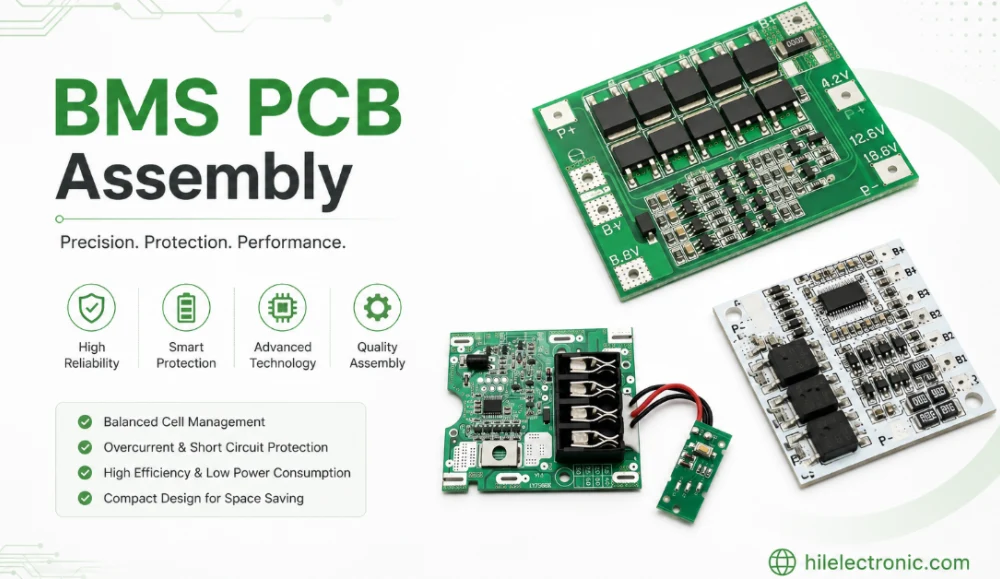
Table of Contents
- BMS PCB Assembly Service Scope
- Battery Management Circuit Assembly Requirements
- High-Current Paths and Low-Voltage Sensing Control
- Component Placement for Protection and Monitoring Circuits
- Connector, Harness and Thermal Interface Support
- Functional Testing for BMS Assemblies
- Prototype, Pilot Run and Production Support
- BMS PCB Assembly RFQ Checklist and FAQ
Highleap Electronics provides BMS PCB assembly services for battery management electronics used in energy storage products, electric mobility, industrial battery packs and power electronics systems. We are a PCB manufacturing and PCB assembly company. We build bare PCBs and assembled PCB products from customer design files, BOMs, drawings, test requirements and approved production notes. We do not design or certify the complete battery pack, battery cells, vehicle system or energy storage system. Our role is to manufacture and assemble the BMS PCB or BMS PCBA according to the released engineering package.
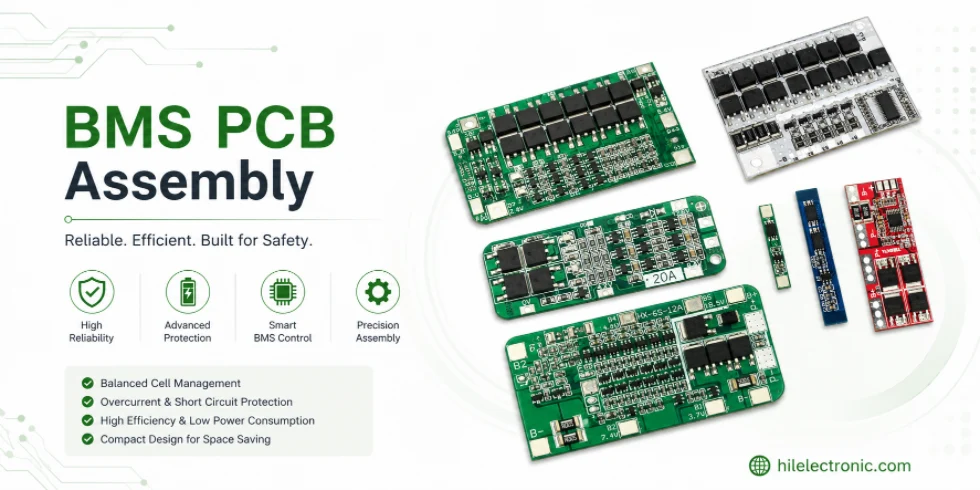
A BMS PCB assembly normally includes voltage sensing, current sensing, temperature sensing, balancing circuits, protection control, communication circuits, connectors and sometimes high-current or high-voltage interface areas. The board may be a compact control PCBA, a large battery pack monitoring board, a cell tap interface board, a power distribution control board or a mixed assembly with connectors and wire harnesses. Reliable assembly depends on correct PCB stackup, component placement, soldering, traceability, inspection, cleaning and test planning.
For related manufacturing pages, see our power electronics PCB assembly, heavy copper PCB assembly and BMS PCB design considerations for assembly and manufacturing.
BMS PCB Assembly Service Scope
Highleap service position: We manufacture and assemble BMS PCBs based on customer-approved files. The customer or product design owner remains responsible for battery system architecture, firmware, protection strategy, safety certification and final product compliance.
Board fabrication and PCBA support
BMS projects may require only bare PCB fabrication, complete PCBA, or a staged build where prototype boards are fabricated first and assembly follows after engineering review. Highleap can support FR4, high Tg, multilayer, impedance-controlled, heavy copper, metal-substrate and other PCB constructions when they match the released stackup and process capability. For PCBA, the normal data package includes BOM, pick-and-place file, assembly drawing, component polarity notes, approved manufacturer list, test notes and packaging requirements.
Typical BMS circuit areas
Voltage measurement, sense-line routing, connector interface and protection components.
Passive balancing resistors, thermal spacing and heat-sensitive component placement.
Shunt, Hall sensor or isolated measurement interface, depending on customer design.
CAN, UART, SPI, isolated communication or customer-specified interfaces.
Assembly methods used in BMS projects
Many BMS boards combine SMT components with through-hole connectors, relays, terminals, shunts, headers or mechanical mounting features. Assembly planning should consider component height, connector orientation, solder joint access, selective soldering needs, conformal coating requirements if specified and final inspection method. When the board includes high-current paths, the PCB fabrication and assembly process must be coordinated so copper thickness, hole plating, soldering thermal balance and inspection requirements are aligned.
Battery Management Circuit Assembly Requirements
Sense accuracy and assembly discipline
BMS measurement accuracy is affected by the design, component tolerance, layout, grounding method, connector quality and assembly consistency. Highleap does not change the electrical design, but assembly discipline helps protect the designed measurement path. Correct component value, polarity, orientation, package match and solder quality are basic requirements. For resistor networks, precision sensing components and ICs with exposed pads, BOM verification and placement inspection are important.
Isolation and high-voltage separation notes
BMS boards used in high-voltage systems may include isolation areas, slots, clearance regions, optocouplers, digital isolators, isolation transformers or separated connector groups. Creepage and clearance values must come from the customer design and applicable product standards. Highleap can manufacture the specified PCB features, but the product owner should define required spacing, slot geometry, coating requirement, working voltage and acceptance criteria in the drawing.
Thermal load around balancing and power components
Balancing resistors, power MOSFETs, shunts, pre-charge paths and high-current connectors can create localized heat. The PCB design should provide enough copper area, thermal vias, spacing and material selection for the intended load. During assembly, solder paste volume, pad design, component seating and inspection method should protect the thermal path. If the project uses conformal coating, potting or thermal interface materials, those requirements should be defined before production because they affect inspection and rework options.
High-Current Paths and Low-Voltage Sensing Control
Separate manufacturing attention for power and sensing areas
BMS boards often combine high-current or high-voltage regions with low-level sensing circuits. These regions have different manufacturing risks. Power areas need copper thickness, solder joint strength, connector reliability and heat dissipation. Sensing areas need correct component values, clean soldering, stable connectors, low contamination risk and careful routing protection. A single board can therefore require both heavy-duty assembly control and precision electronics handling.
| BMS area | Manufacturing concern | Required file note |
|---|---|---|
| Cell sense input | Wrong value, polarity, connector mismatch or contamination can affect measurement. | BOM accuracy, polarity notes, connector pinout and inspection requirement. |
| Balancing resistor area | Thermal rise and solder joint consistency. | Power rating, spacing, thermal copper and coating limitations if used. |
| Current path | Copper heating, terminal soldering and mechanical stress. | Copper weight, via requirement, terminal type and inspection criteria. |
| Communication interface | Connector orientation, ESD sensitivity and signal integrity. | Pinout, polarity, test point and shielding notes if applicable. |
Connector and harness interface control
Battery pack electronics often use multi-pin connectors, wire harnesses, terminals or board-to-board interfaces. Connector orientation, latch direction, plating type, pin count, pitch and mating harness details should match the assembly drawing. If Highleap supports the PCBA together with harness or box-build work, connector and harness documentation should be reviewed as one package.
Shunt and current sensor assembly
Current measurement components require mechanical and electrical consistency. Shunt resistors may require thermal relief planning, controlled soldering and attention to board warpage. Hall sensors and isolated sensors may require accurate placement relative to the conductor or bus structure. The assembly drawing should define any orientation, height, mechanical location or inspection requirement. If a busbar, metal terminal or external current conductor is part of the product, it should be included in the assembly data or mechanical drawing.
Component Placement for Protection and Monitoring Circuits
Protection ICs and precision components
Protection ICs, battery monitor ICs, precision resistors, filter capacitors, TVS devices and isolated communication components must match the approved BOM. Assembly risk increases when MPNs are similar, package sizes are close, or customer-approved alternates have different thermal pads or pinouts. A clean AVL reduces substitution risk. If alternates are allowed, the BOM should identify which alternates are approved and which require customer confirmation before placement.
Polarity and orientation control
BMS boards often contain diodes, TVS arrays, electrolytic capacitors, LEDs, optocouplers, ICs, connectors and sensors with orientation requirements. Polarity notes should be visible in the assembly drawing, not only in the CAD file. First article inspection should verify orientation before the full lot is built. For boards with multiple connector types, pin 1 marking and mechanical keying should be checked carefully.
- BOM review: confirm MPN, package, polarity and approved substitutes.
- Placement review: confirm feeder setup, orientation and board revision.
- First article check: inspect critical ICs, sensors, connectors and protection devices.
- Lot production: proceed after first article approval and document any exception.
Assembly risk around large and small components
BMS boards may combine large terminals and relays with small analog front-end components. Large components create thermal and mechanical soldering demands. Small components require placement accuracy and solder paste control. The process plan should avoid treating the board as a simple SMT job when it includes through-hole power components, tall connectors, press-fit parts or mechanical strain points.
Connector, Harness and Thermal Interface Support
Battery pack interface requirements
The assembly drawing should identify connectors used for cell taps, communication, power, temperature sensing, programming and diagnostics. If the BMS PCBA will be connected to a harness, the harness drawing should include pinout, cable length, color code, terminal type, latch direction, labeling and test requirements. A mismatch between PCB connector and harness drawing can delay final integration even when the PCBA itself is assembled correctly.
Thermal interface and mechanical mounting
Some BMS assemblies are mounted to metal plates, enclosures or battery modules. Mounting holes, grounding pads, thermal pads and keepout areas should be defined in the mechanical drawing. If screws, spacers, insulation sheets or thermal interface materials are part of the assembly, they should be listed in the BOM or assembly notes. The PCB should not rely on undocumented mechanical assumptions for heat transfer or grounding.
Conformal coating and cleaning considerations
Battery electronics may operate in environments where coating is requested. Coating requirements should identify material type, keepout areas, connector exclusions, test points, programming pads and inspection method. Cleaning requirements should also be defined. Flux residues around sensing nodes, high-impedance circuits or connector contacts can create reliability risk, so cleaning and coating should be planned before assembly rather than added after the first build.
Functional Testing for BMS Assemblies
Manufacturing tests and customer-defined functional tests
Standard PCBA inspection can include visual inspection, AOI, X-ray for selected hidden joints, electrical checks and first article review. BMS functional testing depends on customer design and should be defined by the customer or product owner. Highleap can follow customer-provided test procedures, fixture instructions or programming steps when they are included in the manufacturing package and agreed before order release.
Test planning note: A BMS PCBA should not be assumed to pass battery-system requirements only because the board passes assembly inspection. Pack-level validation, firmware behavior, protection thresholds and safety compliance remain part of the customer product qualification plan.
Programming and firmware coordination
If programming is required, the customer should provide firmware files, programming tools, programming interface instructions, checksum or version confirmation method and any security process. The assembly drawing should identify programming connectors or pads. If the firmware must not be loaded by the factory, the PCBA can be supplied unprogrammed with the agreed inspection scope.
Test record requirements
Test records should match the project stage. A prototype may only need basic inspection feedback. A pilot lot may need first article notes, functional test results and assembly observations. A production lot may require serial numbers, test logs, traceability and packaging records. The required record type should be specified in the RFQ so it can be included in quote scope and lead time.
Prototype, Pilot Run and Production Support
Prototype validation builds
Prototype BMS PCB assembly is useful for confirming component fit, connector direction, solderability, programming access, test points, thermal behavior and assembly sequence. Prototype feedback should be converted into controlled drawing or BOM changes. If connector orientation, resistor package, test pad access or coating keepout changes after prototype review, the released files should be updated before pilot production.
Pilot run control
A pilot run should use production-intent materials and assembly methods whenever possible. It helps confirm SMT setup, through-hole soldering, connector handling, inspection points, programming steps and packaging method. If the pilot run uses a substitute component or simplified test plan, that limitation should be documented because it may not represent the final production condition.
Repeat production stability
Repeat orders should use locked BOM, PCB revision, stackup, solder paste, stencil design, inspection notes and packaging requirements. Component lifecycle changes, connector shortages and alternate MPNs should be handled through customer approval. BMS boards often have safety-related functions at the system level, so uncontrolled substitutions can create technical and documentation risk.
BMS PCB Assembly RFQ Checklist and FAQ
Quote package checklist
- Gerber, ODB++ or IPC-2581 data, drill files and fabrication drawing.
- BOM with MPNs, approved substitutes and do-not-substitute parts.
- Pick-and-place file, assembly drawing and polarity notes.
- PCB stackup, copper weight, finished thickness and surface finish.
- Connector drawings, harness interface notes and pinout information.
- High-current, isolation, coating or thermal interface requirements.
- Programming files, test instructions and record requirements if applicable.
- Quantity, target lead time, prototype or production stage and packaging notes.
Internal project links
For high-current board planning, see heavy copper PCB assembly. For charger-related electronics, see EV charger PCB assembly. For broader power conversion builds, see power electronics PCB assembly. For design-for-manufacturing notes, see BMS PCB design considerations.
FAQ
Does Highleap design the complete BMS system?
No. Highleap manufactures and assembles BMS PCBs from customer-approved design files. Battery system design, firmware, pack safety strategy and final compliance remain the responsibility of the product owner.
Can Highleap assemble BMS boards with connectors and through-hole terminals?
Yes, if the assembly files, BOM and process requirements are provided and the component construction is suitable for the agreed assembly process.
Can Highleap support prototype and production quantities?
Yes. Highleap can support prototype, pilot run and production builds according to the approved PCB and PCBA data package.

Recommended Posts
TMM4 Filter PCB Manufacturing
TMM4 filter PCB manufacturing is controlled by the...
TMM3 PCB Manufacturing for RF Modules
TMM3 PCB manufacturing is most useful where the RF module...
TMM6 PCB Fabrication
TMM6 fabrication is the process-control page for a mid-Dk...

TMM10 PCB Manufacturing for Compact RF Designs
Table of contentsHow TMM10 Shrinks RF StructuresTMM10 vs...
How to get a quote for PCBs
Let’s run DFM/DFA analysis for you and get back to you with a report. You can upload your files securely through our website. We require the following information in order to give you a quote:
-
- Gerber, ODB++, or .pcb, spec.
- BOM list if you require assembly
- Quantity
- Turn time
For PCBA services, please provide your BOM (Bill of Materials) and any specific assembly instructions. We also offer DFM/DFA analysis to optimize your designs for manufacturability and assembly, ensuring a smooth production process.