
Isola 185HR PCB Manufacturer for High-Reliability Multilayers
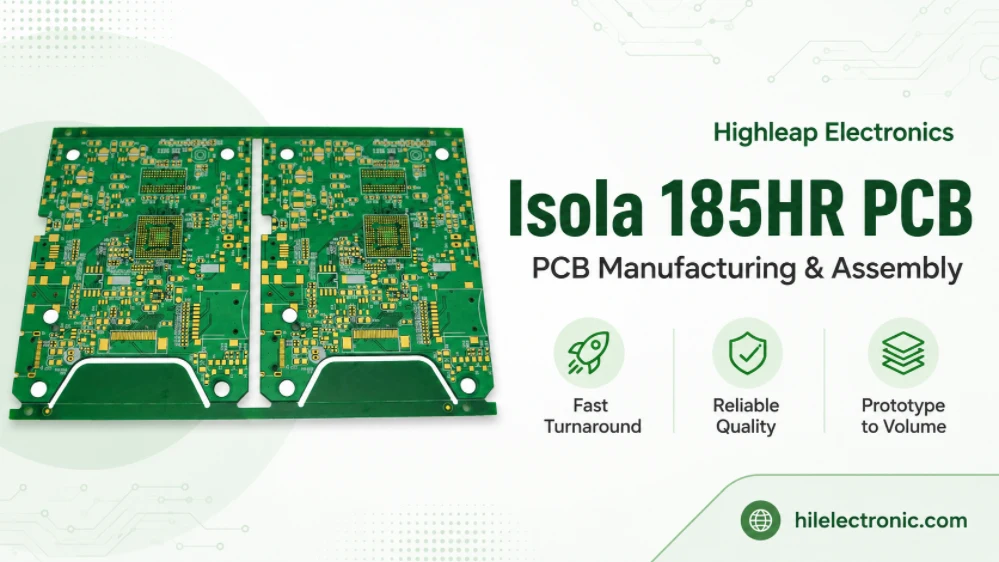
Isola 185HR belongs on a manufacturing page about reliability, not on an RF-material page. It is specified when a multilayer PCB must survive lead-free assembly, repeated thermal exposure, demanding plated holes, humid-bias service or a long product life. The useful question is which failure mechanism the material and process must prevent.
Highleap Electronics manufactures and assembles 185HR multilayers for industrial, automotive, medical and communication products. Stackup, hole geometry, copper plating, moisture control and assembly history are reviewed as one reliability system.
Why PCB Manufacturers Choose 185HR for Long-Term Reliability
High Tg alone does not guarantee a reliable board. 185HR is valuable because its thermal and CAF-related properties provide margin when the board geometry and process are already disciplined. A thick board with small holes, insufficient copper or repeated rework can still fail even on a capable laminate.
Thermal cycling, humidity and long field life increase the value of controlled expansion and CAF resistance.
Thick multilayers and repeated service heating place stress on plated holes and interfaces.
Traceability, process discipline and stable assembly history may be more important than extreme electrical performance.
High layer count and many connectors can make PTH reliability a primary design requirement.
How thermal data should be used
Tg, Td, T260, T288 and Z-axis expansion describe different mechanisms. They should not be collapsed into one maximum temperature rating. The assembly team should provide the expected reflow, wave, selective-solder and rework history so the board design can be judged against the real exposure.
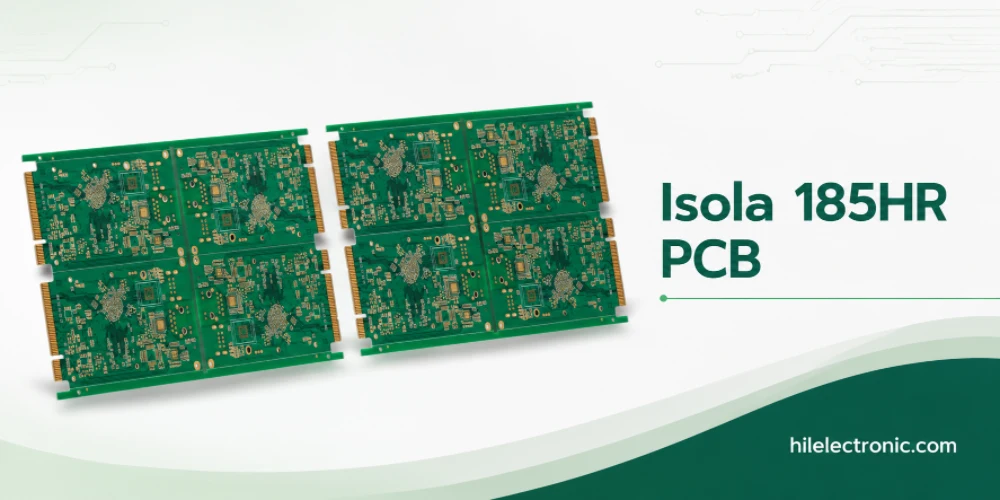
Building a Reliable 185HR Multilayer Stackup
Core and prepreg selection control final thickness, resin fill, copper encapsulation and dimensional stability. The stackup must account for copper distribution and local resin demand. Heavy copper, large clearances and dense via fields can create starvation or uneven thickness if the prepreg construction is selected only from a nominal table.
Drilling, desmear and plated-hole reliability
Hole reliability depends on finished hole size, board thickness, drill quality, desmear, inner-layer connection and copper plating. Highleap reviews aspect ratio and minimum hole-wall copper before release. Critical products may use microsection, thermal stress or IST-style evidence according to the customer specification.
CAF resistance still requires layout discipline
A CAF-resistant resin does not eliminate risk from insufficient conductor spacing, damaged glass bundles, contamination or poor hole preparation. Layout, material, process cleanliness and humid-bias qualification must work together. More information is available in Highleap’s CAF-resistant PCB material guide.
- Match core and prepreg constructions to the copper distribution.
- Review hole aspect ratio and minimum plating before quoting.
- Define the complete assembly thermal history.
- Control moisture before reflow and rework.
- Use lot traceability and approved substitution rules.
- Select reliability evidence according to the field risk, not by habit.
PCB Assembly and Reliability Verification
Lead-free compatibility is a starting point, not a complete assembly plan. Double-sided SMT, press-fit connectors, selective soldering and field rework can accumulate damage. Highleap can coordinate bare-board fabrication with component sourcing, SMT, through-hole assembly and agreed testing so the board and assembly thermal budgets are not reviewed separately.
Production evidence for demanding products
The evidence may include material certificates, stackup records, microsection, electrical test, impedance where applicable, thermal stress, ionic cleanliness or customer-specific acceptance. Medical and automotive programs may require additional documentation and change control.
For assembly planning, see lead-free PCB material for assembly and PCB assembly services.
When 185HR Is the Right Reliability Upgrade
185HR should be compared with generic high-Tg FR-4, 370HR-class systems and lower-loss materials according to the actual failure risk. If the project is limited by insertion loss, a reliability-focused standard-loss laminate is not the correct upgrade. If the risk is plated-hole fatigue, CAF or repeated reflow, selecting an ultra-low-loss resin may add cost without solving the dominant mechanism.
Repeat-production controls
The production release should freeze the exact laminate and prepreg, stackup, hole geometry, copper, IPC class, thermal history and required evidence. Highleap supports prototypes, low-volume and repeat manufacturing with international payment and shipment options confirmed in the quotation.
Discuss the expected field environment, hole geometry and assembly history with Highleap’s PCB engineering team. The review will focus on the failure modes the product must survive and the evidence needed to release production.
185HR reliability questions
Does 185HR prevent barrel cracking? It can reduce material-related stress, but hole geometry, drilling, plating and thermal exposure remain decisive.
Is 185HR a low-loss RF material? No. It is primarily a high-reliability FR-4 system.

Recommended Posts

Taconic RF-35 PCB Manufacturing Service — Prototype Through Volume Production
Figure 1. Taconic RF-35 PCBTaconic RF-35 is the workhorse...

Isola Astra MT77 PCB Manufacturing
Figure 1. Isola Astra MT77 PCB ManufacturingIsola Astra...

Custom Rogers RO4835 PCB Fabrication & Assembly Services
Figure 1. Rogers RO4835 PCBRogers RO4835 PCB is a...

Nelco N4000-13 PCB Material and Manufacturing Guide | Highleap Electronics
Figure 1. Nelco N4000-13 PCBNelco N4000-13 PCB is a...
How to get a quote for PCBs
Let’s run DFM/DFA analysis for you and get back to you with a report. You can upload your files securely through our website. We require the following information in order to give you a quote:
-
- Gerber, ODB++, or .pcb, spec.
- BOM list if you require assembly
- Quantity
- Turn time
For PCBA services, please provide your BOM (Bill of Materials) and any specific assembly instructions. We also offer DFM/DFA analysis to optimize your designs for manufacturability and assembly, ensuring a smooth production process.