
RT duroid 6002 PCB Quote and Stackup

This page owns the quotation and stackup-definition task for RT/duroid 6002. A useful RFQ identifies grade, thickness, copper, layers, board size, impedance requirements, drilling, inspection and quantity before a price is treated as comparable.
Figure 1. Rogers RT/duroid 6002
An RT duroid 6002 PCB quote should describe the finished construction, not just the material grade. Thickness, copper, layer count, hole technology, impedance targets and inspection can change the production cost more than the brand name alone suggests. Rogers RT/duroid 6002 is a ceramic-filled, glass-microfiber reinforced PTFE laminate with a dielectric constant of 2.94 ±0.04 and a dissipation factor of 0.0012 at 10 GHz. Its in-plane CTE of 16 ppm/°C — matched to copper — combined with low z-axis CTE of 24 ppm/°C and published ASTM E595 outgassing data (where applicable) can be relevant to satellite, phased-array, defense, and other space-oriented designs, but the project must confirm the current grade documentation and qualification requirements. This engineering guide reviews selected RT/duroid 6002 data, electrical and thermal performance, design rules, impedance reference, stackup topologies, step-by-step manufacturing process, comparison with related Rogers laminates (5880, 6006, 6010, RO3003, RO4350B), industry applications, cost analysis, and 20+ frequently asked engineering questions.
Table of Contents
- What Is Rogers RT/duroid 6002?
- RT/duroid 6002 Full Datasheet & Material Properties
- Dielectric Constant, Dissipation Factor, TCDk Explained
- Thermal Conductivity, CTE, and Moisture Behavior
- Why CTE Matching Drives Plated Through-Hole Reliability
- RT/duroid 6002 vs 5880 vs 6006 vs 6010 vs RO3003 vs RO4350B
- RT/duroid 6002 Impedance Calculator: 50Ω Microstrip, Stripline, Differential
- Stackup Design: All-PTFE Multilayer and Hybrid FR4 Configurations
- RT/duroid 6002 PCB Manufacturing Process Step-by-Step
- Top 10 Industry Applications: Satellite, Radar, 5G, Aerospace
- Cost Analysis, Lead Time, Availability, and Where to Buy
- Common Engineering Issues and Troubleshooting Guide
- Frequently Asked Questions About RT/duroid 6002 (20+ Q&A)
- RT/duroid 6002 PCB Manufacturing at Highleap Electronics
1. What Is Rogers RT/duroid 6002?
Rogers RT/duroid 6002 is a high-frequency PCB laminate manufactured by Rogers Corporation. It is a three-component composite consisting of a PTFE (polytetrafluoroethylene) matrix, ceramic filler particles, and woven glass-microfiber reinforcement. The material belongs to the RT/duroid 6000 series, which also includes RT/duroid 6006, 6010.2LM, 6035HTC, and 6202. Within this series, RT/duroid 6002 is positioned for designs that require both high microwave performance and survivability in harsh thermal-cycling environments — a combination that conventional unfilled PTFE laminates cannot deliver.
The defining engineering characteristics of RT/duroid 6002 are four-fold:
- CTE matching to copper: an in-plane coefficient of thermal expansion of 16 ppm/°C closely matched to copper at 17 ppm/°C, which dramatically improves plated through-hole reliability under thermal cycling.
- Space-grade outgassing: qualified ASTM E595 performance with TML <1.0 % and CVCM <0.1 %, which may be relevant to a space qualification review but does not by itself establish project acceptance.
- Low microwave loss: dissipation factor of 0.0012 at 10 GHz, among the lowest of all glass-reinforced PTFE laminates.
- Flight heritage: Program history may provide useful background, but a new design still requires its own qualification and acceptance evidence.
RT/duroid 6002 is commonly specified when a design combines moderate-to-high microwave frequencies (1–40 GHz) with severe thermal environments — military temperature cycling, space thermal vacuum, automotive grade-1 underhood — and requires plated through-hole reliability through the cycle count specified by the applicable qualification plan. Within the broader Rogers high-frequency PCB materials portfolio, RT/duroid 6002 is Any ECSS-Q-ST-70-08C requirement must be verified against the current project qualification package rather than inferred from the material name.
2. RT/duroid 6002 Full Datasheet & Material Properties
The table below presents selected reference values reported in published RT/duroid 6002 technical literature; verify the current revision, thickness, and test method before design release. Properties are measured per IPC-TM-650 test methods unless otherwise noted. Values are typical and apply across all standard thickness options. Always verify against the latest Rogers Corporation datasheet revision before final design release.
| Property Category | Property | Value | Unit | Test Method / Condition |
|---|---|---|---|---|
| Electrical | Dielectric constant (Dk, design) | 2.94 ±0.04 | — | IPC-TM-650 2.5.5.5 @ 10 GHz |
| Dissipation factor (Df) | 0.0012 | — | IPC-TM-650 2.5.5.5 @ 10 GHz | |
| Thermal coefficient of Dk | +12 | ppm/°C | −50 to +150 °C | |
| Volume resistivity | 10¹⁰ | MΩ·cm | IPC-TM-650 2.5.17.1 | |
| Dielectric strength | 45 | kV/mm | ASTM D149 | |
| Thermal | Thermal conductivity | 0.44 | W/m/K | ASTM C518 |
| CTE x-axis (in-plane) | 16 | ppm/°C | IPC-TM-650 2.4.41 | |
| CTE y-axis (in-plane) | 16 | ppm/°C | IPC-TM-650 2.4.41 | |
| CTE z-axis (through-thickness) | 24 | ppm/°C | IPC-TM-650 2.4.41 (0–100 °C) | |
| Mechanical | Tensile strength (x) | 50 | MPa | ASTM D638 |
| Density | 2.1 | g/cm³ | ASTM D792 | |
| Glass transition (Tg) | >327 (PTFE melt) | °C | — | |
| Environmental | Moisture absorption | 0.02 | % | ASTM D570 (D48/50) |
| Outgassing TML | <1.0 | % | ASTM E595 | |
| Outgassing CVCM | <0.1 | % | ASTM E595 | |
| Compliance | Flammability rating | UL94 V-0 | — | Halogen-free |
| RoHS / REACH | Compliant | — | — |
Available thicknesses: 0.127 mm (5 mil), 0.254 mm (10 mil), 0.508 mm (20 mil), 0.762 mm (30 mil), 1.524 mm (60 mil). Custom thicknesses available on special order from Rogers.
Standard copper cladding: 0.5 oz (17.5 μm), 1 oz (35 μm), 2 oz (70 μm). Available in standard electrodeposited (ED), reverse-treated foil (RTF), low-profile copper (LP), and resistive foil variants.
Panel sizes: Standard 18″ × 24″, 18″ × 36″, 24″ × 36″. Larger panel sizes available on special order.
3. Dielectric Constant, Dissipation Factor, TCDk Explained
Dielectric constant frequency behavior. The design Dk of 2.94 is measured per IPC-TM-650 2.5.5.5 (clamped stripline resonator) at 10 GHz. The value is highly stable across the practical operating range. From 1 GHz to 40 GHz, Dk varies by less than 1.5 %. At 77 GHz, Dk decreases to approximately 2.91; at 94 GHz to approximately 2.89. For automotive 77 GHz radar designs, designers commonly use Dk = 2.92 with confidence.
Dissipation factor at higher frequencies. Df rises gradually with frequency due to polarization roll-off. Approximate Df values: 0.0012 @ 10 GHz, 0.0018 @ 24 GHz, 0.0024 @ 40 GHz, 0.0030 @ 77 GHz. Insertion loss for a 50-ohm microstrip on 0.254 mm RT/duroid 6002 with 1 oz reverse-treated copper is approximately 0.04 dB/cm at 10 GHz, 0.10 dB/cm at 24 GHz, 0.18 dB/cm at 77 GHz. These values include both dielectric and conductor loss contributions with typical RTF copper roughness (Rz ≈ 2 μm).
Positive TCDk — an uncommon property. The TCDk of +12 ppm/°C is unusual; most PTFE laminates have negative TCDk values ranging from −40 to −400 ppm/°C. The positive coefficient comes from the specific ceramic-glass composite formulation. Across the military temperature range of −55 °C to +125 °C, total Dk variation is only ±0.011 — exceptional stability that eliminates the need for temperature compensation in many filter designs.
Dk anisotropy. RT/duroid 6002 exhibits less than 1 % difference between Dk measured along the warp versus fill direction of the glass weave. This near-isotropy is important for differential pair routing, dual-polarization antennas, and balanced filter designs where weave-induced skew on FR4 typically degrades performance.
Dk uniformity across panel. Panel-to-panel and lot-to-lot Dk variation is held within ±0.04 of nominal. Within a single panel, Dk uniformity is typically within ±0.02. This consistency is critical for filter manufacturing yield and antenna center-frequency repeatability in volume production.
Why Df 0.0012 matters. Every 0.001 of Df adds approximately 0.04 dB/cm of dielectric loss at 10 GHz for typical microstrip geometry. A 10 cm RF feed line on RT/duroid 6002 contributes about 0.04 dB total dielectric loss versus 0.16 dB on FR4 (Df ~0.020). For long feed networks in phased-array antennas with 32 or 64 elements, the cumulative loss savings of low-Df materials directly translate to improved system EIRP and antenna gain.
4. Thermal Conductivity, CTE, and Moisture Behavior
Thermal conductivity (0.44 W/m/K). Moderate for RF laminates — higher than unfilled PTFE (0.20 W/m/K) but lower than ceramic-heavy materials like RO4360G2 (0.80 W/m/K). For high-power amplifier applications, RT/duroid 6002 alone cannot dissipate sustained heat above approximately 2 W/cm². Heat-spreading techniques such as copper coins, embedded copper inlays, or thermal vias underneath active devices are required for power applications above this density.
Moisture absorption (0.02 %). Among the lowest in the industry. Every 0.1 % of absorbed moisture in a PCB substrate shifts Dk upward by approximately 0.02. RT/duroid 6002’s exceptional moisture resistance means Dk drift in humid environments is negligible — important for outdoor cellular base stations, naval shipboard radar, and weather radar systems exposed to high-humidity conditions.
Outgassing (ASTM E595). Total Mass Loss (TML) below 1.0 % and Collected Volatile Condensable Materials (CVCM) below 0.1 % may support a NASA or ESA spaceflight qualification review when the complete project evidence is accepted. This is a major differentiator versus FR4 and most hydrocarbon ceramic materials, which fail E595 limits and cannot fly on optical satellites where outgassing contamination would degrade lens and mirror surfaces.
Lead-free assembly compatibility. Reflow compatibility should be confirmed using the released assembly profile and qualification evidence. Compatible with all lead-free solder profiles including SAC305 and SAC405. Storage life in unopened factory packaging is 12 months minimum.
Operating temperature range. Continuous operating temperature −55 °C to +125 °C standard. Short-duration exposure to 280 °C supported during reflow and rework. Maximum continuous-use temperature is limited by copper foil annealing characteristics rather than the laminate itself.
Flammability (UL94 V-0). Self-extinguishing without halogenated flame retardants. Halogen-free compliant per IEC 61249-2-21. RoHS and REACH compliant.
5. Why CTE Matching Drives Plated Through-Hole Reliability
The single most important property of RT/duroid 6002 — and the reason it is specified in space-grade hardware — is its in-plane CTE of 16 ppm/°C matched to copper at 17 ppm/°C. To understand why this matters, consider what happens inside a plated through-hole during thermal cycling.
During temperature swings, the laminate dielectric expands and contracts at one rate while the copper plating in the via barrel expands and contracts at another. The mismatched strain accumulates with each thermal cycle until the plated copper barrel develops cracks. This failure mode — barrel cracking — is the dominant reliability concern for PTFE-based multilayer PCB constructions and the single biggest reason why “use a Rogers material” is not, by itself, a safe design choice for high-reliability hardware.
The numbers. Conventional unfilled PTFE laminates (such as RT/duroid 5880) have z-axis CTE around 237 ppm/°C versus copper’s 17 ppm/°C — a 14× mismatch. Under MIL-STD-883 Method 1010 thermal cycling (−65 °C to +150 °C), boards typically fail after 100–500 cycles. RT/duroid 6002, with z-axis CTE of 24 ppm/°C and matched in-plane CTE, routinely passes 1,000+ cycles in Interconnect Stress Testing (IST) and can be evaluated against ECSS-Q-ST-70-08C and IPC-6018 Class 3/A requirements when those standards apply.
The strain math. For a 1.6 mm thick board cycled through ΔT = 215 °C: 5880 expands z-axis by approximately 510 μm/m × 215 = 109 ppm strain in the via barrel each cycle; 6002 expands only 24 × 215 = 5.2 ppm strain. The 21× difference in cyclic strain produces orders of magnitude difference in fatigue life.
This is why aerospace PCB designers reach for RT/duroid 6002 over the lower-loss but higher-CTE RT/duroid 5880 whenever the design requires high-aspect-ratio plated through-holes in a multilayer stack. The CTE matching also enables hybrid stackups combining RT/duroid 6002 with FR4 — the in-plane CTE difference between the two materials is small enough that warpage and registration shifts during reflow remain manageable.
6. RT/duroid 6002 vs 5880 vs 6006 vs 6010 vs RO3003 vs RO4350B
Selecting the right Rogers laminate requires comparing key parameters across the candidate materials. The table below covers RT/duroid 6002 against the most common alternatives in microwave PCB design.
| Parameter | RT/duroid 6002 | RT/duroid 5880 | RT/duroid 6006 | RT/duroid 6010.2LM | RO3003 | RO4350B |
|---|---|---|---|---|---|---|
| Dk @ 10 GHz | 2.94 ±0.04 | 2.20 ±0.02 | 6.15 ±0.15 | 10.2 ±0.25 | 3.00 ±0.04 | 3.48 ±0.05 |
| Df @ 10 GHz | 0.0012 | 0.0009 | 0.0027 | 0.0023 | 0.0010 | 0.0037 |
| TCDk (ppm/°C) | +12 | −125 | −410 | −425 | −3 | +50 |
| CTE x,y (ppm/°C) | 16 | 31 | 47 | 24 | 17 | 10 |
| CTE z (ppm/°C) | 24 | 237 | 24 | 24 | 24 | 32 |
| Thermal cond. (W/m/K) | 0.44 | 0.20 | 0.49 | 0.86 | 0.50 | 0.69 |
| Reinforcement | Glass + ceramic | Glass only | Ceramic only | Ceramic only | Ceramic only | Glass + ceramic |
| Material type | PTFE | PTFE | PTFE | PTFE | PTFE | Thermoset |
| Lamination | 380 °C PTFE | 380 °C PTFE | 380 °C PTFE | 380 °C PTFE | 380 °C PTFE | 175 °C FR4-like |
| Space outgassing | Pass | Pass | Pass | Pass | Pass | Not rated |
| PTH reliability | Excellent | Moderate | Excellent | Excellent | Excellent | Excellent |
| Cost (vs FR4) | 5–7× | 4–6× | 5–7× | 6–8× | 4–6× | 2–3× |
| Best application | Aerospace, satellite, phased array | Lowest loss, mmWave links | Compact filters, antennas | Miniaturized resonators | Automotive radar, mmWave | 5G base station, RF circuits |
When to choose RT/duroid 6002 over RT/duroid 5880: When the multilayer construction has plated through-holes that must survive thermal cycling, when outgassing requirements apply, or when the design needs dimensional stability for tight registration. RT/duroid 5880 wins on absolute loss but loses on PTH reliability in multilayer constructions.
When to choose RT/duroid 6002 over RO3003: Both materials have similar electrical properties and PTH reliability. RT/duroid 6002 is preferred when glass-fiber reinforcement is required for dimensional stability, when historical aerospace qualification on the material is needed, or when ASTM E595 outgassing certification is required. RO3003 is preferred when the design is commercial automotive radar and price is a key factor.
When to choose RT/duroid 6002 over RO4350B: When the design absolutely requires PTFE-grade loss tangent (Df 0.0012 vs 0.0037), space outgassing certification, or operation in extreme thermal cycling. RO4350B is preferred when cost is critical or when FR4-compatible processing is needed.
When to choose RT/duroid 6002 over RT/duroid 6006: RT/duroid 6006 has Dk 6.15 — much higher than 6002 — giving substantial circuit miniaturization. Choose 6006 when board area is the binding constraint. Choose 6002 when loss matters more than size and when temperature stability is critical.
7. RT/duroid 6002 Impedance Calculator: 50Ω Microstrip, Stripline, Differential
The following reference table provides approximate trace widths for common impedance targets on RT/duroid 6002. Values assume Dk = 2.94, copper thickness 35 μm (1 oz), typical etch profile, and no solder mask. For production designs, always verify with a field-solver tool (Polar Si9000, HyperLynx, Ansys SIwave) that includes copper roughness correction.
| Substrate thickness | 50 Ω microstrip width (1 oz Cu) | 50 Ω stripline width (1 oz Cu) | 75 Ω microstrip width | 100 Ω diff. pair (w/s) |
|---|---|---|---|---|
| 0.127 mm (5 mil) | 0.30 mm | 0.16 mm | 0.15 mm | 0.20 mm / 0.10 mm |
| 0.254 mm (10 mil) | 0.60 mm | 0.32 mm | 0.30 mm | 0.40 mm / 0.20 mm |
| 0.508 mm (20 mil) | 1.25 mm | 0.65 mm | 0.60 mm | 0.80 mm / 0.40 mm |
| 0.762 mm (30 mil) | 1.85 mm | 0.98 mm | 0.90 mm | 1.20 mm / 0.60 mm |
| 1.524 mm (60 mil) | 3.70 mm | 2.05 mm | 1.85 mm | 2.40 mm / 1.20 mm |
Minimum trace and gap. Standard PTFE fabrication achieves 100 μm trace and 100 μm gap. Premium fabrication via laser direct imaging achieves 75 μm trace and 75 μm gap. For mmWave designs above 24 GHz, plan trace widths above 200 μm wherever possible to manage conductor loss.
Via design. Standard mechanical drill minimum 0.20 mm. Aspect ratios up to 10:1 achievable with experienced PTFE fabricators. For mmWave designs above 20 GHz, use back-drilled vias or laser-drilled microvias to eliminate stub resonance effects. See the backdrilling technology guide for design rules.
Copper foil selection. RT/duroid 6002 is typically supplied with electrodeposited (ED) copper having Rz ~5–6 μm. For low-loss designs above 20 GHz, specify reverse-treated foil (RTF) with Rz ~2 μm or low-profile (LP) foil with Rz <1 μm. RTF reduces conductor loss by 20–30 % at 10 GHz and 40–50 % at 30+ GHz.
Solder mask considerations. Standard LPSM adds approximately 0.012 to effective Dk and approximately 0.001 to effective Df on covered traces. For loss-critical mmWave designs, omit solder mask on signal traces or use specialized mmWave solder mask formulations.
Etch compensation. Typical trapezoidal etch profile produces 25–35 μm undercut per side on 35 μm copper. Compensate by widening artwork by approximately 20 μm per critical edge for ±5 % impedance accuracy.
8. Stackup Design: All-PTFE Multilayer and Hybrid FR4 Configurations
RT/duroid 6002 is used in four primary stackup configurations depending on application complexity and cost target.
Configuration 1 — Single-sided and double-sided RT/duroid 6002. Standard configuration for individual RF circuits — couplers, filters, antennas. Available in all thicknesses from 0.127 mm to 1.524 mm. This is the most common configuration and the fastest to fabricate. Typical lead time 7–10 days from Highleap.
Configuration 2 — All-RT/duroid 6002 multilayer. Up to 16 layers achievable using Rogers 2929 PTFE bondply or 3001 bondply between cores. Provides homogeneous dielectric properties throughout the stack. Used for phased-array T/R modules, complex beam-forming networks, and high-reliability stripline filters. Vacuum lamination at 380–400 °C required. Typical lead time 14–21 days for 8-layer builds.
Configuration 3 — Hybrid RT/duroid 6002 / FR4 stackup. The RT/duroid 6002 layers carry RF traces; FR4 layers carry digital and power. Reduces material cost by 30–60 % versus all-PTFE builds while preserving RF performance on critical layers. CTE compatibility is good due to RT/duroid 6002’s matched in-plane CTE — but bondply selection (Rogers 4450F or 4450T) and lamination profile must be validated for each configuration. See the FR4 hybrid PCB guide for detailed stackup design rules.
Configuration 4 — Hybrid RT/duroid 6002 / RO4350B stackup. An intermediate-cost option combining RT/duroid 6002 RF performance with RO4350B’s FR4-compatible processing economics. Used when only one or two RF layers require space-grade qualification.
Example 6-layer hybrid stackup for 5G phased-array T/R module:
- L1 (Top): 1/2 oz RTF copper on 0.254 mm RT/duroid 6002 — RF traces, antenna feeds
- Bondply: Rogers 2929 PTFE film, 0.038 mm
- L2: 1 oz copper, ground plane
- Core: 0.508 mm RT/duroid 6002 — RF feed network
- L3: 1 oz copper, signal layer
- Bondply: Rogers 4450F prepreg, 0.10 mm
- L4: 1 oz copper, signal layer
- Core: 0.508 mm FR4 (Tg 170 °C) — digital signals
- L5: 1 oz copper, ground plane
- Bondply: FR4 prepreg, 0.10 mm
- L6 (Bottom): 1 oz copper, BGA escape and DC routing
9. RT/duroid 6002 PCB Manufacturing Process Step-by-Step
RT/duroid 6002 requires PTFE-grade fabrication discipline at every step. The complete process flow:
Step 1 — Pre-bake. Bake at 150 °C for 4 hours before lamination to drive off absorbed moisture. Skipping pre-bake causes blistering during lamination. Critical step for first-article builds.
Step 2 — Inner layer imaging and etching. Standard photolithography or laser direct imaging. Etch tolerance ±15 μm achievable on critical features with controlled etch conditions. Use chemistry compatible with PTFE-laminated copper foil.
Step 3 — Inner layer AOI. Automated optical inspection of all inner layers before lamination.
Step 4 — Lamination. Peak temperature 380–400 °C, hold time 15–30 minutes at peak, pressure 250–300 psi, full vacuum required. Cooling rate 2–3 °C/min minimizes residual stress. Temperature gradient across the panel must stay below ±5 °C to prevent uneven bonding. Bondply selection: Rogers 2929 PTFE film for all-PTFE builds, or Rogers 4450F prepreg for hybrid builds.
Step 5 — Drilling. Carbide drills with feed rates similar to FR4 due to glass-fiber reinforcement that reduces PTFE smear. Drill bit life is approximately 500–700 hits per bit versus 1,000+ for FR4. Automated drill condition monitoring is essential. For mmWave designs, use back-drilling station for stub removal.
Step 6 — Plasma desmear. CF₄/O₂ plasma activation (200–400 W, 5–15 minutes) is required to make PTFE surfaces receptive to electroless copper plating. Sodium-naphthalene chemical etch is an alternative but produces less consistent results and creates hazardous chemistry waste streams.
Step 7 — Electroless and electrolytic plating. Deposit 0.5–1.0 μm electroless copper within 4 hours of plasma activation. Follow with electrolytic copper to 25 μm minimum (30–35 μm for high-reliability or space-grade builds). Use pulse plating for uniform deposit on high-aspect-ratio holes.
Step 8 — Outer layer imaging, etching, AOI. Same chemistry as inner layers. ±10 μm etch tolerance achievable with LDI imaging.
Step 9 — Solder mask and surface finish. Standard liquid photoimageable solder mask with micro-etch pre-treatment for adhesion. ENIG is the standard surface finish; immersion silver or ENEPIG preferred for frequencies above 30 GHz to avoid nickel-induced loss.
Step 10 — Post-lamination bake. 150 °C for 4 hours to relieve residual stress, especially critical for thick or hybrid builds.
Step 11 — Electrical test and microsection coupon analysis. TDR impedance verification, optional VNA S-parameter testing, microsectioning of test coupon per IPC-6012 Class 3 / IPC-6018 Class 3. For complete process parameters, see the Rogers PCB manufacturing reference.
Step 12 — Final inspection and packaging. Visual, dimensional, and final electrical inspection. Vacuum-sealed packaging for moisture-sensitive shipping to assembly houses.
10. Top 10 Industry Applications: Satellite, Radar, 5G, Aerospace
1. Satellite payloads. Communications transponders, payload filters, multiplexers, beam-forming networks for commercial geostationary satellites (Boeing 702, Lockheed A2100, Airbus Eurostar), LEO constellations (Starlink, OneWeb, Kuiper, Iridium NEXT), and scientific missions. The combination of low loss, CTE matching, and ASTM E595 outgassing certification makes RT/duroid 6002 the working substrate for these missions.
2. Phased-array radar. Active electronically scanned array (AESA) T/R modules from S-band through Ka-band. Stable Dk across temperature keeps beam-steering precision within specification. Used in airborne fire-control radar, naval surveillance radar, and ground-based air defense radar systems.
3. Defense electronics. Military airborne radar, missile seekers, electronic warfare systems, signal intelligence platforms. Any MIL-PRF-31032, MIL-STD-202, or MIL-STD-883 requirement must be confirmed against the current material documentation and the project qualification plan.
4. Aerospace avionics. Weather radar, traffic collision avoidance (TCAS), ground proximity warning, identification friend-or-foe (IFF) transponders, and ADS-B equipment. Long service life and reliable PTH performance through thermal cycling are essential.
5. 5G mmWave infrastructure. Active antenna unit (AAU) feed networks, beam-forming circuits, and front-end modules for n257, n258, n260, n261 bands. Used in 5G communication PCB applications where infrastructure reliability mandates aerospace-grade construction.
6. Test and measurement. VNA calibration fixtures, signal generator output stages, ATE interface boards where long-term Dk stability matters for calibration retention. Keysight, Rohde & Schwarz, and Anritsu all specify RT/duroid 6002 in their high-frequency calibration kits.
7. Medical imaging. MRI RF coils and high-field NMR probe heads where stable Dk and low outgassing are required. The vacuum environment of MRI bore and NMR cryostats demands low-outgassing materials.
8. Automotive radar. 76–81 GHz forward and corner radars for ADAS where moderate temperature stability and PTH reliability under underhood thermal cycling matter. Tier 1 suppliers including Bosch, Continental, Aptiv, and Veoneer use RT/duroid 6002 for top-tier safety-critical ADAS radar.
9. Quantum computing readout electronics. Cryogenic microwave readout chains operating at 4 K and below. RT/duroid 6002’s stable Dk through wide thermal swings supports superconducting qubit readout circuits used at IBM, Google, Rigetti, and academic quantum research groups.
10. Particle accelerator and fusion research. RF cavities, beam diagnostics, and instrumentation in CERN, ITER, and similar large physics facilities. Vacuum-compatibility from low outgassing is essential in beam tubes.
11. Cost Analysis, Lead Time, Availability, and Where to Buy
Material cost. RT/duroid 6002 is approximately 5–7× the cost of standard FR4 per square meter, and approximately 1.2–1.4× the cost of RT/duroid 5880. The premium reflects the ceramic and glass content plus tighter manufacturing tolerances and Rogers’ qualification programs for aerospace customers.
Distributor stocking. Most distributors (Mouser, Digi-Key, Newark, Sager) stock 0.254 mm and 0.508 mm thicknesses with 1 oz copper. Other thicknesses are typically build-to-order with 4–6 week material lead times from Rogers Corporation. Plan procurement accordingly for first-build projects.
Total PCB cost driver. For a typical 4-layer all-RT/duroid 6002 build, material cost represents about 35–45 % of total PCB cost. The remainder is processing — PTFE-specific steps add 2–3× the labor cost of comparable FR4 fabrication. Engineering charges (impedance testing, microsectioning, outgassing certification) add 5–10 % for space-grade work.
Volume pricing tiers. Rogers offers tiered pricing at 100 m², 1,000 m², and 10,000 m² annual commitment levels. Direct engagement with Rogers regional sales is recommended for production programs above 1,000 m² annual usage.
Lead time at Highleap. Prototype quantities (1–10 panels) ship in 7–10 working days. Production runs ship in 14–21 days depending on volume and layer count. Expedited builds (5–7 days) available with surcharge for first-article and engineering verification builds.
Where to buy RT/duroid 6002 PCBs. Highleap Electronics manufactures RT/duroid 6002 PCBs in prototype through volume production with stock material inventory. Direct material purchase from Rogers Corporation requires minimum order quantities; for designs requiring less than 50 panels, sourcing finished PCBs from a fabrication house is more economical.
12. Common Engineering Issues and Troubleshooting Guide
Issue 1: PTH barrel cracks after 200–300 thermal cycles. Cause: usually insufficient electrolytic copper thickness in the hole barrel. Solution: increase plating to 30 μm minimum, use pulse plating for uniform deposit, verify cross-section on first article.
Issue 2: Dk measurement higher than datasheet value. Cause: solder mask contribution, moisture absorption, or test fixture coupling effects. Solution: measure bare substrate before mask application; ensure samples are baked dry at 105 °C for 4 hours before measurement.
Issue 3: Insertion loss higher than simulation predicts. Cause: typically copper foil roughness contribution not included in simulation. Solution: use copper roughness model (Huray, Hammerstad-Jensen) in field solver; verify with Rz measurement on production foil; specify RTF copper for designs above 20 GHz.
Issue 4: Plating adhesion failure in plated through-holes. Cause: insufficient plasma activation, contaminated surface, or delayed electroless copper deposition. Solution: tighten time between plasma and electroless copper to under 4 hours; verify plasma parameters with surface energy measurement (contact angle <30°).
Issue 5: Warpage in hybrid stackup after reflow. Cause: CTE mismatch and asymmetric copper distribution. Solution: balance copper density across the stack to within ±10 % per layer; use symmetric prepreg distribution; post-bake assemblies at 105 °C for 2 hours to relieve residual stress.
Issue 6: Filter center frequency drifts in production. Cause: Dk variation panel-to-panel or batch-to-batch. Solution: verify Df/Dk on coupon for each lot; use design margin of ±2 % for filter pass-band; include trimming features in production designs.
Issue 7: Surface peel-back during connector soldering. Cause: thermal shock or solder mask edge weakness near connector pads. Solution: avoid solder mask within 0.25 mm of connector pad edges; use immersion silver or ENEPIG instead of HASL for connector areas.
13. Frequently Asked Questions About RT/duroid 6002 (20+ Q&A)
Q: What is the dielectric constant of Rogers RT/duroid 6002?
A: The design Dk of RT/duroid 6002 is 2.94 ±0.04 at 10 GHz, measured per IPC-TM-650 2.5.5.5 clamped stripline method. This value is stable from 1 GHz to 40 GHz with less than 1.5 % variation.
Q: What is the dissipation factor of RT/duroid 6002?
A: Df is 0.0012 at 10 GHz. At 24 GHz Df rises to approximately 0.0018; at 77 GHz to approximately 0.0030.
Q: Is RT/duroid 6002 compatible with FR4 processing?
A: No. RT/duroid 6002 is a PTFE laminate requiring 380–400 °C lamination, plasma activation for plated through-hole adhesion, and PTFE-specific drilling parameters. Standard FR4 manufacturing lines cannot process it without dedicated PTFE equipment.
Q: How does RT/duroid 6002 compare to RT/duroid 5880?
A: RT/duroid 5880 has lower Df (0.0009 vs 0.0012) but much higher z-axis CTE (237 vs 24 ppm/°C). For single-layer or low-aspect-ratio designs, 5880 wins on loss. For multilayer designs with plated through-holes, 6002 wins on reliability.
Q: What applications use Rogers RT/duroid 6002?
A: Satellite payloads, phased-array radar, defense electronics, aerospace avionics, mmWave 5G infrastructure, MRI coils, test equipment, automotive ADAS radar, and quantum computing readout chains.
Q: What is the maximum operating temperature of RT/duroid 6002?
A: Continuous operation up to 280 °C is supported by the PTFE matrix. The practical upper limit for most applications is determined by copper foil annealing and solder reflow constraints, typically 260 °C peak.
Q: Is RT/duroid 6002 space qualified?
A: Yes. The material passes ASTM E595 outgassing requirements (TML <1.0 %, CVCM <0.1 %) used by NASA and ESA for space flight hardware. Flight heritage exists across commercial and military satellite programs since the 1990s.
Q: What is the typical cost premium of RT/duroid 6002 vs FR4?
A: Material cost is 5–7× standard FR4 per square meter. Total PCB cost (including PTFE processing premium) is typically 6–10× a comparable FR4 build.
Q: Can RT/duroid 6002 be combined with FR4 in a hybrid stackup?
A: Yes. Hybrid RT/duroid 6002 / FR4 stackups are common for cost-optimized designs where only the RF layers require PTFE performance. Bondply selection (Rogers 4450F) and lamination profile must be validated for each configuration.
Q: What surface finishes are recommended for RT/duroid 6002?
A: ENIG is the standard for most applications. Immersion silver, ENEPIG, or bare copper with OSP are preferred for frequencies above 30 GHz to avoid nickel-induced magnetic loss. HASL is generally not recommended because the thermal shock can stress the copper-dielectric interface.
Q: What is the CTE of RT/duroid 6002?
A: In-plane (x,y) CTE is 16 ppm/°C, matched to copper. Z-axis CTE is 24 ppm/°C. The CTE matching is the primary reliability advantage versus other PTFE laminates.
Q: Where can I download the RT/duroid 6002 datasheet?
A: Current product literature for the named grade should be obtained from the manufacturer and checked against the revision used for the released design. under Advanced Connectivity Solutions. Always reference the latest revision for design release.
Q: What is the standard thickness of RT/duroid 6002?
A: Standard thicknesses are 0.127 mm (5 mil), 0.254 mm (10 mil), 0.508 mm (20 mil), 0.762 mm (30 mil), and 1.524 mm (60 mil). 0.254 mm and 0.508 mm are the most commonly stocked.
Q: Is RT/duroid 6002 UL94 V-0 rated?
A: Yes. RT/duroid 6002 is UL94 V-0 self-extinguishing without halogenated flame retardants. The material is also halogen-free per IEC 61249-2-21, RoHS compliant, and REACH compliant.
Q: What is the maximum number of layers for RT/duroid 6002 PCBs?
A: Up to 16 layers achievable in all-PTFE construction. Hybrid stackups with FR4 can extend to 20+ layers. A specific layer count is confirmed after stackup, lamination, drilling, and reliability review.
Q: How long does it take to manufacture RT/duroid 6002 PCBs?
A: Prototype and production lead times are quoted after the material, stackup, quantity, and test requirements are reviewed.
Q: What is the minimum trace width and spacing on RT/duroid 6002?
A: Standard fabrication: 100 μm trace and 100 μm gap. Premium fabrication via laser direct imaging: 75 μm trace and 75 μm gap.
Q: Does RT/duroid 6002 require special drilling?
A: Yes. Use carbide drills with feed rates similar to FR4 but with bit life expectations of 500–700 hits per bit. Aluminum entry boards recommended. Plasma desmear required after drilling for plating adhesion.
Q: What bondply is used for RT/duroid 6002 multilayer construction?
A: Rogers 2929 PTFE film (0.038 mm) for all-PTFE builds. Rogers 4450F prepreg for hybrid builds with FR4 or RO4350B layers. Rogers 3001 bondply for some specialty stackups.
Q: Can RT/duroid 6002 be used for automotive radar?
A: Yes. Tier 1 automotive suppliers use RT/duroid 6002 for top-tier 76–81 GHz ADAS radar where temperature stability and underhood thermal cycling reliability are critical.
Q: How does RT/duroid 6002 compare to RO3003 for automotive radar?
A: Both have similar Dk (2.94 vs 3.00) and excellent PTH reliability. RT/duroid 6002 has higher Df (0.0012 vs 0.0010) but glass-fiber reinforcement for better dimensional stability. RO3003 is more common in cost-sensitive commercial radar; RT/duroid 6002 in top-tier safety-critical systems.
Q: What is the difference between RT/duroid 6002 and RT/duroid 6202?
A: RT/duroid 6202 is a newer lower-loss variant with Dk 2.90 and Df 0.0015. Both share similar CTE matching and outgassing performance. RT/duroid 6202 is preferred for new designs at mmWave; RT/duroid 6002 remains common in legacy applications with established qualification.
Q: Does Highleap stock RT/duroid 6002 material?
A: Stock status for 0.254 mm and 0.508 mm RT/duroid 6002, copper construction, and other thicknesses is confirmed for each RFQ; lead time depends on the approved build and current supply.
14. RT/duroid 6002 PCB Manufacturing at Highleap Electronics
Highleap Electronics manufactures RT/duroid 6002 PCBs on dedicated PTFE process lines with full vacuum lamination capability rated to 420 °C. We stock all standard RT/duroid 6002 thicknesses (0.127, 0.254, 0.508, 0.762, 1.524 mm) with 0.5 oz, 1 oz, and 2 oz copper foil options including reverse-treated foil for low-loss designs.
Process capabilities: Up to 16-layer RT/duroid 6002 multilayer construction; all-PTFE and hybrid (with FR4, RO4350B, RO4003C) stackups; blind, buried, and microvias; back-drilling for stub elimination; inline plasma desmear (CF₄/O₂); sodium etch for legacy compatibility; automated drill condition monitoring with Rogers-specific parameter libraries.
Impedance control: Single-ended ±5 %, differential ±7 %, verified by TDR on coupon every panel. Field-solver-based impedance control modeling with copper roughness correction. VNA S-parameter testing can be quoted when required by the agreed frequency range, coupon design, fixtures, and acceptance limits.
Quality and certification: ISO 9001, IATF 16949 (automotive aerospace), IPC-6012 Class 2 and Class 3, IPC-6018 Class 3, MIL-PRF-31032 process compliance, optional space outgassing test reports (ASTM E595). Cross-section reporting available on every lot for high-reliability programs.
Surface finishes: ENIG (most common), immersion silver, ENEPIG (wire-bond compatible), OSP, electrolytic gold for connector contacts. Selective finishes available for mixed-technology assemblies.
Lead time: Prototypes 5–10 working days, production 14–21 working days, expedite available.
Request an RT/duroid 6002 PCB quote — upload Gerber files, stackup, and impedance targets for pricing within 24 hours.

Recommended Posts
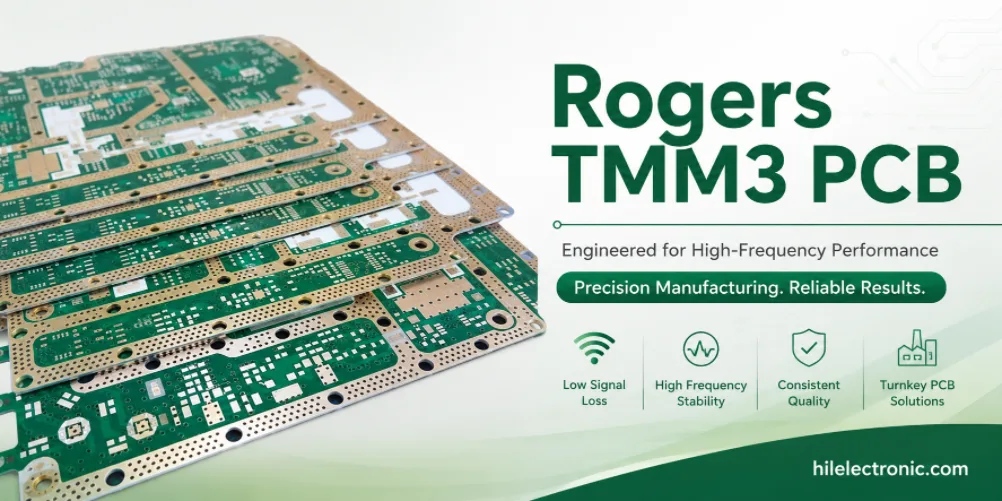
TMM3 PCB Manufacturing for RF Modules
TMM3 PCB manufacturing is most useful where the RF module...
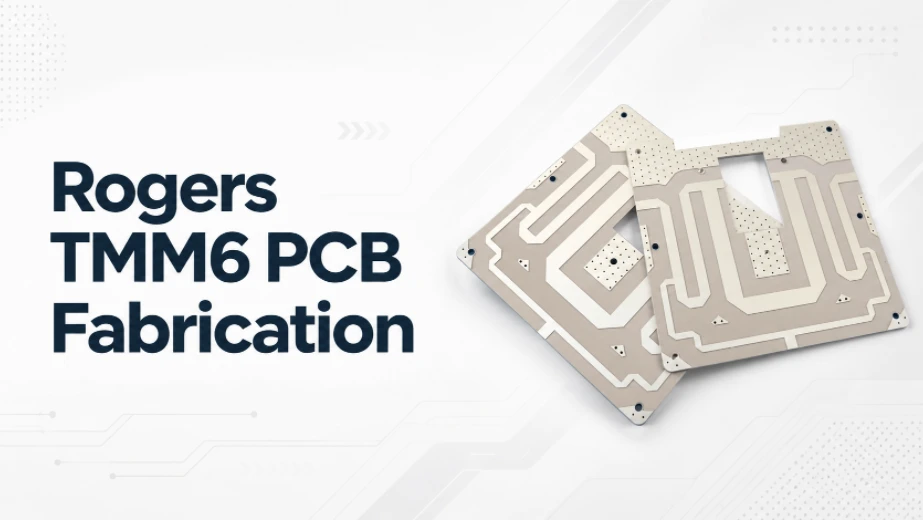
TMM6 PCB Fabrication
TMM6 fabrication is the process-control page for a mid-Dk...

TMM10i PCB Fabrication and DFM
TMM10i PCB fabrication has a stronger DFM emphasis because...
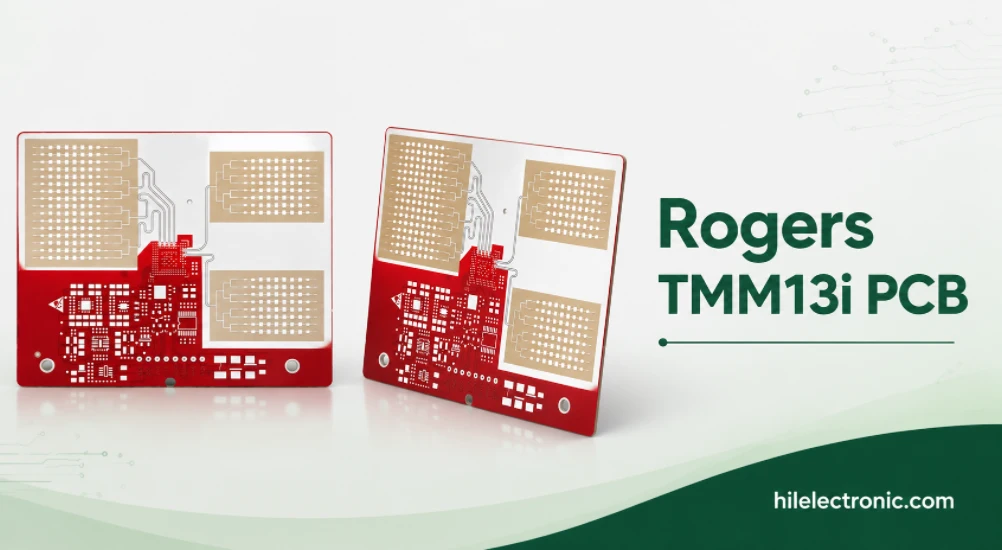
TMM13i PCB Manufacturing
TMM13i PCB manufacturing is aimed at ultra-compact RF...
How to get a quote for PCBs
Let’s run DFM/DFA analysis for you and get back to you with a report. You can upload your files securely through our website. We require the following information in order to give you a quote:
-
- Gerber, ODB++, or .pcb, spec.
- BOM list if you require assembly
- Quantity
- Turn time
For PCBA services, please provide your BOM (Bill of Materials) and any specific assembly instructions. We also offer DFM/DFA analysis to optimize your designs for manufacturability and assembly, ensuring a smooth production process.