
Rogers 5880 vs Other RF PCB Materials

The right 5880 comparison starts with loss budget and fabrication route. Very low-loss laminates can look similar in a catalog, yet drilling, PTFE processing, copper profile and finished thickness can produce different manufacturing outcomes on the same RF geometry. Material scope: the Rogers product name is used to identify the laminate specified for the PCB build. Highleap Electronics provides PCB fabrication and assembly, while the laminate is sourced and verified separately.
When it comes to high-frequency circuit materials, Rogers 5880 Laminates are widely regarded as one of the most reliable and high-performing options for applications that require exceptional signal integrity, low loss, and thermal stability. However, in the broad spectrum of high-frequency materials, it’s important to understand how Rogers 5880 Materials compare to other alternatives and when other materials may be more cost-effective or suitable for specific applications. Highleap Electronics offers custom PCB manufacturing and assembly with Rogers 5880 Laminates and other high-frequency materials to meet your specific needs for 5G, automotive radar, and more.
This page is a material-selection comparison, not a general Rogers product catalog. The practical distinction is how each candidate changes the finished RF construction, conductor loss, mechanical handling and fabrication route for the specific board being quoted.
1. Rogers 5880 Materials vs Rogers 4350B: A Cost-Effective Alternative for Lower Frequency Circuits
A common alternative to Rogers 5880 Laminates in high-frequency circuit design is Rogers 4350B, often chosen for lower-frequency circuits or when budget constraints are a priority. Rogers 4350B is an excellent material for applications that don’t require the extreme low-loss performance or high-frequency consistency that Rogers 5880 Materials offer.
Although Rogers 4350B is a high-frequency laminate made from a PTFE composite material, it has a slightly higher dielectric constant (around 3.48 at 10 GHz) and a higher dissipation factor (approximately 0.0020). These characteristics make it suitable for applications where cost efficiency is prioritized over achieving the absolute lowest loss, such as in 5G base stations operating at lower frequencies or RF circuits with a frequency range under 10GHz.
For applications with budget limitations or less demanding performance requirements, Rogers 4350B offers a good balance of electrical properties at a significantly lower cost compared to Rogers 5880 Materials. However, for more high-performance designs, Rogers 5880 Laminates remain the preferred material, especially for higher-frequency applications where signal loss and phase integrity are critical.
2. Rogers 5880 Laminates vs Other Materials: Low Loss and High-Frequency Performance Above 10GHz
For designs operating above 10GHz, such as 28GHz 5G antenna arrays or 77GHz automotive radar systems, Rogers 5880 Laminates are the candidate for high-performance applications. Here’s why they outperform other high-frequency materials:
1. Dielectric Constant Consistency:
Rogers 5880 Materials offer an exceptionally consistent dielectric constant of 2.20 ±0.02 at 10GHz. This consistency is vital for maintaining signal integrity in high-frequency circuits. It ensures that signal propagation remains stable across the board, crucial for applications like 5G networks and automotive radar systems, where even slight variations can disrupt phase alignment and degrade performance.
2. Low Dissipation Factor:
With a dissipation factor of 0.0009, Rogers 5880 Laminates are among the lowest-loss materials available for high-frequency circuits. This results in minimal signal loss, allowing more energy to reach its destination without absorption by the material. For high-frequency communication systems, radar systems, and satellite communications, this is critical to ensure performance without signal attenuation. In comparison, materials like Rogers 4350B (dissipation factor around 0.0020) and Arlon 25N (dissipation factor around 0.0025) exhibit higher loss, which can negatively impact system efficiency at high frequencies.
3. Signal Fidelity:
As frequencies increase, even the slightest variation in signal integrity can lead to significant performance degradation. Rogers 5880 Laminates ensure superior signal fidelity with their low loss and high-frequency consistency, making them indispensable for advanced RF designs. Maintaining signal purity is crucial for systems that require high data rates, precise phase alignment, and accurate signal processing. Materials like Taconic RF-35 and Rogers 4003C, while suitable for many high-frequency applications, may not provide the same level of performance as Rogers 5880 in more demanding environments, particularly when precise signal fidelity is required. For a 5880 build, the fabrication review should include the PTFE handling route, hole preparation, copper treatment and the tolerance assigned to the RF features. Comparing only Dk and Df misses the production variables that determine whether the first article can be repeated. Exact material property values should be checked against the current supplier documentation for the specified grade and construction.
Why Rogers 5880 is the Preferred Choice Above 10GHz:
For example, in a 28GHz 5G antenna array, even a small variation in dielectric constant or dissipation factor can cause phase errors or signal distortion, reducing data throughput and coverage. Rogers 5880 provides the precision needed to maintain the integrity of high-performance systems, ensuring reliable communication even in densely populated areas where 5G networks are being deployed.
Other High-Frequency Materials to Consider:
-
Rogers 4350B: A cost-effective material with a higher dielectric constant and dissipation factor, suitable for lower-frequency applications but not well suited to above 10GHz designs.
-
Rogers 4003C: Offers good performance for high-frequency applications, but its higher dissipation factor compared to Rogers 5880 makes it less suitable for applications demanding the lowest loss.
-
Arlon 25N: While a solid material for designs up to 10GHz, it doesn’t match the performance of Rogers 5880 at higher frequencies due to its higher dissipation factor.
-
Taconic RF-35: A reliable low-loss material, but its dielectric constant is not as consistent at higher frequencies compared to Rogers 5880, affecting signal propagation.
Rogers 5880 Laminates provide the best performance, particularly for applications requiring high-frequency signal integrity and low-loss characteristics above 10GHz, making them the go-to solution for next-generation technologies like 5G and automotive radar.
3. Rogers 5880 Materials vs Ceramic Materials: Balancing Performance and Cost
Ceramic PCB materials, such as RT/duroid 6010 or Rogers 4003C, are often considered for high-frequency circuits due to their exceptional thermal stability and low loss at high frequencies. However, ceramic materials come with trade-offs in terms of cost, manufacturing complexity, and flexibility.
Ceramic materials are typically used in specialized applications that demand extremely low loss tangents and outstanding high-frequency performance, such as space communications and advanced military systems. However, they are significantly more expensive and challenging to process compared to Rogers 5880 Materials, which provide a better balance of high-frequency performance and manufacturing flexibility at a lower cost.
For most 5G applications or automotive radar systems, Rogers 5880 Laminates offer a cost-effective solution without sacrificing performance, making them the suitable choice for mid- to high-volume production.
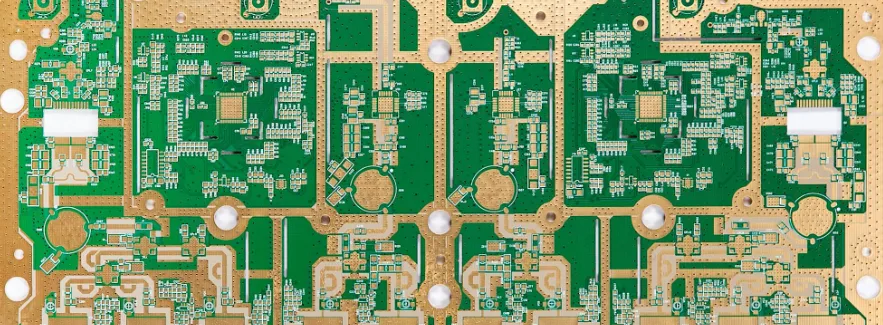
4. Why Rogers 5880 Laminates Outperform Other High-Frequency Materials in Military and Aerospace Applications
In military and aerospace applications, the demands for high-frequency materials are particularly rigorous, requiring not only exceptional signal integrity but also resilience under extreme conditions. Here’s why Rogers 5880 Laminates are often the preferred choice when compared to other high-frequency materials:
-
Superior Signal Integrity at High Frequencies: Unlike many alternative materials, Rogers 5880 Laminates maintain exceptional performance even at frequencies above 10GHz. This is critical for military communication systems and radar technology, where maintaining precise and clear signals is essential for operational effectiveness.
-
Low Loss for Critical Applications: The low dissipation factor (0.0009) of Rogers 5880 ensures minimal signal loss, providing superior performance in high-frequency circuits compared to other high-frequency materials like Rogers 4350B or ceramic-based laminates, which may exhibit higher loss at these frequencies.
-
Thermal Stability and Reliability: Military and aerospace systems often operate in extreme environmental conditions, such as high altitudes and temperature extremes. Rogers 5880 Laminates offer outstanding thermal stability, ensuring that the material remains stable even in such conditions, where other materials may struggle to maintain performance.
Rogers 5880 Laminates provide a robust solution for high-performance military and aerospace applications due to their low loss, excellent high-frequency performance, and superior thermal stability, making them a more reliable choice compared to other high-frequency materials in these demanding fields.
5. Rogers 5880 Laminates vs Other Low-Loss PTFE Materials
Other low-loss PTFE-based laminates, such as Rogers 4003C and Rogers 4350B, provide reliable performance for high-frequency applications. However, these materials typically feature higher dielectric constants and higher dissipation factors compared to Rogers 5880 Laminates, which can result in slightly more signal loss and less precise frequency control in certain applications.
While Rogers 5880 laminates are often seen as a low-loss choice for minimizing signal loss and ensuring consistent frequency precision, the selection decision depends on a variety of factors. For instance, cost considerations may play a significant role in selecting the most appropriate material. Rogers 5880 Laminates are generally more expensive than alternatives like Rogers 4350B or Rogers 4003C, so if budget constraints are a priority, these alternative materials might provide a more cost-effective solution without sacrificing too much performance for lower-frequency applications.
Ultimately, when choosing a material, it’s essential to weigh factors such as signal integrity, performance requirements, and cost. For applications requiring the best performance and minimal loss, Rogers 5880 Laminates are an excellent option. However, for those balancing cost with performance, other materials may be worth considering depending on the specific needs of the project.
Conclusion
While Rogers 5880 Laminates are among the material routes for high-frequency applications, understanding the specific requirements of your project is crucial when selecting the right PCB material. If your application involves frequencies above 10GHz, such as 5G, automotive radar, or satellite communications, Rogers 5880 Materials are the suitable manufacturing route due to their superior low-loss performance, consistent dielectric properties, and thermal stability.
For lower-frequency applications or when cost is the primary concern, materials like Rogers 4350B may provide adequate performance at a more affordable price point. Additionally, ceramic-based materials may be better suited for extremely high-frequency or highly specialized applications, though they come with higher costs and manufacturing challenges.
Ultimately, when signal integrity, low loss, and reliable performance are paramount, Rogers 5880 Laminates are the suitable choice. They offer unparalleled performance and versatility for high-frequency circuit designs, making them the go-to material for engineers seeking specified solutions in the world of 5G networks, automotive radar, satellite communication, and other advanced RF applications. Procurement should compare like-for-like construction. A useful RFQ fixes grade, thickness, copper, finish, hole technology, impedance test and quantity so suppliers are not quoting different stackups under the same material name.

Recommended Posts
TMM4 Filter PCB Manufacturing
TMM4 filter PCB manufacturing is controlled by the...
TMM3 PCB Manufacturing for RF Modules
TMM3 PCB manufacturing is most useful where the RF module...
TMM6 PCB Fabrication
TMM6 fabrication is the process-control page for a mid-Dk...
TMM10 PCB Manufacturing for Compact RF Designs
Table of contentsHow TMM10 Shrinks RF StructuresTMM10 vs...
How to get a quote for PCBs
Let’s run DFM/DFA analysis for you and get back to you with a report. You can upload your files securely through our website. We require the following information in order to give you a quote:
-
- Gerber, ODB++, or .pcb, spec.
- BOM list if you require assembly
- Quantity
- Turn time
For PCBA services, please provide your BOM (Bill of Materials) and any specific assembly instructions. We also offer DFM/DFA analysis to optimize your designs for manufacturability and assembly, ensuring a smooth production process.