
Handheld Altimeter PCB Manufacturing & Assembly for Barometric Instruments
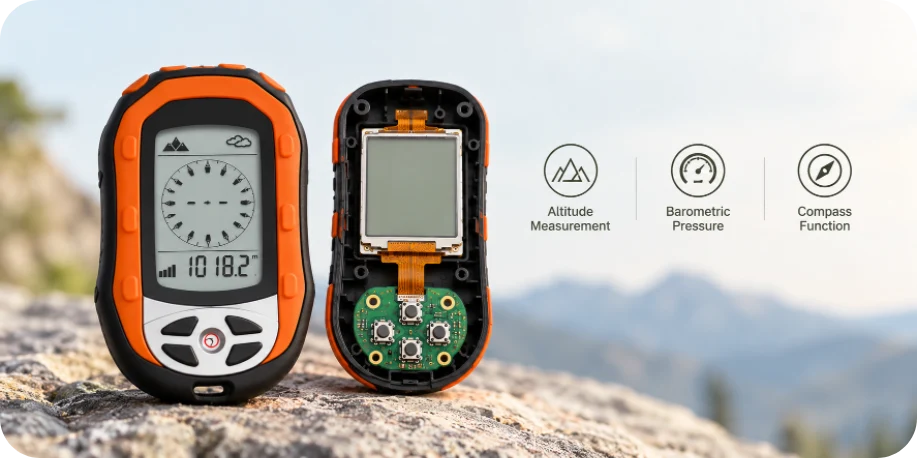
A Handheld Altimeter PCB typically uses an absolute barometric pressure sensor to estimate altitude for hiking, mountaineering or other portable outdoor instruments. Because the measurement depends on ambient pressure, the pressure port, enclosure venting, sensor stress, temperature environment and calibration method are part of the product—not secondary mechanical details.
Highleap Electronics supports customer-designed altimeter hardware with PCB fabrication, sourcing, PCBA, coating or masking processes, programming, inspection and customer-defined calibration/functional test. We can build early samples and pilot lots, then preserve the approved sensor, venting interface and process controls for repeat production.
For procurement teams, the most important manufacturing question is how the final mechanical assembly lets the sensor see the atmosphere without exposing it to contamination, coating, pressure shocks or assembly stress that changes the reading.
Before quotation, define the measurement system
- Exact pressure sensor and approved alternates, if any.
- Pressure vent/port geometry and whether the PCB is coated or sealed.
- Reference/calibration method and temperature range.
- Display, battery/charger, memory, GNSS or compass options.
- Whether Highleap supplies PCBA only or also supports enclosure-level assembly and test.
Define the Altimeter’s Measurement Claim Before Manufacturing
Handheld Altimeter Product Family: Hiking Altimeters, Barometers and Multi-Sensor Outdoor Meters
Handheld altimeter products range from dedicated elevation meters to multi-function outdoor instruments that combine barometric altitude, weather trend, compass, GNSS and temperature. Some are carried in a pocket or clipped to gear; others are built into watches or handheld navigation units. A dedicated altimeter can have a simple display and buttons, while a richer outdoor computer can contain more sensors, memory and wireless interfaces.
The central sensor is an absolute barometric pressure device. Highleap’s pressure sensor electronics overview is relevant to the transducer interface. Modern MEMS pressure sensors can provide digital outputs and internal compensation, but the OEM firmware still decides how to convert pressure into elevation, apply local reference pressure and display trends.
Adjacent products include barometers, variometers, weather meters, GNSS altitude devices and electronic compasses. A variometer emphasizes rate of climb/descent; a barometer emphasizes pressure/weather; GNSS altitude uses satellite positioning. A handheld altimeter page should acknowledge those products without pretending that all elevation technologies use the same sensor or calibration method.
Handheld Altimeter Product Formats: Pocket, Outdoor and Multi-Sensor Instruments
| Product form | Primary measurement | Device-level emphasis |
|---|---|---|
| Pocket barometric altimeter | Atmospheric pressure converted to altitude | Reference calibration, display and low power |
| Altimeter/barometer | Pressure and trend | Weather/elevation mode handling |
| Outdoor multi-sensor meter | Pressure plus compass/temperature/GNSS as selected | Sensor fusion, UI and environmental packaging |
| Variometer | Pressure change over time | Fast response and rate-of-climb calculation |
How Barometric Altitude Works: Pressure, Reference and Weather Effects
Atmospheric pressure decreases with altitude, allowing a pressure sensor to estimate elevation through a standard atmosphere relationship. The result depends on a reference pressure or known elevation. Weather systems also change surface pressure, so a stationary altimeter can appear to drift in altitude as weather changes. This is not necessarily a defective pressure sensor; it is a physical limitation of barometric altitude estimation.
The device may allow users to calibrate to a known elevation, local sea-level pressure or another reference. Some multi-sensor products combine barometric and GNSS information, but the fusion algorithm is product-specific. The PCB manufacturer should not invent or validate an altitude algorithm unless that engineering scope is explicitly included.
The microcontroller performs sensor reading, filtering, conversion, display and logging. Highleap’s microcontroller platform overview is an adjacent reference for embedded processing, but the actual MCU and firmware are selected by the customer. Manufacturing needs the programmed image and calibration/test procedure rather than a generic altitude formula.
Measurement boundary
Barometric altitude is a pressure-derived estimate. A PCB/PCBA factory can verify sensor readings and execute the approved calibration procedure, but it should not promise absolute elevation accuracy independent of reference pressure, weather and product algorithm.
Pressure-Sensing Integration Notes
Reference management is a major part of the user experience. A hiker can calibrate to a known trailhead elevation, an aviation-style instrument may use a pressure setting, and a data logger can combine a local weather reference with its own pressure trend. These are software/product decisions layered on the same pressure sensor. Manufacturing should therefore verify raw pressure and the released calculation firmware rather than treating one displayed elevation as a universal factory truth. For NPI, recording both reference pressure and displayed altitude during test makes failures easier to diagnose: a wrong raw reading points to sensor/hardware, while a wrong conversion with correct pressure points to configuration or software.
Pressure altitude is an estimate derived from atmospheric pressure and a reference model. Weather changes can move the indicated altitude even when the device is stationary. The customer should therefore define the intended use case and calibration workflow before the manufacturing test is written. Our pressure sensor selection and integration resource is relevant to the sensing component, but product accuracy remains a system-level specification.
Pressure Sensor Mounting Can Shift the Result
Handheld Altimeter PCB Architecture: Pressure Sensor, MCU, Display and Memory
A typical handheld altimeter PCB can contain the pressure sensor, MCU, display connector or integrated LCD/OLED, buttons, buzzer, memory, battery/power circuit and optional temperature, compass, GNSS or wireless devices. A dedicated altimeter may fit on one small rigid PCB. More complex products can use a main PCB plus flex or small interface boards depending on enclosure architecture.
Sensor communication is often digital, simplifying analog front-end design, but the board still needs clean power, decoupling and defined logic levels. Highleap’s PCB power-supply design for embedded devices is relevant to the low-voltage rails. A battery charger PCB circuit may be used in rechargeable models, while primary-cell products have different power and user-service requirements.
Display and backlight loads can dominate energy consumption and create local heat. Buttons and seals must align with the enclosure. If the product includes a pressure trend or logging history, nonvolatile memory and real-time clock behavior may need verification across battery replacement or charging cycles.
The architecture should reserve appropriate resources for calibration and user settings. Nonvolatile memory may store pressure offsets, known-elevation references or per-unit coefficients. A real-time clock can support pressure trend and weather functions. If GNSS or compass is added, those sensors can share the MCU and display but bring their own antenna/magnetic constraints. The production BOM and firmware should identify each variant clearly. A “barometer-only” SKU should not accidentally receive software expecting a compass, and a multi-sensor PCB should define unused connector states so missing optional hardware does not look like an assembly defect during test.
The sensor, MCU, display, memory and interfaces should be placed so heat and board stress do not undermine the pressure reading. Package handling and reflow profile also matter for MEMS pressure devices. Highleap builds to the approved sensor datasheet process limits and can flag DFM risks before assembly.
The Vent Path Is Part of the Measurement System
Pressure Port, Venting and Sensor Placement Inside the Enclosure
The pressure sensor must experience ambient pressure, so a fully sealed electronics cavity needs a controlled vent or membrane path. The port should be protected from liquid water, dust and direct airflow effects while allowing pressure equalization. The exact vent membrane and geometry are mechanical design decisions that need validation across temperature, humidity and altitude changes.
Sensor placement should avoid direct heat from regulators, displays or processors because temperature gradients can affect pressure compensation and create transient readings. Mechanical stress is another concern: screws, board bending, adhesive and enclosure compression can strain a MEMS sensor package. The PCB layout should keep the sensor away from high-flex regions and follow the vendor land pattern.
A coating strategy must respect the sensor port. Highleap’s conformal coating process guidance is relevant for outdoor boards, but coating cannot cover or contaminate a pressure inlet unless the sensor vendor and product design explicitly support it. Masking and post-coating inspection should be part of the assembly instructions.
Handheld Altimeter PCB Manufacturing & PCBA
Highleap Electronics supports custom altimeter PCB and PCBA projects with pressure-sensor handling, venting and coating controls, component sourcing, assembly, programming, inspection and customer-defined calibration or functional testing. Move from early samples to repeat or high-volume production with controlled revisions, global shipping options and responsive after-sales support.
The pressure path should be treated as a controlled mechanical feature with dimensions and materials, not an informal hole in the case. Hydrophobic membranes, foam, labyrinths or vents can slow pressure response and can behave differently when wet. During first-article build, the OEM can measure the time for the assembled device to follow a controlled pressure step and use that as a design check. The factory should inspect vent alignment and sensor-port cleanliness before sealing the case. If adhesive or coating processes change, another response check is prudent because invisible contamination at the port can create stable but wrong readings that electrical test will not detect.
A blocked or overly restrictive vent can make a good sensor respond slowly. Coating or adhesive can also contaminate the pressure port. If conformal-coating manufacturing controls is required, masking and keep-out instructions must be explicit. If final enclosure integration is part of the scope, box-build assembly can be quoted separately from the bare PCBA.
Power, Temperature and Outdoor Use Change the Real Error Budget
Low-Power Design, Temperature Compensation and Outdoor Operation
Handheld altimeters are often expected to run for long periods on small batteries. The pressure sensor can operate intermittently, with the MCU sleeping between samples and the display dimmed or off. The correct sampling interval depends on use: a mountaineering display can tolerate slower updates than a variometer measuring climb rate. Power strategy should therefore be tied to the actual device mode.
Temperature affects batteries, sensor behavior and the standard atmosphere relationship. Highleap’s PCB temperature considerations are relevant to material and component operation, but outdoor product accuracy needs system-level validation. A sensor with internal temperature compensation still experiences enclosure gradients and mechanical stress.
Power-on reset, brownout and battery-change behavior should preserve calibration or user settings if required. Rechargeable designs need charging limits appropriate to the cell and outdoor temperature range. Primary-cell products may prioritize ultra-low leakage and simple field replacement instead. The PCB must implement the approved power architecture without assuming one universal battery solution.
Outdoor operation also raises condensation and rapid-temperature-change issues. Moving a cold instrument into warm humid air can create moisture while the pressure cavity equalizes. The enclosure/vent system should manage that exposure without trapping water on the sensor. Battery chemistry and display performance may limit the usable temperature range before the PCB material does. The production test plan can screen current consumption and sensor communication at room temperature, while temperature/condensation testing remains part of design qualification or periodic sampling. This division keeps per-unit test time reasonable and still respects the environmental demands implied by a handheld outdoor instrument.
Battery life and temperature compensation should be validated under the product’s actual operating profile. PCB temperature behavior helps frame thermal behavior at board level, while products with rechargeable cells may also require a controlled charger PCB manufacturing subcircuit or integrated charging design.
PCBA Processing Must Protect the Pressure Port
Handheld Altimeter PCBA, Sensor Stress and Environmental Protection
Pressure-sensor assembly requires careful handling because MEMS packages can be sensitive to soldering, cleaning and mechanical contamination. The footprint and reflow profile should follow the vendor data. The PCB should remain flat around the sensor after assembly, and test fixtures should avoid pushing on the package.
Outdoor products can use coating, gaskets or sealed connectors, but the pressure path must remain functional. Highleap’s PCBA prototype production is useful during early builds when venting, coating masks and fixture design still need refinement. low-volume PCB manufacturing can support pilot runs before those environmental details are frozen for volume.
- A robust build also benefits from reliable PCB construction practices appropriate to the specified outdoor environment. That does not mean every handheld altimeter needs exotic material. Component temperature rating, laminate choice, coating and connector selection should follow the validated product requirement.
- The assembly flow should identify when the pressure sensor is installed relative to cleaning, coating and enclosure sealing. If a sensor is sensitive to cleaning solvent or pressure-wash equipment, it may need a controlled no-clean process or later installation. A fixture that contacts the board during programming should avoid bending the sensor area. For coated products, masking must be inspected after coating removal because residue at the vent can cause response errors. These process details are often more important to measurement quality than adding extra PCB layers, and they should appear in the PCBA work instruction before a pilot batch is released.
Cleaning, coating, sealing and mechanical fastening should be reviewed around the pressure-sensor port. The objective is not maximum encapsulation; it is controlled protection that still allows the sensing element to see ambient pressure as the product design intends.
Calibration and Functional Test Need the Final Mechanical Context
Calibration and Functional Testing for Barometric Altimeter PCBAs
Production testing should first verify sensor communication, raw pressure output, MCU, display, buttons and power behavior. Calibration can then compare readings against a controlled reference pressure or pressure chamber at one or more points according to the customer plan. Highleap’s functional circuit testing in PCBA manufacturing can support a fixture-based procedure, but the pressure reference must have suitable accuracy and traceability for the acceptance limits.
Testing the final enclosure is important because vent restrictions can create response lag. A pressure step or controlled chamber sweep can reveal blocked vents, contaminated sensor ports or excessive time constants. Temperature cycling may also be appropriate for products with a broad outdoor range, particularly if the OEM needs to characterize compensation rather than only screen assembly faults.
- Calibration coefficients should be linked to the unit serial number if they are device-specific. Production software should prevent data from one unit being copied to another. A golden unit can help fixture troubleshooting, but the primary acceptance standard should remain the calibrated reference and customer-defined limits.
- Calibration can be optimized for production by distinguishing sensor verification from full product characterization. A few controlled pressure points can screen offset and response, while extensive altitude/temperature sweeps can be reserved for design qualification or sampled audits. If the sensor vendor provides factory calibration coefficients, the OEM should define whether additional unit-level adjustment is permitted. The fixture software should record raw pressure, corrected value and programmed coefficient so an outlier can be traced later. For a barometer/altimeter combination, test both the pressure display and the altitude conversion at a known reference state to catch configuration errors that a raw-sensor check would miss.
Highleap can execute a customer-defined FCT in PCB assembly procedure that checks the display, buttons, storage, charging, sensors and interfaces. Pressure calibration may use a controlled reference or chamber where required. The OEM should define points, tolerances, temperature conditions and whether calibration data is stored in firmware, EEPROM or production records.
Move From Prototype to Batch Production Without Changing the Baseline
Use prototype PCBA service to discover vent, sensor-stress, firmware and calibration issues with a small lot. Move to low-volume production once the enclosure and test method are stable. Production should then preserve the approved sensor MPN, mechanical vent path, coating mask, calibration version and work instructions.
Highleap can apply reliable PCB manufacturing practices controls throughout the ramp so the product does not quietly change between the prototype that passed and the later lot that ships.
Pressure Accuracy Continues After Reflow
The production package for a handheld altimeter should include PCB fabrication data, BOM, assembly drawings, pressure-sensor information, enclosure and vent details, coating/masking requirements, firmware, calibration procedure, functional-test limits and target quantities. If the customer expects calibration after final enclosure assembly, that sequence should be stated explicitly.
Highleap can use prototype builds to identify whether reflow, board stress, coating boundaries or enclosure assembly shift the sensor output, then lock the accepted process for later batches. This is especially important when the same PCBA is used in several housings: a different vent membrane or mechanical preload can change the finished instrument even when the PCB revision is identical.
Pressure accuracy does not stop at the sensor datasheet and it does not stop when reflow ends. It continues through cleaning, coating, enclosure assembly, venting and calibration. A manufacturing partner is useful when those steps are treated as one measurement chain instead of separate departments.

Recommended Posts
TMM4 Filter PCB Manufacturing
TMM4 filter PCB manufacturing is controlled by the...
TMM3 PCB Manufacturing for RF Modules
TMM3 PCB manufacturing is most useful where the RF module...
TMM6 PCB Fabrication
TMM6 fabrication is the process-control page for a mid-Dk...

TMM10 PCB Manufacturing for Compact RF Designs
Table of contentsHow TMM10 Shrinks RF StructuresTMM10 vs...
How to get a quote for PCBs
Let’s run DFM/DFA analysis for you and get back to you with a report. You can upload your files securely through our website. We require the following information in order to give you a quote:
-
- Gerber, ODB++, or .pcb, spec.
- BOM list if you require assembly
- Quantity
- Turn time
For PCBA services, please provide your BOM (Bill of Materials) and any specific assembly instructions. We also offer DFM/DFA analysis to optimize your designs for manufacturability and assembly, ensuring a smooth production process.