
PCB Assembly with Free BOM Analysis Service
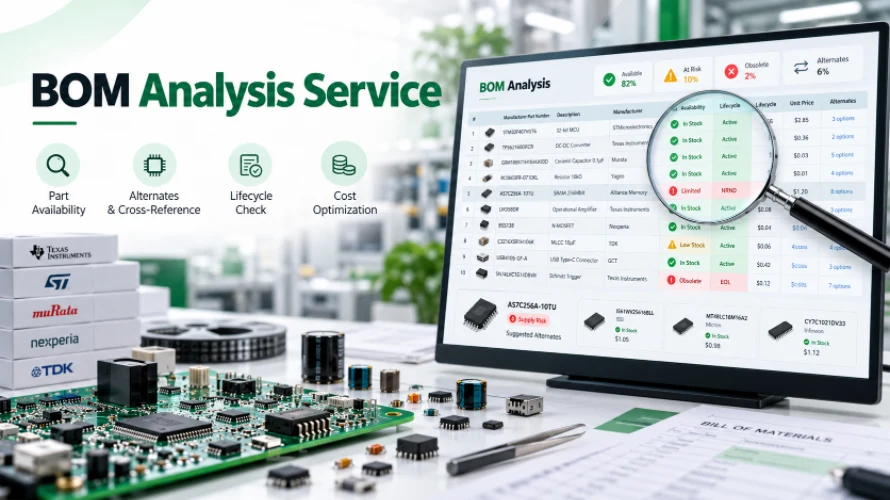
Need a free BOM analysis service before committing to PCB assembly? Highleap Electronics invites OEM and ODM teams to submit a bill of materials for an initial manufacturing and sourcing review as part of a PCBA quotation inquiry. The purpose is practical: identify missing or ambiguous part information, flag procurement and lifecycle risks, clarify substitution rules, and determine what is needed to price a buildable PCB assembly.
Highleap is a PCB fabrication and assembly manufacturer in China, not a standalone BOM software vendor. Our published services include component sourcing, PCB manufacturing, SMT and through-hole assembly, inspection, and project-defined testing. That makes a preliminary BOM review useful beyond the spreadsheet: the same approved component list can inform purchasing, PCB/footprint checks, production planning and a turnkey PCB assembly quotation.
What does “free” mean here? The initial review is intended to help prospective PCBA customers prepare a sourceable, quotation-ready BOM. The exact depth and deliverables should be agreed when the files are submitted. It should not be confused with an unlimited component redesign, a guaranteed real-time stock reservation, a formal regulatory-compliance audit, or an ongoing lifecycle-monitoring contract.
What Highleap Checks in a Free BOM Analysis for PCB Assembly
A useful free BOM analysis answers four purchasing questions: Can every required item be identified, can it be sourced under the customer’s rules, does it match the assembly design, and what is blocking an accurate quote? This is different from merely counting BOM rows or generating an automated price estimate.
For a manufacturing inquiry, Highleap can use the BOM alongside its PCB assembly production requirements. A clean sourceable list needs enough information to purchase the correct components and place them on the correct board revision. An apparently complete BOM may still omit manufacturer part numbers, mix fitted and do-not-fit positions, or specify a package that does not match the approved land pattern.
Five checks that matter before component purchasing
- BOM completeness and normalization: reference designators, quantities per board, values, descriptions, package, manufacturer and exact manufacturer part number (MPN). Duplicate designators, inconsistent units and unpopulated options should be resolved.
- Sourceability: availability indications, procurement channel restrictions, minimum order quantities (MOQ), packaging and material lead-time concerns. Any quoted availability is time-sensitive until stock is committed.
- Lifecycle exposure: active, not recommended for new designs (NRND), end-of-life (EOL), obsolete or other status requiring engineering review. Manufacturer notices and authorized-channel evidence take precedence over a reseller’s generic listing.
- Assembly consistency: footprint/package match, polarity-sensitive components, alternate population options, and differences between the BOM, assembly drawing and centroid file.
- Approval boundaries: which items may be substituted, which are approved-vendor-list (AVL) restricted, and which require written approval from the OEM design owner.
Highleap’s published free PCB manufacturability review covers fabrication data and, for turnkey PCBA projects, assembly-side checks including BOM-to-footprint verification. A BOM-only submission can support a sourcing discussion, but a full physical compatibility check needs the PCB and placement files as well. That distinction prevents a preliminary purchasing review from being mistaken for completed DFM approval.
Practical result: instead of a vague “BOM OK” response, the useful outcome is a prioritized list of confirmed information, clarification requests and risks requiring customer decisions. The depth of the report depends on the available data and agreed review scope.
BOM Risk Analysis: EOL Parts, Shortages and Approved Alternatives
Component lifecycle and shortage screening is one of the highest-value parts of a free BOM analysis service. An OEM can have a technically released design and still be unable to build the planned quantity because one isolated transceiver, MCU, connector or precision reference has an unacceptable lead time or lifecycle status. A preliminary BOM risk analysis should make that problem visible before the production schedule is committed.
Highleap’s electronic component sourcing work can be discussed in terms of exact MPNs, approved supply channels, quantities and proposed alternates. The factory can raise sourcing questions, but engineering equivalence and permission to change a released design remain with the customer unless otherwise authorized.
What a responsible alternative-parts review looks like
Consider a 24 V industrial gateway whose BOM specifies an isolated RS-485 transceiver. A second device may fit the same package but have different isolation ratings, common-mode limits, fail-safe behavior, operating-temperature range or pin functions. A footprint match alone is not proof of interchangeability. Similarly, a replacement MLCC with the same nominal capacitance can have a different effective capacitance under DC bias, and an MCU variant may differ in memory size, silicon revision or programming requirements.
For each proposed replacement, the review should distinguish commercial availability from technical approval. The former may be checked through suppliers; the latter requires design-owner evaluation of datasheets, schematic function, PCB footprint and any qualification implications. No proposed alternative should silently enter the production BOM.
| BOM finding | What it means for the RFQ | Next decision |
|---|---|---|
| Missing or ambiguous MPN | Purchasing cannot identify the exact approved part | OEM confirms manufacturer, package and variant |
| EOL / NRND device | Repeat-order or design-lifecycle risk | OEM approves last-time buy or redesign strategy |
| Long-lead or allocation-risk item | May determine the material-ready date | Confirm sourcing plan and permissible alternatives |
| Package / footprint mismatch | Part may not fit the released assembly | Engineering checks CAD data and corrects the release |
| Unapproved second source | Price or lead-time option, not a production authorization | OEM evaluates and signs off before purchase |
For higher-risk programs, source authenticity and compliance evidence should also be specified. An initial BOM review can identify missing documentation or procurement restrictions, but it cannot certify RoHS/REACH compliance or eliminate counterfeit risk merely by inspecting a spreadsheet. Authorized sourcing, supplier declarations and any additional inspection or testing must be defined in the purchasing agreement.
BOM Cost Optimization Without Compromising the Released Design
PCB assembly BOM cost optimization should reduce total manufacturing cost—not just the sum of unit prices in an online distributor cart. For OEMs, the meaningful cost includes purchased parts, order multiples, component attrition, packaging, logistics, PCB fabrication, assembly setup, testing and any agreed inventory commitment. A cheaper individual component can make the finished PCBA more expensive if it introduces rework, a new footprint or an unreliable supply source.
Where an initial review can uncover avoidable cost
- Over-specified commodity parts: confirm whether a particular voltage, tolerance, temperature or package rating is an actual design requirement before proposing any change.
- Packaging and MOQ mismatches: compare cut tape, reels, trays and minimum buys with the prototype quantity and projected production demand; include placement attrition where appropriate.
- Duplicate specifications: consolidate truly identical approved parts where the design owner permits it, while preserving electrical and reliability requirements.
- Single-source dependency: identify second-source opportunities early enough for qualification rather than switching parts during a production shortage.
- Assembly-driven costs: review whether selected packages, manual operations or unusual handling increase the manufacturing cost even when component pricing is attractive.
Some opportunities only become clear when component selection is reviewed against bare-board fabrication constraints and assembly drawings. A different connector may alter drill sizes, keep-outs and panelization; a replacement QFN may require a new stencil or land pattern. Changes of that kind are engineering decisions, not automatic BOM-cleanup actions.
Similarly, mismatches in centroid origin, side, rotation or reference designators can disrupt assembly regardless of how well components were sourced. Checking the BOM against the placement-data requirements is particularly valuable for first builds and PCB revision transfers.
Important distinction: a free preliminary review can flag potential savings and quotation risks; it should not promise a percentage cost reduction or guarantee future component prices. Final savings require validated alternates, live supplier quotations and an approved manufacturing configuration.
How to Submit Your BOM and Understand the Review Findings
For the fastest useful BOM review, send an editable Excel or CSV file with exact manufacturer part numbers, reference designators and quantities per assembly. A PDF-only BOM or a list of generic values usually creates unnecessary clarification rounds. If the request includes PCB assembly, provide the released PCB and placement files too, so purchasing questions can be reconciled with the actual build.
Recommended free BOM analysis submission package
- BOM: XLSX or CSV with item number, RefDes, quantity per board, manufacturer, MPN, description/value, package and DNP status.
- Procurement rules: approved vendor list, no-substitution parts, customer-consigned items, preferred distributors and any restricted origins or traceability requirements.
- Build files when available: Gerber or ODB++, assembly drawing, pick-and-place/centroid file and the relevant board revision.
- Demand: prototype quantity, planned pilot lot, expected annual usage and target production window. A forecast is not a stock commitment.
- Special requirements: industrial temperature range, RoHS/REACH evidence, moisture sensitivity, programming, calibration or product-specific testing.
For projects with ICT, programming or functional-test needs, coordinate the review with DFT checks for test access. A sourcing-complete BOM is not automatically a test-ready PCBA, especially when programming pads, fixture access or connector test loops are missing.
How to interpret a BOM analysis response
A practical preliminary review can group findings into four actionable categories. Ready for sourcing means the available data identifies the required part and no immediate clarification is evident; it is not a stock guarantee. Clarification required means a field or variant must be confirmed. Supply risk flags lifecycle or lead-time concerns. Engineering approval required identifies a proposed alternate or design-impacting issue that cannot be resolved by purchasing alone.
For example, a review might say: “U7: exact MCU suffix missing—confirm flash capacity and temperature grade”; “J3: specified connector lead time requires purchasing confirmation”; or “C18: proposed alternate has different DC-bias characteristics—engineering approval required.” These are illustrative findings, not results from a real customer BOM. They show the level of specificity that helps an OEM make decisions.
Ask the reviewer to distinguish verified facts, supplier indications and open assumptions. That makes the response useful to procurement and engineering teams and avoids turning an early-stage BOM screen into a misleading certification or production-release document.
From Free BOM Review to Turnkey PCB Assembly Quotation
The commercial value of Highleap’s initial BOM review is a clearer route from component list to buildable, quotable PCBA. Once critical MPNs, sourcing restrictions and open engineering questions are understood, the project can move into a coordinated quotation for PCB fabrication, component procurement, SMT/THT assembly and agreed verification.
For customers considering a turnkey manufacturing process, the quotation should identify the purchasing model—full turnkey, partial turnkey or consigned—plus the board and assembly revision, component-price validity, material risks, tooling, test scope and delivery assumptions. Highleap’s integrated PCB-to-PCBA workflow provides a relevant manufacturing context for these decisions.
Questions OEM buyers ask before submitting a BOM
Is free BOM analysis the same as a free PCB assembly quotation? No. The preliminary analysis examines information needed to source and build the BOM; the quotation prices an agreed scope using quantities, manufacturing data, supplier assumptions and test requirements. The two steps are connected but have different outputs.
Can Highleap find alternatives for obsolete or out-of-stock parts? Potential alternatives can be investigated during component sourcing. They must be checked for technical suitability and approved by the OEM before becoming part of the released BOM.
Can I submit a BOM before the PCB layout is finalized? Yes, for an initial sourceability discussion. But BOM-to-footprint, placement and physical assembly checks remain provisional until the corresponding PCB and assembly files are supplied.
Does a free BOM review guarantee price, availability or RoHS compliance? No. Component prices and stock change, and formal compliance depends on supplier documentation and the customer’s applicable requirements. The review should identify what has been checked and what still requires verification.
What happens after the BOM is reviewed? The OEM resolves missing information and approves sourcing decisions. Highleap can then assess the manufacturing package and project-defined functional test planning for an assembly quotation. Any production release requires the approved files, materials and commercial terms.
Send Highleap Your BOM for an Initial Review
Already have an Excel or CSV BOM? Share the current revision, planned build quantity and any no-substitution rules. Include Gerber and placement files if you also need a PCB assembly quotation. Highleap can review the initial sourcing and manufacturability questions, clarify the applicable no-charge review scope, and identify what is needed to move toward a production-ready PCBA quote.
Submit Your BOM for Free Initial Analysis and PCBA Quotation
Service scope: A preliminary BOM review is not a substitute for circuit-design validation, third-party compliance certification, formal component authentication, stock reservation or customer approval of substitutions. Detailed deliverables, review timing, confidentiality arrangements and any extended engineering work should be confirmed with Highleap for the specific project.

Recommended Posts
Consumer Electronics PCB Assembly
Highleap Electronics provides consumer electronics PCB...
PCB Assembly with Firmware Programming
Highleap Electronics provides PCB assembly with firmware...
24 Layer PCB Manufacturer in China
How to get a quote for PCBs Let‘s run DFM/DFA analysis for...
Ultra Fine Line PCB Manufacturing for High-Density Routing
How to get a quote for PCBs Let‘s run DFM/DFA analysis for...
How to get a quote for PCBs
Let‘s run DFM/DFA analysis for you and get back to you with a report. You can upload your files securely through our website. We require the following information in order to give you a quote:
-
- Gerber, ODB++, or .pcb, spec.
- BOM list if you require assembly
- Quantity
- Turn time
In addition to PCB manufacturing, we offer a comprehensive range of electronic services, including PCB design, PCBA, and turnkey solutions. Whether you need help with prototyping, design verification, component sourcing, or mass production, we provide end-to-end support to ensure your project’s success.
For PCBA services, please provide your BOM (Bill of Materials) and any specific assembly instructions. We also offer DFM/DFA analysis to optimize your designs for manufacturability and assembly, ensuring a smooth production process.