
Concert LED Glow Stick PCB Manufacturing
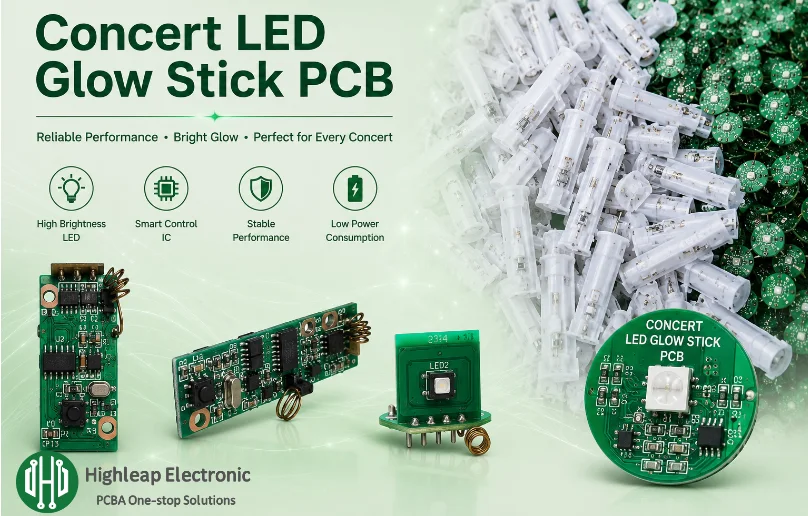
Figure 1. Concert LED glow stick PCB for controllable stage light sticks
Table of Contents
For a long time the glow stick at a concert was a plastic tube you snapped to mix two chemicals. That’s almost gone from large shows. What an audience holds today is an electronic device that an artist’s production team controls in real time — a sea of lights that turns red, sweeps blue across a stadium, or pulses to the beat, all driven from the stage. Behind that effect is a small printed circuit board produced in the tens of thousands for a single show. This article explains what these controllable glow sticks are, how the crowd is controlled from the lighting desk, what the electronics inside look like, and what it takes to produce them at the scale a concert demands.
What a Concert LED Glow Stick Really Is
The modern concert glow stick is an electronic product, not a chemical one. Inside a slim housing it carries one or more RGB LEDs, a small microcontroller, a wireless receiver, a battery, and a switch — all on a compact circuit board. Two facts about how it’s used shape everything about how it’s built:
- The organizer provides it. Rather than fans buying assorted sticks, the event hands out one device to (ideally) everyone — placed on seats, distributed at entry, or bundled with the ticket. That’s what makes a coordinated effect possible: if the whole audience holds the same controllable device, the production can light the entire room as one canvas.
- The venue controls it. Each stick is a receiver. It doesn’t decide its own colour — it does what a transmitter at the venue tells it, so the lighting team can change the colour and pattern of every stick in the building from a control position, in sync with the music and the stage lighting.
This is a different category from a consumer light stick that a fan turns on and waves independently. A controllable concert glow stick is, in effect, a wireless pixel in a crowd-sized display — and that framing drives its design toward low cost per unit, reliable wireless reception, and production consistency across an enormous batch. The same technology appears in another form factor as the LED wristband (the glowing bracelet handed out at some tours), which works the same way; the glow stick is simply the handheld version. Where a basic light stick sits versus this controllable kind is worth making explicit:
| Type | How it lights | Who controls it |
|---|---|---|
| Chemical glow stick | Snap to mix chemicals; single fixed glow | No control; fades over hours |
| Basic LED light stick | RGB LED with on/off and preset modes | The user, with a button |
| Controllable concert glow stick | RGB LED driven by a wireless receiver | The show, from the lighting desk |
How the Whole Crowd Is Controlled from the Stage
The magic of a synchronized crowd is a transmitter and a lot of receivers. A control position at the venue — usually tied into the lighting desk through DMX, the standard lighting-control protocol — broadcasts commands to every glow stick at once, so the crowd’s colour and pattern become another channel the lighting operator runs alongside the stage rig. There are two common ways the signal reaches the sticks, and the choice shapes both the device and the show:
| Control method | How it works | Trade-offs |
|---|---|---|
| RF (radio) | A radio transmitter blankets the venue; sticks receive regardless of line of sight | Whole-venue reach and zoning; each stick needs a radio receiver and antenna |
| IR (infrared) | Infrared emitters placed around the venue (often on trusses) beam to sections | Very low cost per stick; needs line of sight and good IR coverage |
RF can reach an entire arena and supports addressing — the system can talk to zones or sections so the production can run waves, gradients, or shapes across the crowd rather than one uniform colour. IR is cheaper at the device level (a simple receiver), which matters at huge volume, but it relies on emitters covering every seat and on line of sight, so its zoning follows where the emitters point. Either way, the effect is the same from the audience’s seat: the operator pushes a cue and the whole room responds together, locked to the show.
The practical point for anyone building these is that the control scheme is a design decision the customer makes up front, because it changes the board. An RF stick needs a radio receiver and a tuned antenna on the PCB; an IR stick needs an infrared receiver positioned to catch the venue’s emitters. That decision then flows into the layout, the testing, and the cost — which is where the circuit board comes in.
Why RF versus IR changes the whole device
It’s tempting to treat “wireless” as one thing, but the two paths produce noticeably different products. An RF design carries a radio receiver and an antenna, so the PCB has to respect antenna placement, keep noisy copper and the battery away from the antenna area, and be tuned and tested for reception — closer to building a small radio than a simple LED toy. That adds cost per unit but buys reliable whole-venue coverage and the addressing needed for section-by-section effects. An IR design is simpler and cheaper on the board — an infrared receiver and not much else — which is why some very high-volume, near-disposable devices use it; the complexity moves out of the stick and into the venue’s network of IR emitters and their DMX control. So the same brief — “controllable glow sticks for a tour” — yields a different bill of materials, a different layout discipline, and a different per-unit cost depending on which control method the customer chooses. Neither is universally right; arena-and-stadium productions that want rich zoned effects often lean RF, while the lowest-cost mass giveaways often lean IR, and the decision belongs to the product owner, not the factory.

Figure 2. Concert LED Glow Stick PCB
The PCB and Electronics Inside a Controllable Glow Stick
Open one up and the board is small but does several jobs at once. The recurring building blocks of a controllable glow stick PCB are:
- RGB LED(s). One or more red-green-blue LEDs that mix to any colour the show calls for. Colour consistency across the batch matters here, because uneven units are visible when thousands light together.
- A microcontroller. A small MCU reads the wireless commands and drives the LED — setting colour, brightness, and any local effect. It’s the brain that turns a received cue into light.
- A wireless receiver. An RF receiver (with an antenna) or an IR receiver, depending on the control scheme, that picks up the venue’s transmission.
- Power. A battery (a coin cell such as a CR2032 for low-cost single-use designs, or a rechargeable lithium cell with a charging circuit for reusable ones) plus the contacts or holder and any power management.
- A switch or activation. A button or pull-tab that powers the device, sometimes with a local mode as a fallback.
None of these is exotic on its own; the discipline is fitting them onto a small, low-cost board that assembles cleanly at volume. Most designs are compact FR-4 boards, single- or double-sided, sometimes shaped to a slim housing. RF versions demand real layout care around the antenna — keeping it clear of the battery and ground pours and respecting the antenna’s keep-out — which is the kind of thing that separates a stick that receives reliably across a stadium from one with dead spots. The assembly is almost entirely surface-mount (the LED, MCU, and receiver are SMT parts), so the board is built through an SMT assembly process, with any switch or battery contact added as a through-hole or mechanical part.
“From the front of house it looks like magic, but each light in that crowd is just a receiver doing what the desk tells it. The hard part was never the effect — it’s making fifty thousand identical little boards that all wake up, all receive, and all show the same red at the same instant. At that scale, consistency is the whole product.”
— a live-events lighting and technology engineer
Figure 3. Assembled concert LED glow stick PCBA ready for functional testing
Producing Concert Glow Sticks at Arena Scale
What makes glow-stick production its own discipline isn’t the circuit — it’s the scale and the economics. A single arena show needs roughly fifteen to twenty thousand devices; a stadium tour needs many tens of thousands per night, every night. That volume reshapes every priority:
- Cost per unit dominates. When you build tens of thousands and many are effectively single-use, a few cents on the board or the bill of materials multiplies into real money. Designs are kept lean, and component choices and sourcing are made with volume pricing in mind — which is where disciplined component sourcing earns its place.
- Consistency and yield are the product. A dead or wrong-coloured unit is a dark spot in a glowing crowd. One stick isn’t a catastrophe, but yield across tens of thousands directly sets both cost and how clean the overall effect looks, so stable assembly and inspection matter more than on a low-volume board.
- The battery sets the design. A show runs a couple of hours, so the power budget — brightness against battery life — is a core constraint. Single-use designs lean on a coin cell sized to last the event; reusable designs add a rechargeable cell and a charging circuit, raising unit cost but cutting waste across a tour.
- RF designs need testing built in. If the sticks are radio-controlled, reception has to be verified, so functional and RF checks are part of the line, not an afterthought.
- Schedule is fixed. A tour date doesn’t move. The whole run — fabrication, sourcing, assembly, test, and delivery — has to land before the trucks roll, which is why a combined turnkey assembly flow that owns the whole chain is well suited to this work.
Most programs start small and scale: a prototype to prove the effect and the housing fit, a pilot run to confirm the assembly and reception are stable, then full volume for the tour — the path our prototype board service is built for. Getting the design reviewed for manufacturability before the big run is what keeps a fixed launch date safe.
Why arena scale changes the whole design
A board that’s perfectly reasonable to build a hundred of can be the wrong design to build fifty thousand of, and the difference is worth designing for from the start. At volume, every avoidable component is a cost multiplied by the run, so the design is pared to what the effect actually needs — no spare parts, no over-specified battery, no feature that doesn’t earn its cents. Assembly is optimised for throughput: footprints and spacing that place and reflow cleanly at speed, panelisation that runs efficiently, and pads designed so the line doesn’t fight the board. Reception, on RF designs, is validated on real units rather than assumed, because a tuning problem discovered after fifty thousand are built is a disaster on a fixed schedule. And the battery and brightness are matched to the actual show length with margin, because “it worked on the bench for ten minutes” is not the same as “it lasts the encore.” A manufacturability review before committing to volume — checking footprints, antenna keep-outs, panelisation, and assembly-side risks against the real process — is the cheapest place to catch all of this, and our DFM review is built for exactly that handoff from a working prototype to a stadium-sized run.
Concert and Stage Glow Stick PCB Production at Highleap
Highleap Electronics is a PCB manufacturing and PCB assembly factory, and concert and stage glow stick PCB production is a natural fit for what we do: build small electronic boards reliably, in the volumes a show needs, to a customer’s specification. As demand for controllable crowd lighting grows, more event-technology companies, lighting brands, and product owners need a factory that can take a proven glow-stick design and make it at scale — and that’s the role we fill.
You set the specification — the control scheme (RF or IR), the LED and brightness, the battery and whether it’s single-use or rechargeable, the housing constraints, and the volume — and we fabricate the PCB and assemble it to exactly that, source the components at volume pricing, and run functional and reception testing where your design calls for it. Our DFM review looks over the design before the run and flags anything that would hurt yield, reception, or assembly at scale — antenna keep-outs, tight footprints, panelisation — as recommendations for you to decide on. The product design and control technology are yours to define; our part is to manufacture and assemble it consistently, from a first prototype through pilot to a full tour-sized run, and to hold the fixed launch schedule. Whether you’re searching for stage glow stick production or concert glow stick PCB manufacturing, that combined fabricate-source-assemble-test workflow under one roof is what we bring.
Concert Glow Stick FAQs
Are concert glow sticks electronic or chemical?
At modern large shows they’re electronic. Inside a slim housing is a small circuit board with RGB LEDs, a microcontroller, a wireless receiver, and a battery — not the two chemicals of a snap-and-shake stick. That’s what lets the colour change and respond to the show, which a chemical stick can’t do.
How are the glow sticks in a concert controlled?
A transmitter at the venue, usually tied into the lighting desk through DMX, broadcasts commands to every stick at once. Each stick is a receiver that does what it’s told, so the lighting operator changes the colour and pattern of the whole crowd from a control position, synchronized to the music and stage lighting.
What’s the difference between RF and IR controlled glow sticks?
RF (radio) blankets the whole venue and reaches sticks regardless of line of sight, supporting zoned effects across sections — but each stick needs a radio receiver and antenna. IR (infrared) uses emitters placed around the venue and is cheaper per stick, but needs line of sight and good IR coverage. The choice affects the board, the cost, and the kinds of effects possible.
What components are inside a controllable glow stick?
Typically one or more RGB LEDs, a small microcontroller that drives them, a wireless receiver (RF with an antenna, or IR), a battery with its contacts and any power management, and a switch or activation. It’s a compact board — usually FR-4 and mostly surface-mount — that fits a slim housing.
Are concert glow sticks single-use or rechargeable?
Both exist. Many are low-cost, near-single-use devices on a coin cell sized to last the event, sometimes collected for recycling or kept as a souvenir. Others — often on longer tours — are rechargeable, with a lithium cell and a charging circuit, which costs more per unit but reduces waste across many shows. The product owner decides based on cost and sustainability goals.
How many glow sticks does a concert need?
Enough for the audience, since the effect depends on most people holding one. That’s roughly fifteen to twenty thousand for an arena and many tens of thousands per night for a stadium tour. That volume is what makes production consistency, cost per unit, and a fixed delivery schedule the central concerns of manufacturing them.
Who manufactures the PCB inside a concert glow stick?
A PCB manufacturer and assembler builds it — fabricating the small board and assembling the LED, microcontroller, receiver, and battery components onto it, at the volume a show needs, to the product owner’s design. Highleap Electronics handles that fabricate-source-assemble-test workflow for concert and stage glow stick PCB production, from prototype through to a full tour run.

Recommended Posts
TMM4 Filter PCB Manufacturing
TMM4 filter PCB manufacturing is controlled by the...
TMM3 PCB Manufacturing for RF Modules
TMM3 PCB manufacturing is most useful where the RF module...
TMM6 PCB Fabrication
TMM6 fabrication is the process-control page for a mid-Dk...
TMM10 PCB Manufacturing for Compact RF Designs
Table of contentsHow TMM10 Shrinks RF StructuresTMM10 vs...
How to get a quote for PCBs
Let‘s run DFM/DFA analysis for you and get back to you with a report. You can upload your files securely through our website. We require the following information in order to give you a quote:
-
- Gerber, ODB++, or .pcb, spec.
- BOM list if you require assembly
- Quantity
- Turn time
For PCBA services, please provide your BOM (Bill of Materials) and any specific assembly instructions. We also offer DFM/DFA analysis to optimize your designs for manufacturability and assembly, ensuring a smooth production process.