
DSP Chip PCB Design and Assembly Guide
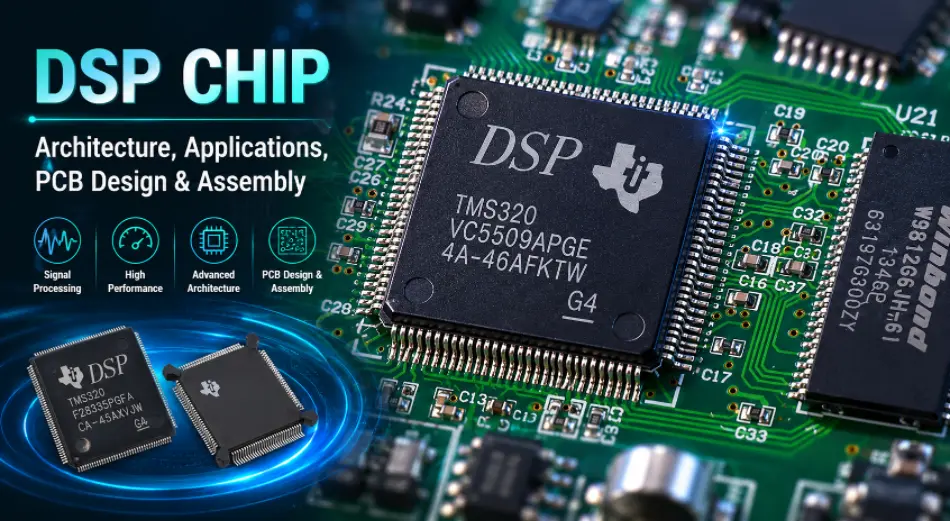
High-performance DSP chip boards need design, fabrication, assembly, and test decisions to be reviewed as one production workflow.
A DSP chip is selected for fast, repetitive signal math, but DSP board failures usually happen at the manufacturing boundary: unstable clocks, noisy analog inputs, weak power delivery, BGA fanout limits, component shortages, inconsistent soldering yield, or test methods that work for one prototype but fail in production.
This guide focuses on the complete DSP chip PCB design, fabrication, assembly, and test workflow. It is written for OEM teams, hardware engineers, sourcing teams, and product owners preparing a DSP chip board for prototype or repeat production with Highleap Electronics.
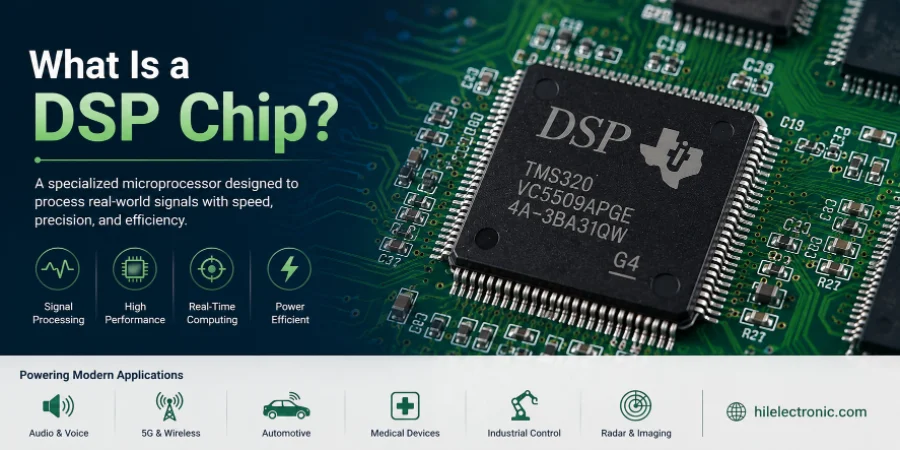
A DSP chip board combines the processor, power rails, clocks, memories, converters, connectors, firmware access, and production test points.
What a DSP Chip PCB Must Do
A DSP chip PCB receives real-world signals, conditions or converts them, processes data in real time, and sends the processed result to another system. Depending on the product, that may involve audio, vibration, motor control feedback, radar, RF baseband, industrial sensors, medical imaging, or communication data.
The board must do more than carry the DSP package. It must maintain signal integrity, provide stable power rails, keep reference clocks clean, support programming and debug access, survive bare PCB fabrication, support assembly inspection, and include enough test access for production verification.
| Board function | Manufacturing implication |
|---|---|
| Signal capture and conversion | Analog routing, grounding, ADC reference stability, shielding, and cleanliness matter. |
| High-speed processing | Stackup, impedance, BGA escape routing, and return path continuity must be checked early. |
| Power delivery | Core, I/O, memory, analog, and clock rails need decoupling and power integrity review. |
| Programming and test | Boot mode access, test pads, fixture clearance, firmware files, and pass/fail limits should be planned before layout release. |
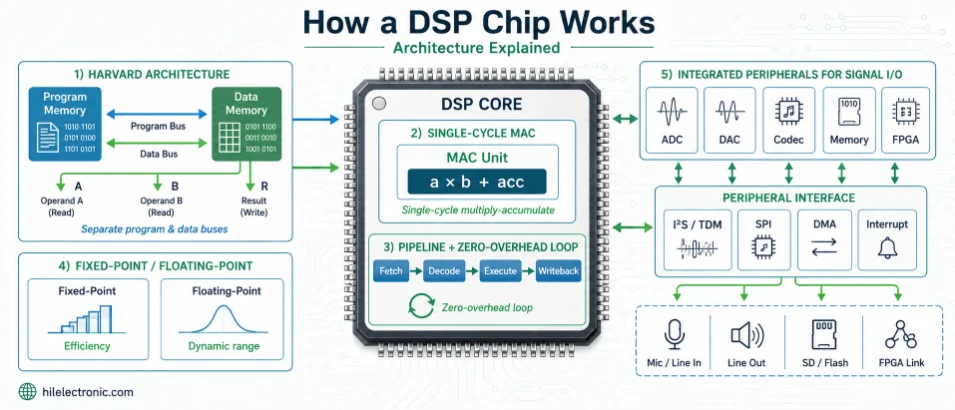
DSP architecture details such as memory buses, clock domains, ADC/DAC interfaces, and DMA paths shape the PCB layout and validation plan.
DSP Architecture Details That Affect the PCB
The internal architecture of a digital signal processor affects the external PCB. A device with multiple memory buses, high-speed serial interfaces, external SDRAM, audio interfaces, ADC/DAC connections, or a complex clock tree creates different layout constraints than a small fixed-point DSP used in a simple controller.
Before quoting a DSP chip PCB, Highleap Electronics checks the schematic and BOM for the signal chain around the processor, not only the processor part number. The review normally includes power rails, boot memory, oscillator or clock source, analog front end, converters, connectors, programming interface, heat path, and any high-speed memory or communication links.
- Clocking: oscillator placement, trace length, shielding, load capacitors, and return path continuity.
- Memory interfaces: length matching, impedance, via count, termination, and reference plane changes.
- ADC/DAC paths: analog/digital partitioning, reference routing, filtering, and low-noise power.
- Boot and debug: JTAG/SWD/UART/SPI access, test pad size, and fixture clearance.
- Thermal behavior: package type, copper area, via arrays, airflow, and enclosure constraints.
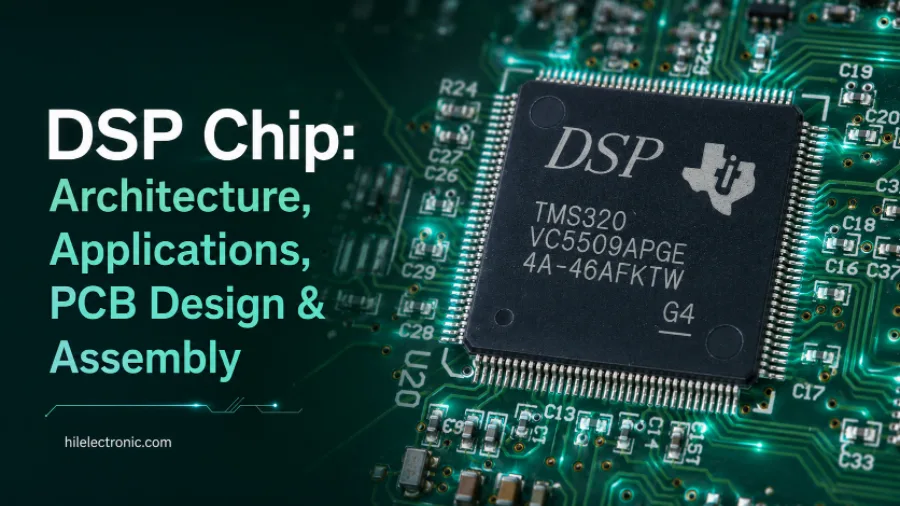
The DSP chip package determines fanout density, via strategy, solder joint inspection access, thermal spreading, and practical PCB layer count.
Package, Stackup, and Component Selection
The DSP chip package often determines the practical PCB stackup. A QFP package may be serviceable with easier inspection access, while a fine-pitch BGA or high-pin-count package may require microvias, via-in-pad, tighter registration control, or a higher layer count. The lowest-cost stackup is not always the lowest-risk stackup.
Highleap reviews package pitch, ball map, power pins, memory placement, and routing channels before recommending a stackup. For high-speed or mixed-signal DSP boards, this review may include controlled impedance PCB requirements, copper balance, sequential lamination needs, and whether test coupons should be added.
| Decision | Risk if ignored | What Highleap checks |
|---|---|---|
| BGA pitch and fanout | Unroutable board or poor yield | Drill size, annular ring, via type, pad design, and X-ray access |
| Core and I/O rail plan | Startup failures, resets, and noise coupling | Regulator placement, decoupling, plane split, and rail sequencing |
| Memory and clock routing | Timing margin loss and intermittent errors | Length matching, impedance, vias, and reference plane transitions |
Component selection also affects procurement. If a DSP chip, memory, converter, or oscillator has limited availability, the assembly schedule depends on sourcing confirmation before production slots are reserved.
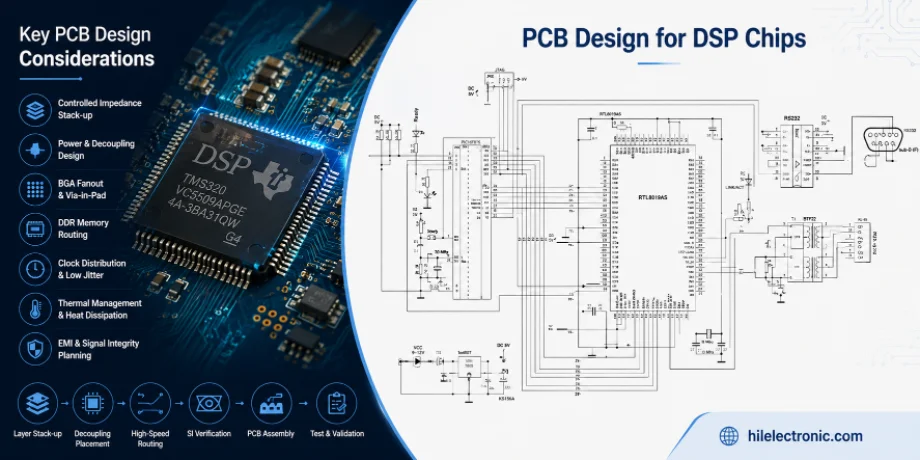
DSP applications require the PCB design to balance signal integrity, analog noise, power conversion, connectors, firmware access, and field reliability.
Application-Driven PCB Design and DFM
A DSP chip used in audio processing does not create the same PCB priorities as one used in radar, motor control, telecom, or industrial sensing. The application determines which tradeoffs matter most: noise floor, latency, thermal dissipation, EMI, sampling accuracy, connector robustness, or test coverage.
- Audio DSP boards need low-noise analog paths, codec placement, clean references, and careful grounding around inputs and outputs.
- Motor-control DSP boards need isolation, gate-drive clearance, current-sense routing, thermal management, and EMI control.
- RF and communication DSP boards need clock discipline, impedance control, shielding strategy, and stable power for converters.
- Industrial DSP boards need connector strength, ESD protection, conformal coating choices, and repeatable functional test.
High-performance DSP chip boards usually fail for practical board-level reasons: broken return paths, insufficient decoupling, aggressive via transitions, poor clock placement, thermal crowding, or unclear fabrication notes. These risks should be reduced before the bare PCB is released for manufacturing.
Related capabilities include PCB assembly service, components sourcing, and free DFM review for PCB projects.
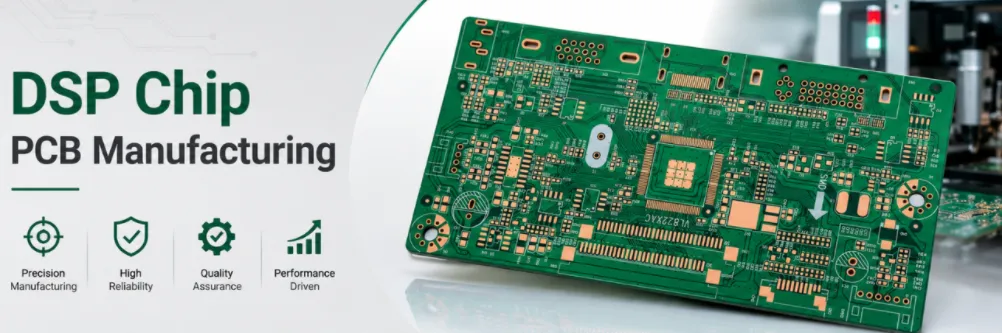
PCB fabrication comes before assembly: stackup, impedance, drill limits, copper balance, solder mask, panelization, and manufacturing records must be confirmed first.
PCB Fabrication and Manufacturing Control
The correct sequence is bare PCB fabrication before component assembly. For a DSP chip PCB, fabrication control starts with the stackup, material selection, copper weight, drill plan, impedance model, solder mask design, surface finish, panelization, and manufacturing notes. If these are wrong, assembly can only expose the problem later; it cannot fix the bare board.
Highleap Electronics typically checks these PCB manufacturing items before assembly is scheduled:
- Gerber, drill, IPC-356 netlist, ODB++ or IPC-2581 package consistency
- Layer stackup, dielectric thickness, copper weight, impedance targets, and coupon needs
- BGA fanout, solder mask expansion, via plugging/filling, and via-in-pad notes
- Clock, memory, converter, and high-speed interface routing constraints
- Panelization, fiducials, tooling holes, component keepouts, and assembly orientation
- Fabrication drawing notes for surface finish, solder mask, legend, controlled depth, slots, and tolerances
For mixed-signal DSP boards, PCB fabrication control also protects later assembly yield. Plane continuity, solder mask registration, BGA pad quality, flatness, and cleanliness all affect whether SMT assembly can be inspected and repeated reliably.
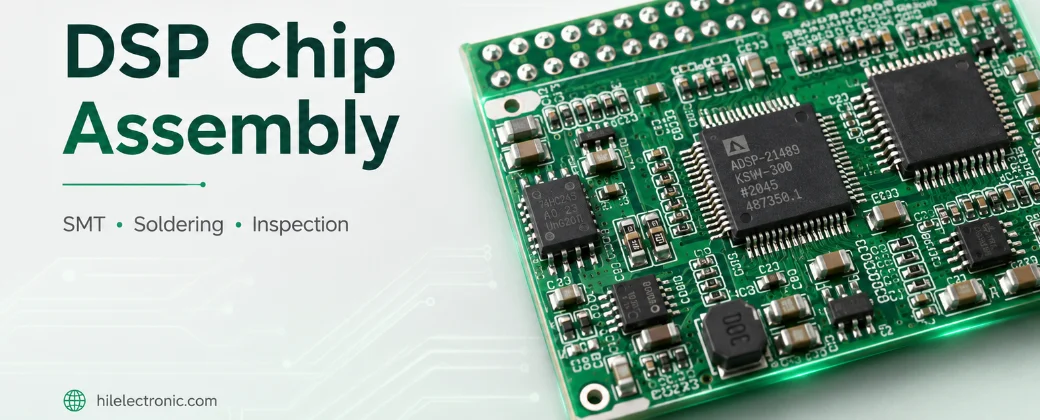
After the bare PCB is manufactured, SMT assembly controls paste volume, placement accuracy, reflow profile, BGA inspection, cleaning, programming, and functional test.
DSP Chip Assembly, Inspection, and Test
After the bare PCB is fabricated and inspected, the project moves to SMT/PCBA assembly. DSP chip assembly needs process control around the processor package and the surrounding components. Fine-pitch QFP packages need lead inspection and coplanarity control. BGA packages need paste volume control, placement accuracy, reflow profiling, X-ray inspection, and sometimes failure analysis if a pattern appears.
Highleap Electronics reviews stencil design, solder paste selection, component moisture sensitivity level, baking needs, placement program, polarity, first-article inspection, AOI coverage, X-ray coverage, and cleaning requirements. If the board includes analog sensing, RF paths, or high-impedance inputs, flux residue and contamination control become more important.
| Assembly stage | DSP board control point |
|---|---|
| Stencil printing | Aperture design for BGA, QFN, fine-pitch ICs, and mixed component sizes |
| Placement | Package orientation, reference designator verification, feeder setup, and MSL control |
| Reflow | Thermal mass balance, peak temperature, soak time, and voiding risk |
| Inspection and test | AOI, X-ray, programming, fixture test, and functional pass/fail records |
Quote Package and Production Records
A DSP chip PCB is not production-ready until the quote package and test method are clear. Prototype bring-up can rely on an engineer at a bench, but production needs repeatable records: what was fabricated, what was assembled, what was programmed, what was measured, what passed, what failed, and how the result is tied to the board serial number or lot.
For DSP chip projects, Highleap Electronics recommends preparing:
- Gerber or ODB++ files, drill data, stackup notes, controlled impedance targets, and fabrication drawing
- BOM with manufacturer part numbers, approved alternates, lifecycle notes, and sourcing responsibility
- Pick-and-place file, assembly drawing, polarity notes, and special handling requirements
- Firmware file, programming method, boot configuration, and debug connector requirements
- Functional test procedure, fixture requirements, pass/fail limits, and reporting format
- Prototype quantity, production quantity, annual forecast, delivery target, and packaging needs
For repeat builds, Highleap can help keep records aligned across PCB fabrication, component sourcing, SMT assembly, inspection, programming, and functional test.
DSP Chip PCB FAQs
What is a DSP chip used for on a PCB?
A DSP chip processes real-time signals such as audio, vibration, motor feedback, radar, RF baseband, sensor data, or communication streams. On a PCB, it works with clocks, memory, converters, power rails, connectors, firmware, and test access.
Why does a DSP chip board need special PCB layout attention?
DSP boards often combine high-speed digital routing with analog inputs, precise clocks, switching power supplies, and dense packages. Poor return paths, weak decoupling, clock noise, or uncontrolled impedance can create intermittent failures.
Does PCB fabrication come before DSP chip assembly?
Yes. The bare PCB must be fabricated and inspected before SMT/PCBA assembly. Stackup, drilling, plating, solder mask, surface finish, panelization, and impedance control must be correct before the DSP chip and other components are assembled.
How many PCB layers does a DSP chip board need?
It depends on package pitch, interface speed, memory routing, power rails, and EMI requirements. Simple boards may use fewer layers, while high-pin-count BGA or high-speed DSP designs often need additional signal and plane layers.
Can Highleap assemble DSP chip boards with BGA packages?
Yes. Highleap Electronics supports PCB manufacturing and PCB assembly for DSP chip boards, including SMT placement, BGA assembly, X-ray inspection, first-article review, and functional test planning when test instructions are provided.
What files are needed for a DSP chip PCB quote?
Send Gerber or ODB++ files, drill data, stackup notes, BOM, pick-and-place file, assembly drawing, impedance requirements, programming instructions, test requirements, quantity, and delivery target.
Can Highleap support DSP chip sourcing as part of assembly?
Yes. When customers provide an approved BOM and acceptable alternates, Highleap Electronics can review sourcing availability for the DSP chip, memory, converters, oscillators, connectors, and other assembly components before production scheduling.

Recommended Posts
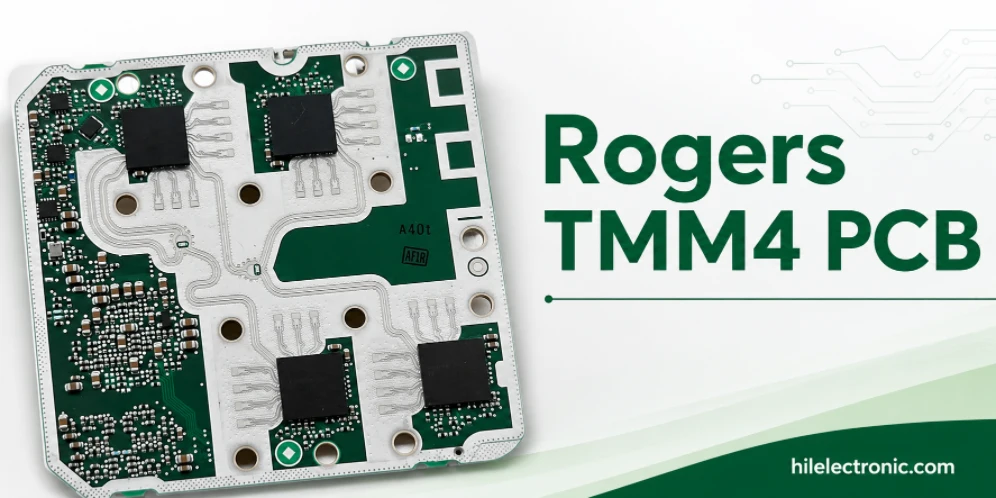
TMM4 Filter PCB Manufacturing
TMM4 filter PCB manufacturing is controlled by the...
TMM3 PCB Manufacturing for RF Modules
TMM3 PCB manufacturing is most useful where the RF module...
TMM6 PCB Fabrication
TMM6 fabrication is the process-control page for a mid-Dk...

TMM10 PCB Manufacturing for Compact RF Designs
Table of contentsHow TMM10 Shrinks RF StructuresTMM10 vs...
How to get a quote for PCBs
Let’s run DFM/DFA analysis for you and get back to you with a report. You can upload your files securely through our website. We require the following information in order to give you a quote:
-
- Gerber, ODB++, or .pcb, spec.
- BOM list if you require assembly
- Quantity
- Turn time
For PCBA services, please provide your BOM (Bill of Materials) and any specific assembly instructions. We also offer DFM/DFA analysis to optimize your designs for manufacturability and assembly, ensuring a smooth production process.