
Fiber Pay Out Spool Board for Tethered Drones

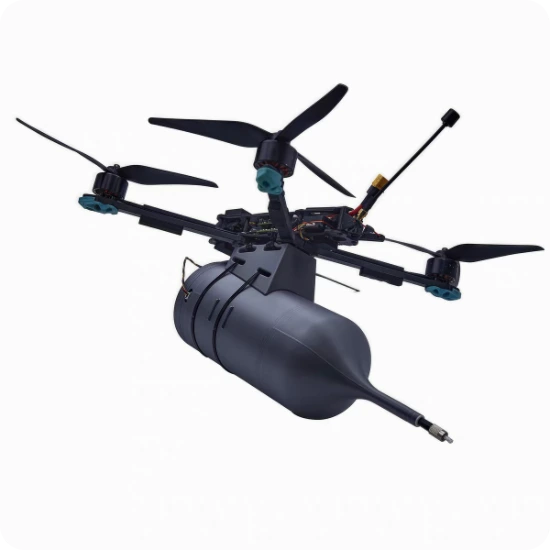
Fiber Pay Out Spool Board is the control board used in tethered drone spool systems to manage fiber deployment in a stable and repeatable way. Its primary job is to release fiber at the correct rate while keeping tether tension within a safe range. In real flight, this is not just a motor-speed problem. The board has to respond to changing spool diameter, drone acceleration, wind disturbance, and shifting tether geometry at the same time.
Because of that, a Fiber Pay Out Spool Board is not just a reel driver. It is a dedicated deployment-control PCB that combines motor drive, tension sensing, closed-loop control, communication with the flight controller, and mixed-signal power design in one subsystem. For tethered drones, the quality of this board directly affects whether fiber deployment remains smooth or becomes unstable.
Table of Contents
What a Fiber Pay Out Spool Board Does
A Fiber Pay Out Spool Board controls the electronic side of fiber deployment in a tethered drone. It sits between the spool mechanism and the aircraft control system, making sure fiber payout follows the actual flight condition rather than just a fixed spool speed.
Main functions of the board
- Drive the spool motor during payout and retrieval
- Measure tether tension and spool movement
- Estimate spool state, such as deployed length or remaining fiber
- Exchange commands and status with the flight controller
- Protect deployment stability during launch, hover, maneuver, and recovery
Why it matters
If the spool releases fiber too slowly, tension rises and the fiber can be damaged. If it releases too quickly, slack develops and deployment becomes unstable. That is why the board must continuously regulate payout according to real tether behavior instead of relying on simple motor commands alone.
In wider system terms, this board is part of the spool-side deployment electronics used in optical tether systems, and it connects naturally to the broader architecture described on the tether spool PCB page and within the fiber optic drone PCB system overview.
Tension Control and Cascaded Loop Design
The most important control principle in a Fiber Pay Out Spool Board is that the real target is tether tension, not spool RPM. Spool speed is only one of the means used to influence tension. Because of that, practical systems usually use a cascaded control structure instead of a single speed loop.
Typical control hierarchy
- Inner current or torque loop for fast motor response
- Speed loop for smooth spool motion
- Outer tension loop for fiber protection and deployment stability
Why cascaded loops are used
In flight, tether tension is affected by more than motor speed. The board also has to account for changing winding radius, wind load, drone acceleration, and the changing shape of the deployed tether. A cascaded loop structure separates fast actuator dynamics from slower mechanical regulation, which makes the control system more stable and easier to tune.
What each loop is responsible for
The inner loop handles the fast electrical and motor dynamics.
The speed loop stabilizes spool rotation and prevents overshoot or unstable motion.
The outer tension loop uses sensor feedback to keep the tether in the correct operating range.
Control-system takeaway
A Fiber Pay Out Spool Board should be designed around tension regulation, not around motor speed alone. Current control handles actuation, speed control smooths spool behavior, and the outer tension loop protects the fiber during real flight conditions.
Why simple speed matching fails
- The effective spool radius changes during payout
- Wind can increase or reduce tension independently of spool speed
- Flight maneuvers can change tether angle and load very quickly
- The same RPM does not always produce the same linear fiber release rate
For these reasons, a speed-only controller is not enough for a reliable tethered drone pay-out system.
Sensor Interfaces and Deployment Feedback
A Fiber Pay Out Spool Board depends on sensor feedback to regulate payout accurately. Without clean and reliable measurements, even a good control algorithm becomes unstable because it is reacting to noisy or delayed information.
Typical sensor inputs
- Tension sensor based on a load cell or strain gauge
- Spool encoder for speed and position feedback
- Optional guide-angle or spool-state sensor
- Thermal monitoring near the motor-drive section
| Sensor | Purpose | PCB requirement |
|---|---|---|
| Tension sensor | Measures tether load | Low-noise analog front end, stable reference, filtered supply |
| Spool encoder | Tracks spool speed and position | Reliable digital capture, clean routing, stable timing |
| Thermal sensor | Protects power stage | Correct placement near heat-generating components |
Sensor-interface design priorities
- Keep low-level analog signals away from switching noise
- Use filtered and stable rails for precision sensing
- Preserve encoder timing integrity
- Match filter bandwidth to actual deployment dynamics
The sensing chain is therefore part of the control system itself, not just an accessory measurement block.
Flight Controller Integration
A Fiber Pay Out Spool Board must work as part of the aircraft control architecture. It needs to exchange commands, feedback, and status with the flight controller or mission computer in real time so spool behavior matches actual flight behavior.
Typical exchanged data
- Deploy and retrieve commands
- Tension targets or operating modes
- Measured tension and spool status
- Estimated deployed length
- Motor, thermal, and fault status
- Flight-state or motion data used for feed-forward control
Why integration quality matters
If flight-controller data arrives too late or inconsistently, the spool board cannot correct deployment behavior in time. That weakens tension regulation during fast maneuvers and phase transitions such as launch or recovery.
Safety and fault handling
The board should also support heartbeat monitoring, fault reporting, and defined fallback behavior so the aircraft can react safely if spool control becomes unavailable or unstable.
Mixed-Signal PCB Design for Spool Electronics
A Fiber Pay Out Spool Board is a mixed-signal PCB by nature. It places a noisy motor-drive section next to precision analog sensing and real-time digital control logic. Because of that, PCB partitioning is directly tied to control quality.
Main layout principles
- Keep motor-drive current loops compact
- Separate power, analog, and digital areas clearly
- Use filtered supply paths for sensing and control sections
- Prevent high-current returns from polluting low-level measurements
- Plan copper distribution and heat spreading for actual load conditions
Typical functional partitioning
- Power zone: motor driver, switching devices, current sensing, bulk capacitors
- Analog zone: tension front end, ADC, references, filters
- Digital zone: MCU, communications, encoder interface, logic
If switching-current paths and analog sensing share uncontrolled return structure, tension readings can drift or become noisy. That directly affects the outer control loop. This is why layout discipline on a pay-out board is not just an EMC concern, but a deployment-control requirement. The same coexistence problem is seen on interference-resistant drone boards, where sensitive signal sections must operate next to electrically aggressive circuitry.
PCB Manufacturing and Assembly at Highleap Electronics
Because a Fiber Pay Out Spool Board combines motor drive, precision sensing, and digital control, its manufacturability has to be evaluated as a control-critical PCB rather than as a generic assembly. Power-stage quality, solder reliability in sensing areas, connector stability, and overall assembly consistency all affect real deployment performance.
Typical manufacturing requirements
- Reliable assembly of power and analog sections on the same PCB
- Consistent solder quality in current-carrying and feedback-critical regions
- Mechanical reinforcement where connectors or structural interfaces are used
- Functional validation under representative electrical and control conditions
Why Highleap Electronics is relevant to this board type
Highleap Electronics is a dedicated PCB fabrication and PCB assembly manufacturer. For Fiber Pay Out Spool Board projects, that means the work is approached from both the manufacturing side and the assembly side, with attention to mixed-signal layout requirements, power-stage robustness, sensing stability, and subsystem-level build consistency.
Highleap provides pay-out board PCB manufacturing and assembly for commercial and defense tethered drone programs. Submit spool specifications through the engineering review form.

Recommended Posts
8 Layer HDI PCB Manufacturer in China
Highleap Electronics provides 8 layer HDI PCB...
8 Layer Rigid-Flex PCB Manufacturing and Cost Guide
An 8 layer rigid-flex PCB combines multilayer rigid...
8 Layer PCB Cost in China: Rigid, Flexible & Rigid-Flex Pricing
How much does an 8 layer PCB cost? The answer depends on...
8 Layer PCB Manufacturing for Prototypes and Volume Production
Highleap Electronics provides 8-layer PCB manufacturing...
How to get a quote for PCBs
Let us run DFM/DFA analysis for you and get back to you with a report.
You can upload your files securely through our website.
We require the following information in order to give you a quote:
-
- Gerber, ODB++, or .pcb, spec.
- BOM list if you require assembly
- Quantity
- Turn time
In addition to PCB manufacturing, we offer a comprehensive range of electronic services, including PCB design, PCBA (Printed Circuit Board Assembly), and turnkey solutions. Whether you need help with prototyping, design verification, component sourcing, or mass production, we provide end-to-end support to ensure your project’s success. For PCBA services, please provide your BOM (Bill of Materials) and any specific assembly instructions. We also offer DFM/DFA analysis to optimize your designs for manufacturability and assembly, ensuring a smooth production process.