
Handheld Inventory Terminal PCB Manufacturing for Scanning, RFID and Wireless Data Capture
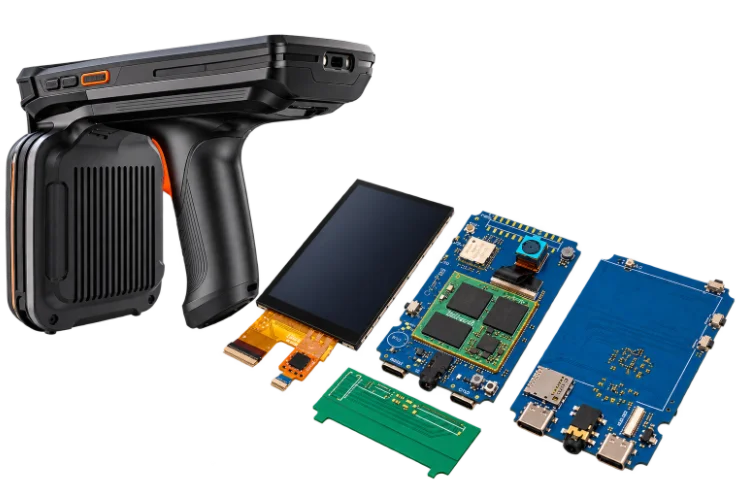

A handheld inventory terminal can combine barcode scanning, RFID, a display or touchscreen, keypad, Wi-Fi/Bluetooth or cellular communication, battery charging and docking contacts. The PCB therefore sits at the center of several mechanically and electrically sensitive interfaces that must remain synchronized through prototype, pilot and recurring production.
Highleap Electronics manufactures and assembles customer-designed handheld inventory terminal PCBs and PCBAs. We can support fabrication, component sourcing, SMT/THT assembly, programming, inspection and customer-defined functional testing based on the exact modules and mechanical interfaces released by the OEM.
1. Key Handheld Inventory Terminal PCB Manufacturing Priorities
Inventory terminals are dense electromechanical products. Manufacturing readiness depends on selecting a board construction that fits the routing requirement while keeping scanner, display, battery and dock interfaces accessible and repeatable.
- HDI only where routing requires it: Fine-pitch processors and memory can justify HDI PCB construction, but compact size alone does not. The stack should match the actual escape routing, via density and reliability requirement.
- Rigid-flex where it removes risky interconnects: A rigid-flex PCB can connect side keys, scanner modules or display sections around a battery when integrated flex tails reduce connector count or improve mechanical packaging.
- Connector geometry control: FPC sockets, board-to-board connectors, coaxial connectors and docking contacts should follow defined mating geometry. Highleap reviews these issues using the same principles applied to PCB connectors.
- Module revision control: Scanner engines, RFID modules and displays should be released by exact manufacturer part number because interface timing, pinout and cable geometry can change across revisions.
- Mechanical access for assembly: Connectors can be electrically correct yet impossible to mate after the PCB is installed. Cable insertion direction and latch access should be checked before enclosure release.
- Service and rework planning: Programming pads, debug points and removable modules should remain accessible long enough to diagnose the PCBA before final mechanical closure.
Does every handheld inventory terminal need HDI?
No. HDI should be used when fine-pitch escape routing or board area requires it. A conventional multilayer board can be more economical and easier to source when it meets the electrical and mechanical requirements.
When is rigid-flex preferable to separate FPC cables?
Rigid-flex is most useful when it reduces connectors, improves three-dimensional routing or controls the position of flex tails. It should be justified by the product architecture rather than used only for miniaturization.
2. Display, Scanner, Wireless and Battery Integration on the Main PCB
The main board normally connects several OEM-controlled modules. Production files should identify exact part numbers, interface types and operating states so the supplier quotes and builds the same product configuration engineering validated.
- Display and touch interface: Fine-pitch FPC connectors, backlight power and touch control should be synchronized with the exact module. The manufacturing considerations for a display PCB are relevant to connector access and power sequencing.
- Battery and charging: Where the board supervises the battery, the released design should follow the required protection and current path. The principles used in a battery management PCB are relevant to sensing, copper distribution and thermal control.
- Wireless communication: Wi-Fi, Bluetooth, cellular or GNSS modules add antenna keep-outs and grounding requirements. These should be preserved as part of the wireless communication PCB architecture.
- Scanner/RFID current demand: Scanner engines and RFID transmit functions can create short current peaks. Regulator sizing and decoupling should be validated in the actual scan/read operating state.
- Dock and pogo contacts: Contact pads or spring-pin interfaces need controlled position, surface finish and mechanical support when they carry charging current or data.
A complete production package therefore includes more than the Gerber files. It should identify the module revisions and mechanical interfaces that make the PCB work inside the finished terminal.
3. PCB Assembly, Component Sourcing and Inspection for Inventory Terminals
Industrial handheld products often remain in production longer than typical consumer electronics, so sourcing rules and assembly repeatability should be established early rather than after components become scarce.
- Approved sourcing strategy: The BOM should identify approved MPNs, alternates, customer-supplied modules and no-substitute components. Highleap can support these controls through components sourcing for turnkey builds.
- Design for assembly review: A pre-production design for assembly review can identify inaccessible FPC latches, tall-component conflicts, difficult shield installation and rework risks before the pilot lot.
- AOI coverage: Accessible SMT placements and visible joints can be checked with AOI in PCBA, while hidden packages may need other inspection or test controls.
- Connector and shield process: External ports, metal shields and through-hole parts may need selective soldering, manual operations or reinforcement defined in the assembly drawing.
- Module handling: Customer-supplied displays, scanners or batteries should have clear incoming-inspection, storage and responsibility rules to prevent material ambiguity.
Which components should be customer-controlled in an inventory terminal build?
The answer depends on the program, but scanner engines, displays, wireless modules, batteries and custom mechanical/electronic subassemblies are commonly controlled by exact MPN and revision.
Highleap Electronics • PCB Manufacturing & PCBA
Manufacturing Review for Handheld Inventory Terminal PCB and PCBA
Send the PCB files, BOM, scanner/RFID module information, display and battery interfaces, expected quantity and test requirements. Highleap can review fabrication and PCBA scope for prototype, pilot or recurring production.
4. Functional Testing for Handheld Inventory Terminal PCBAs
Testing should reproduce the interfaces that create the most integration risk while the board is still accessible. A generic power-on test is usually insufficient for a terminal that combines scanner, wireless, display and charging functions.
- Power and charging: Verify startup, battery/external-power behavior and customer-defined current limits.
- Display and touch: Confirm initialization, communication and the approved module identity where that is part of the test flow.
- Scanner or RFID interface: Verify communication with the released module and the defined trigger or read command.
- USB, dock and keys: Check the physical interfaces that are difficult to troubleshoot after final assembly.
- Wireless/module communication: Highleap can implement customer-defined functional testing using the approved firmware, fixture and pass/fail limits.
5. Production Release and RFQ Data for Handheld Inventory Terminal PCB Manufacturing
The pilot build should confirm that the electrical design, modules and mechanical assembly sequence can be reproduced with production tooling. After approval, the same controlled package should drive recurring orders.
- Fabrication release: Current PCB files, stack-up, thickness and controlled-impedance requirements where applicable.
- Module release: Exact scanner, RFID, display, wireless and battery part numbers with cable/orientation information.
- Assembly release: BOM, centroid data, polarity notes, shield details and special soldering instructions.
- Firmware release: Approved programming image and configuration linked to the hardware revision.
- Test release: Fixture, test script, operating state and measurable pass/fail criteria.
| RFQ item | What Highleap needs | Why it matters |
|---|---|---|
| PCB construction | Released fabrication package and board specification | Defines the physical board and via technology. |
| Modules | Exact MPNs and sourcing responsibility | Prevents different scanner/display/radio assumptions. |
| Mechanical interfaces | Connector, FPC, dock and enclosure references | Controls mating and assembly access. |
| Programming/test | Firmware, fixture and acceptance limits | Creates repeatable PCBA acceptance. |
| Volume plan | Prototype, pilot and recurring quantity | Supports sourcing and production planning. |
What changes should trigger a production review?
Changes to the scanner engine, display, battery, radio module, connector, enclosure, firmware or PCB construction should be evaluated against the OEM change-control process before the next lot is released.
Production RFQ Checklist
- Released PCB fabrication files and board specification
- BOM with exact scanner, display and wireless module MPNs
- Assembly drawing and pick-and-place data
- Connector, FPC, battery and docking mechanical references
- Programming files and approved firmware revision
- Functional test procedure and fixture information
- Prototype, pilot and recurring production quantity
- Packaging, labeling and traceability requirements
Highleap Electronics supports PCB manufacturing and PCB assembly for customer-designed handheld inventory equipment. The manufacturing scope is based on the released engineering package and does not imply that Highleap supplies the finished inventory terminal.

Recommended Posts
8 Layer PCB Cost in China: Rigid, Flexible & Rigid-Flex Pricing
How much does an 8 layer PCB cost? The answer depends on...

8 Layer PCB Manufacturing for Prototypes and Volume Production
Highleap Electronics provides 8-layer PCB manufacturing...
8-Layer PCB Types: Rigid, HDI, Flex & RF | Highleap
Two 8-layer PCBs can have the same layer count but require...

6 Layer PCB Prototype to Mass Production: OEM Release Checklist
Moving a working prototype into pilot and repeat...
How to get a quote for PCBs
Let’s run DFM/DFA analysis for you and get back to you with a report. You can upload your files securely through our website. We require the following information in order to give you a quote:
-
- Gerber, ODB++, or .pcb, spec.
- BOM list if you require assembly
- Quantity
- Turn time
For PCBA services, please provide your BOM (Bill of Materials) and any specific assembly instructions. We also offer DFM/DFA analysis to optimize your designs for manufacturability and assembly, ensuring a smooth production process.