
High Frequency PCB: Definition, Advantages, and Applications

What is a High Frequency PCB?
Definition and Purpose
A high frequency PCB is a specialized circuit board designed to operate at frequencies typically exceeding 1GHz, commonly used in radio frequency and microwave applications. These boards are engineered to handle high-speed signal transmission with minimal loss and distortion, making them essential for modern communication systems and advanced electronics.
Key Material Characteristics
The defining characteristics of high frequency PCBs include low dielectric constant materials, low dissipation factors, and exceptional signal integrity performance. Unlike standard FR-4 boards, high frequency PCBs utilize advanced substrate materials such as PTFE-based laminates from manufacturers like specialty low-loss laminate, Taconic, and Arlon. For cost-sensitive applications, hybrid stackups combining high frequency materials with conventional FR-4 layers provide a balanced approach between performance and budget constraints.
How High Frequency PCBs Differ from Conventional Boards
The fundamental difference between high frequency PCBs and conventional boards lies in how they manage electromagnetic wave propagation. At frequencies above 1GHz, even minor material inconsistencies or design imperfections can cause significant signal degradation, phase shifts, and impedance mismatches that compromise circuit performance.
Key Characteristics of High Frequency PCBs
Dielectric Constant Stability
The dielectric constant determines how electromagnetic waves propagate through the PCB substrate. High frequency PCB materials maintain consistent Dk values across varying temperatures and frequencies, ensuring predictable signal phase relationships. Stable dielectric properties are critical for applications requiring precise timing and synchronization, such as phased array antennas and high-speed digital interfaces.
Dissipation Factor and Signal Loss
The dissipation factor directly affects signal attenuation in high frequency PCBs. Materials with lower Df values minimize energy loss as signals traverse the board, preserving signal strength and reducing the need for amplification. Premium high frequency laminates typically exhibit Df values below 0.004, significantly outperforming standard materials that can exceed 0.020.
Thermal Expansion Matching
Coefficient of thermal expansion compatibility between copper layers and substrate materials prevents mechanical stress in multilayer high frequency PCB assemblies. Mismatched CTE values can cause delamination, cracked plated through-holes, and reliability failures during temperature cycling. Advanced high frequency materials are engineered to closely match copper’s thermal expansion characteristics.
Copper Surface Roughness Control
At microwave frequencies, copper surface roughness becomes a significant contributor to conductor loss. High frequency PCB fabrication employs low-profile copper foils or reverse-treated copper to minimize skin effect losses. Reducing surface roughness from standard profiles to ultra-low profiles can decrease insertion loss by up to thirty percent at frequencies above 10GHz.
Precision Impedance Control
Achieving tight impedance tolerances requires precise control of trace geometry and dielectric thickness in high frequency PCB manufacturing. Modern applications demand impedance accuracy within plus or minus five percent or better, necessitating advanced process controls and materials with consistent electrical properties throughout production.

High-frequency PCB
Advantages of Using High Frequency PCBs
Stable Signal Transmission
High frequency PCBs deliver superior signal integrity through reduced losses, minimal crosstalk, and low noise characteristics. The specialized materials and controlled manufacturing processes ensure that signal quality remains consistent even at multi-gigahertz operating frequencies, enabling reliable data transmission in demanding applications.
Excellent Impedance Control
Maintaining precise characteristic impedance is crucial for matching antennas, amplifiers, and transmission lines in RF and microwave circuits. High frequency PCB designs incorporate controlled impedance traces that preserve signal power transfer efficiency and minimize reflections. This capability is indispensable for wireless communication systems where impedance mismatches directly impact range and data rates.
Thermal Stability
High frequency PCBs maintain consistent electrical performance across wide temperature ranges and under high power conditions. The advanced substrate materials resist property changes that would otherwise cause frequency drift, impedance variations, or increased losses. This thermal stability ensures long-term reliability in both indoor equipment and harsh outdoor environments.
Enhanced Reliability
The combination of mechanically stable substrates, matched thermal expansion properties, and moisture-resistant materials contributes to exceptional reliability in high frequency PCB assemblies. These boards withstand thousands of thermal cycles and years of continuous operation without performance degradation, reducing maintenance costs and system downtime.
Design Flexibility
High frequency PCB technology integrates seamlessly with high-density interconnect structures and mixed-material stackups. Engineers can combine high frequency layers with standard materials in hybrid designs, optimizing cost while maintaining critical RF performance in specific board regions. This flexibility enables sophisticated system architectures that balance performance requirements with manufacturing economics.
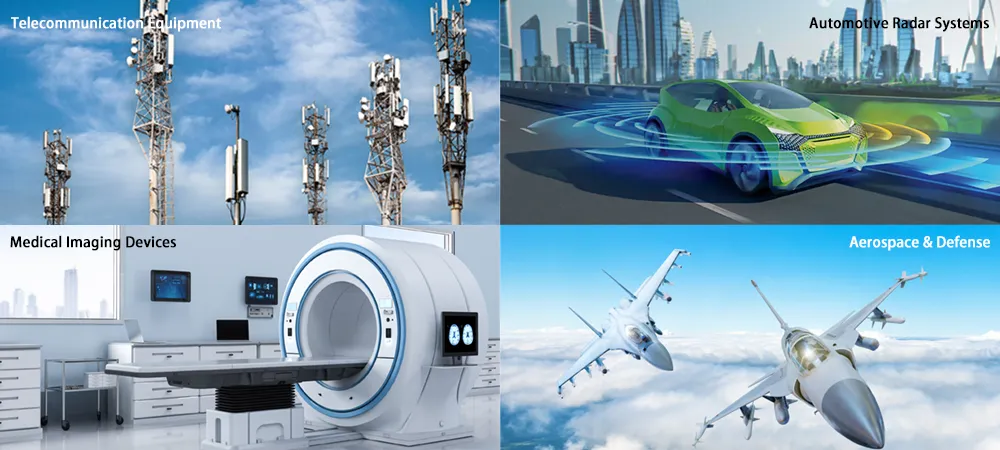
High Frequency PCB Applications
Applications of High Frequency PCBs
Telecommunication Equipment
Fifth-generation wireless infrastructure relies extensively on high frequency PCBs for base station modules, massive MIMO antenna arrays, and millimeter-wave beamforming networks. These boards enable the multi-gigahertz carrier frequencies and wide bandwidths that define 5G performance. Microwave backhaul links and small cell deployments also depend on high frequency PCB technology to maintain signal quality over licensed spectrum bands.
Automotive Radar Systems
Advanced driver assistance systems and autonomous vehicle platforms incorporate high frequency PCBs in radar modules operating at 24GHz and 77GHz bands. These boards process reflections from surrounding objects to enable collision avoidance, adaptive cruise control, and parking assistance. The automotive environment demands high frequency PCBs that withstand extreme temperatures, vibration, and humidity while maintaining millimeter-wave performance over the vehicle’s operational lifetime.
Medical Imaging Devices
Magnetic resonance imaging systems utilize high frequency PCBs in RF coils and transmit-receive modules that generate and detect nuclear magnetic resonance signals. Therapeutic applications including RF ablation systems require precise power delivery at frequencies where standard circuit boards would introduce unacceptable losses. High frequency PCB technology enables the signal fidelity necessary for diagnostic accuracy and treatment effectiveness.
Aerospace and Defense
Satellite communication payloads, radar systems, and electronic warfare equipment operate across microwave and millimeter-wave frequency ranges where high frequency PCBs are essential. These applications demand not only excellent RF performance but also reliability in radiation environments, extreme temperatures, and vacuum conditions. Defense systems incorporate high frequency PCBs in guided missiles, active phased array radars, and secure communication links.
High-Speed Computing and Networking
Data center switches, core routers, and high-performance computing platforms push signal rates beyond 100Gbps per lane, requiring high frequency PCB designs that manage both digital edge rates and embedded clock frequencies. Backplane interconnects and optical module interfaces demand the low-loss characteristics and controlled impedance that high frequency materials provide, enabling the bandwidth scalability that modern networks require.
Choosing the Right Material for High Frequency PCB
Material selection fundamentally determines high frequency PCB performance and cost. Each substrate offers a distinct balance between dielectric stability, loss characteristics, and manufacturability:
- a specialty low-loss laminate – Balanced dielectric stability and cost-efficiency, compatible with standard PCB processes.
- a specialty low-loss laminate – Lower dielectric loss, ideal for demanding microwave and RF circuits.
- Taconic RF-35 – Extremely low loss and consistent performance across temperature variations.
- Panasonic Megtron 6 – Designed for high-speed digital systems requiring tight Dk control and low signal skew.
The trade-off between cost and performance depends on the target operating frequency and application bandwidth:
- Below 6 GHz – High-frequency FR-4 or a specialty low-loss laminate often provides sufficient performance at lower cost.
- Above 10 GHz – Premium PTFE-based or ultra-low-loss laminates become essential to minimize insertion loss and noise.
Material selection should also consider manufacturing compatibility and assembly readiness:
- Fabrication constraints – Some substrates require specialized drilling, routing, and surface preparation.
- Supplier capability – Not all PCB manufacturers are equipped to handle advanced RF materials or hybrid stackups.
- Early coordination – Discussing material and process requirements with fabricators prevents redesigns and production delays.
Selecting the right high frequency PCB material is ultimately a balance between electrical performance, cost, and manufacturability — a decision best made through early collaboration with experienced PCB fabricators.
Conclusion
High frequency PCBs combine advanced materials, precise manufacturing, and disciplined design to ensure stable impedance and low signal loss across demanding applications. They are essential in wireless communication, automotive radar, and high-speed computing systems where consistent electrical performance is critical.
Achieving reliable results depends on working with manufacturers experienced in RF materials, impedance control, and process precision. Subtle factors such as material handling and fabrication accuracy often determine whether a design merely functions or performs optimally.
At Highleap Electronics, we provide high frequency PCB manufacturing with trusted RF materials and tightly controlled impedance processes. Our engineering team collaborates with customers to optimize stackups and balance performance with cost efficiency for next-generation electronic designs.

Recommended Posts
TG150 PCB Manufacturer for Fabrication and Assembly
Highleap Electronics manufactures TG150 PCB boards to...
TG140 PCB Material Selection and Fabrication
Table of Contents TG140 PCB Materials and Selection...
How to Select Tg180 PCB Materials for Custom Boards
Choosing a Tg180 PCB involves more than selecting a...
Tg170 PCB Manufacturing and Assembly for Industrial Electronics
A Tg170 PCB may be specified for industrial electronics,...
How to get a quote for PCBs
Let‘s run DFM/DFA analysis for you and get back to you with a report. You can upload your files securely through our website. We require the following information in order to give you a quote:
-
- Gerber, ODB++, or .pcb, spec.
- BOM list if you require assembly
- Quantity
- Turn time
In addition to PCB manufacturing, we offer a comprehensive range of electronic services, including PCB design, PCBA, and turnkey solutions. Whether you need help with prototyping, design verification, component sourcing, or mass production, we provide end-to-end support to ensure your project’s success.
For PCBA services, please provide your BOM (Bill of Materials) and any specific assembly instructions. We also offer DFM/DFA analysis to optimize your designs for manufacturability and assembly, ensuring a smooth production process.