
AI Data Center Power PCB Manufacturing Solutions

As a comprehensive PCB manufacturing and assembly company, Highleap Electronics serves telecommunications, automotive, industrial automation, and computing infrastructure sectors. In the AI era, we specialize not only in AI data center power PCBs but also in complete AI server motherboards, high-performance GPU and accelerator PCBs, and advanced interconnect boards that link processors, memory, and storage at terabit speeds. These products represent some of our most demanding specializations, where megawatt-scale power delivery meets sub-millivolt precision. Modern AI processors consume unprecedented power—NVIDIA H100 GPUs alone draw 700W each—creating thermal and electrical challenges that push PCB technology to its absolute limits.
The 48V Revolution in Data Center Power
The shift from 12V to 48V power distribution is transforming data center architecture. Simple mathematics drives this change: delivering 1000W at 12V requires 84A, while at 48V it needs only 21A. This 4x current reduction yields 16x lower I²R losses, enabling dramatic efficiency improvements and significant cable size reduction.
But 48V isn’t simply scaled-up 12V. Higher voltage demands fundamentally different design approaches:
- Creepage distances increase from 0.4mm to 1.6mm
- Component selection shifts to 100V-rated parts
- Isolation barriers become mandatory for safety compliance
- Transient suppression must protect against hot-swap events
The benefits justify the complexity. Rack power density improves by up to 40%, cooling requirements drop 30%, and total cost of ownership decreases despite higher component costs. Our high power density PCB expertise enables these next-generation architectures for both AI power delivery boards and AI server platforms.
Most data center designs implement two-stage conversion: 48V to 12V intermediate bus converters (IBC), followed by 12V to 0.8–1.2V voltage regulator modules (VRM). This topology balances efficiency, cost, and reliability while maintaining compatibility with existing infrastructure and ensuring stable operation for massive AI workloads.
Multi-Phase VRM Design for AI Processors
Modern AI accelerators demand unprecedented current delivery. A single H100 GPU requires 700A at less than 1V—impossible for single-phase converters. The solution: distribute load across 16-32 phases, each handling 25-45A.
Multi-phase operation provides critical benefits beyond current capacity. Ripple cancellation reduces output capacitance requirements 75%. Thermal distribution prevents hot spots. Transient response improves through faster di/dt capability. Phase redundancy enables continued operation despite failures.
But multi-phase design demands exceptional PCB precision. Every phase must be identical:
- Trace lengths matched within ±1mm
- Symmetric component placement
- Equal thermal coupling to heatsinks
- Identical via patterns
Even 5% current imbalance causes thermal problems. Hotter phases age faster, increasing imbalance in a destructive cycle. We use specialized design tools ensuring perfect phase matching, validated through simulation before manufacturing.
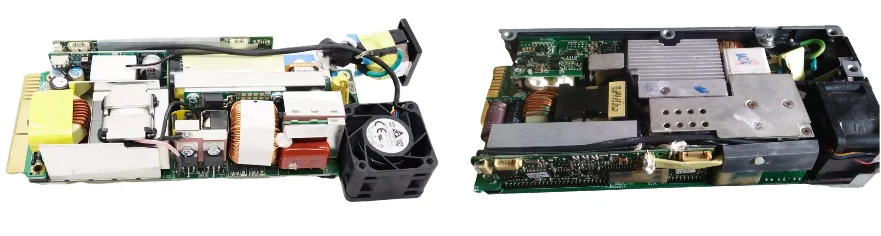
Power stage integration using DrMOS devices simplifies layout but concentrates heat. These 6mm × 6mm packages dissipate 50W, creating thermal flux exceeding 150W/cm². We implement 36-49 thermal vias under each device, filled and plated for maximum heat transfer. Combined with our thermal management PCB techniques, junction temperatures stay within limits.
Thermal Architecture for 24/7 AI Workloads
AI training runs continuously for weeks. Unlike consumer products with idle periods, data center boards operate at maximum power constantly. This demands exceptional thermal design beyond traditional approaches. We implement zone-based thermal management recognizing different temperature limits:
- Power stages tolerate 125°C
- Inductors lose efficiency above 100°C
- Capacitors degrade rapidly above 85°C
- Controllers limited to 105°C maximum
Strategic component placement creates thermal zones. Hot components cluster near airflow entry. Temperature-sensitive parts locate downstream. Copper thickness varies by zone—6-10oz for power areas, standard weights for control circuits.
Above 300W per board, air cooling fails. Liquid cooling integration becomes essential through direct cold plate mounting, embedded heat pipes for spreading, and vapor chambers for isothermal performance. These advanced techniques proven in our ultra-fast charging PCB designs scale to kilowatt power levels.

Power Integrity from DC to GHz
AI processors don’t just need power—they need clean power. Voltage noise causes timing errors, frequency reduction, and computational failures costing millions in lost training time. The power distribution network (PDN) must maintain low impedance across all frequencies. For a 500A processor at 1V with 3% tolerance:
- Allowed ripple: 30mV
- Target impedance: 0.06mΩ
- Required bandwidth: DC to 100MHz+
Achieving sub-milliohm impedance requires frequency-specific strategies:
- DC-1kHz: Heavy copper planes minimize resistance
- 1kHz-1MHz: Bulk capacitance dominates (thousands of microfarads)
- 1MHz-100MHz: Ceramic capacitors provide high-frequency bypassing
- Above 100MHz: PCB planes act as distributed capacitance
We optimize each frequency range through component selection, placement optimization, and stackup design. The result: stable power delivery enabling maximum AI processor performance proven through our GaN power PCB high-frequency expertise.
Redundancy and Intelligent Monitoring
Data center downtime costs $5,000-9,000 per minute. Power delivery must continue despite failures through comprehensive redundancy and monitoring. N+1 phase redundancy ensures continued operation with failed phases. Controllers automatically redistribute current, rebalance thermals, and alert operators. Multiple power supplies feed each rail through ORing circuits preventing backfeed while enabling hot-swap replacement.
Intelligent monitoring tracks every parameter:
- Individual phase currents and temperatures
- Efficiency metrics and trend analysis
- Predictive failure detection
- Real-time optimization algorithms
Digital control enables advanced features like adaptive voltage positioning, non-linear response optimization, and machine learning-based prediction. Our switching power PCB designs support these sophisticated control systems through careful mixed-signal integration.
Frequently Asked Questions
Q: Why do data centers use 48V instead of 12V power?
A: 48V reduces current 4x compared to 12V, cutting losses by 16x and improving efficiency dramatically. Highleap Electronics designs PCBs optimized for 48V with proper spacing, component selection, and isolation ensuring safe, efficient operation in data center environments.
Q: What is a VRM in server design?
A: Voltage Regulator Modules convert 12V or 48V to the 0.8-1.2V required by processors. Modern VRMs use 16-32 phases delivering 500-1000A. Highleap Electronics manufactures sophisticated multi-phase VRM PCBs with matched impedance and sub-milliohm power delivery networks.
Q: How hot do data center PCBs get?
A: Power delivery boards reach 85-125°C during normal operation. Highleap Electronics manages these temperatures through heavy copper planes, thermal via arrays, metal substrates, and liquid cooling integration maintaining safe operating temperatures continuously.
Q: What causes server power supply failure?
A: Common failures include capacitor degradation from heat, solder fatigue from cycling, and overstress from transients. Highleap Electronics prevents these through optimized thermal design, automotive-grade components, and comprehensive validation testing.
Q: How efficient are modern data center power supplies?
A: Best-in-class designs achieve 94-96% from 48V to processor voltage. Highleap Electronics’ optimized layouts minimize losses through reduced resistance, optimal placement, and advanced materials. Our power module PCB designs push efficiency even higher.

Related Articles

RT duroid 6002 PCB Quote and Stackup
This page owns the quotation and stackup-definition task...
TMM6 Filter PCB Manufacturing
Table of contentsWhy Microwave Filter Designers Use...
Taconic RF 35 vs RO4350B PCB
Table of contentsRF-35 vs RO4350B Procurement and...
TMM4 Filter PCB Manufacturing
TMM4 filter PCB manufacturing is controlled by the...
How to get a quote for PCBs
Let us run DFM/DFA analysis for you and get back to you with a report.
You can upload your files securely through our website.
We require the following information in order to give you a quote:
-
- Gerber, ODB++, or .pcb, spec.
- BOM list if you require assembly
- Quantity
- Turn time
In addition to PCB manufacturing, we offer a comprehensive range of electronic services, including PCB design, PCBA (Printed Circuit Board Assembly), and turnkey solutions. Whether you need help with prototyping, design verification, component sourcing, or mass production, we provide end-to-end support to ensure your project’s success. For PCBA services, please provide your BOM (Bill of Materials) and any specific assembly instructions. We also offer DFM/DFA analysis to optimize your designs for manufacturability and assembly, ensuring a smooth production process.