
High Power Density PCB Manufacturing and Design Expertise

As electronic devices continue to shrink while demanding higher performance, the need for high power density PCB solutions has become critical. These boards allow engineers to deliver more power within smaller footprints, enabling cutting-edge innovations in data centers, electric vehicles, aerospace, medical devices, and high-speed communication systems. Highleap Electronics leads the industry by combining advanced materials, thermal management techniques, and precision manufacturing to achieve power densities far beyond conventional PCBs.
What is a High Power Density PCB?
A high power density PCB is designed to deliver maximum electrical power in the smallest possible volume. Unlike traditional PCBs, these boards must manage extreme thermal and electrical stresses while maintaining efficiency and long-term reliability. The industry standard of 50W/in³ is no longer enough. Today, applications demand 100W/in³ or higher, with specialized designs reaching 150W/in³ or more. Achieving this requires innovation in materials, stackup design, embedded components, and cooling techniques. Highleap Electronics, a top PCB manufacturer in China, specializes in multilayer PCBs, server PCBs, and power density PCBs for advanced power systems.
Advanced Materials for High Power Density PCBs
Conventional FR-4 materials become limiting above 50W/in³. Highleap Electronics employs advanced substrates and composites tailored for high power density PCB designs:
- Thermally enhanced laminates with conductivity 1–3W/mK
- High Tg materials (170–200°C) for stability
- Aluminum nitride (170W/mK) for extreme thermal spreading
- Diamond composites for ultimate heat conduction
At high switching frequencies, low-loss substrates like a specialty low-loss laminate and PTFE composites are essential. Our expertise in wireless charging PCB design ensures the right material selection for efficiency and reliability.
3D Integration and Embedded Components
One of the most effective strategies for high power density PCB design is 3D integration. Instead of using only the board surface, engineers build vertically, embedding components directly into the PCB stackup. This allows for:
- Embedding passive components within inner layers
- Placing active devices in milled cavities
- Integrating magnetic cores into the stackup
- Using heat sinks as structural elements
This approach saves up to 40% of board space, lowers parasitic inductance, and improves mechanical strength. Substrate-integrated magnetics further reduce footprint by transforming inductors and transformers into planar structures. Highleap applies these methods in power module PCB production to achieve power densities previously considered impossible.
Advanced Cooling Solutions for High Power Density PCBs
At extreme density, conventional cooling fails. Temperature rise follows ΔT = P × Rth, where power concentrates in tiny volumes requiring thermal resistance approaching zero.
Vapor Chamber Integration: Vapor chambers spread heat 100x better than copper. We integrate 2-3mm chambers directly in PCB stackups providing 200W/cm² heat flux capability, isothermal surfaces despite hot spots, and compatibility with standard assembly. Components mount directly above with thermal vias providing coupling.
Embedded Liquid Cooling: For ultimate density, coolant flows through the PCB itself via microchannels milled in inner layers (3mm × 0.5mm typical), serpentine routing for coverage, and direct impingement on hot spots. Manufacturing requires precise milling, hermetic sealing, pressure testing, and chemical compatibility validation.
These exotic techniques proven in our ultra-fast charging PCB designs enable sustained 100W/in³+ operation impossible with air cooling.
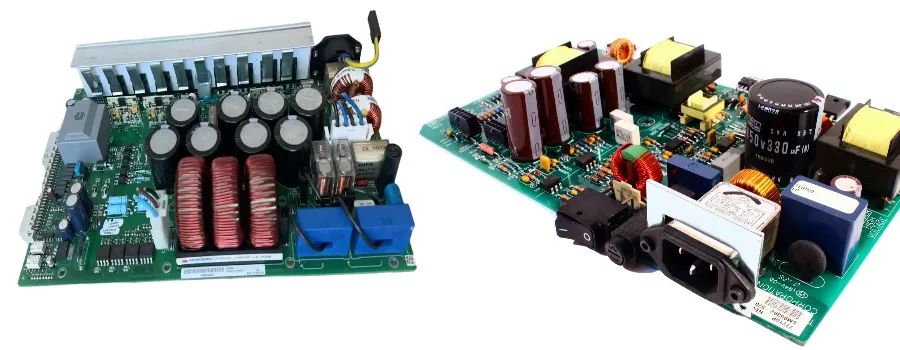
Material Innovations for High Power Density PCBs
Standard FR-4 becomes limiting above 50W/in³. Advanced materials unlock higher performance though at increased cost and complexity.
Thermally Enhanced Options: Next-generation laminates offer dramatic improvements:
- Thermal conductivity: 1-3W/mK (vs 0.3 for FR-4)
- Higher glass transition: 170-200°C
- Lower CTE for reliability
- Standard process compatibility
For extreme applications, aluminum nitride (170W/mK), direct bonded copper (zero interface), and diamond composites (ultimate spreading) push boundaries further.
High-Frequency Considerations: Power density often requires MHz switching to shrink magnetics. This demands low-loss materials like a specialty low-loss laminate, PTFE composites, and hybrid stackups optimizing cost versus performance. Our wireless charging PCB experience guides material selection for high-frequency power.
Applications of High Power Density PCB
The demand for high power density PCB solutions spans across industries:
- Data Centers: Higher rack density and efficient cooling for AI and cloud computing
- Automotive: Compact yet powerful boards for EV drivetrains and charging systems
- Aerospace: Weight-sensitive, high-performance power electronics
- Medical Devices: Portable, energy-efficient diagnostic and life-support systems
- 5G Telecom: Ultra-reliable boards for base stations and high-frequency applications
These capabilities proven through AI data center power PCB manufacturing push power density boundaries daily.
Testing and Reliability for High Power Density PCBs
Standard testing misses failure modes unique to extreme density. We implement comprehensive validation beyond conventional methods.
Thermal Characterization:
- IR imaging with 0.1°C resolution
- Transient impedance measurement
- Junction temperature extraction
- Heat flow visualization
Accelerated Life Testing:
- 50,000+ power cycles
- Thermal shock -55°C to +125°C
- Combined stress testing
- Statistical failure prediction
This validation developed through EV charging PCB programs ensures reliability despite operating at physical limits.
FAQs
Q: What’s the maximum power density achievable?
A: Highleap Electronics achieves 50W/in³ with forced air, 100W/in³ with liquid cooling, and 150W/in³+ with vapor chambers or embedded cooling. Theoretical limits approach 1000W/in³ with exotic techniques.
Q: How does high power density affect cost?
A: High density typically increases PCB cost 2-5x due to advanced materials, HDI technology, and complex manufacturing. However, system cost often decreases through reduced size, fewer boards, and simplified assembly. Highleap optimizes total cost, not just PCB cost.
Q: What are the main reliability concerns?
A: Primary concerns include thermal cycling fatigue, electromigration, component overstress, and CTE mismatch. Highleap Electronics addresses these through comprehensive design rules, advanced materials, and extensive testing ensuring long-term reliability.
Q: Which industries need high power density PCBs?
A: Aerospace (weight critical), automotive (space constrained), medical devices (portable), telecom (5G infrastructure), and data centers (rack density) all demand maximum power density. Highleap serves all these markets with appropriate quality standards.
Q: Can existing designs be converted to high density?
A: Direct conversion rarely works—high density requires fundamental redesign. Highleap Electronics helps optimize existing designs, typically achieving 40-60% size reduction while improving reliability through our switching power PCB optimization expertise.

Related Articles
TMM PCB Fabrication
Table of Contents TMM PCB Fabrication Scope for RF and...

RT duroid 6002 PCB Quote and Stackup
This page owns the quotation and stackup-definition task...
TMM6 Filter PCB Manufacturing
Table of contentsWhy Microwave Filter Designers Use...
Taconic RF 35 vs RO4350B PCB
Table of contentsRF-35 vs RO4350B Procurement and...
How to get a quote for PCBs
Let us run DFM/DFA analysis for you and get back to you with a report.
You can upload your files securely through our website.
We require the following information in order to give you a quote:
-
- Gerber, ODB++, or .pcb, spec.
- BOM list if you require assembly
- Quantity
- Turn time
In addition to PCB manufacturing, we offer a comprehensive range of electronic services, including PCB design, PCBA (Printed Circuit Board Assembly), and turnkey solutions. Whether you need help with prototyping, design verification, component sourcing, or mass production, we provide end-to-end support to ensure your project’s success. For PCBA services, please provide your BOM (Bill of Materials) and any specific assembly instructions. We also offer DFM/DFA analysis to optimize your designs for manufacturability and assembly, ensuring a smooth production process.