
GaN Power PCB Design and Fabrication Services
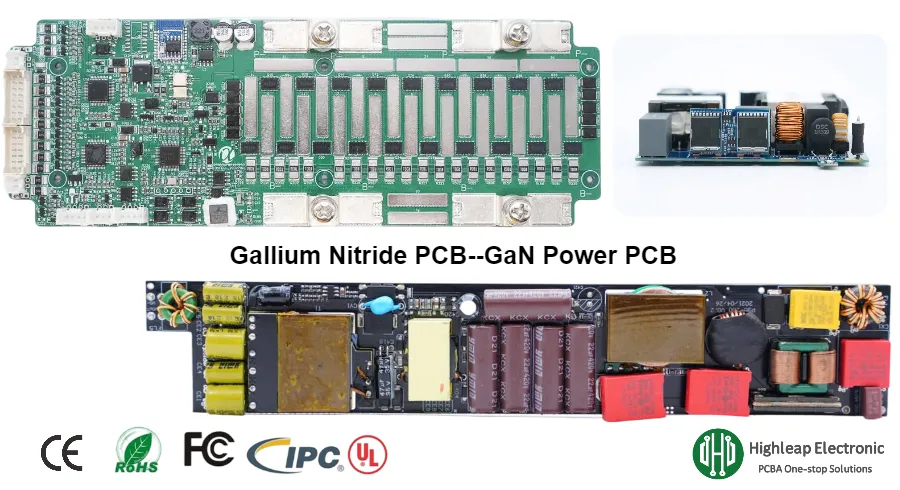
GaN Power PCB: Redefining High-Frequency Power Design
A GaN power PCB (also called a Gallium Nitride PCB or GaN-based power board) is engineered for next-generation power electronics. By replacing silicon with GaN devices, these boards achieve ultra-fast nanosecond switching, higher efficiency, and unmatched power density—ideal for applications such as EV charging, renewable energy inverters, aerospace systems, and telecom power modules.
Why GaN Power is Different
GaN (Gallium Nitride) is a wide-bandgap semiconductor that allows transistors to switch up to 10x faster than traditional MOSFETs. For example, a GaN FET can transition from 0V to 600V in under 5ns, dramatically reducing energy loss and enabling compact, high-frequency designs.
Design Challenges in GaN Power PCBs
Such extreme switching speeds make PCB layout critical. Even 1nH of parasitic inductance can cause damaging voltage overshoot. To ensure reliability, Highleap Electronics applies advanced techniques such as:
- Minimized power loops scaled to millimeters
- Via arrays for vertical current flow with reduced inductance
- Optimized trace geometry, grounding, and parasitic control
Performance Benefits
When properly designed and manufactured, GaN power PCBs unlock performance levels unattainable with silicon boards:
- Efficiency approaching 99% with minimal energy loss
- Power density exceeding 100W/in³ for compact systems
- Switching frequencies up to 10MHz enabling smaller magnetics
At Highleap Electronics, we combine precision PCB fabrication with proven heavy copper technology to support demanding GaN designs. Our end-to-end manufacturing and assembly services ensure reliable, scalable, and high-performance GaN power PCBs for critical industries worldwide.
Minimizing Loop Inductance in GaN Power PCBs
In GaN power PCB design, even a few nanohenries of inductance can cause dangerous voltage overshoot and efficiency loss. Unlike conventional silicon layouts where current flows horizontally across the board, GaN requires ultra-short, vertical current paths to keep switching stable at nanosecond speeds.
How Highleap Electronics Reduces Inductance
We apply advanced stackup and layout strategies to achieve reliable performance in GaN systems:
- Optimized PCB stackup – Adjacent power and ground planes separated by thin dielectric for reduced loop area
- High-density via arrays – 20+ vias placed directly at connection points for vertical current flow
- Plane-based routing – Using copper planes instead of traces to minimize parasitics
- Precise component placement – Gate drivers within 5mm of GaN FETs and capacitors directly connected with vias
Why It Matters
These techniques reduce loop inductance to below 2nH—up to 10× lower than traditional PCB designs.
The result is stable high-frequency operation, reduced overshoot, and higher overall efficiency.
Our proven high power density PCB expertise ensures GaN-based systems achieve maximum performance without compromising reliability.
Gate Drive Precision Requirements
GaN gates are fragile—exceed 7V and devices fail permanently. Unlike silicon MOSFETs tolerating ±20V, GaN demands absolute precision. But delivering precise gate voltage while switching hundreds of volts in nanoseconds challenges even experienced designers.
The solution: Kelvin source connections. Power current flows through one path while gate drive references a separate connection carrying no current. This eliminates voltage errors from power path inductance.
Gate resistance determines switching behavior:
- Too low (<1Ω): Destructive oscillation
- Too high (>10Ω): Excessive switching losses
- Optimal (2-5Ω): Balanced performance
We place gate resistors directly at GaN devices, not at drivers. Surface-mount 0402 packages minimize parasitic inductance. Traces route as controlled impedance transmission lines. These details determine whether GaN delivers on its promise or fails spectacularly.

Thermal Management for Concentrated Power
GaN’s efficiency is remarkable—98% isn’t unusual. But that remaining 2% concentrates in tiny die areas. A 100W converter dissipates just 2W, but thermal flux exceeds 100W/cm²—higher than a rocket nozzle.
Traditional thermal vias can’t handle these densities. We implement comprehensive solutions:
- Via-in-pad arrays directly under devices
- 0.2mm vias on 0.4mm honeycomb pitch
- Copper filling for maximum conductivity
- Direct coupling to heatsinks or cold plates
For extreme applications, embedded copper coins provide zero thermal resistance paths. These solid copper blocks, integrated during lamination, drop junction temperatures 20-30°C versus via arrays.
Material selection impacts thermal performance dramatically. Standard FR-4’s 0.3W/mK creates bottlenecks. We offer thermally enhanced laminates (1-3W/mK), metal-core substrates (5-380W/mK), and ceramic options (20-170W/mK). Our thermal management PCB capabilities ensure GaN devices stay within safe operating limits.
High-Frequency Materials and EMI Control
At multi-megahertz switching, PCB materials affect circuit performance. Standard FR-4’s loss tangent (0.02) causes excessive heating above 1MHz. High-frequency materials become essential.
We regularly process:
- a specialty low-loss laminate (loss tangent 0.0037)
- Isola I-Speed (balanced cost/performance)
- PTFE composites (ultimate performance)
But exotic materials increase cost 3-5x. Hybrid stackups optimize performance and cost—high-frequency materials only where needed, standard FR-4 elsewhere.
EMI presents unique challenges. GaN’s fast edges generate energy from DC to 1GHz. Without proper design, emissions exceed limits by 30dB. We implement near-field containment through minimized switching nodes, ground plane shielding, and edge rate control where acceptable. These techniques from our switching power PCB experience ensure compliance.
Frequently Asked Questions
Q: What makes GaN better than silicon MOSFETs?
A: GaN switches 10x faster with dramatically lower losses, enabling 99%+ efficiency and 3-5x power density. Highleap Electronics optimizes PCB layouts with sub-2nH power loops, controlled impedance routing, and advanced thermal management to realize these benefits.
Q: What are the main challenges with GaN design?
A: Primary challenges include parasitic inductance minimization, precise gate drive requirements, thermal concentration, and EMI control. Highleap Electronics addresses these through specialized stackups, via optimization, controlled impedance routing, and comprehensive testing.
Q: Can existing silicon designs use GaN directly?
A: Rarely—GaN requires complete layout redesign. Highleap Electronics helps evaluate existing designs and develops optimized GaN solutions, typically achieving 50% size reduction and 3-5% efficiency improvement through our LED driver PCB optimization experience.
Q: What switching frequencies can GaN achieve?
A: GaN enables 100kHz to 10MHz+ operation. Highleap Electronics manufactures PCBs optimized for these frequencies using low-loss materials, controlled impedance, and minimal parasitics proven in wireless charging PCB applications.

Related Articles
TMM PCB Fabrication
Table of Contents TMM PCB Fabrication Scope for RF and...

RT duroid 6002 PCB Quote and Stackup
This page owns the quotation and stackup-definition task...
TMM6 Filter PCB Manufacturing
Table of contentsWhy Microwave Filter Designers Use...
Taconic RF 35 vs RO4350B PCB
Table of contentsRF-35 vs RO4350B Procurement and...
How to get a quote for PCBs
Let us run DFM/DFA analysis for you and get back to you with a report.
You can upload your files securely through our website.
We require the following information in order to give you a quote:
-
- Gerber, ODB++, or .pcb, spec.
- BOM list if you require assembly
- Quantity
- Turn time
In addition to PCB manufacturing, we offer a comprehensive range of electronic services, including PCB design, PCBA (Printed Circuit Board Assembly), and turnkey solutions. Whether you need help with prototyping, design verification, component sourcing, or mass production, we provide end-to-end support to ensure your project’s success. For PCBA services, please provide your BOM (Bill of Materials) and any specific assembly instructions. We also offer DFM/DFA analysis to optimize your designs for manufacturability and assembly, ensuring a smooth production process.