
60/40 vs 63/37 Solder: Melting Points, Eutectic Behavior, and Which to Use
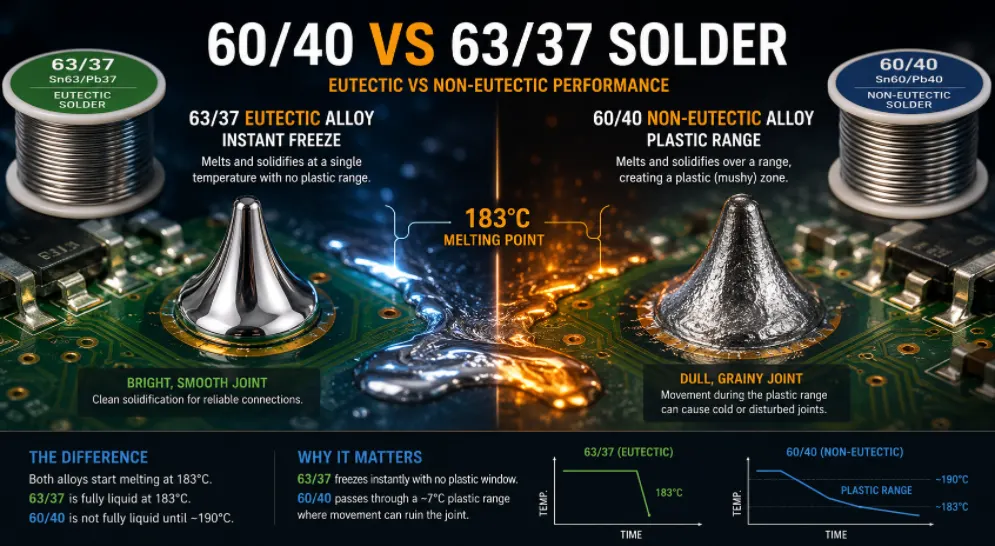
Figure 1. 60/40 vs 63/37 solder
Last updated: May 2026 · A practical comparison for hand soldering, rework, and assembly
The choice between 60/40 and 63/37 solder comes down to a single metallurgical fact — one is eutectic and one is not — and that fact ripples through how each alloy melts, freezes, and forms joints. Both are tin-lead solders that have anchored electronics work for decades, and both still earn their place in 2026 despite the rise of lead-free. This guide explains the difference in plain terms, gives the melting numbers side by side, traces the joint-quality consequences down to what a bad joint physically looks like, and ends with clear guidance on when to reach for each alloy and how to specify it for an assembly order.
- What the 60/40 and 63/37 numbers actually mean
- The eutectic point and why 63/37 is special
- Melting points and the plastic range, side by side
- How the plastic range creates cold and disturbed joints
- Choosing between 60/40 and 63/37 by application
- RoHS, lead-free, and where leaded solder still lives
- Forms, storage, and safe handling of both alloys
- Specifying your solder alloy on an assembly order
- Frequently asked questions
What the 60/40 and 63/37 numbers actually mean
The numbers are simply the tin-to-lead ratio by weight. 60/40 solder is 60% tin and 40% lead. 63/37 solder is 63% tin and 37% lead. A three-percent shift in tin sounds trivial, but it lands one alloy exactly on a special point in the tin-lead system and leaves the other just off it — and that small difference changes their melting behavior in a way you can feel at the bench.
Why tin and lead are paired at all
Tin provides the wetting and bonding; lead lowers the melting point and improves workability and flow. Neither metal alone solders electronics well — tin on its own melts higher and is more brittle, while lead on its own wets poorly. Combined, the pairing dominated electronics soldering for generations precisely because it is forgiving, flows readily, and forms reliable joints at modest temperatures that don’t cook nearby components.
Why a 3% difference matters
In most alloy systems a 3% composition change is noise. In the tin-lead system it is the difference between sitting on the eutectic point and sitting beside it — and that single distinction governs whether the alloy melts at one temperature or across a range. The remaining debate between the two ratios is really a debate about how each alloy transitions between solid and liquid, not about which metals are present.
The eutectic point and why 63/37 is special
A eutectic alloy has one specific composition that melts and freezes at a single, sharp temperature — behaving like a pure metal rather than a mixture. In the tin-lead system, that magic ratio is 63% tin / 37% lead. At its eutectic point, 63/37 goes straight from solid to liquid (and back) with no in-between stage.
What “eutectic” means in practice
Most mixtures melt gradually: as you heat them, they begin to soften at one temperature and only become fully liquid at a higher one. A eutectic composition skips that middle ground. Heat 63/37 to 183 °C and it is solid right up to that point, then fully liquid; cool it back below 183 °C and it is liquid right up to that point, then fully solid. The transition is essentially instantaneous, which is the property professionals prize.
Non-eutectic 60/40 and its mushy middle
60/40 sits just off the eutectic point, so it is non-eutectic. Instead of one melting temperature it has a melting range. As it heats, it begins to soften at one temperature and is not fully liquid until a higher one; on cooling it passes back through that same range. Within that band the alloy is partly solid and partly liquid — a pasty, semi-solid “plastic” state that is the root of 60/40’s quirks and the reason it demands a steadier hand during cooling.
Melting points and the plastic range, side by side
The two alloys begin melting at the same point; they diverge in what happens just above it. The table makes the contrast concrete.
| Property | 63/37 (Sn63Pb37) | 60/40 (Sn60Pb40) |
|---|---|---|
| Type | Eutectic | Non-eutectic |
| Melts at | 183 °C (361 °F), single point | ~183–190 °C, a range |
| Plastic range | None | ~7 °C window |
| Freezes | Instantly and cleanly | Gradually through the range |
| Cold-joint risk | Lower | Higher if disturbed |
| Relative cost | Slightly higher (more tin) | Lower |
| Typical preference | Fine-pitch, SMT, pros | Through-hole, hobby, budget |
The same start, a different finish
Both alloys begin melting at 183 °C. The difference is what happens above it: 63/37 is fully liquid at 183 °C, while 60/40 is not fully liquid until roughly 190 °C. In practice, an iron set around 300–350 °C is well above both, so the working feel while applying solder is similar — the divergence shows up during the critical cooling moment, not while you are heating the joint.
Why the cooling moment is the one that matters
Soldering quality is decided in the second or two after you remove the iron. That is when the joint solidifies and locks in its internal structure. An alloy that freezes instantly gives movement no opportunity to spoil the joint; an alloy that lingers in a semi-liquid state offers a window in which a nudge can ruin it. This is the whole practical case for eutectic solder in one sentence.
How the plastic range creates cold and disturbed joints
This is the heart of why professionals favor 63/37. When 60/40 cools through its plastic range, there is a window in which the joint looks solid but is still semi-liquid inside. If the component or wire moves during that window — a nudge, a vibration, a hand twitch — the solidifying crystal structure is disrupted before it can set properly.
What a disturbed joint looks like
The result is a disturbed or cold joint: dull, grainy, and lumpy rather than bright and smooth. Such joints can be mechanically weak and electrically unreliable, and they often need rework. Because 63/37 has no plastic range, it freezes the instant it cools below 183 °C, leaving almost no window for movement to spoil the joint. That single property — a clean, instant freeze — is the practical advantage that makes eutectic solder the default for fine-pitch and professional hand soldering.
Why disturbed joints are dangerous, not just ugly
A dull joint is not merely cosmetic. The disrupted crystal structure can leave microscopic voids and poor metallurgical bonding, so the joint may pass a quick test yet fail later under vibration or thermal cycling. Intermittent faults traced to cold joints are among the most frustrating to diagnose precisely because the connection works sometimes. Preventing them at the source — with a forgiving alloy and a steady cool-down — is far cheaper than chasing them later.
The forgiving side of 60/40
The plastic range is not purely a liability. Some technicians value it for tasks like wiping joints, working a fillet, or sculpting solder on larger connections, where a brief workable window actually helps. For undisturbed through-hole joints, 60/40 performs perfectly well and costs a little less — which is why it remains a sensible default for general hobby and repair work.
Choosing between 60/40 and 63/37 by application
Neither alloy is universally “better”; each suits different work. Match the alloy to the job.
By task type
- Fine-pitch SMT and professional hand soldering: 63/37. The clean, instant freeze reduces bridging and cold joints where precision matters most.
- Wave soldering and plating: 63/37 is the common choice for its consistent, predictable behavior across many joints at once.
- General hobby work, through-hole, and repairs: 60/40 is perfectly adequate and usually cheaper.
- Joint sculpting and wiping: 60/40’s plastic window gives a brief workable stage some technicians prefer.
For beginners specifically
Either alloy works while learning, but 63/37’s forgiving freeze means fewer ruined joints because there is no plastic window for a shaky hand to spoil. Many beginners find it the easier alloy to get consistent results with, which is why it is the common recommendation for a first roll of solder despite costing marginally more.
A simple decision rule
If the work is small, dense, or has to be reliable, choose 63/37. If the work is large, through-hole, undisturbed, and budget-sensitive, 60/40 is fine. When in doubt, 63/37’s broader tolerance makes it the safer default — the small price premium buys consistency.
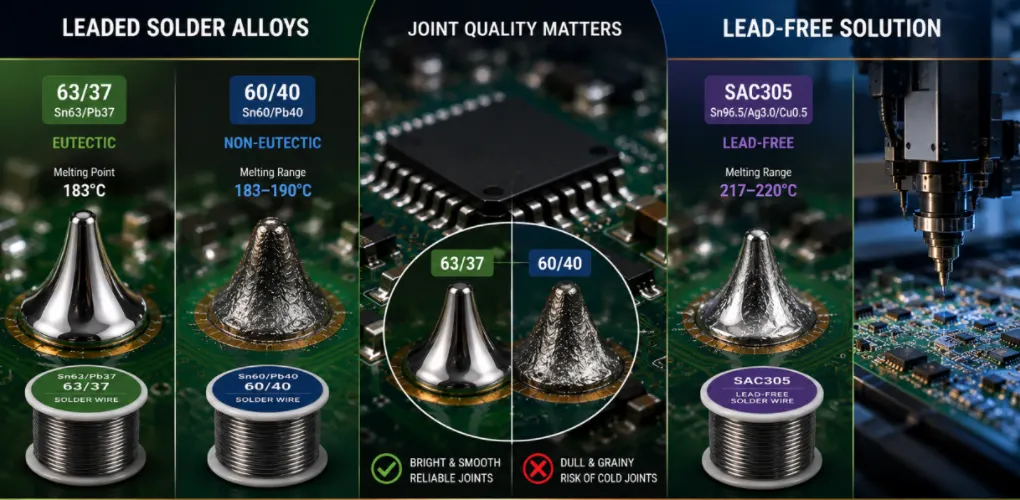
Figure 2. 60/40 and 63/37 solder comparison
RoHS, lead-free, and where leaded solder still lives
Both 60/40 and 63/37 contain lead, so neither is RoHS-compliant. They cannot be used in commercial products sold into the EU and many other markets that mandate restriction of hazardous substances.
The lead-free alternative
For compliant production, manufacturers use lead-free alloys, most commonly SAC305 (96.5% tin, 3% silver, 0.5% copper). SAC305 melts higher — around 217–220 °C — and behaves differently from leaded solder: it wets less aggressively, looks duller even when correct, and requires hotter irons and tighter process control. Switching from leaded to lead-free is a process change, not just a material swap.
Where leaded solder is still permitted and preferred
Leaded solder remains widely used for prototyping, rework, repair, hobby work, and certain exempt high-reliability applications — aerospace, defense, and some medical contexts — where lead is still permitted because its proven reliability and absence of tin-whisker risk outweigh other concerns. For everyday learning and bench work where RoHS does not apply, 63/37 and 60/40 remain excellent, easy-to-use choices.
Mixing leaded and lead-free
Avoid mixing the two on the same joint. Combining SAC305 with leaded solder produces an alloy with unpredictable melting behavior and can weaken the joint. If a board was built lead-free, rework it lead-free; if it was built leaded, rework it leaded. Keep separate solder and, ideally, separate iron tips for each.
Forms, storage, and safe handling of both alloys
Both 60/40 and 63/37 come in the same physical forms, and both demand the same lead-safe habits.
Available forms
The common forms are rosin-core wire (the standard for hand soldering, with flux built into the core), solid wire (for use with separate flux), bar (for wave and dip soldering), and paste (for stencil printing and reflow). Common wire diameters of 0.6–0.8 mm suit most board work; finer wire suits fine-pitch SMT, thicker wire suits large joints and wires.
Storage
Store solder wire in a cool, dry place; many products reference materials standards such as ASTM B32 for composition. Wire keeps for years. Solder paste is different — it has refrigeration and shelf-life requirements that wire does not, must be brought to room temperature before use, and degrades once opened, so it is bought to suit a production run rather than stockpiled.
Safety
Lead is a genuine health hazard. Work with ventilation, avoid breathing flux fumes, do not eat or drink at the bench, and wash your hands after handling leaded solder. Keep solder and food strictly separated. These precautions are simple and non-negotiable, and they apply equally to 60/40 and 63/37 — the alloys differ in melting behavior, not in toxicity.
Specifying your solder alloy on an assembly order
If you outsource assembly, the alloy choice is not just a bench preference — it changes the process, the thermal profile, and which markets you can legally sell into. Specify it up front.
What to state
- Leaded vs. lead-free — this is the first and most consequential decision, driven by your target market’s compliance rules.
- Specific alloy if leaded — 63/37 for fine-pitch and high-reliability work, 60/40 where cost matters and joints are undisturbed.
- Compliance documentation needed — RoHS/REACH declarations if you are selling into regulated markets.
Why it changes the process
A lead-free line runs a hotter reflow profile with a higher peak temperature and tighter control than a leaded line; the two are not interchangeable mid-run. Telling your assembler the alloy and compliance target before production lets them set the correct thermal profile, choose compatible paste, and confirm the board and components can survive the required temperatures.
From specification to built board
Highleap Electronics runs both leaded and RoHS-compliant lead-free assembly lines and will confirm the right alloy, reflow profile, and documentation for your board and target market before production begins — flagging any compliance or thermal concern during a free DFM review.
Frequently asked questions
Is 63/37 or 60/40 solder better?
For most electronics work, 63/37 — its eutectic behavior gives a clean, instant freeze that resists cold joints, which matters especially for fine-pitch and professional soldering. 60/40 is cheaper and perfectly fine for general hobby and through-hole work.
Do 60/40 and 63/37 melt at the same temperature?
They begin melting at the same point, 183 °C. 63/37 is fully liquid there; 60/40 is not fully liquid until about 190 °C, giving it a plastic range that 63/37 lacks.
What is a eutectic solder?
One whose composition melts and freezes at a single sharp temperature, like a pure metal. 63/37 is the eutectic tin-lead alloy; 60/40 sits just off the eutectic point and is not.
Can I use these solders in products sold in Europe?
No. Both contain lead and fail RoHS. Use a lead-free alloy such as SAC305 for compliant commercial products sold into the EU and similar markets.
Why does my 60/40 joint look dull and grainy?
Likely a disturbed joint — the part moved while the solder was still in its plastic range. Reheat with flux until it flows into a shiny, smooth cone, then hold it perfectly still while it cools.
Is one alloy stronger than the other?
63/37 is marginally stronger and more consistent, but for most joints the difference is small. Consistency, not raw strength, is the real reason professionals prefer it.
Can I mix 60/40 and 63/37?
You can, and the result is a near-eutectic blend, but there is little reason to do so deliberately. Avoid mixing leaded solder with lead-free, however — that combination melts unpredictably and can weaken joints.

Recommended Posts
TMM4 Filter PCB Manufacturing
TMM4 filter PCB manufacturing is controlled by the...
TMM3 PCB Manufacturing for RF Modules
TMM3 PCB manufacturing is most useful where the RF module...
TMM6 PCB Fabrication
TMM6 fabrication is the process-control page for a mid-Dk...
TMM10 PCB Manufacturing for Compact RF Designs
Table of contentsHow TMM10 Shrinks RF StructuresTMM10 vs...
How to get a quote for PCBs
Let‘s run DFM/DFA analysis for you and get back to you with a report. You can upload your files securely through our website. We require the following information in order to give you a quote:
-
- Gerber, ODB++, or .pcb, spec.
- BOM list if you require assembly
- Quantity
- Turn time
For PCBA services, please provide your BOM (Bill of Materials) and any specific assembly instructions. We also offer DFM/DFA analysis to optimize your designs for manufacturability and assembly, ensuring a smooth production process.