
Custom 65% Keyboard PCB and PCBA Manufacturing
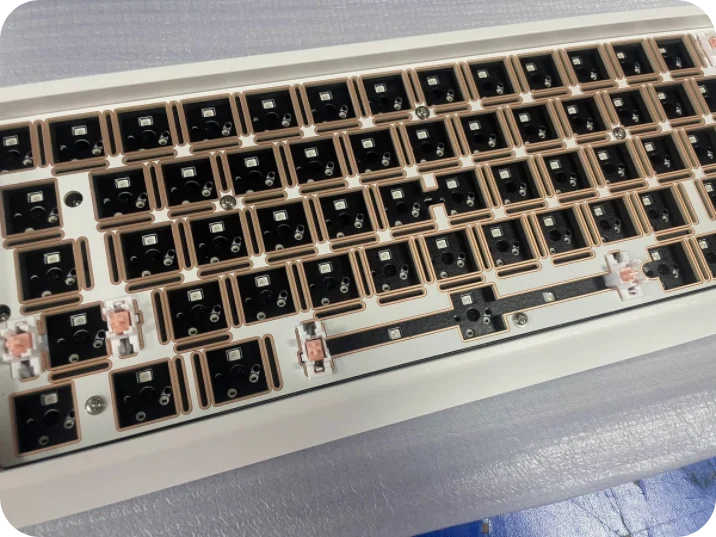
Table of contents
- 1. From Design Files to Production-Ready Keyboard PCBA
- 2. 65% Keyboard PCB Fabrication and DFM Review
- 3. Keyboard PCBA Assembly and Process Control
- 4. Firmware Programming and Keyboard PCBA Testing
- 5. Common Manufacturing Risks in 65% Keyboard Projects
- 6. Optional Electromechanical Integration Support
- 7. Prototype, NPI and Repeat Production Support
- 8. Why Work With Highleap Electronics?
- 9. Request a 65% Keyboard PCB and PCBA Quote
- 10. Procurement FAQ for Custom Keyboard Projects
Companies searching for a 65% mechanical keyboard manufacturer often need a supplier that can manage the electronics manufacturing stage rather than a consumer keyboard brand. A reliable build requires coordinated PCB fabrication, component sourcing, keyboard PCBA assembly, firmware programming, inspection and production testing. Mechanical integration may also be required when the project scope and approved drawings are clearly defined.
Highleap Electronics is a PCB manufacturing and PCB assembly factory supporting customer-owned custom mechanical keyboard projects. Highleap can take released manufacturing files through bare-board fabrication, SMT and through-hole assembly, programming, testing and repeat production. Its role is to establish a controlled electronics manufacturing route—not to replace the customer’s product design team, keyboard brand or industrial-design ownership.
1. From Design Files to Production-Ready Keyboard PCBA
A custom 65% mechanical keyboard should move through one connected manufacturing workflow. Separating fabrication, sourcing, assembly and firmware increases revision and test risk. Highleap reviews them as one production package and returns focused questions where approval is required.
| Manufacturing stage | Main customer input | Highleap manufacturing output |
|---|---|---|
| File and DFM review | Gerber or ODB++, BOM, pick-and-place data, drawings and revision status. | A buildability review, sourcing questions and a defined production scope. |
| PCB fabrication | Released stack-up, fabrication notes and mechanical data. | Inspected bare keyboard PCBs manufactured to the approved data. |
| PCBA assembly | Approved BOM, CPL, assembly drawing and do-not-fit information. | Assembled and inspected 65% keyboard PCBA units. |
| Programming and test | Firmware, programming instructions, test method and acceptance criteria. | Programmed boards with agreed verification records. |
| Optional integration | Approved enclosure parts, drawings and assembly instructions. | A defined electromechanical assembly when included in the quotation. |
This workflow gives engineering a visible route to a production-ready PCBA and gives procurement a clearer quotation by separating fabrication, sourcing, assembly, programming, testing and optional integration.
Service boundary
Highleap manufactures the PCB and electronic assembly from customer-approved data. Product architecture, industrial design, key layout decisions, firmware ownership and final market certification remain under the customer’s control unless a separate scope is agreed.
2. 65% Keyboard PCB Fabrication and DFM Review
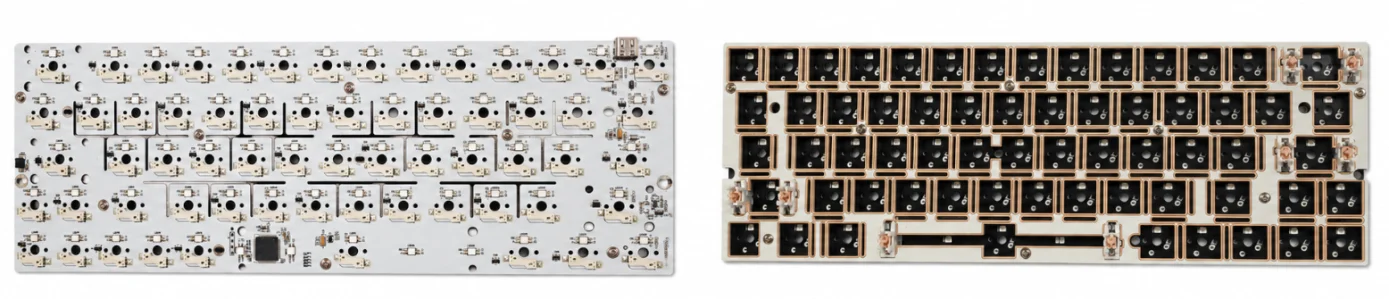
The PCB is both an electrical platform and a mechanical interface. It carries the key matrix, controller, lighting and connectors while aligning with switches, stabilizers, the plate, daughterboards and enclosure. Highleap provides custom PCB fabrication from the released manufacturing package.
Material, layer count, thickness, copper construction, solder mask and surface finish are reviewed against the customer specification. FR-4, multilayer construction, black solder mask and ENIG may be used, but the correct build depends on the released design.
A useful keyboard PCB review must go beyond a generic trace-and-spacing check. Highleap can review the manufacturability of features that are specific to mechanical keyboard electronics:
- Switch footprints and their relationship to the plate and key layout.
- Hot-swap socket pads, orientation and solder access when sockets are used.
- Stabilizer, mounting-hole and PCB-outline alignment with the mechanical drawing.
- USB-C or other interface-connector footprint, support pads and enclosure clearance.
- Daughterboard connector position, cable routing and mating direction.
- RGB LED polarity, repeated placement pattern and lighting-power distribution.
- Keyboard matrix diode orientation and reference-designator clarity.
- Flex cuts, edge features, gasket areas or other mechanically sensitive details.
- Wireless antenna keep-out areas and battery-connector polarity where applicable.
These checks reduce the risk of receiving electrically correct boards that do not fit the product. Highleap can consolidate critical questions through a focused DFM review before tooling and fabrication.
Bare-board inspection should follow the approved fabrication requirement. The exact inspection and documentation scope is confirmed during quotation because product designs, reliability requirements and customer reporting needs differ. Highleap does not publish unverified generic tolerances as a substitute for reviewing the actual keyboard PCB data.
For additional information focused on the board itself, buyers can also review Highleap’s guide to 65% mechanical keyboard PCB design and manufacturing considerations.
3. Keyboard PCBA Assembly and Process Control
After PCB fabrication and BOM approval, Highleap prepares the project for PCB assembly. A typical 65% keyboard PCBA may include an MCU, matrix diodes, resistors, capacitors, ESD protection, voltage regulation, USB connectors, wireless modules, indicator LEDs, per-key RGB LEDs and other product-specific components.
The assembly package is checked for revision consistency before production. Gerber data, BOM, pick-and-place coordinates, assembly drawings and firmware references should describe the same released hardware version. Conflicting revisions are returned for confirmation rather than resolved through factory assumptions.
Component preparation
Confirm approved MPNs, package data, polarity, customer-supplied parts and substitution rules.
SMT assembly
Prepare stencil, placement program and reflow route for repeated diodes, LEDs, ICs and passive devices.
Secondary operations
Complete through-hole, connector, hot-swap socket or approved manual operations where required.
Inspection control
Use first-piece checks, AOI and targeted inspection according to component and solder-joint risk.
Professional keyboard PCBA assembly matters because the board contains many repeated components. A diode or LED orientation error can be reproduced across multiple positions if it is not detected at the first-piece stage. Connector alignment, solder volume and mechanical loading also require attention because interface failures may appear only after the PCBA is installed in the enclosure.
Highleap can support turnkey, partial-turnkey or customer-consigned material models. Under a turnkey route, sourcing is controlled through the approved BOM and customer source requirements. Proposed alternatives are not treated as automatically interchangeable; the replacement MPN and reason for the change should be approved when electrical, firmware, optical or mechanical performance may be affected. Highleap’s component sourcing service can be included in the PCBA quotation.
4. Firmware Programming and Keyboard PCBA Testing
Assembly completion does not prove that a keyboard PCBA is ready for integration. Highleap can include MCU programming when the customer supplies the released firmware, instructions, hardware and version-identification method.
The appropriate test coverage depends on the design and available test assets. A keyboard PCBA verification plan may include:
- Bare-board electrical test before assembly.
- First-piece and AOI inspection after SMT assembly.
- Firmware flashing and programmed-version confirmation.
- USB enumeration or interface communication checks.
- Keyboard matrix continuity or key-position scan verification.
- RGB LED orientation, illumination and basic pattern checks.
- Connector and daughterboard communication checks.
- Current-consumption checks against customer-defined limits.
- Wireless, battery or charging functions when applicable and supported by the test procedure.
Testing must be tied to acceptance criteria. Highleap can execute customer-provided procedures and review production fixtures. When a complete fixture is unavailable, the quotation can define an interim method and clearly state its limitations.
For projects requiring a more formal production test process, Highleap can coordinate PCB functional testing requirements with the assembly plan. Test software, fixtures, golden samples, limits and result-record format should be identified before repeat production.
Important
Highleap verifies the assembly against the agreed manufacturing and test specification. It does not independently define whether the customer’s firmware provides the intended market features unless that engineering scope is separately agreed.
5. Common Manufacturing Risks in 65% Keyboard Projects
Experienced manufacturing support is most valuable when it prevents a repeatable problem before the full build. The following risks commonly affect custom keyboard electronics and should be closed during DFM, sourcing or first-article review.
| Risk | Possible effect | Manufacturing control |
|---|---|---|
| PCB, BOM and CPL revisions do not match | Incorrect components, missing placements or unusable programs. | Confirm one controlled release before purchasing and setup. |
| LED or diode polarity is unclear | Repeated nonfunctional keys or lighting defects. | Verify drawing, silkscreen, package data and first-piece orientation. |
| USB connector lacks mechanical support or clearance | Poor fit, solder-joint stress or interface failure. | Review footprint, enclosure opening and installation load. |
| Hot-swap socket design is not production-ready | Weak pads, incorrect orientation or difficult rework. | Review land pattern, soldering route and mechanical direction. |
| PCB outline or mounting features do not match the housing | The finished PCBA cannot be installed correctly. | Compare released PCB and mechanical drawings before fabrication. |
| Firmware and hardware versions are not controlled | Programming failures or inconsistent field behavior. | Record the approved image, checksum or version identifier by build. |
| Production test is defined too late | Assembled boards wait for a fixture or ship with limited coverage. | Review programming and test requirements during quotation. |
Closing these risks also improves quotation accuracy. The factory can identify special assembly operations, customer approvals, test assets and mechanical dependencies before they become late engineering changes or unexpected non-recurring charges.
6. Optional Electromechanical Integration Support
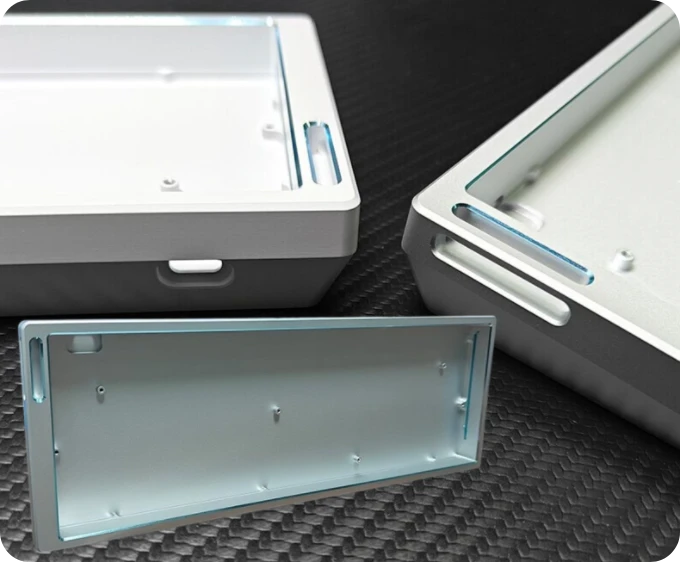
Highleap’s core business is PCB fabrication and PCB assembly. For projects that need more than an assembled board, Highleap can evaluate a defined electromechanical integration scope. This support may include installing a programmed PCBA into customer-approved housing components, connecting a daughterboard or cable, applying insulation, fastening approved hardware and completing specified functional or cosmetic checks.
The scope is project-specific. Aluminum CNC housings, anodized finishes, plates, foam, gaskets, key switches, keycaps, cables, batteries and packaging should not be assumed to be included in a standard keyboard PCBA quotation. These items may be customer-supplied or coordinated through approved sources only when responsibilities, specifications, acceptance standards and material ownership are clear.
Before integration, the manufacturing review should confirm:
- PCB outline, mounting holes, plate features and enclosure clearance.
- Connector access, cable routing and daughterboard orientation.
- Fastener type, torque, insulation and ESD-sensitive handling.
- Battery placement and polarity controls for wireless products.
- Cosmetic surfaces that require protective handling.
- Final test, labeling, packaging and traceability requirements.
This wording keeps the service boundary accurate: Highleap can support an approved assembly process, but it is not presented as a standalone keyboard brand or as the designer of the customer’s complete mechanical product.
7. Prototype, NPI and Repeat Production Support
Custom keyboard projects normally develop through several manufacturing stages. Highleap can support early prototypes, controlled NPI builds, small batches and repeat production, with the process controls adjusted to the maturity of the released design.
| Build stage | Customer objective | Manufacturing focus |
|---|---|---|
| Prototype | Confirm electrical behavior, firmware and mechanical fit. | Fast review, limited quantity, clear assumptions and issue feedback. |
| NPI or validation | Create a repeatable production baseline. | Approved BOM, first-article gate, controlled programming and test definition. |
| Small batch | Support launch, evaluation or a limited market release. | Material planning, retained process data and repeatable inspection. |
| Repeat production | Maintain quality, supply and delivery consistency. | Revision control, approved sourcing, recurring test coverage and forecast alignment. |
During NPI, useful manufacturing outputs should be retained for the next order: approved material decisions, stencil and placement programs, first-article findings, programming versions, test conditions and accepted deviations. This prevents repeat production from restarting as a new engineering build. Highleap’s NPI PCB assembly services are structured around this transition.
Production quantity, material commitments, lead time and reusable non-recurring costs are reviewed per project. They should not be replaced by a universal MOQ or generic delivery promise because MCU availability, custom parts, testing and revision maturity can materially change the manufacturing plan.
8. Why Work With Highleap Electronics?
Highleap Electronics supports custom keyboard projects through its established PCB and PCBA manufacturing services. The commercial value is not that Highleap acts as a consumer keyboard company. It is that one electronics manufacturing partner can review the board, source approved components, assemble the PCBA, program the MCU, perform agreed testing and preserve the production baseline for future orders.
- PCB manufacturing support: fabrication to customer-released materials, stack-up, finish and mechanical data.
- Keyboard PCBA assembly: SMT, through-hole and approved manual operations for controllers, diodes, LEDs, connectors and related electronics.
- Component sourcing: turnkey, partial-turnkey or consigned-material arrangements with customer-controlled substitutions.
- Programming and testing: customer-defined firmware flashing and verification integrated into the manufacturing route.
- Prototype-to-production continuity: retained process information, approved BOM decisions and revision control.
- Optional integration support: defined PCBA installation or electromechanical assembly when drawings and responsibilities are approved.
- Focused engineering communication: consolidated questions linked to price, schedule, buildability and product risk.
For buyers using the search term 65% mechanical keyboard manufacturer, this distinction is important. Highleap is best positioned as a mechanical keyboard PCB manufacturer and keyboard PCBA assembly partner supporting the electronics and agreed integration stages of an OEM product.
Highleap’s position
A PCB and PCBA manufacturing factory supporting customer-owned custom mechanical keyboard projects from PCB fabrication through programmed, tested electronic assemblies and defined integration.
9. Request a 65% Keyboard PCB and PCBA Quote
Send the available design package, required quantity and target manufacturing scope for review. Gerber or ODB++, BOM and quantity are normally enough to begin a budgetary assessment. Pick-and-place data, assembly drawings, firmware and test requirements are needed before the production route can be finalized.
Gerber or ODB++, BOM, CPL, assembly drawings, fabrication notes and revision identifier.
Firmware image, programming method, test procedure, fixture status and acceptance limits.
Mechanical drawings, approved parts, hardware list, work instructions and inspection standard.
Prototype or production quantity, forecast, target date, sourcing model and reporting needs.
A useful quotation should identify the included PCB fabrication, component sourcing, keyboard PCBA assembly, programming, test and optional integration scope. It should also separate assumptions, customer-supplied items and one-time charges from recurring production cost.
Need a feasibility or cost review? Use the PCB assembly quotation page to send the current files. Highleap can return the manufacturing scope, open questions, sourcing risks and recommended first-build controls for your custom 65% keyboard electronics project.
10. Procurement FAQ for Custom Keyboard Projects
What can I send if the complete keyboard PCBA file package is not ready?
Send the current Gerber or ODB++, BOM, quantity and revision status. Highleap can identify whether the quotation is firm or conditional. Production should not begin until the released PCB, BOM, placement data and drawings describe the same hardware revision.
Can Highleap manufacture the bare keyboard PCB and complete the PCBA assembly?
Yes. Highleap can combine PCB fabrication, approved sourcing, SMT and through-hole assembly, programming and agreed testing. The quotation identifies included operations, customer-supplied parts and required approvals.
How are prototype and repeat-production quantities handled?
Each build is quoted according to its product stage. Prototypes prioritize learning; NPI adds first-article, revision and test controls; repeat production reuses approved process data. Quantity, material commitments and reusable setup costs are confirmed in the quotation.
How does component substitution approval work?
Highleap can identify unavailable parts and propose alternatives. The replacement MPN and reason for change are returned for approval whenever form, fit, function, firmware, color or reliability may be affected.
What should be defined for customer-supplied components?
Define the MPN, quantity, packaging, overage, delivery timing and responsibility for shortages or unusable material. Storage, return and remaining-material ownership should also be agreed.
Can firmware be provided after the PCBA order is placed?
Sourcing or PCB fabrication may begin while firmware is being finalized, but its release date and programming method must be visible in the schedule. Shipment may be affected if the approved image, fixture or acceptance procedure is not ready.
Can Highleap install the PCBA into a keyboard housing?
Highleap can evaluate defined integration when approved housings, drawings, work instructions and acceptance criteria are available. Housing supply, cosmetic quality, switches, keycaps, batteries, accessories and packaging must be confirmed during quotation.
What information improves the accuracy of a keyboard PCBA quote?
Provide the current revision, quantity, expected follow-on volume, sourcing rules, firmware status, test coverage and unusual mechanical operations. Clear do-not-fit and alternative-part rules help separate firm costs from assumptions.

Recommended Posts
TMM4 Filter PCB Manufacturing
TMM4 filter PCB manufacturing is controlled by the...
TMM3 PCB Manufacturing for RF Modules
TMM3 PCB manufacturing is most useful where the RF module...
TMM6 PCB Fabrication
TMM6 fabrication is the process-control page for a mid-Dk...
TMM10 PCB Manufacturing for Compact RF Designs
Table of contentsHow TMM10 Shrinks RF StructuresTMM10 vs...
How to get a quote for PCBs
Let’s run DFM/DFA analysis for you and get back to you with a report. You can upload your files securely through our website. We require the following information in order to give you a quote:
-
- Gerber, ODB++, or .pcb, spec.
- BOM list if you require assembly
- Quantity
- Turn time
For PCBA services, please provide your BOM (Bill of Materials) and any specific assembly instructions. We also offer DFM/DFA analysis to optimize your designs for manufacturability and assembly, ensuring a smooth production process.