
Rigid-flex PCB Assembly for Prototype and Production
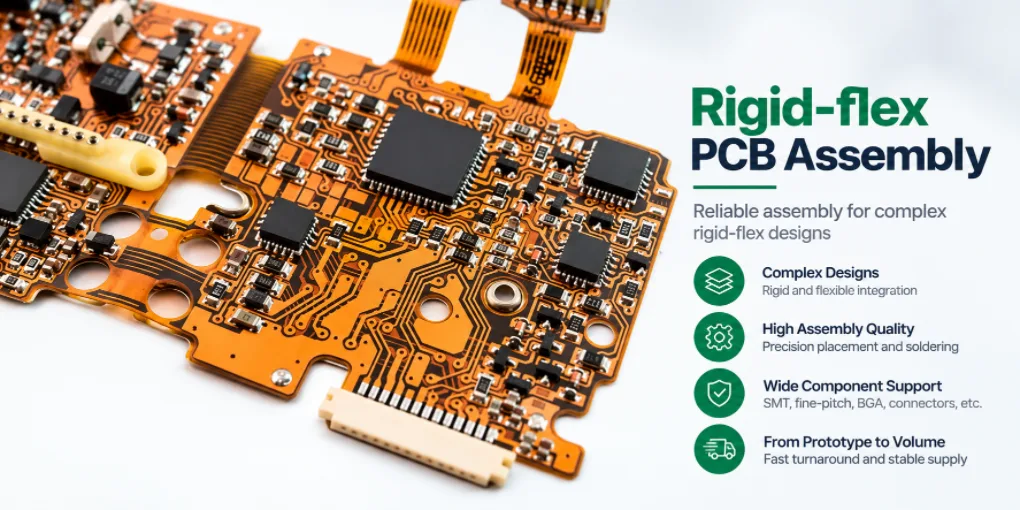
Figure 1. Rigid-flex PCB assembly
Rigid-flex PCB assembly combines rigid circuit board sections with flexible circuit sections in one interconnected structure. Because the finished board must support both electrical functions and mechanical routing, production involves more than component placement and soldering. PCB construction, component locations, board support, handling, inspection, testing, and the intended installation method can all affect the assembly process.
Highleap Electronics is a PCB manufacturing and PCB assembly factory providing rigid-flex PCB fabrication and PCBA production. Depending on the project scope, our manufacturing services can include rigid-flex PCB fabrication, component sourcing, SMT assembly, through-hole assembly, inspection, electrical testing, and functional testing.
For customers looking for a Rigid-flex PCB assembly supplier, the manufacturing process should be based on the complete production package rather than the PCB type alone. Highleap reviews the board construction, BOM, placement data, assembly requirements, production quantity, and quality requirements to establish an appropriate manufacturing process for each project.
Have a rigid-flex PCB ready for assembly? Send your PCB files, BOM, placement data, assembly drawings, production quantity, and testing requirements for a manufacturing review and quotation.
Rigid-flex PCB Assembly From PCB Manufacturing to PCBA
When the bare rigid-flex PCB and the assembled board are purchased from different suppliers, the customer may need to coordinate PCB fabrication, component procurement, assembly documentation, revisions, inspection requirements, and delivery between separate companies. For projects with more complex board construction, managing these stages through multiple suppliers can add unnecessary coordination.
Highleap Electronics provides both rigid-flex PCB manufacturing and PCB assembly. When both services are included in the project, the PCB fabrication and assembly requirements can be reviewed as one manufacturing program.
Manufacturing Scope Based on the Project
The exact manufacturing scope depends on the customer’s requirements. A rigid-flex PCBA project may include:
- Rigid-flex PCB fabrication
- Component sourcing and procurement
- SMT component assembly
- Through-hole assembly when required
- Solder paste printing and reflow soldering
- Automated optical inspection
- Electrical testing when specified
- Functional testing when a suitable test procedure is available
- Prototype, pilot, and repeat production
This manufacturing model gives customers the option of coordinating PCB fabrication and assembly through one manufacturing source instead of managing the bare PCB and PCBA through separate suppliers.
Turnkey and Customer-Supplied Components
Component procurement can be arranged according to the customer’s purchasing model. For a turnkey project, Highleap can manage component sourcing as part of the assembly scope. Customers that already have approved components or inventory can provide customer-supplied materials according to the agreed production arrangement.
Regardless of the sourcing model, production should be based on the released BOM and approved component specifications. A component should not be substituted simply because another part has the same package.
How Rigid-flex Construction Affects Assembly
A rigid-flex PCB behaves differently from a conventional rigid board because its construction combines rigid sections with flexible circuit sections. The flexible portions may allow the finished circuit to bend or route through a constrained mechanical space, while the rigid sections commonly provide the support needed for component mounting.
This physical structure affects how the board is supported, positioned, handled, inspected, and packaged during assembly. The exact production method depends on the construction and mechanical requirements of the individual board.
Rigid Sections and Flexible Sections
| Board Area | Assembly Consideration |
|---|---|
| Rigid section | Provides a relatively stable surface for component mounting and assembly operations. |
| Flexible section | Requires appropriate handling because the section is designed to provide flexibility or controlled routing. |
| Rigid-flex transition | Needs to be considered when the board is supported and handled during production. |
| Stiffened area | Can provide additional mechanical support for specific component or connector areas when included in the design. |
Mechanical Requirements Should Be Defined Before Production
The PCB fabrication files and assembly documentation should provide the information required to understand the mechanical characteristics of the finished board. This is particularly useful when the PCBA will be folded or routed into a product enclosure after assembly.
The production team should be able to distinguish the areas intended to remain rigid from the areas designed to flex. This information helps ensure that board support and handling during production remain consistent with the customer’s released design.
Component Sourcing and Placement for Rigid-flex PCBA
The component population of a rigid-flex board can vary significantly between products. A single assembly may contain passive components, integrated circuits, connectors, power devices, and other packages distributed across one or more rigid sections.
For this reason, the BOM and placement data are important parts of the manufacturing package. Package size alone does not define an approved production component.
Component Sourcing
The production BOM should identify the required component using the available manufacturer part number and applicable electrical specifications. Where approved alternatives are permitted, those alternatives should be defined according to the customer’s requirements.
Highleap can provide component sourcing for PCB assembly when procurement is included in the manufacturing scope.
Component Placement
Components are commonly mounted on suitable rigid sections because these areas provide the mechanical support needed during assembly and operation. However, the actual component arrangement must follow the customer’s PCB design and assembly documentation.
Placement coordinates, component orientations, reference designators, BOM information, and the PCB revision should remain synchronized. This becomes particularly important when a product has undergone several engineering revisions before entering production.
Managing Component Alternatives
If an approved component becomes unavailable, a substitute should not be selected solely because it has the same package or appears to fit the same PCB footprint. The proposed alternative should meet the required specifications and follow the customer’s approval procedure.
This is especially important for repeat production, where an undocumented component change can create differences between production lots.
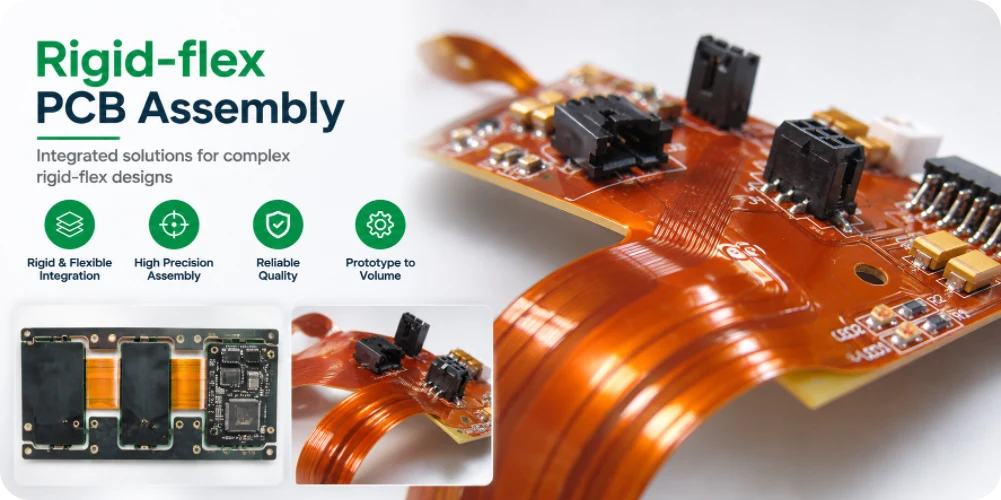
Figure 2. Rigid-flex PCBA
Rigid-flex PCB Assembly Process
There is no single assembly sequence that applies to every rigid-flex PCB. The manufacturing route depends on the board construction, component population, assembly technology, production quantity, and inspection requirements.
1. Manufacturing Review
Before production, the PCB fabrication files, BOM, placement data, assembly drawings, quantity, and available quality requirements are reviewed. Any information that could affect PCB fabrication or assembly should be clarified before production begins.
2. PCB Fabrication and Material Preparation
When PCB fabrication is included in the project, the rigid-flex boards are manufactured according to the released PCB specifications. Components are prepared according to the agreed sourcing arrangement, including factory-sourced and customer-supplied materials where applicable.
3. Solder Paste Printing and SMT Placement
For SMT production, solder paste is applied to the required pads using an appropriate stencil and production setup. The board needs suitable support during printing and component placement so that the rigid and flexible portions remain properly positioned.
Component placement follows the released coordinates, orientations, and BOM information.
4. Reflow and Additional Assembly
Reflow soldering is performed using a process established for the solder paste, PCB construction, and component population. If the product includes through-hole components or other assembly operations, those operations are completed according to the approved production sequence.
Highleap provides PCB assembly services for customers requiring electronic assembly as part of a broader PCB manufacturing project.
5. Inspection and Testing
After assembly, the PCBA undergoes the inspection and testing specified for the project. The required methods depend on the board design, component types, and customer’s quality requirements.
Inspection and Testing for Rigid-flex PCBA
Quality control for a rigid-flex PCBA should consider both the electronic assembly and the physical condition of the finished board. The appropriate inspection coverage depends on the component types, board construction, product requirements, and customer’s quality specification.
| Inspection or Test | Typical Purpose |
|---|---|
| SPI | Checks solder paste deposition before component placement. |
| AOI | Checks visible component placement, polarity, soldering conditions, and detectable assembly defects. |
| X-ray | Provides additional inspection for hidden solder joints or packages that cannot be adequately evaluated visually. |
| Electrical testing | Verifies specified electrical connections or characteristics using the agreed test method. |
| Functional testing | Checks whether the completed PCBA performs its intended functions when a suitable test procedure is available. |
Mechanical Condition of the Finished Assembly
For rigid-flex assemblies, quality review can also include the physical condition of flexible sections, rigid-flex transitions, stiffeners, connectors, and other mechanically relevant features when these characteristics are defined by the customer’s drawings or specifications.
The acceptance criteria should come from the released product requirements rather than applying identical mechanical criteria to every rigid-flex design.
Highleap can support AOI inspection, electrical testing, and functional testing according to the requirements of the project.
Prototype and Production Rigid-flex Assembly
Rigid-flex PCB assembly projects can begin with a prototype and later move into pilot or recurring production. The basic assembly technology may remain similar, but the importance of process consistency, material planning, and revision control increases as the project moves into regular production.
| Production Stage | Primary Focus |
|---|---|
| Prototype | Confirm the PCB construction, component population, assembly data, handling method, and inspection requirements. |
| Pilot production | Evaluate material availability, assembly consistency, inspection coverage, and production repeatability. |
| Repeat production | Maintain the approved PCB revision, BOM, component sources, assembly process, and quality requirements. |
Highleap supports PCB assembly prototype production for customers who need to validate their manufacturing process before moving into larger production quantities.
Revision Control for Repeat Orders
Rigid-flex products can contain both electrical and mechanical changes between revisions. A change to a connector, stiffener, flexible routing area, component, PCB construction, or assembly requirement can affect production even when the overall product remains similar.
For recurring orders, the manufacturing package should therefore be controlled by the customer’s current released revision. This helps reduce the risk of an earlier BOM, PCB file, placement file, or assembly instruction being used during a later production run.
What to Provide for a Rigid-flex PCB Assembly Quote
An accurate quotation requires enough information to understand both the PCB manufacturing scope and the assembly requirements. For rigid-flex PCBA, the board construction and component population can both influence production requirements and cost.
| Information | Purpose |
|---|---|
| Rigid-flex PCB fabrication files | Defines the board construction, dimensions, rigid and flexible sections, and fabrication requirements. |
| BOM | Defines component specifications, quantities, manufacturer part numbers, and approved alternatives. |
| Placement data | Provides component locations, orientations, and assembly information. |
| Assembly drawings | Provides polarity, orientation, mechanical instructions, and other production information. |
| Production quantity | Helps determine material planning and the appropriate production arrangement. |
| Sourcing arrangement | Identifies factory-sourced components and customer-supplied materials. |
| Inspection and testing requirements | Defines the required inspection, electrical testing, functional testing, or other quality controls. |
Provide the Latest Production Documentation
If the finished rigid-flex PCBA will be folded, routed, or installed into a specific mechanical structure, that information should also be communicated during the manufacturing review. It provides useful context for production handling, inspection, and packaging.
You can review Highleap’s PCB assembly file requirements before preparing your quotation package.
When the PCB files, BOM, placement data, quantity, and assembly requirements are ready, submit the project through our PCB assembly quotation process.
HIGHLEAP ELECTRONICS
Rigid-flex PCB Assembly for Your Next Production
Send your PCB files, BOM, placement data, assembly drawings, production quantity, and testing requirements. Highleap Electronics can review the manufacturing scope from rigid-flex PCB fabrication through PCBA production.
Rigid-flex PCB manufacturing | PCB assembly | Component sourcing | SMT assembly | Inspection and testing | Prototype to production

Recommended Posts

Isola Astra MT77 PCB Manufacturing
Figure 1. Isola Astra MT77 PCB ManufacturingIsola Astra...

Nelco N4000-13 PCB Material and Manufacturing Guide | Highleap Electronics
Figure 1. Nelco N4000-13 PCBNelco N4000-13 PCB is a...

Copper Clad Laminate: Complete Material Selection Guide for PCB Engineers
Every electrical property that matters in a printed...

Inside a China Ceramic PCB Factory: Process Control Across Power/LED/RF/Medical
Table of Contents Inside a China Ceramic PCB Factory: How...
How to get a quote for PCBs
Let‘s run DFM/DFA analysis for you and get back to you with a report. You can upload your files securely through our website. We require the following information in order to give you a quote:
-
- Gerber, ODB++, or .pcb, spec.
- BOM list if you require assembly
- Quantity
- Turn time
For PCBA services, please provide your BOM (Bill of Materials) and any specific assembly instructions. We also offer DFM/DFA analysis to optimize your designs for manufacturability and assembly, ensuring a smooth production process.