
Desktop Computer PCB Manufacturing for Custom Motherboards and PCBA
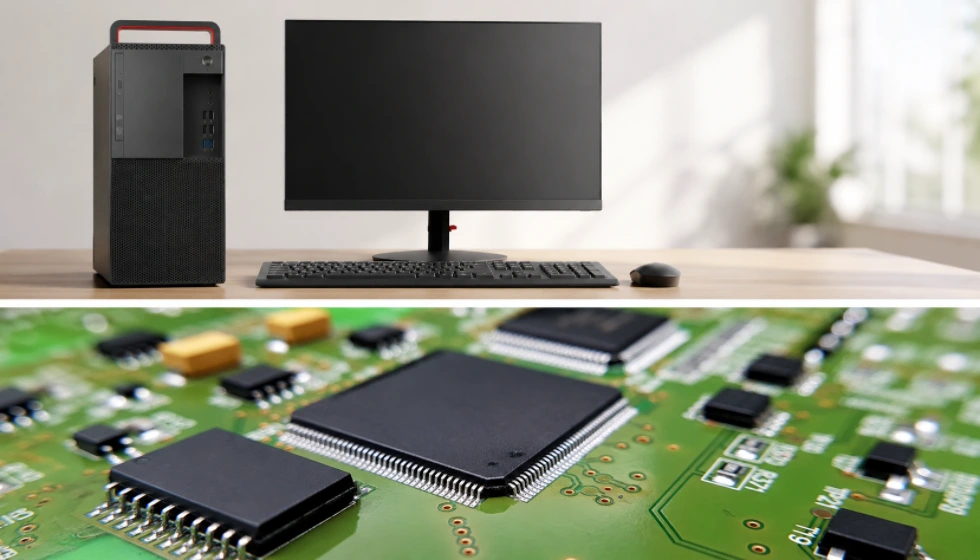
Table of contents
- From Released Desktop Motherboard Data to a Controlled Manufacturing Package
- Desktop Motherboard PCB Fabrication: Stack-Up, Impedance and Board Construction
- PCBA Assembly for Processor, Memory, Expansion and I/O Hardware
- BOM Sourcing and Variant Control for OEM Desktop Platforms
- Production Testing for Desktop Motherboard PCBAs
- Cost Drivers, Prototype Builds and Production Transfer
- What to Verify With a Desktop Motherboard PCB/PCBA Supplier
- Global OEM Supply Support for Desktop Motherboard Programs
- Request a Desktop Computer PCB and PCBA Review
A desktop computer motherboard combines processing, memory, storage, power conversion, expansion and external I/O on one mechanically defined electronic platform. Manufacturing the board is therefore more than reproducing copper from Gerber files. The released stack-up, high-speed interconnects, power distribution, large connectors, BGA packages, optional configurations and production test plan all have to work as one controlled build.
Highleap Electronics supports customer-designed desktop computer PCBs from bare-board fabrication through PCB assembly, approved component sourcing and customer-defined functional testing. The scope can cover prototype, NPI and repeat production while the customer retains ownership of the motherboard architecture, firmware, mechanical design and final system qualification.
A custom desktop board may follow an ATX, micro-ATX, Mini-ITX or proprietary mechanical format, but form factor alone does not determine the manufacturing process. Processor package, DIMM or soldered memory architecture, PCIe expansion, M.2 storage, Ethernet, USB, display interfaces, power-stage density and chassis constraints can materially change the PCB construction and assembly route.
1. From Released Desktop Motherboard Data to a Controlled Manufacturing Package
A useful desktop motherboard RFQ should define the board, the component population and the intended verification method as one revision-controlled package. The fabricator cannot safely infer a stack-up from a schematic, and the assembler should not infer fitted options from purchase-order text. Gerber or ODB++, fabrication notes, BOM, pick-and-place data, assembly drawings and revision identifiers should point to the same hardware release.
Product Definition
Before tooling or material commitment, Highleap can perform a focused PCB DFM review to identify file conflicts, manufacturability questions and assembly dependencies that affect the quote. On a desktop motherboard, common review points include board outline and mounting holes, connector datum, BGA escape geometry, controlled-impedance nets, via structures, large copper areas, component-to-heatsink clearances and any option population rules.
Manufacturing Translation
| RFQ input | What it controls | Why it matters |
|---|---|---|
| Gerber or ODB++ and fabrication drawing | Layer data, drill structure, outline, stack-up notes and special features | Defines the bare-board build rather than leaving construction assumptions to the factory. |
| BOM with manufacturer part numbers | Approved components, alternates, DNI parts and customer-supplied items | Prevents uncontrolled substitutions in platform-sensitive circuits. |
| Pick-and-place and assembly drawing | Reference designators, orientation, side, fitted options and connector placement | Keeps SMT and secondary assembly aligned with the released hardware. |
| Mechanical drawing | Mounting, I/O opening, heatsink and chassis relationships | Reduces the risk of an electrically correct PCBA that cannot be installed. |
| Programming and test requirements | Firmware version, power-on sequence, interface checks and acceptance limits | Turns inspection into a defined production release gate. |
2. Desktop Motherboard PCB Fabrication: Stack-Up, Impedance and Board Construction
Desktop motherboard PCB fabrication has to preserve the electrical assumptions created during layout. Controlled-impedance traces depend on the released geometry and dielectric construction, not only on nominal trace width. Where DDR, PCIe, USB, Ethernet or other fast interfaces are impedance-sensitive, the fabrication package should identify the required nets, target values and stack-up rather than relying on a generic “high-speed PCB” note.
Stack-Up & Geometry
Highleap can manufacture customer-defined multilayer boards and review the stack-up against manufacturability through its high-speed PCB manufacturing workflow. The important production variables include dielectric thickness, copper distribution, reference-plane continuity, drilled-via construction, registration, finished thickness and any impedance test requirement. More complex via structures should be used because the layout needs them, not because a desktop motherboard is assumed to require a particular HDI architecture.
Fabrication Control
Power distribution also affects fabrication. Processor, memory and expansion power sections may create dense copper, thermal-via fields and asymmetric copper areas. The board shop should review copper balance and lamination behavior together with the released design so that electrical needs are met without creating avoidable flatness or registration risk.
3. PCBA Assembly for Processor, Memory, Expansion and I/O Hardware
A desktop motherboard normally combines high-density SMT with mechanically demanding connectors. BGA processors, chipsets, controllers and fine-pitch power devices require stable printing, placement and reflow. DIMM sockets, PCIe connectors, power connectors, stacked USB/Ethernet assemblies and headers may require a different secondary process and careful mechanical support.
Highleap’s BGA PCB assembly capability can be integrated with the wider PCBA route when hidden solder joints or dense packages are present. Inspection should be risk-based: AOI is useful for visible placement and solder conditions, while X-ray may be specified for selected hidden-joint packages. Neither method alone proves that the motherboard functions correctly, so inspection and functional test should remain separate controls.
Interconnect / Load Path
- Stencil and paste control: match aperture strategy to the actual fine-pitch, power and connector pad mix.
- First-piece verification: confirm orientation, fitted options, polarity and connector types before the batch proceeds.
- Large-component support: control seating and coplanarity for sockets and I/O hardware that interact with the chassis.
- Thermal profile discipline: account for the difference between dense copper power areas and small passive components.
- Rework limits: define acceptance and approval rules for expensive BGA devices and mechanically sensitive connectors.
Highleap Electronics • PCB Manufacturing & PCBA
Request a Desktop Motherboard Review
Send your Gerber or ODB++, BOM, assembly data and quantity. Highleap will review the PCB fabrication, sourcing, assembly, programming and test scope for a controlled build.
Request a PCB & PCBA Quote →Discuss Manufacturing Requirements →
✓ DFM and DFA review ✓ Prototype to repeat production ✓ PCB fabrication and assembly
4. BOM Sourcing and Variant Control for OEM Desktop Platforms
Motherboard component sourcing is not a simple value-and-package exercise. Clock devices, power components, flash memory, network controllers, connectors and programmable parts can be tied to firmware, mechanical fit or electrical performance. Highleap can include electronic component sourcing in turnkey or partial-turnkey builds, but proposed alternatives should be returned for approval whenever form, fit, function, firmware or reliability can change.
Approved Parts
OEM desktop programs also commonly create several SKUs from one PCB. A configuration may change optional network devices, storage interfaces, headers, security modules or other fitted parts. The production package should therefore contain a controlled option matrix that links each SKU to its BOM revision, DNI references, firmware image, label and test profile.
Variant / Lifecycle Control
This is especially important for repeat orders. A reorder should recover an approved production configuration, not reconstruct it from old email threads. Keeping the hardware revision, BOM variant and test route linked also makes quotation changes easier to explain when a component becomes unavailable.
5. Production Testing for Desktop Motherboard PCBAs
Bare-board electrical test verifies the fabricated PCB, and assembly inspection verifies workmanship; neither confirms that the completed motherboard can perform its intended computing functions. A production test plan should define which risks are checked before power-on and which functions are verified after programming.
Manufacturing Sequence
- Powered Functional Checks. Depending on the customer design and available fixtures, PCB functional testing may include short and rail checks, power-on behavior, firmware identification, memory detection, storage interfaces, network link, selected USB/display ports and other customer-defined I/O. A golden sample or known-good peripherals can help standardize the station, but acceptance limits and software must remain controlled by the project documentation.
- Acceptance & Records. For platforms with many external connectors, test coverage should be prioritized according to field risk and production economics. A connector that is difficult to access after chassis assembly may deserve PCBA-level verification, while another function may be more efficiently tested after system integration.
6. Cost Drivers, Prototype Builds and Production Transfer
Desktop computer PCB cost is driven by the released manufacturing content rather than by the product name. Bare-board cost can change with board area, layer count, material, copper construction, via architecture, controlled impedance, finish, tolerance and test requirements. PCBA cost is influenced by BOM value, placement count, fine-pitch packages, large connectors, secondary operations, programming, inspection and functional-test time.
NPI Baseline
A prototype build should be treated as an engineering learning cycle. The objective is to close DFM questions, verify the stack-up, confirm difficult packages and connectors, validate the firmware/test route and document any accepted deviations. When the design moves into NPI, those decisions should become controlled production data rather than disappearing into prototype notes.
Cost control that does not weaken the product
The most useful savings come from removing manufacturing complexity that the design does not need: unnecessary via structures, avoidable stack-up changes between variants, uncontrolled BOM diversity or test steps that duplicate later system verification. Cost reduction should follow the released electrical and mechanical requirements, not override them.
7. What to Verify With a Desktop Motherboard PCB/PCBA Supplier
A desktop motherboard supplier should be evaluated on the complete manufacturing route, not on a bare-board price alone. The key question is whether the same production package can be taken from fabrication through assembly and test without hidden assumptions between departments.
Process Ownership
| Supplier question | Useful evidence in the quote or review |
|---|---|
| How will the released stack-up and impedance requirements be controlled? | A defined fabrication build, identified impedance nets and stated test/verification scope. |
| How are BGA and large connectors inspected? | A package-specific inspection plan rather than a blanket claim that one inspection method covers everything. |
| How are BOM alternates approved? | Clear sourcing rules, exact replacement MPNs and customer approval where the substitution can change performance or fit. |
| How are motherboard variants separated? | SKU/BOM/DNI/firmware/test mapping under revision control. |
| What is tested before shipment? | A written test method with fixtures, software, limits and responsibility boundaries. |
8. Global OEM Supply Support for Desktop Motherboard Programs
Desktop motherboard programs are developed by OEMs, system integrators and specialist hardware teams in many regions, while PCB fabrication and PCBA production may be consolidated with an export-oriented manufacturing partner. Highleap supports international B2B PCB/PCBA projects, so the core manufacturing package remains centered on released fabrication data, an approved BOM, placement files, mechanical drawings and customer-defined test requirements rather than on the buyer’s location.
North America: OEM and System-Integration Projects
For engineering and procurement teams in the United States and Canada, useful supplier comparisons are built around manufacturing scope rather than a generic board price. A team evaluating a desktop motherboard PCB manufacturer in China should confirm multilayer fabrication, controlled-impedance handling, BGA assembly, approved component sourcing, variant control and the test coverage required before shipment. Prototype and NPI orders should also define what data must be retained for the next build.
Europe: Documentation, Revision Control and Repeatability
Programs managed from Germany, the United Kingdom, the Netherlands and France often involve multiple engineering, procurement and system-integration stakeholders. For an OEM computer motherboard PCBA assembly project, the released revision, approved substitutions, fitted options, firmware identity and acceptance criteria should therefore travel with the order. That makes quotation changes traceable and reduces the chance that a repeat order is rebuilt from informal assumptions.
Asia-Pacific: Compact Platforms, Supply Coordination and Engineering Handover
Hardware teams in Japan, South Korea and Singapore may source complex bare boards, assembled motherboard PCBAs or turnkey electronics through cross-border supply chains. When comparing a custom desktop mainboard PCB supplier, the practical questions remain the same: Can the factory build the released stack-up, assemble the package mix, control high-value parts, verify the agreed functions and preserve the production baseline?
For an international desktop PCB/PCBA quotation: send the destination country together with Gerber or ODB++, BOM, CPL, mechanical data, quantity and test requirements. Highleap can then separate PCB fabrication, component sourcing, assembly, programming, test and logistics requirements in the manufacturing review.
9. Request a Desktop Computer PCB and PCBA Review
Send These Inputs
For a desktop motherboard quotation, send the current Gerber or ODB++ package, fabrication notes or stack-up, BOM, pick-and-place data, assembly drawing, quantity and revision status. Add mechanical data when connector or heatsink position is critical, and include firmware and test information when programming or functional verification is required.
Highleap Reviews
Highleap can return a manufacturing scope covering bare-board fabrication, approved sourcing, PCBA assembly, inspection and defined testing. Use the PCB assembly quote page to submit the project files and identify whether the build is a prototype, NPI batch or repeat-production order.

Recommended Posts
TMM4 Filter PCB Manufacturing
TMM4 filter PCB manufacturing is controlled by the...
TMM3 PCB Manufacturing for RF Modules
TMM3 PCB manufacturing is most useful where the RF module...
TMM6 PCB Fabrication
TMM6 fabrication is the process-control page for a mid-Dk...
TMM10 PCB Manufacturing for Compact RF Designs
Table of contentsHow TMM10 Shrinks RF StructuresTMM10 vs...
How to get a quote for PCBs
Let’s run DFM/DFA analysis for you and get back to you with a report. You can upload your files securely through our website. We require the following information in order to give you a quote:
-
- Gerber, ODB++, or .pcb, spec.
- BOM list if you require assembly
- Quantity
- Turn time
For PCBA services, please provide your BOM (Bill of Materials) and any specific assembly instructions. We also offer DFM/DFA analysis to optimize your designs for manufacturability and assembly, ensuring a smooth production process.