
How to Get an Accurate High Frequency PCB Quote China

Figure 1. High Frequency PCB
Table of Contents
- Why HF PCB Quoting Is Not an Online Form Exercise
- The Complete RFQ Package: Every Item You Must Include and Why
- Hidden Line Items and Common Misunderstandings in HF PCB Quotes
- How to Compare Quotes from Multiple Suppliers Without Comparing False Equivalents
- Quoting Strategy by Project Phase: Prototype, Pre-Production, and Volume
- From Quote to PO: Compressing the Administrative Timeline
- Highleap’s Quoting Process for HF PCBs
An online PCB quote calculator gives you a price for a 4-layer FR4 board in seconds. That same calculator is useless for a high frequency PCB quote China inquiry because it cannot account for: which specific specialty low-loss laminate grade and thickness you need (cost varies 5–15× by grade), whether VLP copper foil is required (2–4× the standard foil price), whether back-drilling is needed for via stubs, whether the specified material is in stock or requires weeks of sourcing, or what impedance testing scope is included. An engineering-reviewed high-frequency PCB quote requires a detailed technical exchange between your engineering team and the manufacturer’s quoting engineers — and the quality of your RFQ submission directly determines the accuracy and turnaround time of the quote you receive. This guide explains how to get an accurate, actionable quote from a China-based PCB manufacturer for your high frequency project.
1. Why HF PCB Quoting Is Not an Online Form Exercise
1.1 Cost Variables That Online Calculators Cannot Handle
Standard online PCB quotation tools are built for FR4 boards where cost is driven primarily by layer count, board size, quantity, and surface finish. High frequency boards introduce cost variables that require engineering judgment:
- Material grade specificity: “specialty low-loss laminate” is not a material specification. a specialty low-loss laminate costs 5–8× standard FR4. a specialty low-loss laminate costs 10–15×. a PTFE-based low-loss laminate costs 8–12×. The specific grade determines the material cost line item, which represents 35–70% of total board cost.
- Copper foil type: Standard ED vs. RTF vs. VLP vs. HVLP — each carries a different price. The foil type is not a standard dropdown in online calculators.
- Special process steps: Plasma desmear, PTFE surface activation, back-drilling, selective solder mask — each adds discrete cost. Online tools do not itemize these.
- Impedance testing scope: Coupon testing per panel, 100% board-level testing, VNA insertion loss measurement — the testing scope significantly affects per-unit cost but is not a standard quote parameter.
- Material availability: A quote for a material not in stock must include the sourcing lead time — which may change the delivery timeline and potentially trigger expedited material procurement surcharges.
1.2 The Quoting Requires Engineering Review
A legitimate HF PCB quote from a China manufacturer involves an engineer reviewing your files and specifications — not an automated system generating a price from parameters. The engineer evaluates:
- Whether the specified stackup is manufacturable with available materials
- Whether the trace geometries achieve your impedance targets on their process
- Whether any special processes (back-drill, selective mask) are required but not stated
- Panel utilization for your specific board dimensions
This engineering review takes 4–24 hours depending on complexity. It is not overhead — it is what makes the quote accurate.
2. The Complete RFQ Package: Every Item You Must Include and Why
2.1 Mandatory Technical Items
| RFQ Item | Why It Matters for the Quote | What Happens If Missing |
|---|---|---|
| Gerber files (all layers + drill + outline) | Determines panel utilization, drill count, feature complexity | Quote is a rough estimate only; price may change after file review |
| Exact material designation (e.g., “a specialty low-loss laminate low-profile copper foil 0.508 mm”) | Material cost is 35–70% of total — grade determines this | Manufacturer assumes cheapest specialty low-loss laminate grade; price changes when you clarify |
| Complete stackup specification | Determines material quantity, lamination complexity, bonding material cost | Manufacturer guesses the stackup; may be wrong, leading to re-quote |
| Copper weight per layer | Affects material cost and etch processing time | Default assumption (1 oz) may not match your requirement |
| Copper foil type (ED, RTF, VLP, HVLP) | VLP/HVLP costs 2–4× standard ED | Standard ED assumed; cost added when you specify VLP later |
| Surface finish (ENIG, immersion Ag, OSP) | ENIG costs 1.8–2.5× OSP | HASL assumed (not suitable for most HF boards); re-quote needed |
| Impedance requirements + tolerance | ±5% requires coupon testing on every panel; ±10% may be spot-checked | No impedance testing quoted; added as change order after PO |
| Special processes (back-drill, via fill, selective mask) | Each adds $0.50–$5.00 per board depending on complexity | Not included in quote; discovered during DFM, causing price increase |
| IPC class (Class 2 vs. Class 3) | Class 3 requires tighter inspection criteria, increasing inspection time and reject rate | Class 2 assumed; upgrade to Class 3 may add 10–20% to cost |
| Quantity + delivery schedule | NRE amortization, panel setup economics, material volume pricing | Quote for wrong quantity is useless for budgeting |
2.2 The “No Surprises” RFQ Rule
Every item not specified in the RFQ will be assumed by the manufacturer — and assumptions create price changes later. The goal is a quote where the price is final once you accept it. To achieve this, specify everything. If you are unsure about a parameter (e.g., whether to use VLP or standard copper), ask the manufacturer to quote both options — good manufacturers will provide alternatives with price comparisons.
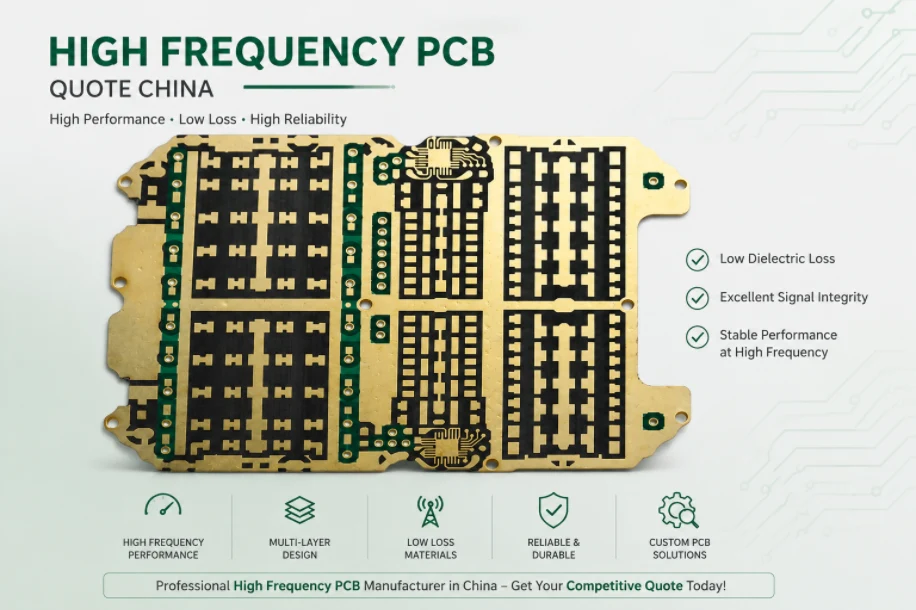
Figure 2. High Frequency PCB
3. Hidden Line Items and Common Misunderstandings in HF PCB Quotes
3.1 NRE (Non-Recurring Engineering) Charges
HF orders commonly include NRE for: stackup modeling/impedance simulation, photo-tool generation, etch compensation artwork creation, impedance coupon design, and first-article engineering time. NRE typically ranges from $200–$800 for a 4-layer specialty low-loss laminate hybrid, up to $1,500+ for complex multi-layer PTFE stackups. Some manufacturers bundle NRE into the per-unit price (making it invisible but still present); others list it separately.
When comparing quotes, ask each manufacturer to break out NRE separately. A quote with $500 NRE and $25/board is not the same as a quote with $0 NRE and $30/board — the first is cheaper at 100 boards ($3,000 total) but more expensive at 20 boards ($1,000 vs. $600).
3.2 Material Price Volatility
specialty low-loss laminate laminate prices fluctuate with raw material costs and demand. A quote valid for 30 days may not hold if material prices increase before your PO is issued. Clarify: Is the quoted material price locked for the validity period? Is there a material price adjustment clause for orders placed after the quote expires? For large production orders, some manufacturers offer material price lock by accepting a material deposit.
3.3 Panel Utilization Assumptions
The quote assumes a specific panelization. If the manufacturer re-panelizes after receiving your order (due to board outline features, breakaway tab requirements, or coupon placement), the per-unit price may change. Ask the manufacturer to include their panelization layout with the quote — this also lets you verify that the coupon placement and separation method meet your requirements.
3.4 Test Scope Differences
“Electrical testing included” does not mean the same thing across manufacturers:
- Continuity + isolation only: Verifies no opens or shorts. Does not verify impedance. This is the minimum.
- + Impedance coupon testing (per panel): TDR measurement on coupons from each panel. Standard for HF boards.
- + 100% board impedance testing: Every individual board measured. Significantly more expensive. Required for Class 3/high-reliability.
- + VNA insertion loss measurement: S-parameter measurement at operating frequency on test coupons. Available on request, not standard.
Ensure the test scope in each quote matches your actual requirement before comparing prices.
4. How to Compare Quotes from Multiple Suppliers Without Comparing False Equivalents
4.1 Normalize Scope Before Comparing Price
Before comparing quoted prices, verify that all quotes include:
- The same material grade and copper foil type
- The same surface finish type and thickness
- The same testing scope (coupon testing, board-level testing, VNA)
- The same IPC class
- The same special processes (back-drill, via fill, selective mask)
- The same delivery timeline (express adds 15–30% at some manufacturers)
- The same documentation deliverables (impedance report, cross-section, material cert)
A quote that is 20% cheaper but excludes impedance testing, uses standard ED copper instead of VLP, and assumes IPC Class 2 instead of Class 3 is not a fair comparison.
4.2 NRE vs. Per-Unit Cost Separation
Separate NRE from per-unit pricing before comparing. Calculate total cost at your actual order quantity:
Total Cost = NRE + (Per-Unit Price × Quantity)
The manufacturer with the lowest per-unit price is not necessarily cheapest at your quantity if their NRE is higher.
4.3 Total Cost of Ownership Factors
Price is one component of total cost. Also consider:
- Yield: A manufacturer with 95% first-pass yield on HF boards delivers 95 good boards out of 100 fabricated. A manufacturer with 80% yield must fabricate 25% more panels to deliver the same quantity — that waste is either absorbed in their price or passed to you as longer lead time.
- Engineering support value: A manufacturer that catches a DFM issue before fabrication saves you a $5,000–$20,000 re-spin. That DFM review capability has real economic value even if it is included “free” in the quote.
- Assembly integration: A manufacturer offering turnkey assembly eliminates inter-vendor logistics, incoming inspection at the assembly house, and the risk of finger-pointing between fabrication and assembly suppliers when there is a quality issue.
5. Quoting Strategy by Project Phase: Prototype, Pre-Production, and Volume
5.1 Prototype Phase (5–25 boards)
Optimize for speed and engineering support, not unit price. At 10 boards, a $5/board price difference is $50 total — irrelevant compared to the schedule impact of choosing a manufacturer with faster DFM turnaround and stocked material. Request quotes with:
- Rush delivery option
- Material alternatives if your specified grade is not in stock
- DFM review turnaround time (not just fabrication time)
5.2 Pre-Production Phase (50–200 boards)
This is the qualification and cost optimization phase. Request quotes that include:
- First article data package (impedance report, cross-section, material cert)
- Cpk analysis over 10+ panels
- Tooling retention for repeat orders
- Volume pricing projections for the next phase
Use this phase to establish NRE amortization and validate the manufacturer’s production-level quality.
5.3 Production Phase (200+ boards)
Optimize for per-unit cost, schedule reliability, and total cost of ownership. Request:
- Volume price breaks at multiple quantity levels
- Blanket PO pricing (locked price for 6–12 months with quarterly releases)
- Material consignment option (pre-purchase substrates at current price)
- Combined fabrication + assembly pricing
6. From Quote to PO: Compressing the Administrative Timeline
6.1 The Quote-to-PO Cycle
A typical sequence: RFQ submitted → 24 hrs → Quote received → 2–5 days internal approval → PO issued → 1–2 days PO processing → Production starts. Total: 4–8 business days from RFQ to production start, before any fabrication time.
6.2 How to Compress It
- Submit complete RFQ: Eliminates the back-and-forth clarification cycle (saves 1–3 days)
- Pre-approve budget internally: Have procurement approval before the quote arrives (saves 2–5 days)
- Use a blanket PO: For repeat orders, eliminate the quote-approve-PO cycle entirely — issue a release against the blanket PO (saves 4–7 days)
- Authorize production start on quote acceptance: Issue PO simultaneously with production start authorization, rather than sequentially (saves 1–2 days)
For rush orders, the difference between a 4-day and 8-day quote-to-PO cycle can push your delivery back by a full business week.
7. Highleap’s Quoting Process for HF PCBs
Highleap Electronics provides detailed, transparent quotes for high frequency PCB orders:
- Quote turnaround: Within 24 hours for complete RFQ packages; same-day for returning customers with established pricing
- Line-item transparency: Material, fabrication processing, testing, NRE, and surface finish broken out separately
- Material confirmation: Stock availability verified and confirmed in the quote — no post-quote material surprise
- Panelization included: Optimized panel layout provided with the quote
- Alternative options: When a lower-cost material or process alternative meets your requirements, it is quoted alongside your specified configuration with performance comparison
- Multi-quantity pricing: Prototype, pre-production, and production pricing provided in a single quote for budget planning
- Combined fab + assembly: Single quote from bare board through PCBA delivery

Recommended Posts
TMM4 Filter PCB Manufacturing
TMM4 filter PCB manufacturing is controlled by the...
TMM3 PCB Manufacturing for RF Modules
TMM3 PCB manufacturing is most useful where the RF module...
TMM6 PCB Fabrication
TMM6 fabrication is the process-control page for a mid-Dk...

TMM10 PCB Manufacturing for Compact RF Designs
Table of contentsHow TMM10 Shrinks RF StructuresTMM10 vs...
How to get a quote for PCBs
Let‘s run DFM/DFA analysis for you and get back to you with a report. You can upload your files securely through our website. We require the following information in order to give you a quote:
-
- Gerber, ODB++, or .pcb, spec.
- BOM list if you require assembly
- Quantity
- Turn time
For PCBA services, please provide your BOM (Bill of Materials) and any specific assembly instructions. We also offer DFM/DFA analysis to optimize your designs for manufacturability and assembly, ensuring a smooth production process.