
Laptop Computer PCB and PCBA Manufacturing for Custom Notebook Platforms
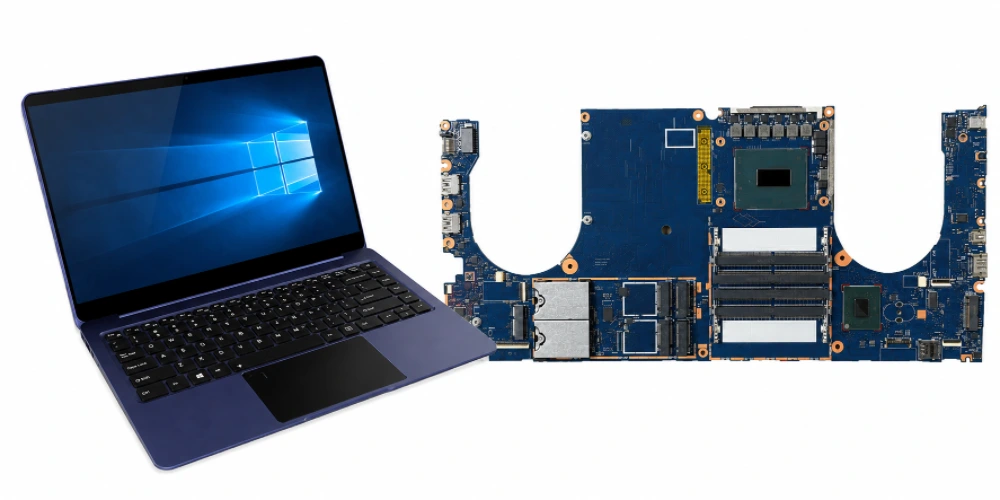
Table of contents
- Treat the Laptop as a Mainboard Plus Interconnect and Daughterboard System
- Laptop Motherboard Fabrication: Density, Stack-Up and Via Architecture
- Fine-Pitch and BGA Assembly for Thin Portable Motherboards
- Power, Battery and Charging Circuits Need Clear Manufacturing Boundaries
- Display, Camera, Keyboard and Touchpad Interconnect Control
- Component Sourcing, Platform Revision and NPI Cost Control
- Laptop Motherboard Programming and Functional Testing
- Global OEM Manufacturing Support for Custom Laptop Electronics
- Request a Laptop Computer PCB and PCBA Manufacturing Review
A laptop motherboard has to deliver desktop-class computing functions inside a thinner, battery-powered mechanical system. Processor, memory, storage, power conversion, battery charging, wireless connectivity, display interfaces and external I/O compete for limited board area while the motherboard must also align with heat pipes, fans, speakers, batteries, keyboard assemblies and multiple flex-cable connections.
Highleap Electronics manufactures customer-owned laptop PCBs and PCBAs from released production data. The scope can combine multilayer PCB fabrication, PCB assembly, approved component sourcing, programming and customer-defined functional testing. Flex circuits, daughterboards or rigid-flex assemblies can also be reviewed when they are part of the released electronics set.
Laptop architectures vary widely by brand and product class. Some use soldered processors and memory, some use replaceable memory or storage modules, and connector/daughterboard layouts are often proprietary. Manufacturing should therefore follow the actual mechanical stack and board set rather than assume a standard laptop motherboard form factor.
1. Treat the Laptop as a Mainboard Plus Interconnect and Daughterboard System
The main motherboard is only one part of many laptop electronics packages. USB or audio daughterboards, keyboard/touchpad boards, camera modules, display cables, battery interconnects, speaker wiring and sensor boards may all connect to it. If those interfaces are not controlled together, the main PCBA can be electrically correct and still fail final assembly.
Mechanical Datum
The manufacturing package should identify the released motherboard revision and every customer-supplied or factory-built interconnect that affects assembly. Highleap can review the PCB outline, connector positions, mounting holes and flex interfaces against the mechanical drawing before fabrication.
Interconnect / Load Path
| Data set | Production purpose |
|---|---|
| Mainboard Gerber/ODB++ and fabrication drawing | Defines PCB construction, outline, drill and stack-up requirements. |
| BOM/CPL/assembly drawing | Controls component population, orientation and optional hardware. |
| Flex/daughterboard drawings | Controls mating connectors, cable direction and auxiliary PCBA revisions. |
| Mechanical stack | Confirms board, battery, cooling and connector clearances. |
| Programming/test package | Links the motherboard revision to firmware and functional acceptance. |
2. Laptop Motherboard Fabrication: Density, Stack-Up and Via Architecture
Laptop motherboards often require dense routing because the board outline is constrained by battery, cooling and enclosure geometry. HDI, blind vias or microvias may be appropriate when BGA escape or routing density requires them, but those features should come from the released layout rather than from a blanket assumption that every laptop board is HDI.
Key Manufacturing Controls
- Stack-Up & Geometry: Where HDI is specified, Highleap can review the stack-up and via structure through its HDI PCB manufacturing workflow. The build should define dielectric construction, microvia depth, capture pads, filled/capped via requirements where applicable, finished thickness and lamination sequence.
- Fabrication Control: DDR, PCIe, USB, display and other high-speed links should be fabricated to the approved impedance and stack-up geometry. Thin board constructions can also be mechanically sensitive, so thickness tolerance, copper balance and panelization need to be reviewed together with the customer’s assembly and enclosure requirements.
3. Fine-Pitch and BGA Assembly for Thin Portable Motherboards
Laptop PCBAs can contain soldered processors, chipsets, memory devices, power controllers, QFN/LGA packages and dense passive arrays. Component spacing can be tight on both sides of the board, and underside components must remain compatible with fixtures, shielding and the chassis.
Placement & Reflow
Highleap can integrate BGA PCB assembly, AOI and targeted X-ray into the process according to the released package mix. Stencil design, placement, reflow and first-piece inspection should be developed for the actual board, while rework limits for expensive or mechanically sensitive devices are agreed before volume production.
Mechanical Operations
Small board-to-board and FPC connectors deserve special attention because they can be damaged by misalignment or repeated manual handling. Connector orientation, seating and latch condition should be part of first-piece and final visual inspection.
Highleap Electronics • PCB Manufacturing & PCBA
Request a Laptop Motherboard Manufacturing Review
Send your Gerber or ODB++, BOM, assembly data and quantity. Highleap will review the PCB fabrication, sourcing, assembly, programming and test scope for a controlled build.
Request a PCB & PCBA Quote →Discuss Manufacturing Requirements →
✓ DFM and DFA review ✓ Prototype to repeat production ✓ PCB fabrication and assembly
4. Power, Battery and Charging Circuits Need Clear Manufacturing Boundaries
A laptop motherboard interacts directly with the battery pack, adapter input, charging circuitry and system power rails. The assembler must build these circuits to the released BOM and polarity/orientation data; it should not alter protection, charging or power-stage components as a sourcing convenience.
Manufacturing Translation
If the project includes a separate battery-management PCB, that board should have its own released data and acceptance criteria. Battery pack design, cell selection, pack certification and charger safety validation are not implied by a laptop motherboard PCBA quotation.
During functional test, the customer can define safe power-up conditions, current limits, adapter/battery simulators and the sequence used before connecting valuable processors or displays. This reduces the risk of turning a simple assembly defect into a damaged high-value board.
5. Display, Camera, Keyboard and Touchpad Interconnect Control
Portable computers rely heavily on flex cables and small connectors to move signals through the hinge and around the enclosure. Display, camera, microphone, keyboard, touchpad and antenna connections can all have different pinouts, cable lengths and mechanical constraints.
Bend / Flex Zone
For customer-designed flex circuits, Highleap can evaluate flex PCB manufacturing or rigid-flex PCB options when they are part of the approved design. The bend zone, stiffener, connector land pattern and assembly orientation should be defined in the released data.
Rigid-to-Flex Transition
At laptop integration, a cable should not be substituted solely by connector type. Shielding, impedance, length, bend direction, adhesive or retention features can affect display and peripheral behavior. Approved drawings or samples are the correct production reference.
Interconnect Sets Should Be Verified as a Product Configuration
A laptop can contain several visually similar FPCs and micro-connectors with different pinouts, lengths, stiffeners or bend directions. If these items are supplied separately from the mainboard, receiving and kitting controls should still tie them to the same product revision. This avoids a situation where a correct PCBA is paired with a mechanically compatible but electrically different cable during system integration.
- Cable identity: control part number, revision, connector orientation and installation side rather than relying on appearance.
- Connector handling: define latch opening, insertion depth and cable support for fine-pitch FPC connectors that can be damaged after soldering.
- Fixture coverage: decide whether display, camera, keyboard, touchpad and other interfaces are tested with dedicated fixtures, known-good peripherals or only after final product assembly.
- Mechanical evidence: keep the drawing revision used to confirm connector position, heatsink clearance, screw locations and cable routing with the manufacturing record.
These controls are especially useful during NPI because a laptop can pass bare-PCBA inspection while still failing later at hinge routing, connector access or peripheral integration. Closing those issues before repeat production reduces rework that is difficult to diagnose at the board level.
6. Component Sourcing, Platform Revision and NPI Cost Control
Notebook platforms can be sensitive to component substitutions because firmware, thermal limits and mechanical fit are tightly integrated. Processor/SoC, memory, flash, clocks, wireless devices, power components and compact connectors should be controlled through an AVL with clear approval rules.
Approved Parts
Highleap can provide component sourcing for turnkey or partial-turnkey builds. When a critical part is unavailable, the replacement MPN and reason for the change should be returned for customer review rather than treated as automatically interchangeable.
Variant / Lifecycle Control
Hardware revision, BIOS/firmware image and fitted option set should stay synchronized. If the same board supports several RAM/storage/wireless configurations, the factory should receive a SKU matrix rather than derive the build from model names alone.
Production Scaling and Commercial Control
Laptop PCB cost depends on board area, layer count, HDI or via architecture, material, impedance, thickness, finish and test requirements. PCBA cost is influenced by a high-value BOM, dense placement, double-sided assembly, BGA inspection, flex/daughterboard handling, programming and functional-test time.
Manufacturing Sequence
- Prototype Learning. The prototype build should prove more than electrical functionality. It should close PCB/flex manufacturability questions, verify connector and chassis fit, establish the assembly sequence, confirm the programming route and identify any components that are difficult to source or rework.
- NPI Baseline. Before repeat production, freeze the approved board construction, BOM/AVL, flex and daughterboard revisions, programming image and test procedure. That baseline is what allows a later reorder to be manufactured as the same product rather than a new engineering build.
7. Laptop Motherboard Programming and Functional Testing
Production test should verify the functions exposed to PCB/assembly risk before the mainboard is buried in the laptop chassis. Depending on the customer design, this can include power-on, firmware identification, memory/storage detection, battery/adapter input behavior, network, USB, display output, keyboard/touchpad interfaces, camera or audio checks and fan-control signals.
Powered Functional Checks
Highleap can execute PCB functional testing from customer-provided procedures, fixtures and acceptance criteria. Thermal runtime, battery endurance, EMC, drop or complete laptop safety qualification remain separate system-level activities unless specifically included in a broader scope.
8. Global OEM Manufacturing Support for Custom Laptop Electronics
Custom laptop programs combine a dense mainboard with batteries, flex cables, displays, cameras, keyboards, touchpads, antennas and optional daughterboards. For international sourcing, the highest risk is usually not distance itself; it is an incomplete product release that separates the PCB from the mechanical and interconnect information needed to build a working assembly.
United States and Canada: Custom Notebook and Specialist Portable Systems
Teams comparing a laptop motherboard PCB manufacturer in China should provide the stack-up, controlled-impedance requirements, BGA package data, flex-cable interfaces, battery/charging boundaries, mechanical drawings and test plan. If Highleap is only building the motherboard PCBA, the quote should state which display, battery and peripheral fixtures are available for functional verification.
Germany, the UK and France: Revision and Supplier Coordination
For European notebook programs, a custom laptop PCBA assembly supplier may need to coordinate long-lead processors, memory, storage, wireless devices, power components and chassis-specific connectors. Approved alternates and engineering changes should therefore be controlled through an AVL/BOM process rather than introduced during purchasing without product approval.
Japan, South Korea and Australia: Compact Hardware and Product Integration
Asia-Pacific laptop projects can place strong emphasis on compact packaging, display quality and mechanical integration. When evaluating an OEM notebook motherboard PCB supplier, the buyer should confirm not only board fabrication and SMT capability but also how flex connectors, fine-pitch parts, X-ray inspection where required, programming and peripheral-interface tests are handled.
For a global laptop quote, send the destination market and forecast with the released motherboard, BOM, CPL, flex/daughterboard data and test requirements. Highleap can then define which activities belong to PCB fabrication, PCBA assembly, sourcing, programming, test and any optional system integration.
9. Request a Laptop Computer PCB and PCBA Manufacturing Review
Send These Inputs
Send the released motherboard Gerber or ODB++, stack-up/fabrication notes, BOM, CPL, assembly drawing, quantity and revision. Include mechanical drawings, flex/daughterboard data, firmware and production test requirements when they are part of the manufacturing package.
Highleap Reviews
Highleap can review PCB fabrication, HDI or flex requirements where present, PCBA assembly, sourcing, inspection and customer-defined testing. Submit the project through the PCB assembly quote page.

Recommended Posts
TMM4 Filter PCB Manufacturing
TMM4 filter PCB manufacturing is controlled by the...
TMM6 PCB Fabrication
TMM6 fabrication is the process-control page for a mid-Dk...
TMM3 PCB Manufacturing for RF Modules
TMM3 PCB manufacturing is most useful where the RF module...

TMM10 PCB Manufacturing for Compact RF Designs
Table of contentsHow TMM10 Shrinks RF StructuresTMM10 vs...
How to get a quote for PCBs
Let’s run DFM/DFA analysis for you and get back to you with a report. You can upload your files securely through our website. We require the following information in order to give you a quote:
-
- Gerber, ODB++, or .pcb, spec.
- BOM list if you require assembly
- Quantity
- Turn time
For PCBA services, please provide your BOM (Bill of Materials) and any specific assembly instructions. We also offer DFM/DFA analysis to optimize your designs for manufacturability and assembly, ensuring a smooth production process.