
Medical Ceramic Circuit Board Fabrication and Assembly

Figure 1. Medical Ceramic Circuit Board
Table of Contents
- Why Medical Devices Use Ceramic Circuit Boards
- Regulatory Requirements That Shape Ceramic PCB Design for Medical Use
- Material Selection for Medical Ceramic Circuit Boards
- Application-Specific Design Examples
- Assembly and Testing Requirements for Medical-Grade Boards
- Qualification and Validation Process
- Highleap’s Medical Ceramic Circuit Board Services
A medical ceramic circuit board must meet requirements that go far beyond standard industrial specifications. Medical devices operate inside or on the human body, in sterilization environments, and in diagnostic systems where measurement accuracy directly affects patient outcomes. The substrate must perform reliably for years — sometimes decades — under conditions that degrade organic PCB materials.
Ceramic substrates address these requirements through inherent material properties: chemical inertness that survives autoclave sterilization, dimensional stability that maintains calibration over thousands of thermal cycles, and dielectric performance that supports high-frequency ultrasound and imaging signals without drift. This guide covers what makes ceramic circuit boards essential for medical applications, and what engineers and procurement teams need to specify correctly.
1. Why Medical Devices Use Ceramic Circuit Boards
1.1 Properties That Matter in Medical Applications
| Requirement | FR4 Limitation | Ceramic Advantage |
|---|---|---|
| Sterilization compatibility | FR4 absorbs moisture during autoclave (121°C steam); degrades over repeated cycles | Near-zero moisture absorption; dimensionally stable through unlimited autoclave cycles |
| Biocompatibility | Organic resins may leach compounds; not inherently biocompatible | Alumina and AlN are inert, non-toxic, and used in implantable devices |
| Long-term stability | Dk/Df drift with age, moisture, and temperature cycling | Stable dielectric properties over 20+ year device lifetimes |
| Thermal management | 0.3 W/m·K — inadequate for laser drivers, ultrasound power stages | 24–230 W/m·K depending on material — handles high-power medical electronics |
| Signal integrity at high frequency | Dielectric loss increases significantly above 1 GHz | Loss tangent <0.001; supports ultrasound (1–20 MHz) and RF imaging without degradation |
| Hermetic sealing | Cannot form hermetic seals | Ceramic substrates can be brazed to titanium or kovar enclosures for implantable devices |
1.2 Medical Device Categories Using Ceramic PCBs
- Implantable devices: Pacemakers, cochlear implants, neurostimulators — require hermetic ceramic substrates with decades-long reliability
- Diagnostic imaging: Ultrasound transducer arrays, X-ray detector modules, MRI gradient coil drivers — require thermal management and signal integrity that ceramic provides
- Surgical instruments: Electrosurgical generators, laser scalpel drivers — high-power RF stages where ceramic handles the thermal and voltage demands
- Patient monitoring: Precision sensor modules for temperature, pressure, and biochemical measurement — where ceramic’s long-term dielectric stability maintains calibration accuracy
2. Regulatory Requirements That Shape Ceramic PCB Design for Medical Use
2.1 Quality System
Medical ceramic circuit boards must be produced under an ISO 13485-certified quality management system. This is not optional — it is a prerequisite for selling medical devices in the US (FDA), EU (CE/MDR), and most other regulated markets.
ISO 13485 requires:
- Documented process controls for every manufacturing step
- Full material traceability (ceramic substrate lot → fabrication lot → assembly lot → finished device)
- Validated processes — meaning the manufacturing process is proven to consistently produce conforming output, not just inspected after the fact
- CAPA (Corrective and Preventive Action) system for non-conformances
- Change control — no process or material changes without formal evaluation and approval
2.2 Biocompatibility
For devices with patient contact (especially implantables), the ceramic substrate and all surface materials must be evaluated per ISO 10993 (biological evaluation of medical devices). Alumina is widely accepted as biocompatible; surface finishes and solder materials require separate evaluation.
2.3 IEC 60601 Compliance
Medical electrical equipment must meet IEC 60601-1 for safety. The ceramic PCB design affects creepage and clearance distances, insulation resistance, and dielectric withstand voltage — all of which must be verified during design and confirmed during production testing.
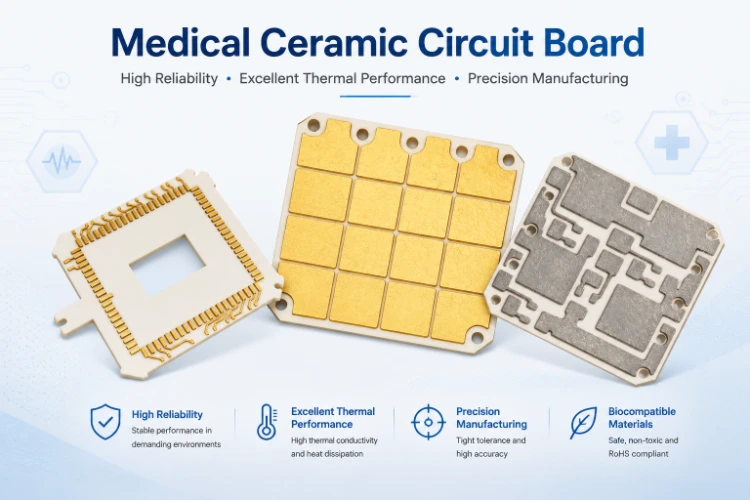
Figure 2. Medical Ceramic Circuit Board
3. Material Selection for Medical Ceramic Circuit Boards
- 99.6% alumina: The default for most medical ceramic circuit boards. Higher purity than industrial-grade 96% alumina; lower surface porosity provides better metallization adhesion and cleaner surfaces for biocompatibility. Used in diagnostic imaging substrates, sensor modules, and reusable sterilizable instruments
- Aluminum nitride (AlN): Selected when thermal management is the primary challenge — surgical laser diode drivers, high-power ultrasound transmitter stages, and power amplifiers in MRI systems where thermal conductivity above 170 W/m·K is needed
- Silicon nitride (Si₃N₄): Chosen for implantable power modules where extreme thermal cycling reliability (>10,000 cycles) and mechanical shock resistance are critical. Its ~800 MPa flexural strength prevents substrate cracking during assembly and device deployment
4. Application-Specific Design Examples
4.1 Ultrasound Transducer Array
- Substrate: 99.6% Al₂O₃ (0.38 mm thick)
- Metallization: Thin film (sputtered Au) for fine-pitch transducer element connections (50 µm line/space)
- Key requirement: Low dielectric loss (<0.001 Df) at 1–15 MHz; dimensional stability ±0.02 mm for element pitch accuracy
4.2 Implantable Neurostimulator Power Stage
- Substrate: AlN (0.635 mm thick)
- Metallization: DBC (0.3 mm Cu) for current delivery to stimulation electrodes
- Key requirement: Hermetic seal compatibility (substrate flatness ≤5 µm for braze-to-titanium enclosure); thermal management for charge pump circuitry
4.3 Electrosurgical Generator RF Power Stage
- Substrate: Al₂O₃ 96% (1.0 mm thick)
- Metallization: Thick film (Ag-Pd conductors with integrated thick-film resistors)
- Key requirement: Voltage isolation >5 kV per IEC 60601-1; thermal handling for 200–400W RF output at 300–500 kHz
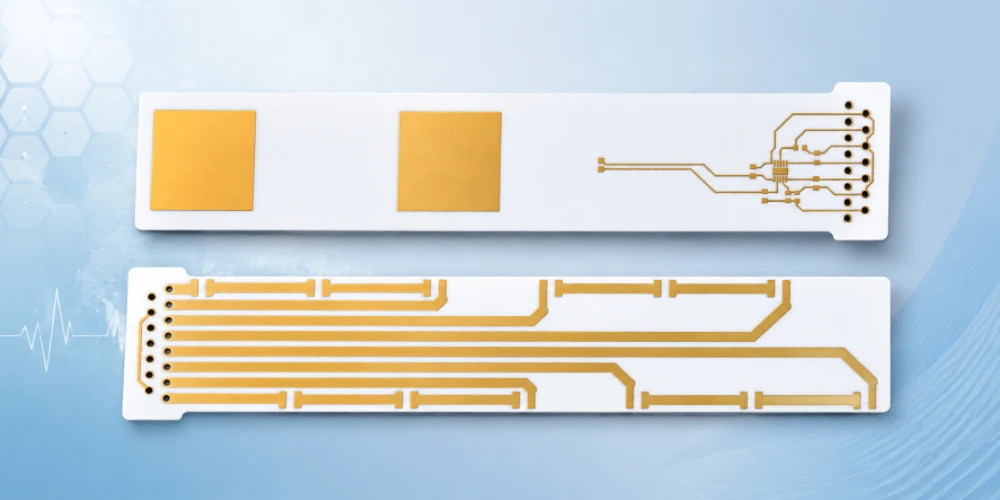
Figure 3. Medical Ceramic PCB
5. Assembly and Testing Requirements for Medical-Grade Boards
- Assembly environment: Controlled cleanliness (ISO Class 7/8 cleanroom or better for implantable devices); documented cleaning processes between assembly steps
- Component traceability: Every component traceable to manufacturer lot; authorized distributor sourcing required — no broker market components
- Process validation: Solder reflow profiles, die-attach processes, and wire bonding parameters must be formally validated (IQ/OQ/PQ protocol) before production
- Testing: 100% electrical testing; X-ray inspection for BGA and die-attach void analysis; functional testing under simulated operating conditions
- Reliability: Accelerated life testing per IEC 60068 — thermal shock, vibration, humidity — with documented acceptance criteria
6. Qualification and Validation Process
Qualifying a ceramic circuit board supplier for medical devices involves:
- Supplier audit: On-site assessment of ISO 13485 compliance, ceramic-specific process controls, and cleanroom facilities
- Process qualification: Build qualification lots (typically 3 consecutive lots); verify dimensional, electrical, and reliability results meet specification
- Design validation: Test assembled modules under worst-case operating conditions; confirm compliance with IEC 60601, biocompatibility (ISO 10993), and product-specific standards
- Documentation package: Complete DHF (Design History File) support — material certificates, process validation reports, inspection records, traceability matrices
This process typically takes 6–12 months. Starting with a supplier that already holds ISO 13485 and has documented medical ceramic PCB experience reduces this timeline significantly.
7. Highleap’s Medical Ceramic Circuit Board Services
Highleap Electronics provides ceramic circuit boards for medical device applications under our ISO 13485-certified quality system:
- Materials: Al₂O₃ (96%, 99.6%), AlN, Si₃N₄ — with incoming inspection and full lot traceability
- Metallization: DBC, thick film, thin film — selected based on your application requirements
- Assembly: SMT assembly, die attach, wire bonding in controlled-environment facilities
- Certifications: ISO 9001, ISO 13485 (medical), IATF 16949, ISO 14001
- Documentation: CoC, material traceability, inspection reports, reliability test data — formatted for regulatory submission
- Engineering support: DFM review, thermal simulation, and design guidance for IEC 60601 compliance
We support medical device companies from early-stage prototype through production, providing the process stability and documentation rigor that medical regulators require.

Recommended Posts
TMM4 Filter PCB Manufacturing
TMM4 filter PCB manufacturing is controlled by the...
TMM3 PCB Manufacturing for RF Modules
TMM3 PCB manufacturing is most useful where the RF module...
TMM6 PCB Fabrication
TMM6 fabrication is the process-control page for a mid-Dk...

TMM10 PCB Manufacturing for Compact RF Designs
Table of contentsHow TMM10 Shrinks RF StructuresTMM10 vs...
How to get a quote for PCBs
Let‘s run DFM/DFA analysis for you and get back to you with a report. You can upload your files securely through our website. We require the following information in order to give you a quote:
-
- Gerber, ODB++, or .pcb, spec.
- BOM list if you require assembly
- Quantity
- Turn time
For PCBA services, please provide your BOM (Bill of Materials) and any specific assembly instructions. We also offer DFM/DFA analysis to optimize your designs for manufacturability and assembly, ensuring a smooth production process.