
PCB Trace Current Capacity: Width, Copper Weight, and IPC-2221
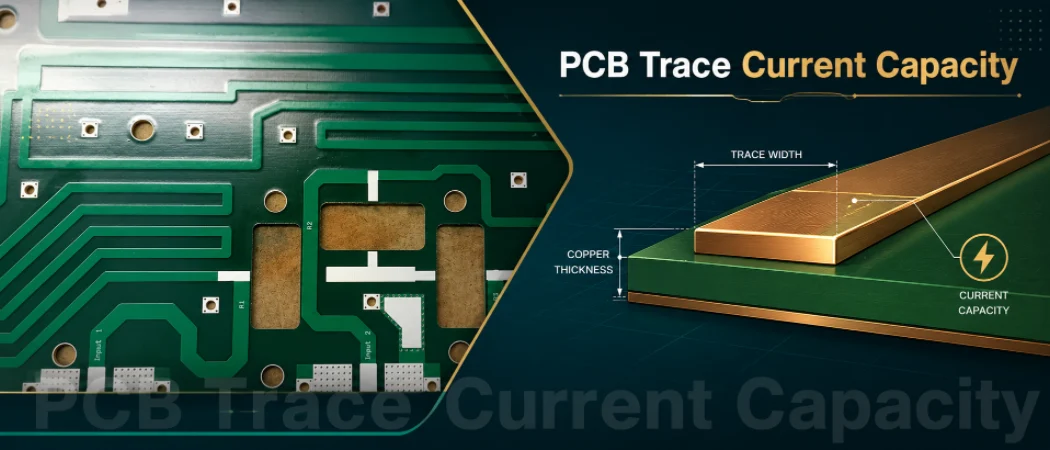
Figure 1. PCB trace current capacity depends on copper weight, trace width, layer position, and acceptable temperature rise.
Every copper trace is a thin resistor that warms up when current flows through it. Size it right and a board runs cool for years; size it short and the trace overheats, ages the laminate, and can open like a fuse. This guide answers the questions engineers actually search – how many amps a trace carries, what 1 oz copper is in millimeters, when to switch to heavy copper – and shows how Highleap Electronics turns those numbers into a board it can manufacture and assemble reliably.
1. How many amps can a copper trace carry?
There is no single maximum current for a trace – the limit is whatever temperature rise you accept. As a quick reference, a 1 mm (about 40 mil) wide trace in 1 oz copper on an outer layer carries roughly 2 A at a conservative 10°C rise, and about 4 A at a 30°C rise. Current heats the trace in proportion to current squared times resistance, and the trace settles wherever it can shed that heat into surrounding copper, laminate, and air.
Three trace properties set the resistance and therefore the heating. Cross-sectional area – width times copper thickness – dominates; doubling either roughly halves the resistance. Length adds proportional resistance and voltage drop but barely changes peak temperature. And copper’s resistance rises about 0.4% per °C, so a hot trace is a slightly higher-resistance trace, which feeds back into more heat. Three environmental factors decide how easily heat escapes: outer versus inner layer, the ambient temperature inside the enclosure, and any airflow or heatsinking. If you are new to how traces are built and specified, the fundamentals of PCB trace design are a useful primer before sizing for power.
2. What is 1 oz copper thickness in mm? (copper weight chart)
1 oz copper is about 35 microns thick, which is 0.035 mm or roughly 1.37 mil. Copper thickness is quoted by weight per square foot – an old convention that trips up newcomers – so the conversions worth memorizing are:
| Copper weight | Microns | Millimeters | Typical use |
|---|---|---|---|
| 0.5 oz | ~17.5 µm | ~0.0175 mm | Inner layers, fine lines |
| 1 oz | ~35 µm | ~0.035 mm | Standard outer layers |
| 2 oz | ~70 µm | ~0.070 mm | Power boards |
| 3 oz | ~105 µm | ~0.105 mm | High-current, motor drives |
Because capacity tracks cross-sectional area, you carry more current either by widening the trace or by ordering thicker copper. On a dense board, stepping up to a 3 oz copper build is often cleaner than carving out room for a very wide track, and for high-power work a full heavy copper PCB is purpose-built for the job.
3. Trace width vs current chart (1 oz & 2 oz copper)
For 1 oz copper on an outer layer at a conservative 10°C rise, a 1 A trace needs roughly 0.5 mm (20 mil) and a 3 A trace roughly 1.8 mm (70 mil). The full chart below is a starting point based on IPC-2221, not a substitute for a calculation against your own temperature target; inner-layer traces typically need about double these widths.
| Current | Width – 1 oz, outer, 10°C rise | Width if upgraded to 2 oz |
|---|---|---|
| 0.5 A | ~0.3 mm (12 mil) | ~0.15 mm (6 mil) |
| 1 A | ~0.5 mm (20 mil) | ~0.3 mm (12 mil) |
| 3 A | ~1.8 mm (70 mil) | ~0.9 mm (35 mil) |
| 5 A | ~3.3 mm (130 mil) | ~1.7 mm (66 mil) |
| 10 A | ~8 mm (315 mil) – use a pour | ~4 mm (157 mil) |
Width grows fast with current. Past a few amps a single trace becomes impractical, and the better answer is a copper pour or plane, parallel traces on several layers stitched with vias, or heavier copper – which is where dedicated heavy copper current-capacity engineering keeps high-current rails cool.
4. Internal vs external trace width: why inner traces need to be wider
An internal trace needs roughly double the width of an external trace to carry the same current, because it is sandwiched in laminate and cannot shed heat to the air. IPC-2221 uses different constants for the two cases precisely for this reason – an outer trace cools by convection into air, while an inner trace is thermally insulated and stores more heat at the same width.
The practical consequence: a width you validated for an outer layer can quietly overheat if the same net is routed on an inner layer in a multilayer board. When you move power between layers, size for the inner-layer case, and use multiple vias in parallel at each transition so the layer-change does not become a hot bottleneck.

Recommended Posts
TMM4 Filter PCB Manufacturing
TMM4 filter PCB manufacturing is controlled by the...
TMM3 PCB Manufacturing for RF Modules
TMM3 PCB manufacturing is most useful where the RF module...
TMM6 PCB Fabrication
TMM6 fabrication is the process-control page for a mid-Dk...

TMM10 PCB Manufacturing for Compact RF Designs
Table of contentsHow TMM10 Shrinks RF StructuresTMM10 vs...
How to get a quote for PCBs
Let’s run DFM/DFA analysis for you and get back to you with a report. You can upload your files securely through our website. We require the following information in order to give you a quote:
-
- Gerber, ODB++, or .pcb, spec.
- BOM list if you require assembly
- Quantity
- Turn time
For PCBA services, please provide your BOM (Bill of Materials) and any specific assembly instructions. We also offer DFM/DFA analysis to optimize your designs for manufacturability and assembly, ensuring a smooth production process.