
用于导航、电池供电、安全性和车队可靠性的AMR和AGV机器人PCB
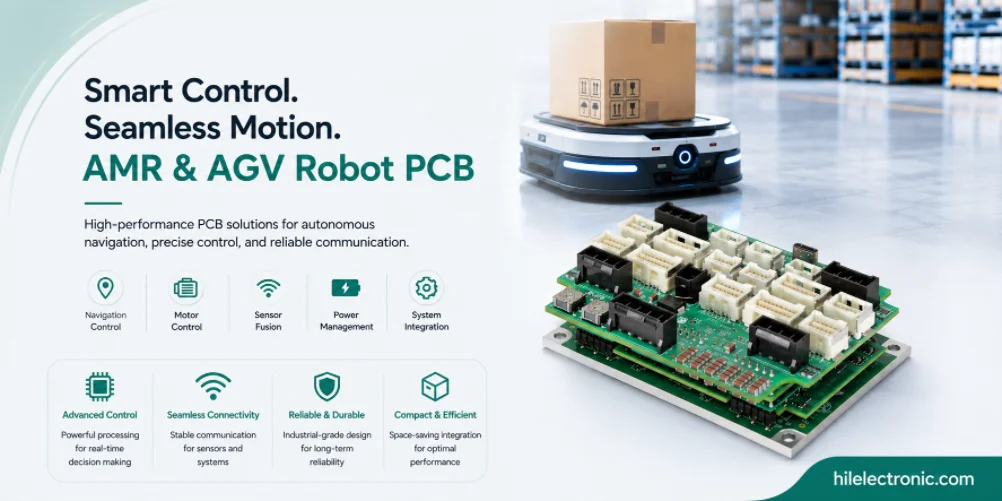
AMR and AGV robot PCBs support mobile platforms that move materials through warehouses, factories, hospitals, logistics centers, and commercial facilities. Their boards must combine battery-powered operation, navigation sensors, safety scanners, motor control, wireless communication, charging interfaces, and rugged construction for vibration and shock.
This guide explains the electronics and manufacturing requirements behind AMR and AGV platforms. It covers navigation architecture, motion configuration, payload handling, safety in shared human spaces, battery and charging design, fleet serviceability, and production testing. FAQ content has been rewritten as industry guidance rather than supplier-centered sales answers.
What Makes AMR and AGV Electronics Distinct
在机器人系统中的作用
Autonomous Mobile Robots (AMR) and Automated Guided Vehicles (AGV) are battery-powered mobile platforms that move payloads around warehouses, factories, and other facilities. Their electronics differ from fixed industrial robots because they run on batteries, navigate autonomously (AMR) or along defined paths (AGV), operate in shared human spaces, and must survive rough handling. What makes AMR/AGV electronics distinct:
- Battery-powered operation: battery management and power efficiency directly determine runtime. Every watt matters.
- Autonomous navigation: LIDAR, cameras, and sensor fusion for AMR. Magnetic tape, QR codes, or reflectors for AGV.
- Payload handling: lifters, rollers, arms, or specialty payload interfaces. Application-specific electronics.
- Safety in shared spaces: safety scanners, e-stops, and dynamic behaviour meeting ISO 3691-4 for AGV or ANSI R15.08 for AMR.
- 无线通信: Wi-Fi standard; some platforms use 5G or private LTE. Cellular for outdoor delivery.
- Ruggedised construction: shock and vibration from rough floors and payload handling.
控制设计风险
For AMR and AGV PCBs, manufacturability input should happen before connector placement, enclosure fit, fixture access, thermal paths, and harness routing are frozen. Late changes to these details usually trigger mechanical rework, test-fixture redesign, or reliability compromises that could have been avoided with early DFM review.
Component selection should include lifecycle status, approved alternates, package availability, temperature rating, and safety or isolation ratings where relevant. Amr and agv pcbs often stay in production or service longer than consumer electronics, so unresolved sourcing risk becomes a field-support issue, not only a purchasing issue.
在系统层面,电路板的设计应基于功能、环境、使用寿命和测试覆盖率,而不仅仅是原理图。这可以避免常见的错误,即设计出技术上正确但难以装配、难以维护或安装到机器人后不够坚固的PCB。
Navigation electronics often share timing and power constraints with the robot camera board 和 sensor interface assembly.
Navigation Architecture: SLAM, Fixed Path, Fiducials, GPS
Architecture Choices for Navigation Architecture
Navigation architecture varies substantially between AMR and AGV. The main navigation approaches are:
- LIDAR SLAM: simultaneous localisation and mapping. Standard for AMR; no fixed infrastructure required.
- Camera SLAM: vision-based navigation. Cheaper than LIDAR; less robust in featureless environments.
- Fixed path following: magnetic tape, painted lines, or embedded wire. Standard AGV; no on-board mapping needed.
- Fiducial-based: QR codes or reflective markers at known positions. Common hybrid AGV/AMR approach.
- GPS: outdoor mobile robots. Requires clear sky view; supplemented with IMU during signal loss.
- UWB: ultra-wideband positioning. Precision indoor positioning where required.
Validation Requirements for Navigation Architecture
可靠性取决于电路板设计中预留的裕量:铜箔宽度、隔离间距、散热、连接器固定、元件降额以及检测覆盖范围。制造部门应验证这些特性,而不是将PCB视为通用组件,采用通用的合格/不合格测试。
应通过带标签的连接器、易于访问的测试点、清晰的电路板型号以及序列号跟踪来考虑可维护性。当机器人现场发生故障时,良好的电路板级诊断功能可以让维修团队快速定位问题,而无需更换大型组件或退回整个机器人。
实际操作中,应选择满足信号、安全、散热和机械性能要求的最简单的结构。规格过高会增加成本,而规格过低则会导致测试或现场部署期间需要返工。
Motion Configuration: Differential, Skid Steer, Ackermann, Omnidirectional
Selection Criteria for Motion Configuration
Motion control on AMR/AGV drives typically uses differential or omnidirectional configurations. The main configurations are:
- Differential drive: two independent drive wheels plus casters. Simple, cheap, common on warehouse AMR.
- Skid steer: four drive wheels, each independent. Better traction; higher power.
- Ackermann steering: car-like steering. Common on outdoor and delivery platforms.
- 全向: mecanum or Swedish wheels enabling lateral motion. Common where lateral positioning needed.
- Tracked: tracks instead of wheels. Rugged; common on outdoor and construction platforms.
How Motion Configuration Affects Cost and Reliability
测试覆盖率要求会随着可靠性要求而变化。消费类应用所需的测试覆盖率低于工业应用;工业应用所需的测试覆盖率低于医疗应用;医疗应用所需的测试覆盖率低于安全关键型应用。使测试覆盖率与实际需求相匹配,既能控制成本预算,又能提供应用所需的可靠性保障。
制造文档在设计阶段往往投入不足,事后补建成本高昂。生产过程中收集的单元测试记录有助于多年后的现场调查;组件批次追溯性则有助于对现场退货进行事后分析。尽早规划文档的项目能够拥有所需的记录;而后期添加文档的项目往往会丢失原本需要的数据。
Payload Handling: Conveyor, Lift, Manipulator, Delivery
Key Design Choices for Payload Handling
Payload handling electronics depend on the specific application. Common payload interfaces are:
- Conveyor top: powered rollers or belt on top of robot. Motor control plus sensors for payload presence.
- Lift plate: elevating plate for pallet or cart pickup. Actuator control plus position sensing.
- Arm or manipulator: mounted manipulator for pick-and-place. Often uses separate joint drive electronics.
- Cart connector: automated coupling to towed carts. Sensor and actuator interface for connection state.
- 自动售货机: delivery robot compartment access control. Actuators, locks, and user interfaces.
- Sortation: automated sortation interface. Sensor plus actuator for sortation logic.
制造和可靠性方面的考虑
生产过程中的供应链可视性会影响成本和可靠性。具备主动采购能力的制造商能够应对原本会导致生产中断的配额周期;而缺乏主动采购能力的制造商则会将供应问题转嫁给客户。主动采购的价值在行业整体短缺时最高,在供应稳定时最低。
设计迭代周期受益于紧密的设计-制造反馈。能够及时提供DFM反馈的制造合作伙伴可以加快迭代速度;而反馈缓慢或流于表面的合作伙伴则会相应减慢迭代速度。那些部分基于反馈质量选择制造合作伙伴的项目,通常比那些仅以最低报价为选择标准的项目更快地完成原型制作阶段。
Safety Architecture for Shared Human Spaces
Architecture Choices for Safety Architecture for Shared Human Spaces
Safety architecture on AMR/AGV meets standards for mobile robotics in shared human spaces. The main safety features are:
- Safety scanner: laser scanner detecting people in the robot path. Speed reduction or stop based on detected proximity.
- 紧急停止: physical stop buttons on robot chassis. Redundant hardware paths.
- Bumper sensors: physical contact detection. Backup to scanner-based avoidance.
- 速度监控: safe speed control; monitored speed limits. Meets Performance Level d or higher on safety-critical applications.
- 警告装置: audible and visual warnings during motion. Local behaviour matched to environment.
- Zone monitoring: operation restricted to defined zones. Prevents robot excursion into unauthorised areas.
Validation Requirements for Safety Architecture for Shared Human Spaces
产量区间经济效益对不同生产规模下工艺选择的影响各不相同。年产量100,000万件时有效的工艺,在年产量500件时往往无效;原型制作阶段适用的工艺,在大批量生产时往往不适用。根据实际产量匹配制造方法,才能确保每个产量区间的经济效益。
监管认证义务因应用和市场而异。客户提交的生产证明材料要求可能从极少(例如非监管市场的消费品)到非常详尽(例如保存期限严格的医疗器械)不等。在报价时明确认证要求的项目能够确保生产流程的正确设置;而后期添加认证要求的项目则有时需要对流程进行调整。
Runtime targets depend on the 电池管理PCB, power-distribution electronics, and a sourcing plan that can support fleet maintenance.
Battery and Power Management for Runtime
电气和热要求
Battery and power management on AMR/AGV directly affects runtime economics. The main considerations are:
- 电池化学: LFP standard for its cycle life; NMC where energy density matters more than cycle life.
- 费用管理: opportunity charging during idle; scheduled charging at docks. Charge behaviour affects fleet operations.
- State-of-charge accuracy: affects when robots return to charge. Poor accuracy strands robots or wastes runtime.
- 再生制动: recovers energy during deceleration. Modest efficiency benefit; useful on high-cycle applications.
- 电源模式: standby, active, and rapid-startup modes. Affects total energy consumption over fleet lifetime.
生产测试和失效模式
由同一制造合作伙伴集中生产,可以保留跨代产品积累的机构知识。拥有多代类似产品制造经验的合作伙伴深谙具体问题,了解哪些工艺调整可以提高良率,以及哪些设计模式易于制造。这些知识无法轻易转移给新的合作伙伴。
持续的工程制造对话能够随着时间的推移,改善产品本身和供应商关系。反馈给工程部门的良率数据有助于改进设计;反馈给现场的数据则有助于改进设计和制造工艺。积极开展这种对话的项目,其产品在各个世代中都能不断进步。
有关相邻设计决策,请参见 robot BMS PCB for mobile battery packs 和 robot power distribution PCB for mobile platforms.
For pilot and fleet builds, component availability should be checked through electronics component sourcing support before the robot enters repeat production.
Manufacturing AMR and AGV PCBs at Highleap
生产前DFM审查
Highleap manufactures AMR/AGV electronics with the specific discipline mobile robots need. The specific capabilities include:
- 抗振动和抗冲击能力: component selection and mounting supporting mobile-platform stress.
- Battery and power distribution: integrated manufacturing of BMS and power distribution boards.
- Navigation sensor integration: LIDAR interface boards, camera boards, and sensor fusion boards.
- 运动控制: differential, skid steer, and omnidirectional drive boards.
- 无线通信: Wi-Fi, LTE, and specialty wireless integration.
- Safety-rated manufacturing: support for ISO 3691-4 and ANSI R15.08 certification submissions.
测试、可追溯性和构建交接
机器人制造工艺融合了多种传统电子领域的实践经验。例如,消费电子领域注重成本控制和批量生产;工业电子领域强调可靠性工程和长使用寿命;汽车电子领域关注振动和环境适应性;医疗电子领域则强调文档记录和可追溯性。机器人技术正是受益于这些经验的融合。
将制造业视为战略性环节——例如投资于供应商关系、共享预测信息、协调产能——的项目,通常比将制造业视为交易性环节的项目表现更佳。交易性的做法虽然节省了谈判时间,但却错失了长期供应商合作关系带来的累积效益。
AMR and AGV Robot PCB FAQs
What is the difference between AMR and AGV electronics?
AGVs usually follow predefined paths using magnetic tape, reflectors, QR codes, or embedded guidance. AMRs use onboard perception and navigation to plan routes dynamically. Both need motor control, safety, battery management, communication, and charging electronics, but AMRs generally require more compute, sensors, and synchronization for navigation.
Which PCBs are common in AMR and AGV robots?
Common boards include a main controller, motor driver boards, battery management system, power distribution board, sensor interface board, safety I/O board, communication board, charging interface board, and payload-specific electronics. The exact mix depends on payload, navigation method, battery voltage, fleet communication, and required safety standard.
What navigation sensors affect AMR PCB design?
AMRs may use LIDAR, cameras, depth sensors, IMUs, wheel encoders, ultrasonic sensors, UWB, or GPS for outdoor use. Each sensor affects interface selection, power budget, connector placement, synchronization, EMI control, and mechanical mounting. Sensor boards should be designed together with the navigation algorithm and mechanical layout.
How do safety scanners connect to AMR and AGV electronics?
Safety scanners usually connect through safety-rated digital outputs, industrial Ethernet, or dedicated safety protocols, depending on the scanner and system architecture. The PCB must support reliable power, isolated inputs, diagnostic monitoring, emergency-stop integration, and a defined safe stop when the scanner detects a person or obstacle.
How does battery design affect AMR and AGV PCB requirements?
Battery voltage, capacity, discharge current, charging method, docking strategy, and runtime target all affect PCB design. High-current paths may need heavy copper, large connectors, thermal management, inrush control, and fault protection. Battery data should also be integrated into fleet software so robots charge before operational failure.
What PCB design issues are caused by vibration and shock?
Mobile robots experience floor impacts, payload shifts, docking impacts, and continuous vibration. PCBs need secure connectors, proper component orientation, strain relief, mounting support, conformal coating when needed, and test points that remain reliable after vibration. Large components and batteries require special mechanical retention rather than solder joints alone.
What production tests are important for AMR and AGV PCBs?
Tests should verify power rails, motor-drive outputs, communication links, sensor interfaces, charging path, safety inputs, firmware programming, current draw, and fault reporting. For fleet deployment, serial-number records, firmware version tracking, and functional test logs help diagnose recurring field issues across many robots.
What should be considered when designing charging-interface PCBs?
Charging-interface boards must handle alignment tolerance, contact wear, inrush current, over-current protection, temperature monitoring, communication with the charger, and safe behaviour during partial connection. Docking robots also need protection against arcing, contamination, and repeated mechanical cycles over the fleet's service life.

推荐文章

Taconic RF-35 PCB制造服务——从原型到批量生产
图 1. Taconic RF-35 PCBTaconic RF-35 是主力机型……

Isola Astra MT77 PCB制造
图 1. Isola Astra MT77 PCB 制造 Isola Astra...

定制 Rogers RO4835 PCB 制造和组装服务
图 1. Rogers RO4835 PCB Rogers RO4835 PCB 是一款……

Nelco N4000-13 PCB材料和制造指南 | Highleap Electronics
图 1. Nelco N4000-13 PCB Nelco N4000-13 PCB 是一款……
如何获取 PCB 报价
我们将为您进行DFM/DFA分析,并尽快向您提供报告。您可以通过我们的网站安全上传文件。为了给您报价,我们需要以下信息:
-
- Gerber、ODB++ 或 .pcb,规格。
- 如果需要组装,请提供 BOM 清单
- 数量
- 转弯时间
如需 PCBA 服务,请提供您的 BOM(物料清单)和任何具体的装配说明。我们还提供 DFM/DFA 分析,以优化您的设计,提高可制造性和装配性,确保生产流程顺畅。