
Component Obsolescence Management PCB Assembly
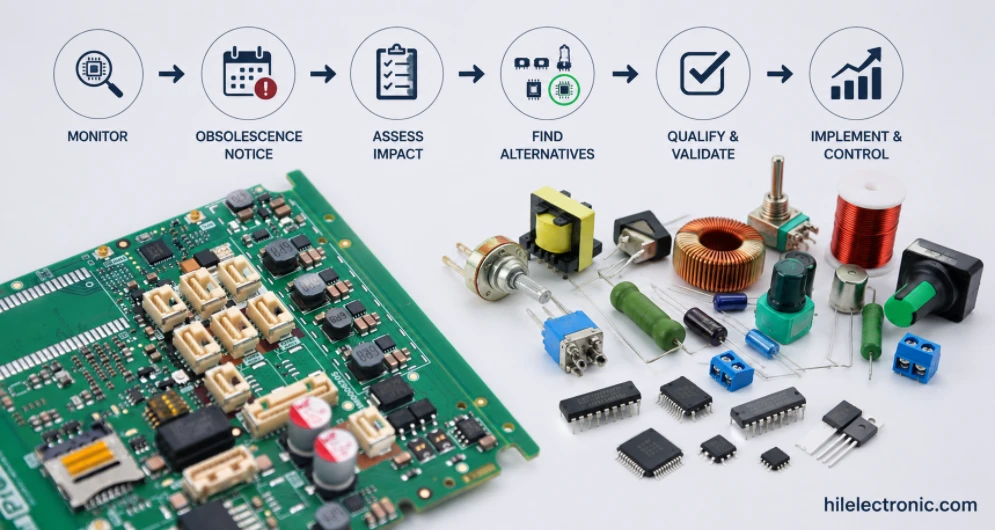
Component obsolescence management is the controlled process used to keep an electronic product buildable after a manufacturer changes, restricts or discontinues a part. For a PCB assembly buyer, the issue is rarely limited to purchasing. One EOL microcontroller, memory device, power IC, connector or sensor can affect the schematic, PCB footprint, firmware, programming files, compliance evidence, test limits, service inventory and unit cost.
Highleap Electronics supports obsolescence projects that require more than finding inventory. Depending on the agreed scope, the work can combine electronic component sourcing, alternate-part review, PCB revision, prototype fabrication, assembly, programming and customer-defined functional validation. The commercial objective is to release a documented production solution before the original part becomes an emergency.
Request an obsolescence recovery review
Send the current BOM, affected manufacturer part numbers, annual demand, remaining product life and available design files. Highleap can separate sourcing-only options from changes that require engineering and validation.
When Component Obsolescence Becomes a Production-Critical Issue
The first visible symptom may be a rejected purchase order or a quoted lead time that exceeds the production window. The real exposure is broader. A part may still appear in online inventory while the manufacturer has stopped accepting orders, moved the device to NRND, changed the package, transferred the wafer process or issued a final shipment date. Each event creates a different engineering and commercial response.
| Trigger | Production implication | Decision required |
|---|---|---|
| Product discontinuance or EOL notice | Original supply has a defined end date | Last-time buy, qualified alternate or redesign |
| NRND status | The part may remain orderable but has limited future support | Set a migration date before volume or service demand is exposed |
| Allocation or persistent long lead time | Supply exists, but quantity and date cannot support the build plan | Reserve authorized stock, approve alternates or split production |
| Package or process change | Electrical function may remain similar while assembly or reliability changes | Review PCN details, footprint, stencil, reflow and test impact |
| Broker-only availability | Traceability, storage history and authenticity become uncertain | Escalate source approval and inspection requirements |
IEC 62402 defines obsolescence management as a lifecycle process covering policy, planning, mitigation, resolution and performance improvement. That framework is useful because the cheapest immediate purchase is not always the lowest-cost production decision. A buyer must consider remaining product demand, redesign effort, compliance obligations and the cost of an unplanned line stop.
Build a Reliable Obsolescence Data Baseline Before Choosing a Solution
A correct decision starts with a clean product baseline. Marketing descriptions, internal stock codes and generic part descriptions are not enough. Highleap normally needs the exact manufacturer part number, quantity per assembly, reference designators, approved manufacturers, package, firmware dependence, annual usage, current inventory and target end-of-production date.
Separate lifecycle status from availability
“Out of stock” does not mean obsolete, and “active” does not guarantee practical availability. A component can be active but allocated, limited to a long factory cycle, available only in an unsuitable package or subject to a high MOQ. Conversely, authentic remaining stock may exist after an EOL notice. The project should therefore record both manufacturer lifecycle status and current authorized-channel supply.
Identify the real design dependency
The same component can have very different replacement difficulty in different products. A voltage regulator with generous headroom may accept several alternates; the same regulator in a thermally constrained enclosure may depend on exact dropout, current limit and package thermal resistance. For programmable parts, record firmware version, memory map, programming method, security configuration and calibration data. For connectors, include mating part, mechanical envelope, retention method and enclosure interface.
The baseline should also distinguish production inventory from warranty and service inventory. Service demand often continues after new production ends and may justify a different solution, such as a controlled last-time buy for repair stock while new builds migrate to a redesigned PCB.
Monitor Lifecycle Notices and Create Internal Decision Dates
Obsolescence management fails when the team treats the supplier’s final-order deadline as the engineering deadline. Before a last-time-buy date, the customer may need to compare alternates, obtain samples, update a schematic, modify the PCB, revise firmware, build prototypes, complete regression tests and obtain internal or regulatory approval. Purchasing also needs time to approve NCNR exposure and determine who owns excess inventory.
A practical schedule establishes several internal dates:
- Assessment date: confirm lifecycle status, stock, demand and affected products.
- Resolution date: select last-time buy, alternate qualification or redesign.
- Engineering release date: freeze the revised BOM, PCB files, firmware and test requirements.
- Pilot date: build and evaluate a controlled first article before original stock is exhausted.
- Volume transition date: prevent mixed revisions from entering production without traceability.
Product change notifications also matter. A PCN can alter assembly site, die revision, mold compound, lead finish, package dimensions or manufacturing process without discontinuing the MPN. The review must determine whether the change affects solderability, moisture sensitivity, thermal behavior, programming, EMC, reliability or customer qualification. A revision-controlled decision log prevents one department from approving a change that another department cannot manufacture or test.
Choose Between Authorized Stock, Last-Time Buy, Alternate Parts and Redesign
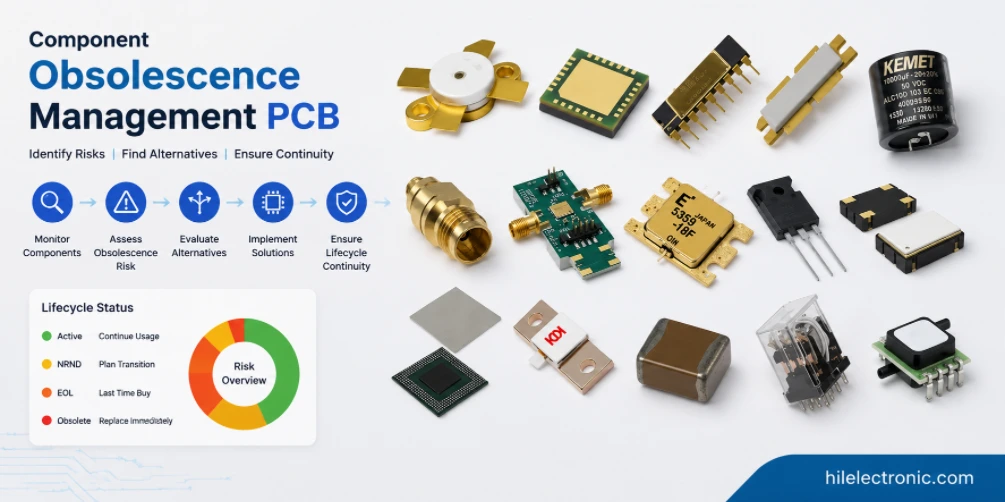
There are four common resolution paths, and each fits a different product situation. Authorized stock purchase is appropriate when genuine inventory can bridge a temporary gap. A last-time buy can support products with finite remaining demand. Alternate qualification is preferred when a compatible device can preserve the design. Redesign is necessary when the obsolete function, package or technology no longer has a defensible replacement.
| Resolution path | Best fit | Main risks | Evidence required |
|---|---|---|---|
| Buy authorized inventory | Short-term gap with released design | Stock reservation, lot/date-code limits, quote expiry | Source traceability and incoming records |
| Last-time buy | Predictable remaining demand and high redesign cost | Forecast error, aging, excess stock, storage liability | Demand model, storage plan and ownership terms |
| Form-fit-function alternate | Comparable device with manageable differences | Hidden electrical, package or firmware differences | Comparison matrix, first article and functional results |
| PCB or architecture redesign | No acceptable drop-in device or long remaining product life | NRE, schedule, compliance and test redevelopment | Released design package and qualification plan |
The remaining product life is decisive. Spending heavily to redesign a product with a few hundred service units may be irrational. Buying five years of aging inventory for a growing product may be equally poor. Highleap can quote original-stock, alternate and redesign scenarios separately so that the buyer can compare total program cost instead of unit price alone.
Calculate Last-Time-Buy Quantity and Long-Term Storage Exposure
A last-time buy is not simply annual demand multiplied by the number of remaining years. The calculation should include forecast uncertainty, production yield, engineering samples, field returns, warranty obligations, service spares and the expected phase-out curve. It should also subtract usable stock already held by the customer, contract manufacturer and authorized channel.
Commercial terms must state who owns the inventory, where it is stored, whether it can be used for other programs, how insurance and write-offs are handled, and what happens if demand is lower than forecast. NCNR orders require explicit approval because the financial exposure can remain even if the product forecast changes.
Storage changes the technical risk
Semiconductors and passive components can be stored for extended periods, but handling conditions matter. Moisture-sensitive packaging, dry-pack integrity, desiccant condition, humidity indicators, terminal oxidation, solderability, tape-and-reel condition and ESD controls may require periodic review. IEC 62435 provides guidance for long-duration storage of electronic components. The storage plan should define inspection, bake or reconditioning rules before parts enter PCB assembly.
Highleap does not treat aged stock as automatically acceptable. When long-held or customer-consigned material is used, the quotation and quality plan should identify source, storage history, date-code policy, incoming inspection and any additional verification agreed for the project.
Engineer Alternate Parts at the Correct Validation Depth
A replacement must be classified by change depth. The same MPN from another authorized distributor normally requires commercial and traceability review. An equivalent passive may require dimensional, dielectric, derating and performance checks. A semiconductor alternate may affect startup state, timing, analog accuracy, protection thresholds, thermal behavior, firmware registers or EMC performance.
| Change class | Engineering review | Typical validation |
|---|---|---|
| Same MPN, different authorized source | Source authorization, lot and date code | Incoming inspection and traceability |
| Equivalent resistor, capacitor or inductor | Value, tolerance, rating, temperature, bias, ESR/ESL, pulse and dimensions | First article plus product-specific electrical check |
| Form-fit-function IC | Pin behavior, limits, sequencing, timing, thermal and firmware impact | Engineering samples, programming and regression test |
| Package or footprint change | Schematic, layout, stencil, assembly access and mechanical fit | Prototype build, inspection and functional validation |
| Architecture change | Complete circuit and software interface | Full qualification defined by the customer’s product requirements |
Datasheet comparison is necessary but not sufficient. A replacement QFN can have different exposed-pad geometry or wettable-flank visibility. A connector can share pitch and pin count while changing insertion force or housing height. A memory device can match density but require different initialization or timing. When PCB changes are required, Highleap can combine PCB DFM review, prototype PCB fabrication, assembly and agreed testing in one controlled release.
Control BOM, Firmware, Compliance and Test Documentation Together
An approved replacement is not released until all affected documents agree. The BOM should identify the approved MPN and substitution rule. The AVL should define allowed manufacturers and approval status. Gerber or ODB++ data, centroid files, drawings and stencil data must match the released PCB revision. Firmware, programming instructions, calibration files and security keys must identify the supported hardware revision.
The test specification should state what must be verified and the acceptance limits. A vague instruction such as “functional test” is not sufficient for a changed MCU, sensor, memory or power device. Define power-up behavior, current consumption, communication, programmed version, analog range, interface checks and any stress or regression tests required by the design owner. Highleap can perform AOI, X-ray where applicable, programming and functional testing when these activities and acceptance criteria are included in the agreed manufacturing scope.
Compliance impact must be assessed by the product owner. A replacement can affect EMC, safety files, environmental declarations, automotive documentation, medical-device records or customer approvals. Not every alternate requires full recertification, but the decision should be documented rather than assumed. The production traveler, first-article report and change approval should provide traceability from the obsolete part to the released resolution.
Transfer the Obsolescence Solution Into Repeat Production
A successful prototype does not automatically create a stable volume process. Before transition, confirm remaining original stock, the effective serial or lot boundary, label requirements, mixed-revision rules and service strategy. If both original and alternate parts may be used, the BOM and AVL must state whether they are interchangeable within the same production lot and whether test limits differ.
The first controlled build should verify material identity, assembly behavior, programming, inspection and product function. A PCBA first-article inspection can link the released documents to the physical assembly. Yield, rework and test data should be reviewed before volume release, especially when package, thermal mass or firmware changes are involved.
Repeat orders require continued lifecycle checks. An alternate selected today can itself become NRND. Highleap can flag quoted availability and proposed source changes during requotation, but the customer should maintain ownership of the approved design and product-life strategy. The most resilient outcome is usually a controlled AVL with more than one technically approved option for noncritical lines and explicit no-substitution rules for design-critical components.
What Highleap Delivers for an Obsolescence-Controlled PCB Assembly Project
Highleap’s role is to connect the sourcing decision to a manufacturable and testable production package. The exact deliverables depend on the information available and the customer’s approval process, but a project can include:
- BOM normalization and exact-MPN verification;
- authorized-source, customer-consigned and remaining-stock scenarios;
- alternate comparison tables with identified technical differences;
- PCB and assembly impact review;
- revised prototype and first-article build where required;
- programming, inspection and customer-defined test execution;
- revision-controlled BOM, AVL, manufacturing files and approval records;
- separate quotation for sourcing-only, alternate-validation and redesign routes.
For an efficient review, send the current BOM, Gerbers or ODB++ files, assembly drawings, firmware reference, affected MPNs, annual demand, inventory position, remaining product life, compliance constraints and available functional-test specification. Incomplete packages can be reviewed initially, but engineering release requires controlled production data.
The quotation should identify assumptions, excluded validation, price validity, material ownership and approval gates. This prevents an emergency component purchase from being mistaken for a complete obsolescence solution.
Move from EOL notice to a controlled production release
Highleap can review the affected BOM line, sourcing options, PCB impact and validation scope, then quote the most practical recovery route for your remaining product life.

Recommended Posts
Rogers TMM4 PCB Manufacturer for Compact Microwave Filters
TMM4 is most useful when a microwave circuit must become...
Rogers TMM3 PCB Manufacturer for Mechanical RF Modules
TMM3 is selected when an RF circuit must behave as part of...
Rogers TMM6 PCB Fabrication for Dk 6.0 Thermoset Microwave Boards
Figure 1. Rogers TMM6 PCB fabricationRogers TMM6 PCB...
Rogers TMM10 PCB Manufacturing for RF Designs
Table of contentsHow TMM10 Shrinks RF StructuresTMM10 vs...
How to get a quote for PCBs
Let’s run DFM/DFA analysis for you and get back to you with a report. You can upload your files securely through our website. We require the following information in order to give you a quote:
-
- Gerber, ODB++, or .pcb, spec.
- BOM list if you require assembly
- Quantity
- Turn time
For PCBA services, please provide your BOM (Bill of Materials) and any specific assembly instructions. We also offer DFM/DFA analysis to optimize your designs for manufacturability and assembly, ensuring a smooth production process.