
Medium Volume PCB Assembly for Stable Repeat Orders
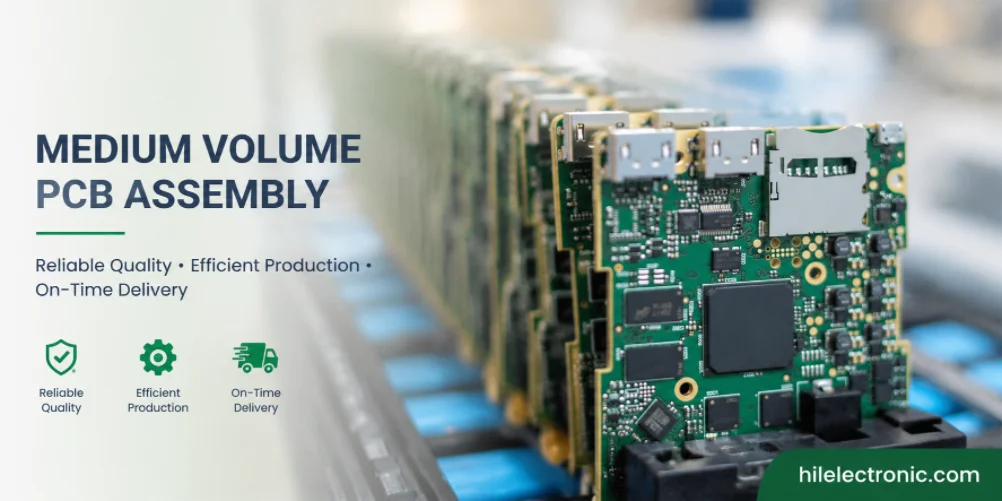
Table of contents
- What Is Medium Volume PCB Assembly?
- When Is an OEM Ready for Medium-Volume Production?
- How Are Components and PCBs Planned for Repeat Batches?
- How Is the Assembly Process Made Repeatable?
- How Are Yield, Quality and Traceability Managed?
- How Are Testing and Capacity Scaled?
- Medium Volume PCB Assembly Cost and Lead Time
- Request Medium Volume PCB Assembly Pricing
- Medium-Volume PCB Assembly Questions
Medium volume PCB assembly serves OEMs that have moved beyond prototype or occasional small batches but do not need continuous mass production. The quantity range varies by product complexity; what defines the program is recurring demand, a stable product baseline and enough volume to justify reusable tooling, planned material and production scheduling.
Highleap Electronics supports mid volume PCBA manufacturing for industrial, communications, medical, power, automotive and other electronic products subject to project review. The service can include PCB fabrication, component sourcing, SMT, through-hole assembly, programming, testing, traceability, coating and box build where required.
For quotation, send the board files, BOM, quantity per release and expected annual demand. If the forecast is uncertain, provide the first order and likely repeat pattern. Highleap can compare batch options without requiring a formal procurement forecast before the initial price review.
1. What Is Medium Volume PCB Assembly?
Medium batch PCB assembly is generally positioned between small engineering or low-volume builds and dedicated high-volume production. A simple board may reach medium-volume economics at a lower quantity than a complex mixed-technology product. The practical definition depends on setup, test time, material packs and release frequency.
| Program type | Typical operating pattern | Manufacturing priority |
|---|---|---|
| Low volume | Small or irregular releases, frequent changes. | Flexibility and low commitment. |
| Medium volume | Recurring monthly/quarterly batches with a stable baseline. | Repeatability, material planning and scalable capacity. |
| High volume | Large scheduled demand and sustained line loading. | Cycle time, automation, capacity and continuous yield control. |
Highleap can compare low-volume PCB assembly and high-volume PCB assembly services for the same product. The recommended model is based on actual release behavior rather than a fixed marketing quantity.
2. When Is an OEM Ready for Medium-Volume Production?
The design should be stable enough that PCB, components, firmware, test and acceptance can be repeated without frequent emergency changes. A successful prototype proves function, while an NPI or pilot should close the main manufacturing risks before larger commitments.
- Released PCB, BOM and assembly configuration.
- Approved component sources or alternate policy.
- Reusable stencil, programs and work instructions.
- Defined inspection and functional-test coverage.
- Known packaging and traceability requirements.
- Forecast or release pattern sufficient for material planning.
- Change process for future revisions and temporary deviations.
Highleap can support NPI and prototype PCB assembly when the product is not yet ready. Moving too early into medium volume can multiply unresolved design, sourcing or test problems across a larger material commitment.
Highleap can perform a readiness review using the current files and first planned quantity. The result identifies whether the order can enter repeat production directly or should begin with a smaller pilot, limited material commitment or added first-article hold.
3. How Are Components and PCBs Planned for Repeat Batches?
Medium volume turnkey PCBA benefits from forecast-based purchasing, but the customer should distinguish firm demand from flexible demand. Highleap can plan long-lead and high-value parts differently from standard components, reducing shortages without buying every item for the full annual forecast.
| Material group | Possible planning method | Commercial control |
|---|---|---|
| Long-lead/strategic semiconductors | Reserve or buy against firm/approved forecast. | NCNR, deposit and alternate approval. |
| Standard passives | Purchase in economic packs and share where approved. | Excess ownership and carry-forward. |
| Custom PCB | Fabricate by release or scheduled larger lots. | Revision risk, shelf life and panel economics. |
| Customer-supplied parts | Receive against batch or buffer stock. | Count, overage, shortage and storage responsibility. |
| Obsolescence-risk parts | Monitor lifecycle and qualify alternatives early. | Customer approval and last-time-buy decision. |
Highleap integrates component sourcing for production with PCB fabrication. The quotation should state material validity and liability so the unit price is not separated from the inventory commitment behind it.
4. How Is the Assembly Process Made Repeatable?
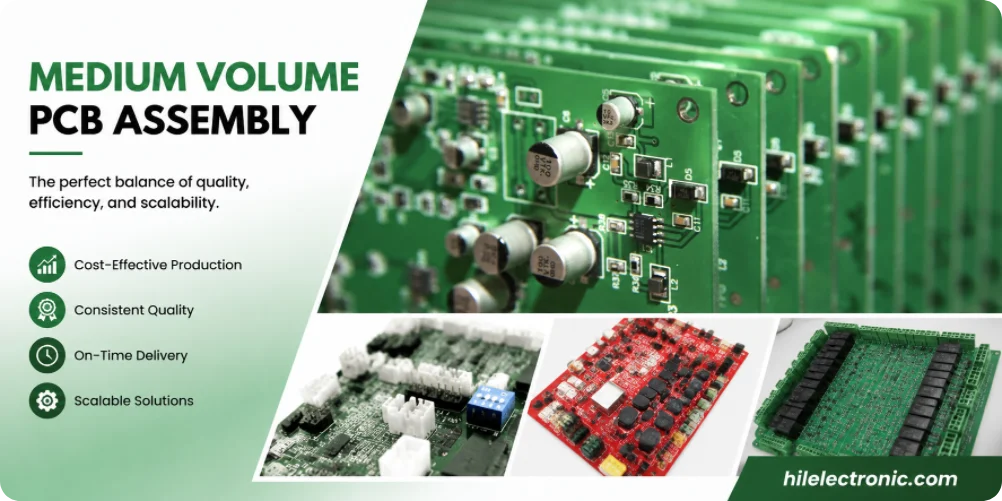
Repeat production should reuse controlled stencils, placement programs, soldering profiles, fixtures, programming files, test assets and work instructions. Highleap verifies the setup at the start of each batch and applies first-unit checks based on product risk and revision status.
Verified material setup, printing, placement, reflow and inspection.
Repeatable insertion, fixture, soldering and workmanship instructions.
New revision or alternate enters the route only after approval.
Programs and tooling are maintained for future releases.
Yield and defects are compared with prior production, not viewed in isolation.
A first-article inspection for repeat PCB assembly can be applied after a revision, long production gap, material change or tooling change. Stable repeat lots may use a streamlined setup verification instead of a full customer hold.
5. How Are Yield, Quality and Traceability Managed?
Medium volume creates enough data to identify recurring defects and test bottlenecks. Highleap can monitor first-pass yield, defect categories, rework and functional-test results by lot. The customer and factory can then prioritize the dominant issue rather than react to isolated failures.
| Metric | Use | Customer action |
|---|---|---|
| First-pass yield | Shows how many units complete the route without repair. | Review declining trend or major batch change. |
| Defect Pareto | Identifies dominant assembly or test failure modes. | Approve design/process corrective action where required. |
| Test yield | Measures acceptance and test-system stability. | Separate product failures from fixture false failures. |
| Delivery performance | Shows whether material and capacity planning are working. | Adjust forecast or release policy. |
| Material excess/shortage | Shows supply-plan accuracy and commercial exposure. | Update authorization, alternates or batch size. |
Highleap can provide medium-volume lot traceability and PCB quality inspection at the agreed level. The system should collect useful data without imposing serial-level complexity on products that only need lot traceability.
6. How Are Testing and Capacity Scaled?
Assembly equipment is not always the capacity constraint. Functional test, programming, manual insertion, coating or final assembly may require more time than SMT. Medium volume planning must balance the complete route and identify where another fixture, station or operator is needed.
- Calculate expected demand by release and required delivery rate.
- Measure or estimate cycle time at SMT, THT, programming, test and final operations.
- Identify the slowest or least flexible operation.
- Improve the process or add tooling/stations where the forecast justifies it.
- Validate the revised capacity during a representative batch.
- Monitor utilization and failure rate as demand changes.
Highleap can integrate functional test capacity for repeat batches and box-build integration for medium-volume products into the capacity model. A fast SMT line does not guarantee delivery if one test fixture or manual enclosure step limits output.
7. Medium Volume PCB Assembly Cost and Lead Time
Unit cost normally improves compared with prototype or low-volume builds because setup is spread across more units, material can be planned and reusable tooling reduces labor. The final price still depends on batch size, BOM, PCB complexity, assembly mix, test and inventory terms.
Stable release, economic batch, approved alternates, reusable tooling and efficient test.
Large NCNR purchases, custom parts, uncertain forecast or frequent revisions.
Forecasted long-lead parts, retained programs and scheduled capacity.
New tooling, source qualification, pilot validation and test development.
The PCB assembly cost structure should be reviewed across the first order and repeat releases. Highleap can quote several batch scenarios so procurement can compare unit price with inventory, cash and change risk.
Highleap can also compare customer-held safety stock, component buffer and finished-PCBA buffer options. The best choice depends on replenishment risk, product revision stability and how quickly the OEM must respond to customer demand.
8. Request Medium Volume PCB Assembly Pricing
Send the board files, BOM, first release quantity and expected repeat pattern. If annual demand is not confirmed, give a range or likely monthly/quarterly batch. Add test, coating or box-build needs when applicable.
The quotation should show material assumptions, setup/tooling, recurring unit cost, lead time and excess/NCNR terms. Highleap can also provide pilot pricing if the product has not yet been validated for repeat production.
Use the medium-volume PCB assembly quote request to begin. Highleap can compare batch sizes and sourcing models without requiring a fixed long-term commitment at the first inquiry.
Highleap can show first-order, recurring-batch and forecast-based material scenarios in the same commercial response. The buyer can choose the balance between unit cost, inventory exposure and replenishment speed.
9. Medium-Volume PCB Assembly Questions
What quantity is considered medium-volume PCB assembly?
There is no universal range. Board complexity, setup, test time and release frequency determine the practical category. Some programs may be hundreds per batch; others may be several thousand. Highleap quotes the actual demand pattern rather than applying a fixed threshold.
Can medium-volume orders be released monthly or quarterly?
Yes. Highleap can compare release schedules and material strategies. Monthly batches reduce finished-goods exposure, while larger quarterly batches may improve setup and logistics economics.
Do we need a firm annual forecast?
No for an initial quote. Provide the first quantity and a realistic range or expected repeat pattern. A firmer forecast becomes important before Highleap commits long-lead or NCNR material.
Can production scale beyond medium volume later?
Yes, subject to process, test and capacity review. Highleap can identify tooling, automation, fixture and supply changes needed as demand grows.
What do scalable PCB assembly services include?
Scalable PCB assembly services retain the approved process while adding material planning, fixtures, test stations, capacity and production monitoring as demand grows. Scaling should not require the product to be reintroduced from the beginning.
Is 500 to 5000 PCB assembly always considered medium volume?
The phrase 500 to 5000 PCB assembly is a useful search range, but it is not a universal manufacturing definition. A simple board and a complex mixed PCBA have different setup, test and capacity economics.
Can repeat production PCB assembly start with an uncertain forecast?
Yes. Repeat production PCB assembly can begin with the first firm order and a demand range. Highleap can keep long-lead purchasing limited until the customer authorizes a firmer forecast.
How is mid volume PCBA manufacturing different from high volume?
Mid volume PCBA manufacturing emphasizes flexible scheduled batches and shared capacity. High volume is more likely to justify dedicated automation, larger material commitments and sustained line loading.

Recommended Posts
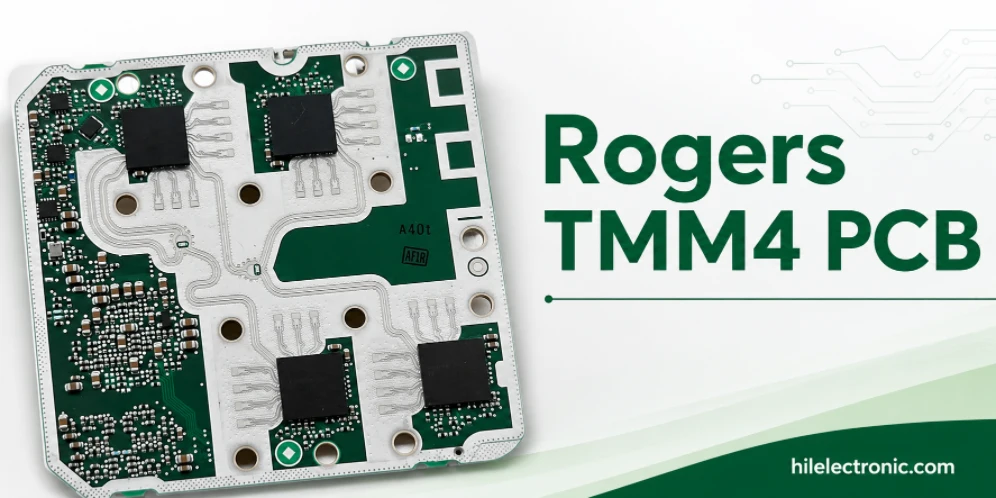
TMM4 Filter PCB Manufacturing
TMM4 filter PCB manufacturing is controlled by the...
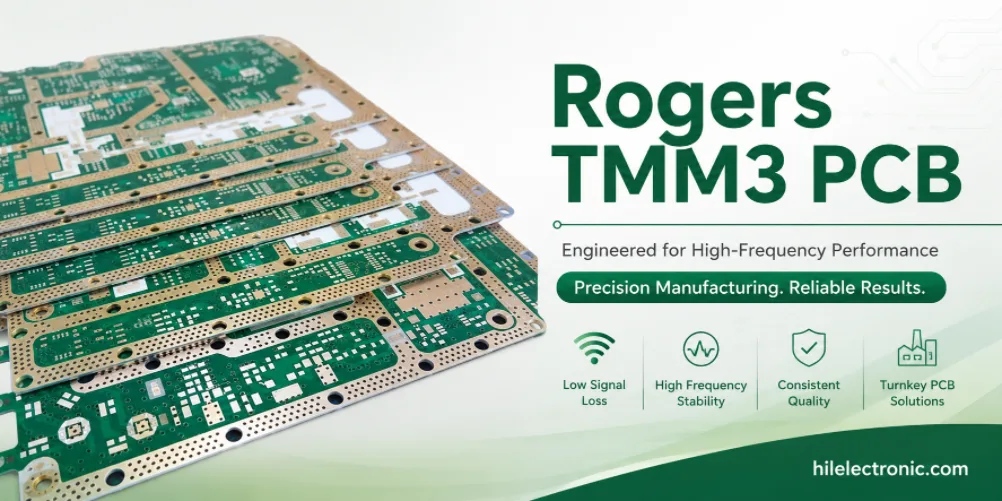
TMM3 PCB Manufacturing for RF Modules
TMM3 PCB manufacturing is most useful where the RF module...
TMM6 PCB Fabrication
TMM6 fabrication is the process-control page for a mid-Dk...
TMM10 PCB Manufacturing for Compact RF Designs
Table of contentsHow TMM10 Shrinks RF StructuresTMM10 vs...
How to get a quote for PCBs
Let’s run DFM/DFA analysis for you and get back to you with a report. You can upload your files securely through our website. We require the following information in order to give you a quote:
-
- Gerber, ODB++, or .pcb, spec.
- BOM list if you require assembly
- Quantity
- Turn time
For PCBA services, please provide your BOM (Bill of Materials) and any specific assembly instructions. We also offer DFM/DFA analysis to optimize your designs for manufacturability and assembly, ensuring a smooth production process.