
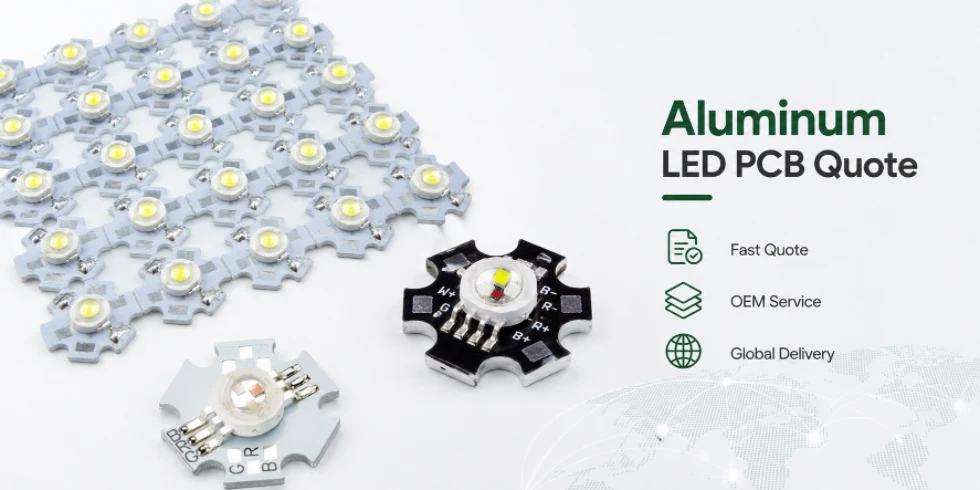
Aluminum LED PCB Quote and Cost Guide

Aluminum LED PCB quotes from different suppliers often show a 2× price difference for apparently identical specifications. Some of that difference is margin. Most of it is specification ambiguity — suppliers quoting against different assumptions about your material grade, dielectric Tc, copper weight, or testing requirements. This article breaks down every cost component in an aluminum LED PCB quote so you can compare suppliers accurately and know immediately when a low quote reflects a lower specification rather than a lower cost.
The Five Primary Cost Drivers
Article Navigation
- The Five Primary Cost Drivers
- NRE (Non-Recurring Engineering) Charges
- Prototype vs. Production Pricing: Why the Gap Exists
- How to Structure an RFQ for an Accurate First Quote
- Reading Competitor Quotes: Apples-to-Apples Comparison
- FAQ
1. Dielectric Material Grade
This is the single largest variable in aluminum LED PCB pricing and the one most frequently obscured in low-cost quotes. A board quoted at “2.0 W/m·K thermal conductivity” could be using:
- Branded dielectric from Bergquist, Ventec, or Shengyi: tested, consistent, traceable to a datasheet — costs 2–4× more than generic
- Generic Chinese import composite: stated Tc may be accurate to ±30%, no independent test data, batch-to-batch variation significant
When comparing quotes, always ask: what dielectric brand and grade is included in this price? If the answer is “standard thermal material” or “equivalent grade,” you are comparing against an unknown.
The dielectric cost represents 25–45% of total board cost on a standard 1-layer aluminum LED PCB. Specifying a 3.0 W/m·K Bergquist GP3000 versus a 1.0 W/m·K generic adds approximately 40–70% to material cost alone.
2. Copper Weight and Processing
Moving from 1 oz to 2 oz copper adds one additional plating cycle and changes etch chemistry. Moving to 3 oz adds further process complexity because etch uniformity across the panel at 3 oz requires tighter process control. The cost increment from 1 oz to 2 oz is typically 15–25% of processing cost; from 1 oz to 3 oz is 35–55%.
Heavy copper also changes minimum trace/space capability. If your 3 oz design requires 4/4 mil trace/space, discuss this with the factory before quoting — not all facilities can hold 4/4 at 3 oz on aluminum, and those that cannot will either reject the job or produce inconsistent results.
3. Surface Finish
Listed from lowest to highest cost:
- OSP: baseline
- LF-HASL: 5–12% premium over OSP
- ENIG: 20–40% premium over OSP, depending on gold thickness specification
ENIG also adds 3–5 working days to lead time due to the electroless nickel and immersion gold bath cycle. ENIG surface finish is the right choice for fine-pitch LED components and multi-reflow processes despite the cost premium.
4. Board Dimensions and Panel Utilization
Board cost scales with area, but not linearly. A 100 × 100 mm board is not twice the cost of a 50 × 100 mm board — because the fixed cost per panel (setup, press cycle, test) is distributed across more boards when the individual board is smaller and more fit per panel.
Circular and irregular board outlines typically produce 20–35% more material waste per panel than rectangular boards of equivalent area. This scrap cost is real and should appear in your quote as a panelization efficiency factor. If it does not, the supplier may be absorbing it in margin — which tends to produce cost surprises in volume production.
Panel size capability matters: some factories max out at 400 × 500 mm for aluminum; larger panels require different press and handling equipment. If your board is 250 × 400 mm, confirm the factory can run your board dimensions before assuming standard pricing applies.
5. Electrical Testing and Certification Requirements
A basic aluminum LED PCB quote includes:
- Continuity and isolation test (flying probe or bed-of-nails)
- Hi-pot test (1500 V is standard; some applications require 3000 V)
- Visual inspection
Additional cost items that may or may not be included in your first quote:
- AOI: adds 5–10% to per-board cost; standard on high-density or fine-pitch boards
- Cross-section analysis: adds setup cost of $100–300 per lot as a sampling check
- UL 94V-0 material certification per lot: material compliance documentation from the dielectric supplier
- First article inspection report: 1–3% cost adder on initial production run, then negligible for repeat orders
NRE (Non-Recurring Engineering) Charges
NRE for aluminum LED PCBs typically covers:
- Tooling (drill programs, routing files, V-score programs): $50–200 for standard outlines; up to $400–600 for complex shapes or tight-tolerance slots
- Artwork (photo-tool or LDI programming): usually included in tooling; standalone charge if tight-tolerance imaging requires separate step
- Custom panelization design: $100–300 if non-standard nesting is required
NRE is a one-time charge and should not recur on repeat orders with the same specification. Confirm this explicitly — some factories re-charge tooling on every order. Learn more about how non-recurring engineering charges are structured in PCB manufacturing.
Prototype vs. Production Pricing: Why the Gap Exists
A 10-panel prototype of a 150 × 150 mm aluminum LED PCB might cost $35–50 per board. The same board at 500-piece production quantities might cost $4–8. The gap comes from:
- Setup cost amortization: press calibration, drill program verification, and test fixture setup costs are the same whether you run 10 boards or 500
- Panel utilization: prototypes are often run on partial panels with lower utilization
- Priority queue cost: prototype turnaround requires interrupting production scheduling
The ratio of prototype to production price is not a negotiating tactic — it reflects real cost structure. A supplier quoting $8 for a 10-piece prototype is likely cutting quality control steps or amortizing the actual costs into production pricing. See how PCB fabrication costs scale with volume for context.
How to Structure an RFQ for an Accurate First Quote
Ambiguous RFQs produce ambiguous quotes that cannot be compared. Include:
- Gerber files (or at minimum: board dimensions, layer count, minimum trace/space, hole sizes)
- Aluminum alloy grade (1050, 5052) and base thickness (mm)
- Dielectric thermal conductivity (W/m·K) and brand preference if any
- Copper weight (oz)
- Surface finish (ENIG, LF-HASL, OSP)
- Solder mask color
- Hi-pot voltage requirement
- IPC class (Class 2 or Class 3)
- Required documentation (UL 94V-0 cert, RoHS, REACH, COC)
- Quantity and delivery schedule (one-time, repeat, blanket order)
Highleap Electronics provides detailed quote breakdowns showing material, processing, testing, and NRE as separate line items — not a single-price quotation that obscures the cost structure. Submit your specifications through the aluminum LED PCB quote page.
Reading Competitor Quotes: Apples-to-Apples Comparison
When you receive multiple quotes for the same aluminum LED PCB, check these items before assuming the lowest price is a win:
| Item | Confirm It Matches Your Spec |
|---|---|
| Dielectric brand and grade | Not just “2.0 W/m·K standard” |
| Hi-pot voltage | 1500 V vs. 3000 V matters |
| ENIG gold thickness | 1 µin vs. 3 µin vs. 5 µin |
| Solder mask type | UV-cure vs. thermal-cure affects adhesion |
| IPC class | Class 2 vs. Class 3 acceptance criteria |
| Testing scope | Hi-pot included? AOI included? |
| Lead time basis | Calendar days vs. working days |
A quote that is 30% below market for the same specification is usually missing one of the above items. Ask for a line-item breakdown before awarding.
FAQ
What is the typical price range for aluminum LED PCBs? At 2024–2026 pricing, standard specification (1-layer, 1.0 W/m·K dielectric, 1 oz copper, ENIG, 100 × 100 mm) runs approximately $3–8 per board at 100–500 piece quantities, $1.50–3.50 at 1,000+. Higher thermal conductivity, heavier copper, and ENIG all push toward the upper end of each range.
Does the quote include shipping? Not typically. Shipping cost for aluminum LED PCBs depends on quantity, destination, and mode (air vs. sea). Ask for EXW factory pricing and then calculate freight separately. For context, 500 boards of 150 × 150 mm in standard packaging weighs approximately 12–18 kg.
How quickly can I get a quote? For standard specifications submitted with Gerber files, Highleap Electronics returns a detailed quote within 24 hours on business days. Non-standard dielectric grades or large-format boards (>400 × 500 mm) may require 48 hours for material availability confirmation.
Should I include assembly in the PCB quote request? If you need turnkey assembly, quote PCB fabrication and SMT assembly together. Combined turnkey PCB assembly quoting typically yields better total pricing than purchasing bare board and assembly separately, because panelization, solder paste stencil, and test fixture costs are optimized across both steps.

Recommended Posts
TMM4 Filter PCB Manufacturing
TMM4 filter PCB manufacturing is controlled by the...
TMM6 PCB Fabrication
TMM6 fabrication is the process-control page for a mid-Dk...
TMM3 PCB Manufacturing for RF Modules
TMM3 PCB manufacturing is most useful where the RF module...
TMM10 PCB Manufacturing for Compact RF Designs
Table of contentsHow TMM10 Shrinks RF StructuresTMM10 vs...
How to get a quote for PCBs
Let‘s run DFM/DFA analysis for you and get back to you with a report. You can upload your files securely through our website. We require the following information in order to give you a quote:
-
- Gerber, ODB++, or .pcb, spec.
- BOM list if you require assembly
- Quantity
- Turn time
For PCBA services, please provide your BOM (Bill of Materials) and any specific assembly instructions. We also offer DFM/DFA analysis to optimize your designs for manufacturability and assembly, ensuring a smooth production process.